

Widebody paddles get recommended constantly in rec pickleball. They’re marketed as “forgiving,” “stable,” and “great for consistency.”
All of that can be true — but only in the right hands, at the right stage of development.
New to pickleball? Start with our best pickleball paddles for beginners, picked with lab data and 3,600 player survey responses.
If you’ve ever wondered whether a widebody paddle will actually help your game or quietly hold it back, here’s the honest breakdown.
If you would rather skip the theory, the paddle quiz turns your answers into three lab-scored picks in about 90 seconds.
Ten questions, three paddles matched to how you play, scored on lab data.
What Is a Widebody Paddle (Technically)?
A widebody paddle is defined by its wider face and shorter length compared to standard or elongated paddles.
Typical specs:
- Width: ~8.0–8.25 inches
- Length: ~15.5–15.75 inches
- Shorter reach, larger horizontal face
- Often paired with a lower swingweight (how heavy the paddle feels when you swing it), making it easier to accelerate and control at the kitchen
That extra width isn’t cosmetic. It changes how the paddle behaves in three important ways:
- Bigger effective sweet spot
- Higher torsional stability on off-center hits
- Easier paddle face control at slow to medium speeds
Widebody vs Other Paddle Shapes (What Actually Changes)
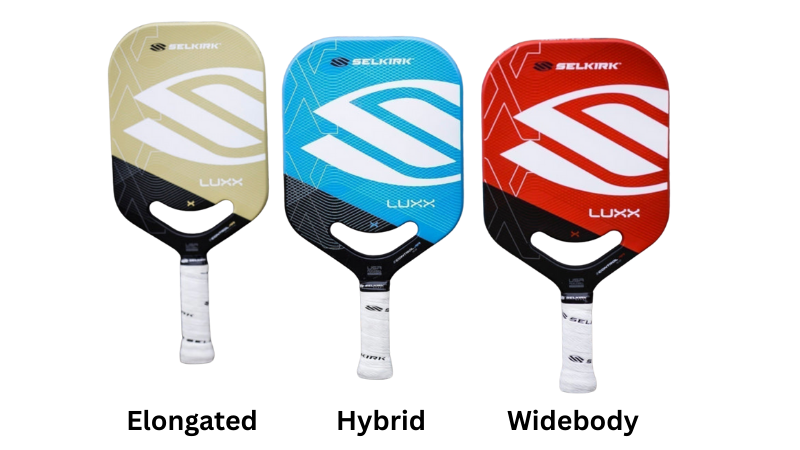
Here’s how widebody paddles compare to the two other common shapes (wide body vs elongated, widebody vs hybrid) rec players consider:
| Feature / Feel | Widebody | Standard / Hybrid | Elongated |
|---|---|---|---|
| Typical Width | Widest (8.0–8.25”) | Medium (7.5–7.8”) | Narrowest (~7.3”) |
| Typical Length | Shortest | Medium | Longest |
| Sweet Spot | Largest | Medium | Smallest |
| Stability on Mishits | Excellent | Good | Fair |
| Reach | Short | Balanced | Long |
| Hand Speed | Fast | Moderate | Slower |
| Power Potential | Low–Medium | Medium | High |
| Best For | Control, blocks, resets | All-court balance | Drives, serves, passing shots |
| Common Skill Range | 2.5–3.75 (sometimes higher) | 3.5–4.5 | 4.0+ or singles players |
Key takeaway: widebody paddles trade reach and leverage for forgiveness and stability. That’s a feature — not a flaw — if it matches how you actually play.
Why Widebody Paddles Feel So Good in Rec Play
Widebody paddles tend to feel “easy” immediately — and there’s a reason for that.
1️⃣ Forgiveness on Mishits
Because the face is wider and mass is spread laterally, off-center contact:
- twists the paddle less
- sends the ball back with more predictable trajectory
This is huge for rec players who don’t hit the exact center every time.
2️⃣ Stability at the Kitchen
At the NVZ, widebody paddles shine:
- easier blocks
- calmer resets
- fewer surprise pop-ups on fast hands battles
If you’re often late or jammed at the kitchen, widebody paddles reduce punishment.
3️⃣ Faster Hand Speed (Usually)
Most widebody paddles have:
- shorter length
- lower swingweight
That makes them easier to maneuver in:
- firefights
- counters
- reflex exchanges
This is why many doubles-focused players gravitate toward them.
Who Widebody Paddles Are Best For
✔ Ideal for:
- Beginner to early-intermediate players (2.5–3.75)
- Players prioritizing control, blocks, and consistency
- Doubles players who live at the kitchen
- Players with shorter swings or compact mechanics
- Anyone struggling with mishits and paddle stability
Widebody paddles are especially helpful if:
- you miss wide or clip the frame
- your resets float when rushed
- you want confidence without muscling the ball
Where Widebody Paddles Start to Show Limits
This is the part marketing rarely talks about.
1️⃣ Reduced Reach
The shorter length means:
- less reach on passing shots
- harder time handling deep, fast balls
- more work on wide dinks and stretched volleys
At higher levels, reach matters.
2️⃣ Lower Leverage on Drives & Serves
Widebody paddles don’t generate free power easily.
If your game relies on:
- heavy drives
- aggressive thirds
- deep serves
You may feel like you’re working harder for the same pace.
3️⃣ Can Mask Technical Issues
Because widebody paddles are forgiving, they can:
- hide late contact
- cover inconsistent swing paths
- delay footwork improvements
That’s not bad — unless you never outgrow it.
When a Widebody Paddle Stops Being the Best Choice
Most players don’t “outgrow” widebody paddles suddenly — it happens gradually. You might be ready to move on if:
- you consistently hit the center of the paddle
- your misses are long, not mishit
- you want more reach on dinks and counters
- your drives feel underpowered
- you’re playing faster opponents who stretch the court
This often happens around the solid 4.0 level — not always, but often.
What to Choose Instead (and Why)
- Want more reach without losing all forgiveness?
→ Standard / hybrid shape - Rely on drives, serves, or singles play?
→ Elongated shape - Love widebody stability but want more pop?
→ Widebody with perimeter weighting
The key isn’t abandoning widebody — it’s matching shape to how you win points.
Bottom Line
Widebody paddles are excellent for:
✔ Building confidence
✔ Reducing errors
✔ Stabilizing your short game
They’re not a shortcut to power — and they’re not forever for everyone.
The best paddle shape isn’t about hype or level.
It’s about which shape reduces your most common miss under pressure.
That’s when paddle choice actually matters.