When playing older pickleball players, don’t judge by age alone. Read their mobility, reaction speed, balance, skill level, and competitiveness. Strong senior players deserve real pickleball. Lower-mobility players need smarter shot choices, safer pressure, and fewer fall-risk balls like reckless lobs or repeated sprint-forcing drops.
Playing against older pickleball players can get awkward fast.
You want to compete, but you also do not want to be the person ripping balls at someone during a casual morning game. At the same time, going too soft can feel just as wrong — especially when the player across from you has better hands, better placement, and enough pickleball IQ to make you look silly.
That is why “older player” is not a useful category.
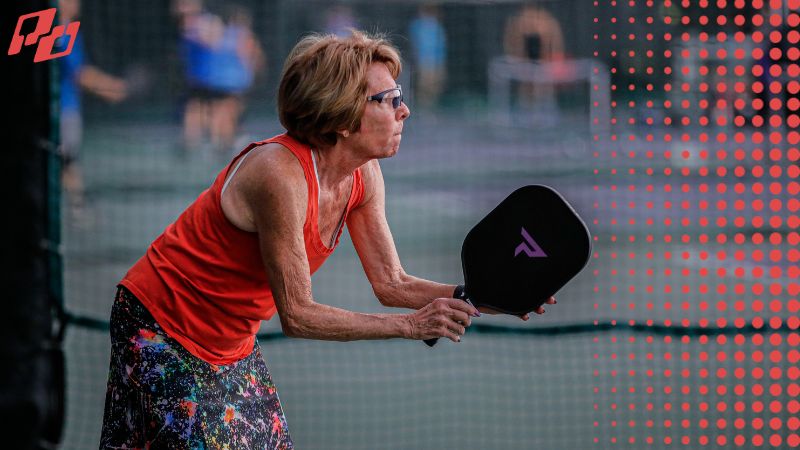
Some older players are sharp, competitive, and fully capable of handling pace. Some are former tennis players with nasty slices, great touch, and a soft game that can pick you apart. Others may be newer, slower, recovering from injuries, or mostly there for exercise, friendship, and fun.
So the smartest approach is not to automatically take your foot off the gas. It is to read the player in front of you.
Are they moving well? Are they handling pace? Are they competing hard? Are they struggling with balance, reaction time, or mobility? That read matters more than their age.
You are not adjusting to the birth year.
You are adjusting to the player’s capacity.
And that is where smart, respectful rec-play judgment starts.
The Big Mistake: Assuming Age Equals Weakness
If you automatically soften everything because someone is 65, 70, or 75, you may think you are being respectful.
But for many older players, it feels like the opposite.
A lot of experienced senior players do not want charity balls. They do not want you apologizing for hitting a normal drop, attacking a popup, or making them play real pickleball. They stepped on the court to compete, move, think, and test themselves.
And frankly, many older players are better than younger players in the parts of pickleball that matter most.
They may not cover the court like a 30-year-old.
- But they may read the ball earlier.
- They may stay calmer in the kitchen.
- They may reset better.
- They may avoid low-percentage attacks.
- They may expose your impatience.
- They may beat you without ever looking athletic.
- That is why “older” is not a strategy report.
It is just a demographic detail.
Before you adjust your game, watch how they actually play.
Can they move forward safely?
Can they handle pace?
Can they turn for a lob?
Can they defend their body?
Can they recover after wide balls?
Are they asking for a competitive game?
Are they playing smart shots back at you?
If yes, play real pickleball. Maybe not reckless pickleball. But real pickleball.
The Other Mistake: Pretending Mobility Does Not Matter
The opposite mistake is pretending age, mobility, and injury risk never matter. That is not toughness. That is poor awareness.
Pickleball has a lot of movements that become riskier with lower mobility: backpedaling, sudden lunges, short sprints forward, sharp lateral reaches, and quick recovery from awkward positions.
So if an older player has obvious movement limits, poor balance, visible braces, slow recovery steps, or a history of falls, you should notice that.
It is not because they are “too old.”
It is because some shots create a different kind of risk.
A hard ball to the paddle is one thing.
A lob that forces a shaky backpedal is another.
A normal third-shot drop is one thing.
A repeated drop volley that turns every point into a sprint test is another.
A controlled overhead to open court is one thing.
A full-power smash at the body from close range is another.
Good players know the difference.
The Three Types of Older Opponents
This is a more useful way to think about it.
The Skilled Senior Competitor
This player may be 65, 70, or older, but they can play. They understand spacing, court position, resets, dinks, and shot selection.
They may not sprint for everything, but they rarely give you the same mistake twice.
Against this player, do not play fake-soft pickleball.
They will feel it.
And they may punish you for it.
Play strategically. Use normal pickleball patterns. Attack popups. Hit drops. Move the ball. Test their backhand. Challenge their feet.
Just avoid reckless body shots and unnecessary fall-risk lobs unless the game clearly calls for full competition.
The respect here is not softness.
The respect is taking them seriously.
The Limited-Mobility Social Player
This player may enjoy the game, but they are not moving well. They might have knee issues, balance concerns, recent injuries, or limited ability to chase short and deep balls.
Against this player, you can still play real pickleball, but you should reduce movement traps.
✖️ Do not repeatedly lob them.
✖️ Do not keep drop-volleying them from the baseline.
✖️ Do not force emergency lunges just because you can.
Instead, work on placement inside their playable range.
Hit to the feet.
Hit to open space, but not absurd space.
Use controlled pace.
Extend points.
Let them hit meaningful balls.
The respect here is not pretending they are equal movers.
The respect is creating a game they can actually play.
The Older Banger
This player may have limited movement but plenty of offense. They drive hard, speed up early, and attack anything high.
Against this player, you do not need to feel guilty about competing.
But you also do not have to mirror their chaos.
The best response is usually not to bang harder.
It is to make them play lower balls.
Block their pace.
Reset to the kitchen.
Move them with controlled angles.
Attack only when they give you height.
A lot of older bangers are trying to shorten points because long movement patterns are harder. If you feed them pace, you may be giving them exactly what they want.
Make them bend.
Make them dink.
Make them hit one more balanced shot.
That is not mean.
That is pickleball IQ.
Should You Smash Popups Against Older Players?
Yes — but with target discipline.
A popup is a mistake. In real pickleball, mistakes get punished. But punishment does not have to mean maximum violence.
There are three ways to finish a popup:
- through the person
- at the feet
- or into space
In rec play, especially against older players, the best answer is usually feet or space.
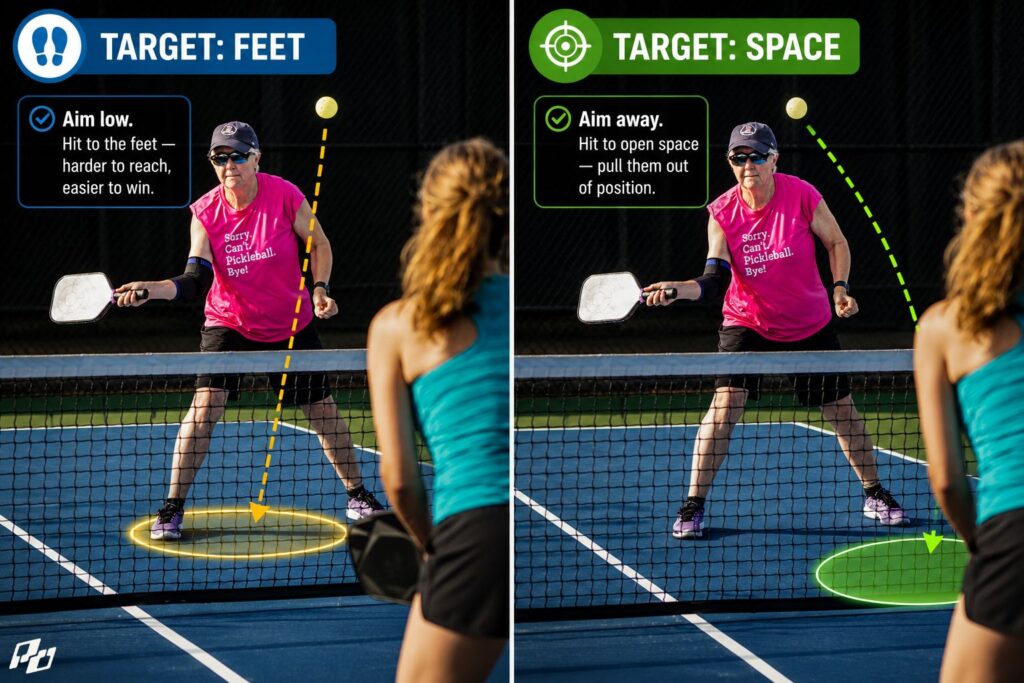
If you can win the point with a 60% overhead angled away, why blast it at someone’s chest? That does not make you tougher. It just shows you only have one finishing speed.
The more advanced skill is controlled putaway power.
Your cue: Finish the point, not the person.
A clean putaway to open court is competitive. A full-power body smash in a casual mismatch is lazy.
Should You Drop Older Players Short?
Sometimes.
But understand the difference between a normal pickleball drop and a mobility trap.
A third-shot drop that lands in the kitchen is normal. That is the sport.
A drop volley when they are stuck deep can also be completely legitimate, especially against mobile or competitive players.
But if the only reason the shot works is that the player physically cannot move forward, and you repeat it over and over in casual rec play, you are not really proving much.
Use it as a shot. Do not make it the entire personality of the game.
A good standard:
⮕ If they can move forward safely, use the short court.
⮕ If they cannot, use it sparingly and work on other patterns.
Should You Lob Older Players?
This is the one shot that deserves extra caution.
A lob is not just another placement shot. It often forces a player to turn, backpedal, look up, and move backward. That is a riskier movement combination, especially for players with balance issues or limited mobility.
Against strong, mobile older players?
Fine.
Against tournament players?
Fine.
Against someone who lobs you first and clearly moves well?
Fine.
Against a lower-mobility social player who backpedals awkwardly?
Be careful.
You can win points other ways.
If you do lob, give them a ball they can turn for, not a panic ball that makes them stumble backward.
The cue: Do not use the lob as a fall-risk test.
That is a simple rule that keeps social rec play safer.
The Better Way to Compete: Reduce Pace, Not Pressure
A common mistake is thinking the only alternative to blasting is feeding soft balls. But you can reduce pace while keeping tactical pressure. That is the sweet spot against many older players.
Instead of hitting harder, hit smarter:
✓ Lower to the feet
✓ Deeper to the baseline
✓ Middle to create communication
✓ Behind the moving player
✓ Soft into the kitchen
✓ Angled but not unreachable
✓ Firm but below the attack zone
This is the kind of pickleball that challenges without overwhelming. It also helps your own game because it trains precision.
Anyone can hit hard when the ball sits up.
Can you win with 70% pace and 100% placement?
That is the real test.
The “Respectful Pressure” Shot Menu
Here is a useful menu for playing strong but not reckless against older opponents.
| Situation | Respectful Pressure Shot | What It Avoids |
|---|---|---|
| Popup | Controlled overhead to feet or open court | Body blast |
| Weak return | Deep controlled third or roll | Cheap short sprint every time |
| Opponent stuck deep | Occasional drop, then play the rally | Repeated sprint trap |
| Opponent slow laterally | Moderate angle | Emergency wide lunge |
| Opponent poor backward mover | Keep ball in front more often | Fall-risk lob |
| Opponent handles pace well | Normal drives and counters | Unnecessary soft-pedaling |
| Opponent flinches at pace | Lower-speed placement | Reaction-time bullying |
| Competitive senior | Full strategic game | Patronizing softness |
This is not a kindness chart. It is a better decision chart.
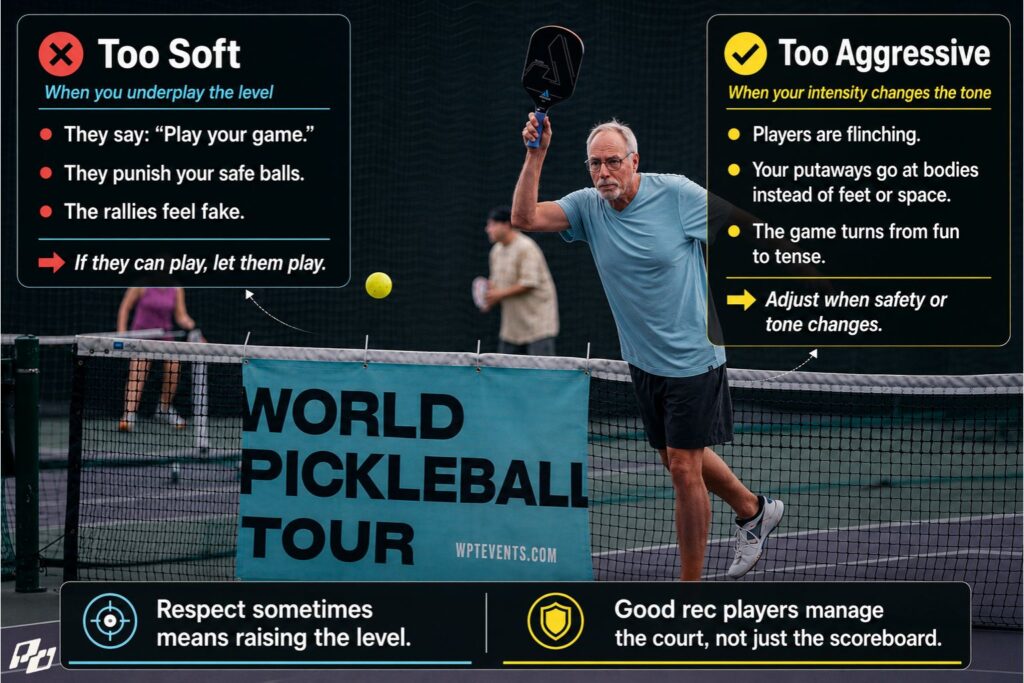
How to Tell If You’re Being Too Soft
You may be underplaying if:
- they look annoyed when you apologize
- they start attacking you harder
- they say “play your game,
- they are clearly moving well
- they punish your safe balls
- the rallies feel fake
- you are intentionally missing
- or you are treating a skilled player like a beginner
Older players are not props in your good-person story. If they can play, let them play. Respect sometimes means raising the level.
How to Tell If You’re Being Too Aggressive
You may be overdoing it if:
- the game is a blowout and you keep attacking the same weakness
- players are flinching
- your putaways are going at bodies instead of feet or space
- someone is repeatedly stumbling or reaching dangerously
- your lobs create panic backpedaling
- one opponent barely touches the ball
- or the tone of the court changes from fun to tense
At that point, adjust. Not because you are wrong to compete. Because good rec players manage the court, not just the scoreboard.
The Best Internal Challenge: Win Without Cheapness
Here is a great rule when you are clearly better or more athletic than older opponents: Win without cheapness.
That means you can still win.
But do it with skills that transfer to better games.
Win with clean thirds.
Win with better resets.
Win with lower dinks.
Win with controlled attacks.
Win with feet targets.
Win with patience.
Win with anticipation.
Win with ball control.
Avoid winning only through repeated aces, body shots, fall-risk lobs, or sprint-trap drop volleys.
Those may work, but they do not always make you better. And in social rec play, they often make the game worse.
The Older Player Advantage You Should Respect
A lot of younger or more athletic players underestimate what older players are actually good at.
They may not beat you with speed. But they can absolutely beat you with:
Patience.
They are not in a rush to end the point.
Shot selection.
They usually know which balls are worth attacking — and which ones are traps.
Soft-game discipline.
They are often comfortable dinking, resetting, blocking, and waiting.
Court sense.
They know where to stand, how to cover the middle, and how to make the court feel smaller.
Percentage pickleball.
They are often better at letting bad balls go, avoiding panic attacks, and making you hit one more shot.
That is why playing older, skilled opponents can be such a good lesson.
You may have the legs.
They may have the map.
So instead of trying to blast through them, study how they make the game uncomfortable without looking rushed.
✔ Watch where they stand before you hit.
✔ Notice how early their paddle is ready.
✔ Pay attention to how rarely they attack from bad positions.
✔ See how they use soft angles to pull you out of shape.
✔ Notice how often they make you move without swinging hard.
That is the part younger athletic players often need most: not more power, but better control of the point.
What to Do If They Complain About Hard Shots
Sometimes players complain when you attack popups, even if the shot was fair. That is tricky.
You do not need to apologize for every normal pickleball shot. But you can adjust tone and target.
Instead of saying, “Well, don’t pop it up,” which may be true but not helpful, try:
- “I’ll keep it away from bodies.”
- “I’ll aim feet and open court.”
- “I’m not trying to hit anyone — just finishing the ball.”
- “Tell me if you want a more social pace.”
That keeps the game friendly without turning you into a punching bag for complaints.
And if the group truly does not want normal attacks, that is fine. It just means you are playing a social rally game, not a competitive one.
Adjust or find another court.
What to Do If They Tell You Not to Hold Back
Believe them — but do not go from friendly rally mode straight to full send.
Ramp up in layers.
Start with normal pickleball pace to safe targets: feet, open court, middle, or controlled angles. Then let their response tell you how much more pressure they actually want.
- If they block your pace cleanly, start moving the ball more.
- If they move well, use more of the court.
- If they counter well, run your real patterns.
- If they attack you first, compete back.
That is the best version of respectful play: not babying them, not blasting them, but testing the level honestly.
Start with respect. Then let their game earn the next gear.
The Rule for Rec Play vs Tournament Play
In tournaments, the answer is simple: use your legal weapons. If a player has a mobility weakness, that is part of competition.
In social rec play, the answer is more nuanced: use your skill without turning physical limitations into the whole strategy.
That does not mean tournaments have no sportsmanship or rec play has no competition. It means the purpose of the game changes.
- Tournament goal: win within the rules.
- Social rec goal: create a good game.
- Competitive rec goal: do both.
Knowing which game you are in is half the battle.
The Best Compliment Is a Game They Want to Play Again
Here is the standard I’d use: after the game, would that older player want you back on their court?
✔️ Not because you handed them points.
✔️ Not because you treated them like they were fragile.
X But because you gave them a real game that matched what they could handle.
That is the balance.
Against a sharp, mobile senior player, bring real pickleball. Let them see pace, drops, counters, pressure, and patterns. A lot of older players would rather lose a real point than win a fake one.
Against a lower-mobility player, show a different kind of skill. Win with touch. Win with depth. Win with feet targets. Win with controlled putaways. Win by making the court feel playable, not dangerous.
The bonus rule is simple: adjust the shot, not the respect.
- A softer overhead can still be respectful.
- A controlled drop can still be competitive.
- A ball to the feet can still teach.
- A rally that includes everyone can still be serious pickleball.
And honestly, this is good for your own game too. If you can only win by overpowering slower players, that skill will disappear the moment you face better hands. But if you learn to control tempo, placement, height, and pressure, you are building tools that work everywhere.
So do not think of it as “playing down.” Think of it as learning another gear.
The best rec players are not just the ones with the biggest shots. They are the ones who can read the court, read the people, and create the right kind of game.