Most 3.5 players are not stuck because they need a brand-new game. They are stuck because their decisions are just a little late, a little rushed, or a little out of sync with the point.
You already have shots. You can serve, return, dink, drive, block, and occasionally hit a third-shot drop that makes you feel like you belong at 4.0.
But the next level is not about having more shots.
It is about knowing which shot the point is asking for.
That is where the 3.5 ceiling really shows up. Not in the highlight shots, but in the small choices: when to move, when to hold, when to reset, when to attack, and when to simply make your opponent hit one more ball.
At 3.5, the question is usually, “Can I hit this?”
At 4.0, the question becomes: What does this point need right now?
Mistake #1: Choosing Shots by Ball Height Only
This might be the most expensive decision-making mistake at 3.5. You see a ball that sits a little high, and your brain immediately says: attack.
That sounds reasonable. High balls are attackable, right?
Sometimes, yes.
But at 3.5, players often attack because the ball is high enough, not because the situation is good enough. Those are different things. A ball can be high and still be a bad speed-up.
Why?
- Because your opponent might be balanced.
- Their paddle might already be in front.
- Your contact might be too close to your body.
- Your feet might be drifting.
- Your partner might not be ready for the counter.
- The ball might be above net height, but the point may not actually be attack-ready.
That is the trap.
At 3.5, many players treat ball height like a green light. At 4.0, players read a fuller picture: ball height, contact point, opponent balance, opponent paddle position, their own balance, and what happens if the attack comes back.
The attack is not just about the ball you hit. It is about the next ball you might have to defend.
Why This Happens
Intermediate players are often rewarded for attacking too early because lower-level opponents do not punish them consistently. A chest-high speed-up might win against a 3.0 player who drops their paddle or flinches.
But against better players, that same ball comes back faster, lower, and earlier than expected. Then the 3.5 player thinks, “I need to hit harder.”
⮕ No. You need to pick better moments.
Power did not fail you.
The decision did.
What to Do Instead
Before speeding up, use a three-part read: Ball. Body. Opponent.
- The ball: Is it above net height and in front of you?
- Your body: Are you balanced, still, and able to recover?
- The opponent: Are they late, reaching, leaning, split wide, or paddle-down?
If you only have the ball, but not body and opponent, it is probably not a true green light. That does not mean you never attack. It means your speed-up needs a reason.
A better attack usually comes when the opponent is:
- leaning into a dink
- reaching outside their body
- recovering from a wide ball
- late getting their paddle back
- split too far apart from their partner
- or stuck with their weight moving the wrong way
That is when a speed-up becomes more than a hard shot. It becomes a decision.
Change the Way You Think
Stop thinking:
“Is this ball attackable?”
Start thinking:
“Is my opponent punishable?”
That shift is huge.
A ball can be attackable.
But the opponent has to be vulnerable.
Court Cue
High ball is not enough. Attack the player’s balance, not just the ball.
Mistake #2: Advancing Because You Hit the Ball, Not Because You Earned Space
A lot of 3.5 players know they should get to the kitchen. So after they hit a third shot or fifth shot, they start moving forward almost automatically.
The idea is correct.
The timing is often wrong.
The kitchen line is the best place to play from, but you do not get to walk there just because you want to. You have to earn it with a ball that makes your opponents hit up, reach down, or slow their attack.
This is where many 3.5 players get trapped.
They hit a mediocre drop, start charging forward, and then get the next ball drilled at their feet. They are moving, upright, and late. So they swing awkwardly, pop it up, or panic-block.
Then they blame the drop. But the real mistake was not always the shot. It was the decision to advance behind it.
⮕ A decent ball buys you a step.
⮕ A great ball buys you two or three.
⮕ A bad ball buys you nothing
Why This Happens
Players hear “get to the kitchen” so often that they treat it like a race. But the transition zone is not just space to run through. It is a series of checkpoints.
Every shot either earns you the next step forward or tells you to hold. The 4.0 player understands this.
The 3.5 player often moves forward because the plan says move forward, even when the ball says stop.
What to Do Instead
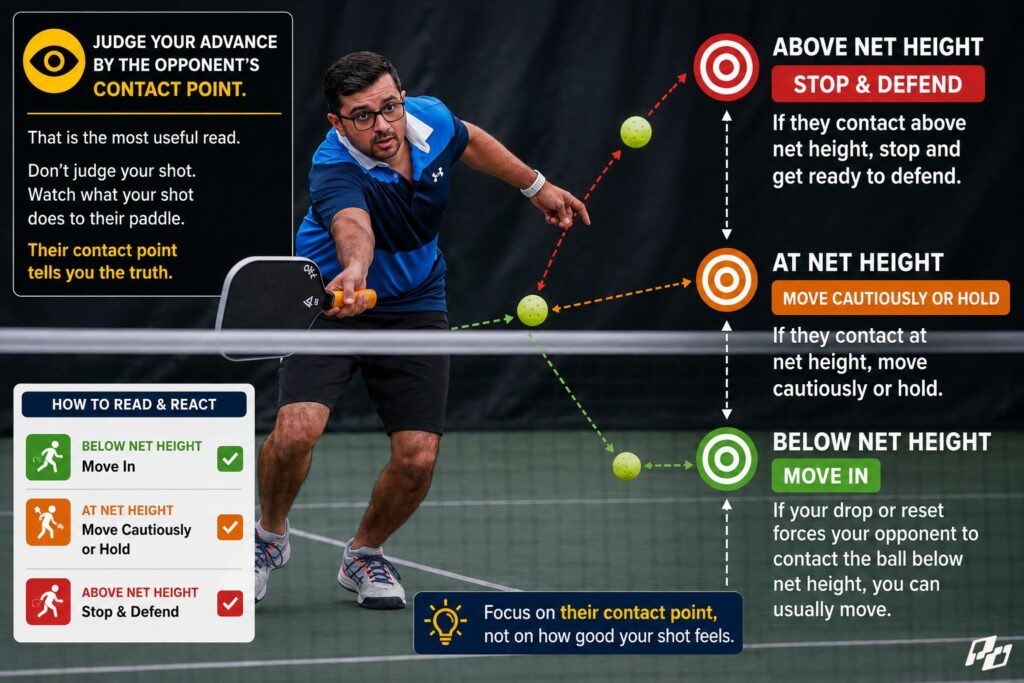
Judge your advance by the opponent’s contact point. That is the most useful read.
- If your drop or reset forces your opponent to contact the ball below net height, you can usually move.
- If they contact at net height, move cautiously or hold.
- If they contact above net height, stop and get ready to defend.
This is much easier than trying to judge whether your own shot was “good.” Watch what your shot does to their paddle.
Their contact point tells you the truth.
The Transition Rule
Use this simple system:
| Opponent Contact | Your Decision |
|---|---|
| Below net height | Move forward |
| Around net height | Creep forward or hold |
| Above net height | Stop, get low, defend |
| Opponent is stepping into the ball | Stop immediately |
| Opponent is reaching down or stretching | Take space |
The mistake is not being in the transition zone. The mistake is moving through it without permission.
Change the Way You Think
Stop thinking:
“I need to get to the kitchen.”
Start thinking:
“What did my last shot earn?”
Sometimes it earns the line.
Sometimes it earns one step.
Sometimes it earns nothing.
Respect that.
Court Cue
Do not run to the kitchen. Earn the next tile.
Mistake #3: Resetting Too Late
Most 3.5 players understand the reset in theory. They know a reset is a soft shot that neutralizes pace and drops the ball into the kitchen.
But they use it too late.
They wait until they are already in trouble — stretched, jammed, off balance, or getting blasted in the transition zone. By then, the reset becomes a rescue attempt instead of a controlled decision.
Better players reset earlier. They do not wait for the point to become an emergency.
This is a quiet but massive difference.
At 3.5, players often try to counter one extra ball because they do not want to “give up offense.” But if your feet are late, your paddle is rushed, or your contact is below your knees, countering is not offense.
It is denial.
Why This Happens
Resetting feels passive. A lot of intermediate players think softening the ball means they are giving the opponent control.
But a good reset is not passive. It is a defensive takeover. You are taking a chaotic point and forcing it back into a slower shape.
That is control.
The 3.5 player thinks, “They hit hard, so I need to hit hard back.”
The 4.0 player thinks, “They gave me pace. Can I remove it?”
That is a totally different mindset.
What to Do Instead
Use the four early reset signals:
Off balance.
If your feet are not set, reset.
Off court.
If you are pulled wide, reset.
Low contact.
If the ball is below net height or below your knees, reset.
Late contact.
If the ball is behind your ideal strike zone, reset.
You do not need all four. One is enough.
If one of those is true, your job is not to win the exchange. Your job is to keep the rally alive and rebuild position.
Change the Way You Think
Stop thinking:
“Can I counter this?”
Start thinking:
“Am I stable enough to counter the next ball too?”
That is the part 3.5 players miss.
Maybe you can counter this ball.
But if the counter comes back, are you ready?
If not, reset now.
Court Cue
Reset before you are desperate.
Mistake #4: Dinking Without Changing the Opponent’s Contact Point
A lot of intermediate players dink just well enough to stay in the rally. That sounds good. But it is also why they plateau.
At 3.5, a dink rally often becomes a waiting room. The ball goes over. The ball comes back. Nobody is really gaining anything. Then someone gets impatient and attacks the wrong ball.
The problem is not that the player cannot dink. The problem is that their dinks do not change anything.
- They do not move the opponent.
- They do not lower the opponent’s contact point.
- They do not stretch the opponent’s balance.
- They do not create a predictable next ball.
They are just “in.”
At 4.0, dinking has a job. Every dink is trying to create one of three things:
- a lower contact point
- a wider contact point
- or a less comfortable next ball
That is the difference between dinking to survive and dinking to build.
Why This Happens
A lot of 3.5 players learned dinking as a safety skill.
Keep it low.
Keep it in.
Do not pop it up.
That is a good start. But eventually, safe dinking becomes too neutral.
If your opponent can take every dink in balance, in front of their body, with a quiet paddle, you are not pressuring them.
You are giving them rhythm. And rhythm is dangerous.
What to Do Instead
Think about dinking in layers:
Layer one: safety
Keep the dink unattackable.
Layer two: shape
Make them move, bend, or reach.
Layer three: pattern
Know what you are trying to create.
For example:
A crosscourt dink to the outside foot can pull them wider.
A middle dink can create hesitation between partners.
A slightly deeper kitchen dink can jam their paddle.
A down-the-line dink can test their backhand and freeze their partner.
A soft angle can make them reach instead of step.
None of this has to be flashy.
The goal is not to hit a winner with the dink.
The goal is to make their next ball worse.
Change the Way You Think
Stop thinking:
“Did my dink go in?”
Start thinking:
“Did my dink make their next shot harder?”
That is the real question.
A dink that lands in but gives your opponent perfect balance may not be bad.
But it also may not be doing enough.
Court Cue
Do not dink to continue. Dink to change something.
Mistake #5: Returning Deep Without a Fourth-Shot Plan
Most serious 3.5 players know they should return deep.
That advice is everywhere.
And it is correct.
But here is the underrated mistake: they hit a good deep return… and then stop thinking. They run in, arrive late, and react to the third shot like the point just surprised them.
A deep return is not the end of your job.
It is the beginning of your fourth-shot plan.
Your return should help you do two things:
✓ Buy time to get forward
✓ Create a predictable third shot
If you return deep to the wrong player, or you have no idea what third shot is likely coming, you may still be unprepared.
At 4.0, players do not just return deep.
They return deep with a purpose.
Why This Happens
The return feels like a simple shot, so players often mentally check out after making it. But in doubles, the return is one of your biggest tactical decisions because it shapes the whole rally.
Return short, and the serving team gets an easy third.
Return deep but floaty to a strong driver, and you may invite pace.
Return deep to a player with a weak drop, and you may get the exact fourth-shot ball you want.
Return deep to the middle, and you may reduce angles.
Return deep to the backhand, and you may force a weaker third.
Depth matters.
But depth plus target is better.
What to Do Instead
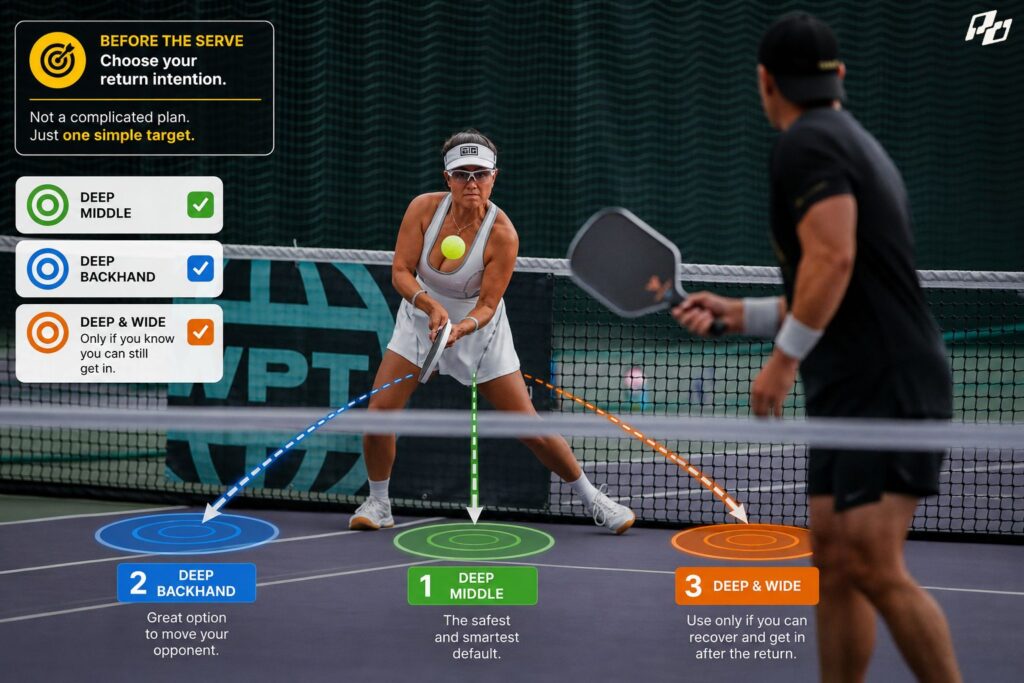
Before the serve even comes, choose your return intention.
Not a complicated plan.
Just one simple target:
✓ Deep middle
✓ Deep backhand
✓ Deep to the weaker third-shot player
✓ Deep with height to give yourself time
✓ Deep and wide only if you know you can still get in
Then, after you return, your next job is not just “run to the kitchen.” Your job is to:
- Move
- Split
- Read the third
- Decide whether the fourth shot should keep them back, block pace, or take the drop out of the air
That is the missing link for many 3.5 players.
Change the Way You Think
Stop thinking:
“I returned deep, so I did my job.”
Start thinking:
“What fourth shot did my return create?”
A good return is not just deep.
It sets up your next decision.
Court Cue
Return with a fourth-shot plan.
Mistake #6: Treating the Middle Like a Safe Zone Instead of a Pressure Zone
Intermediate players are often told to hit middle because it reduces angles and creates confusion.
That is true.
But many 3.5 players misunderstand the middle.
They hit middle as a bailout.
Not as a weapon.
There is a difference.
- A lazy middle ball at waist height can be attacked.
- A low middle ball between two players can create hesitation.
- A deep middle return can reduce third-shot angles.
- A middle dink can force partners to decide who takes it.
- A middle speed-up can jam both paddles if timed well.
The middle is not automatically safe.
It becomes valuable when the height, timing, and purpose are right.
Why This Happens
“Hit middle” sounds simple, so players treat it like a default target.
When in doubt, middle.
But better opponents are not confused by every middle ball. They are only bothered by middle balls that arrive at awkward heights or awkward moments.
If your middle ball sits up, both opponents may want it.
That is not confusion. That is invitation.
What to Do Instead
Use the middle for one of three reasons:
To reduce angles.
Deep return or defensive reset middle.
To create communication pressure.
Dink or roll between partners.
To jam spacing.
Attack the inside hip or paddle-side seam when both players are tight.
But do not hit middle just because you are out of ideas. The middle still needs shape.
- Low middle is useful.
- Deep middle is useful.
- Late middle is useful.
- Floating middle is trouble.
Change the Way You Think
Stop thinking:
“Middle is safe.”
Start thinking:
“What kind of middle ball causes a problem?”
The target is not magic.
The shape is the weapon.
Court Cue
Middle only works when it is low, deep, late, or confusing.
Mistake #7: Playing the Score Instead of the Pattern
This one is subtle.
And it shows up constantly at 3.5.
Players change their shot selection because of the score, not because of the rally pattern.
At 9-9, they suddenly drive harder.
At 10-8, they play not to miss.
After losing two points, they force a speed-up.
After winning a long dink rally, they get impatient the next time.
The score starts making decisions for them.
Better players know the score matters.
But it does not rewrite the rules of the point.
If the ball is below net height at 3-3, it is still below net height at 10-10.
If your opponent is balanced at 2-1, they are still balanced at game point.
If you are off balance, the correct shot is still probably a reset.
Pressure does not change the right decision.
It just tempts you to abandon it.
Why This Happens
At 3.5, players often want emotional relief.
A hard drive feels like relief.
A speed-up feels like taking control.
A soft reset feels scary because it means the point continues.
But higher-level pickleball rewards tolerance. Can you make the right boring decision when the score is tight?
That is a 4.0 skill.
What to Do Instead
Give yourself one pressure rule before the game.
For example:
- At 8-8 or later, I will not attack below net height.
- At game point, I will return deep middle.
- When I am rushed, I will reset.
- When my partner is pulled wide, I will cover middle first.
- When the opponent is balanced, I will not speed up just because I am nervous.
These rules keep you from inventing desperate pickleball under pressure.
Change the Way You Think
Stop thinking:
“Big point, I need a big shot.”
Start thinking:
“Big point, I need the right shot.”
The right shot may be simple.
That is why it works.
Court Cue
Pressure does not change the percentages.
Mistake #8: Not Knowing What Phase of the Point You’re In
This is the hidden master mistake behind almost everything else.
A lot of 3.5 players play every ball like it exists by itself.
But pickleball points have phases.
- The serve and return phase.
- The third/fifth shot phase.
- The transition phase.
- The kitchen construction phase.
- The attack phase.
- The scramble phase.
Each phase has a different job. If you use the wrong mindset for the phase, you make bad decisions.
You try to win during the neutralizing phase.
You rush during the transition phase.
You dink passively during the construction phase.
You reset when you actually had a clean attack.
You attack during the scramble phase when survival was the win.
This is what makes a player look “almost 4.0” but not quite there.
They have shots.
They do not always know what phase those shots belong to.
The Phase Map
| Phase | Your Main Job | Common 3.5 Mistake |
|---|---|---|
| Serve/return | Create depth and time | Going for too much or returning without a plan |
| Third/fifth shot | Earn forward space | Trying to win immediately |
| Transition | Stay balanced and neutralize | Advancing behind bad balls |
| Kitchen construction | Create discomfort | Dinking just to keep it in |
| Attack | Strike when opponent is vulnerable | Attacking only because ball is high |
| Scramble | Survive and reset shape | Swinging harder while off balance |
This is the biggest mindset shift in the article. Do not just choose a shot.
Choose the job.
Change the Way You Think
Stop thinking:
“What shot do I want?”
Start thinking:
“What phase are we in?”
Once you know the phase, the decision gets clearer.
Court Cue
Name the phase. Pick the job. Then hit the shot.
The 3.5 to 4.0 Decision Checklist
Before your next game, do not try to fix everything. Pick one decision habit.
Use this checklist:
✓ If I am off balance, I reset.
✓ If my last shot did not force a low contact, I do not keep charging forward.
✓ If the opponent is balanced, I do not speed up just because the ball is high.
✓ If I return deep, I prepare for the fourth shot I created.
✓ If I dink, I try to change contact point, balance, or court position.
✓ If the score gets tight, I trust percentages instead of emotion.
That is the 3.5-to-4.0 bridge.
Not more chaos.
Better choices.
The Smallest Better Decision Is Usually Enough
Here is the part to keep coming back to: you do not have to play perfect pickleball to move past 3.5.
You just have to stop donating the same few points over and over.
That is good news, because improvement is closer than it feels. You do not need to rebuild your serve, buy a new paddle, learn three flashy attacks, or suddenly become the calmest player at the park.
Start smaller. Pick one decision habit for the next two weeks.
⮕ Maybe it is: no speedups unless my feet are still.
⮕ Maybe it is: if I am moving through contact, I reset.
⮕ Maybe it is: after every return, I expect the fourth shot instead of just running forward.
⮕ Maybe it is: in a dink rally, I try to change one thing — depth, width, height, or balance.
That is how real progress happens at this level.
Not by thinking about ten corrections at once.
But by making one smarter choice so often that it becomes automatic.
And honestly, that is when the game starts feeling different.
You stop reacting to every ball like it is an emergency.
You start seeing patterns earlier.
You feel less rushed.
You give away fewer cheap points.
You make opponents earn more.
And suddenly, rallies that used to feel chaotic start feeling manageable.
That is the real 4.0 shift.
Not playing prettier.
Playing clearer.