When recreational players watch the pros, they usually fixate on the obvious stuff.
➡️ How hard they hit.
➡️ How fast their hands are.
➡️ How clean their rolls, flicks, and speedups look.
That makes sense. Those are the most visible parts of the game.
What’s harder to see—and far more impactful for rec players—are the training decisions and micro-adjustments that make those shots possible without forcing them. These are the things that don’t show up on highlight reels but quietly decide rallies.
After training with a professional player, three takeaways stood out—not because they were flashy, but because they immediately translated to cleaner execution, calmer decision-making, and fewer self-inflicted errors in rec play.
These aren’t new shots. They’re better ways to train and apply the shots you already have.
1. Why Focusing on One Skill Longer Beats “Doing Everything”
The mistake most rec players make
Most rec sessions feel productive because they cover a lot. But covering a lot often means never staying long enough for correction to happen.
Early reps are noisy. Your body is:
- reacquainting itself with the motion
- compensating for timing errors
- defaulting to old habits
That’s why many players say, “I practice this all the time, but it never shows up in games.” The practice never gets past the adjustment phase.
What pros understand about skill development
The first 10–15 minutes of most drill sessions are mostly calibration, not deep learning. Pros expect that. They don’t judge progress early.
The real learning window opens when:
- fatigue starts to appear
- attention wavers slightly
- mistakes become repetitive instead of random
That’s when the brain begins refining movement instead of just executing it.
This is why focusing on one skill per day during a camp or training block feels so effective. Your nervous system isn’t competing priorities. It can settle.
Extra context for rec players
If you only have 60–90 minutes:
- spending 30–40 minutes on one skill is not “too much”
- it’s often the minimum needed to see transfer
If you leave practice thinking, “That finally felt better near the end,” you were just getting to the useful part.
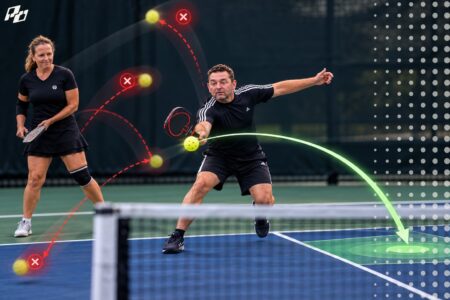
2. Why Pros Counter Up, Not Through
Why this matters more than it sounds
At the kitchen, reaction time is limited. Most counter errors happen because players try to win the point on the counter instead of neutralizing it first.
Pros assume:
- the attacker already supplied pace
- their job is placement and margin
That mindset alone changes outcomes.
Clarifying “slightly closed paddle face”
The face is closed relative to the incoming pace—not forced closed. This doesn’t mean “roll it aggressively” or “flick it.”
It means:
- the paddle face isn’t open and floating
- the wrist stays quiet
- the lift comes from swing path, not a flip
The upward motion buys you:
- net clearance
- time to recover position
- a chance to win the next exchange
When rec players should lean into this most
- When you’re reacting late
- When the ball is coming into your body
- When the rally already feels sped up
If your counter keeps finding the net, it’s almost never because you didn’t hit hard enough.
3. How Paddle Contact Point Changes the Ball (and How Grip Plays Into It)
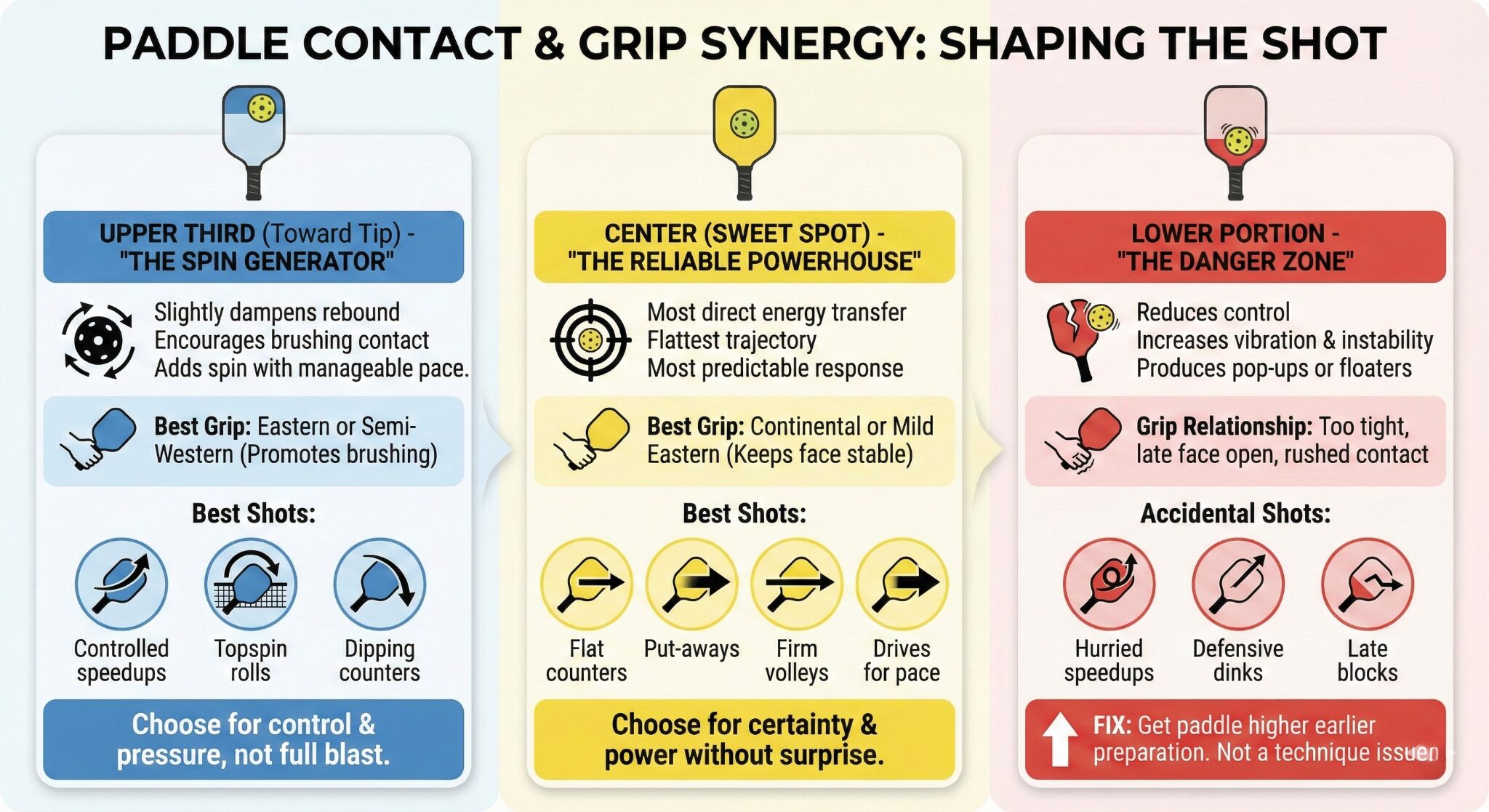
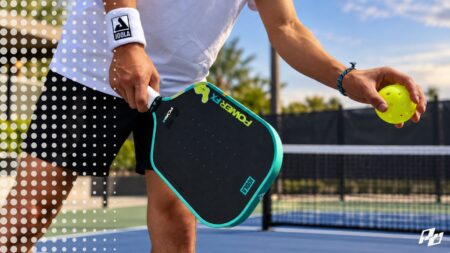
Your paddle face isn’t uniform. Where the ball hits the paddle—and how you’re gripping it—work together to shape the shot.
Center of the Paddle (Sweet Spot)
What it does:
- Most direct energy transfer
- Flattest trajectory
- Most predictable response
Best grip fit:
- Continental or mild Eastern: these grips keep the paddle face stable through contact, which is why the sweet spot feels so clean and solid.
Best shots to use it for:
- flat counters
- put-aways
- firm volleys
- drives when you want pace and certainty
When to choose it: when you want the ball to come off exactly how you expect, without added spin or surprise.
Upper Third of the Paddle (Toward the Tip)
What it does:
- Slightly dampens rebound compared to center contact
- Encourages brushing contact
- Adds spin while keeping pace manageable
Best grip fit:
- Eastern or slightly semi-Western: these grips naturally support a brushing motion, making it easier to lift and roll the ball without overhitting.
Best shots to use it for:
- controlled speedups
- topspin rolls at the kitchen
- dipping counters
- pressure shots that stay in
When to choose it: when the rally already has pace and you want control with pressure, not a full blast.
Lower Portion of the Paddle
What it does:
- Reduces control
- Increases vibration and instability
- Often produces pop-ups or floaters
Grip relationship: this contact zone usually shows up when:
- the grip is too tight
- the paddle face opens late
- the contact point is rushed
Shots where it accidentally appears:
- hurried speedups
- defensive flicks
- late blocks
What to do instead: if you’re contacting the ball low on the face often, it’s usually a timing or preparation issue, not a technique problem. Get the paddle higher earlier in the preparation phase.
The Practical Takeaway for Rec Players
You don’t need to change your swing to control pace.
You can:
- use center contact for clean, decisive shots
- use higher contact for controlled pressure and spin
- avoid low-face contact by preparing earlier, not swinging harder
Grip sets the default face angle. Contact point fine-tunes the outcome.
Once you understand how those two work together, your attacks stop feeling all-or-nothing—and start feeling intentional.
Quick-Reference Training Plan (Use This)
Session Goal
Improve control, consistency, and decision-making—not add new shots.
1️⃣ Skill Focus Block (30–40 minutes)
Choose ONE skill only per session.
Examples:
- crosscourt dinks
- counter blocks
- controlled speedups / rolls
Rules
- first 10–15 minutes = warm-up reps (don’t judge yet)
- middle reps = adjust
- last 10 minutes = quality under mild fatigue
If it only feels good at the end, you did it right.
2️⃣ Counter Control Block (15–20 minutes)
- partner speeds up at 70–80%
- you counter with:
- compact swing
- quiet wrist
- slight upward path
Goal = net clearance + recovery, not winners.
3️⃣ Contact Point Awareness Block (10–15 minutes)
Same swing, different contact:
- 5 reps center contact
- 5 reps higher on paddle
Alternate and feel the difference.
4️⃣ Short Play Segment (10–15 minutes)
Play points with one constraint:
- “one more ball” mindset
- or no full-power speedups
This is where training transfers.
Weekly Structure
- 2–3 sessions per week
- one main skill per session
- rotate skills across days, not within sessions
Coach’s reminder: progress comes from depth, not variety.
The Bigger Lesson Behind All Three Tips
All three takeaways point to the same underlying shift:
Pros reduce chaos. Rec players add to it.
Pros:
- narrow focus
- build margin under pressure
- use small adjustments instead of big swings
Rec players often do the opposite—not because they’re careless, but because no one explains this layer.
➡️ You don’t need more shots.
➡️ You don’t need harder shots.
You need clearer intent in how you train and how you respond under pressure.
That’s what makes these tips powerful. They don’t change your game overnight—but they quietly change how reliable it becomes.
And reliability is what wins most rec matches.