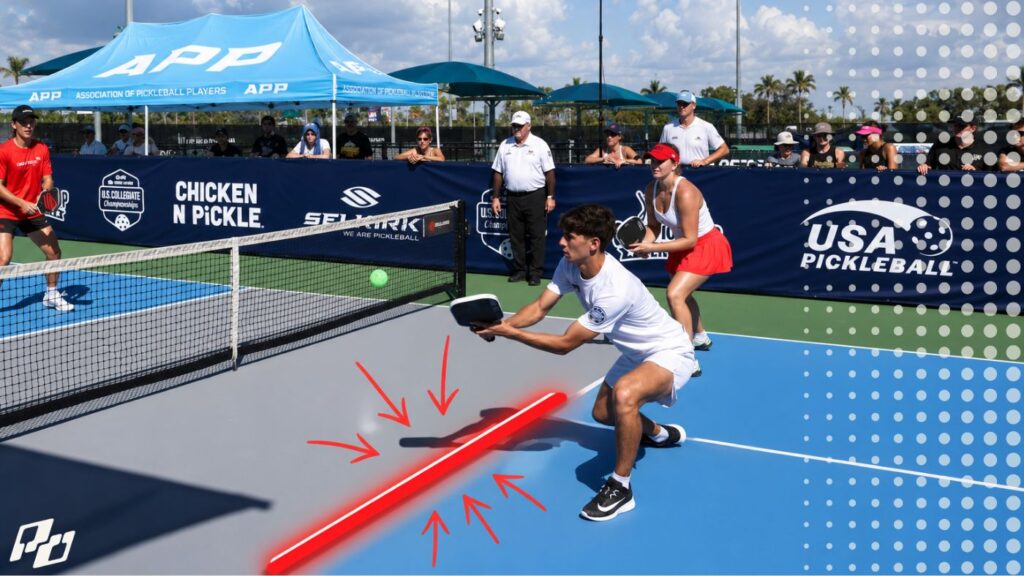
Protecting the line in pickleball means taking reachable dinks out of the air before they land near your kitchen line. This cuts off space, takes time away from opponents, and turns neutral dink rallies into offensive pressure. The goal is not to attack every ball, but to intercept the right balls early.
Pro player Zane Navratil calls it protecting the line — and once you understand it, you will never look at a dink rally the same way.
It is simple enough to try the next time you play, but it is also one of those ideas that exposes a big gap between average rec players and stronger players.
Most rec players think dinking is about being soft, patient, and consistent. That is only part of it.
At higher levels, dinking is also about owning space. Better players do not automatically let every dink bounce. They look for balls they can take out of the air, especially near the kitchen line, because that changes the whole rally. Taking dinks out of the air can reduce your opponent’s setup time and help you control the rally earlier.
That is the heart of protecting the line. You are not just standing at the kitchen. You are defending the space above and around it.
And once you start doing that, your opponents feel it.
What “Protect the Line” Really Means
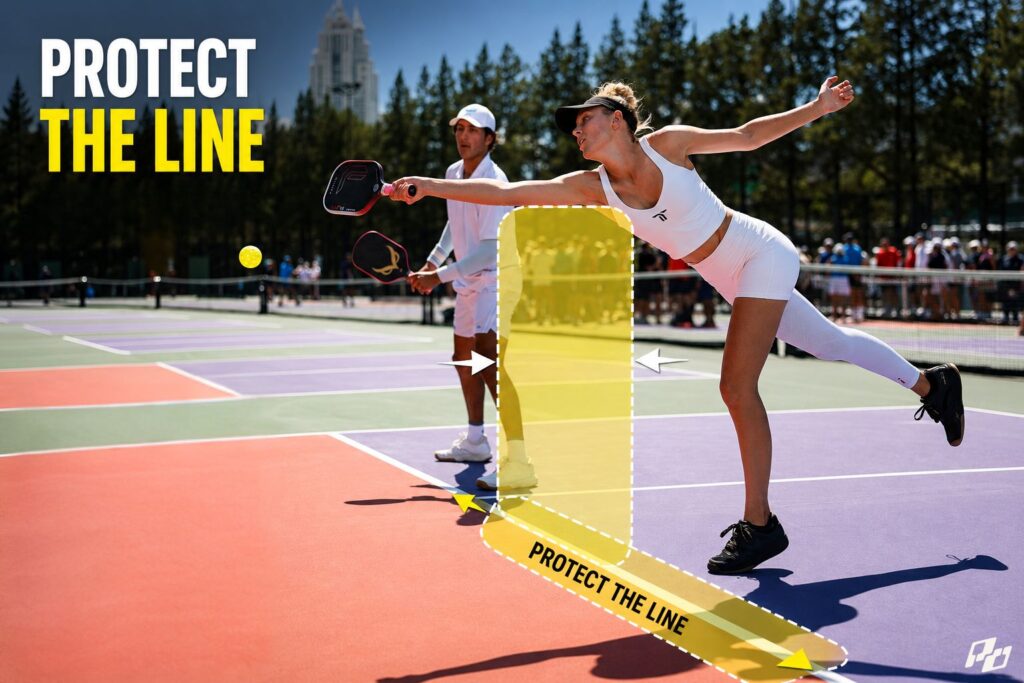
Protecting the line means treating your kitchen line like a boundary you are responsible for.
If a dink is floating toward the area around your feet, you do not automatically back up and let it bounce. You ask: Can I take this ball out of the air before it drops?
⮕ When you can, you cut it off.
That does three things:
| What You Take Away | Why It Matters |
|---|---|
| Space | Your opponent has less court to work with. |
| Time | They have less time to recover and prepare. |
| Angles | They cannot move you as easily with soft dinks. |
This is why stronger players look calm at the kitchen. They are not just reacting to the ball after it lands. They are shrinking the rally before it develops.
The kitchen rule still matters, of course: you cannot volley while standing in the non-volley zone, and the kitchen line counts as part of that zone for faults.
So this is not about lunging into the kitchen and volleying illegally. It is about learning your legal reach zone from behind the line.
Why This Starts to Matter Around 3.5 and Above
At 3.0, you can win a lot of points by simply keeping dinks low and avoiding silly misses. At 3.5, that starts to change.
Players can dink longer. They can move you side to side. They can wait for you to float one. If you always let the ball bounce, you give them time to keep resetting the point.
At 4.0 and above, protecting the line becomes even more important because kitchen rallies are less about “who can dink the longest” and more about who creates pressure first without over-attacking.
That is the level-up.
You stop thinking: “Can I keep this dink in?”
And start thinking: “Can I take this ball early enough to make their next shot worse?”
That is a very different game.
Coaches often describe the kitchen as a pressure area where footwork, paddle discipline, balance, and timing matter more than big swings. Good kitchen control lets you hold ground, absorb pace, and reduce your opponent’s reaction time.
The Big Mistake: Letting Too Many Dinks Bounce
A dink that bounces is not always bad.
Sometimes letting it bounce is the right choice, especially if the ball is low, sharp, or pulling you off balance.
But many rec players let balls bounce out of habit.
The ball is reachable.
The contact point is comfortable.
The opponent is still recovering.
And the rec player still lets it land.
Now the ball drops lower. The contact point gets worse. The opponent gets more time. The rally resets.
That is a missed opportunity. The goal is not to volley every dink. That will make you reckless. The goal is to recognize the dinks you can legally take early without losing your balance.
Better rule: If the ball is high enough, close enough, and you can stay stable, protect the line.
The Contact Window That Matters
Protecting the line is really about finding your personal contact window.
Not every player has the same reach. A taller player with long arms may take balls out of the air that a shorter player should let bounce. A player with great balance may handle a wider dink. A player with tight shoulders or slow recovery may need a smaller range.
That is why this skill is so valuable. It teaches you what is actually yours.
| Ball Type | Take It Out of the Air? | Why |
|---|---|---|
| Floating toward your outside foot | Usually yes | You can cut off the angle before it pulls you wider. |
| Sitting above net height | Yes, if balanced | This can become a roll, press, or controlled attack. |
| Dropping below net height fast | Usually no | Let it bounce unless you can lift it cleanly. |
| Wide and low | Usually no | Reaching creates pop-ups and recovery problems. |
| Soft and reachable in front | Often yes | You can take time away without swinging big. |
| At your body with no room | Maybe no | If you are jammed, a bounce may give you space. |
The key phrase is if balanced.
A ball is not “yours” just because you can touch it. It is yours if you can take it early and still be ready for the next shot.
The Adjustment: Reach More, But Don’t Lunge More
This is where the idea gets misunderstood.
Protecting the line does not mean diving for everything. It does not mean stabbing at balls with a stiff arm. It does not mean leaning so far forward that your next move is a kitchen fault.
It means improving your effective range.
That range comes from:
- a quiet paddle face
- a stable lower body
- a small forward reach
- contact in front of your body
- a recovery plan after the volley
The best players make this look subtle. They do not look like they are chasing the ball. They look like they are calmly removing it from the rally before it becomes a problem.
A good mental image: You are not attacking the ball. You are intercepting it.
That keeps the swing compact.
The “Protect the Line” Decision System
Before you take the ball out of the air, check three things:
1. Height
Can you contact it around net height or higher?
If yes, you may be able to protect the line.
If the ball is dropping below net height, be careful. That is where pop-ups, scoops, and net balls happen.
2. Balance
Can you reach without lunging, falling, or drifting into the kitchen?
If yes, take it early.
If no, let it bounce.
3. Recovery
Can you get your paddle back after contact and handle the next shot?
If yes, it is probably a smart volley.
If no, you may be winning this ball but losing the next one.
Simple rule: Height gives permission. Balance gives control. Recovery makes it worth it.
What Shot Should You Hit When You Protect the Line?
Not every early-contact ball should be attacked. That is another rec-player trap.
Sometimes the best line-protecting shot is simply a firm dink volley that lands short and low. Sometimes it is a roll to the outside foot. Sometimes it is a speedup. Sometimes it is a block into a better location.
Here is the better breakdown:
| Situation | Best Choice |
|---|---|
| Ball is reachable but low | Soft volley dink back into the kitchen |
| Ball is above net height | Roll or controlled speedup |
| Opponent is leaning middle | Push dink behind their outside foot |
| Opponent is recovering from wide | Take it early and keep them stretched |
| You are slightly off balance | Absorb it short, do not attack |
| You are fully stretched | Let it bounce unless you can control it |
The mistake is thinking every air dink has to become offense. It does not.
Sometimes protecting the line just means not letting your opponent move you for free.
The Drill Rec Players Should Use
Play a kitchen-only game with one twist: A ball that lands on or behind the kitchen line wins the point for the other team.
That forces both players to protect the line instead of casually letting reachable dinks bounce.
⮕ Start straight ahead. Then go crosscourt. Then add controlled speedups once the movement feels cleaner.
This drill works because it changes your attention. You stop watching dinks as “soft balls” and start seeing them as balls you may need to intercept.
But keep the first version controlled. If you go full-speed too soon, you will turn it into a reach-and-panic drill.
The goal is not to prove how far you can stretch. The goal is to learn which balls you can take early with structure.
The Range Test
Here is a simple way to find your real range. Have a partner feed dinks that land in three zones:
Zone 1: directly in front of you
These should become your easiest air dinks.
Zone 2: one step to either side
These teach you to load, reach, and recover.
Zone 3: wide and low near the sideline
These teach discipline. Some should be left to bounce.
After each ball, ask:
Was I balanced after contact?
Did my paddle face stay quiet?
Could I handle the next ball?
If the answer is no, that ball may be outside your current effective range. That does not mean forever.
It means drill it before trusting it in a match.
Common Mistakes When Players Try This
⮕ Reaching with the arm instead of moving the base
If your feet stay dead and your arm does all the work, the paddle face gets unstable. The fix is a small adjustment step before the reach — just enough to keep your body organized and your paddle quiet.
⮕ Taking low balls out of the air just because you can
A low air dink is not automatically attackable. Volley it from below net height with a stiff wrist, and you are probably feeding your opponent. Take it early only if you can control the shape.
⮕ Forgetting the kitchen rule
Your momentum matters. If you volley from outside the kitchen and your momentum carries you into the non-volley zone, it is still a fault. That is why balance is not optional.
⮕ Trying to win the point immediately
Protecting the line is pressure, not desperation. The goal is to make the next ball easier. A winner is great, but the real win is forcing your opponent to play from a worse position.
The Best Cues
“Own the bounce zone.”
Do not automatically give your opponent every ball that is about to land near your line.
“Touch it early, not harder.”
The advantage is timing, not violence.
“Reach with balance.”
If your body falls after contact, you reached too far.
“Protect first, attack second.”
The first goal is taking away time. The attack comes only when the ball allows it.
“Find your real range.”
Your job is not to copy a pro’s reach. It is to expand the range you can control.
This Is One of the Fastest Ways to Stop Playing “Polite” Pickleball
A lot of rec players are too polite at the kitchen.
They let reachable dinks bounce.
They let opponents move them around.
They wait for an obvious pop-up.
They only attack when the ball is begging to be attacked.
Better players do not wait that long. They pressure the rally earlier.
That is what protecting the line teaches you. It does not turn you into a reckless attacker. It turns you into a player who takes away comfortable options.
And that is a big step up.
⮕ At 3.0, keeping the ball in play is enough.
⮕ At 3.5, you need to stop giving opponents free time.
⮕ At 4.0, you need to make your kitchen position feel uncomfortable to play against.
Protecting the line helps you do all three.