Pickleball is supposed to be fun. That is part of the problem.
Because when you feel nervous before open play, tight during a close game, or embarrassed after a bad miss, it can feel ridiculous.
You tell yourself: “Why am I anxious? It’s just pickleball.”
But that is exactly why so many players keep quiet about it.
Pickleball anxiety is not always about tournaments or medals. For rec players, it is often social. You worry about playing badly in front of your group. You dread being the weak fourth. You hope you do not get picked last. You finally get invited into a stronger game and suddenly feel like one bad match might cost you your spot.
That pressure is real. And it can make a casual sport feel weirdly personal.
What Pickleball Anxiety Actually Feels Like
It usually does not show up as, “I am anxious.” It sounds more like this:
“I don’t want to mess this up for my partner.”
“Everyone here is better than me.”
“I hope they don’t regret inviting me.”
“If I miss another return, I’m done.”
“Why do I play fine with my friends but terrible with this group?”
Then your body joins in.
Your grip gets tighter. Your serve gets careful. Your feet stop moving. Your dinks float. You speed up balls you should not attack because you want the point to end.
That is the cruel part: anxiety makes you play in the exact way you were afraid of playing.
Sports psychology often explains performance anxiety through attention. Under pressure, athletes either get distracted by worries or start overthinking movements that normally happen automatically. Both can disrupt performance.
In pickleball terms:
You stop playing the ball.
You start playing the fear of the next mistake.
Why Rec Pickleball Can Feel So Socially Intense
Rec pickleball has a sneaky status system.
There are beginner courts, intermediate courts, advanced courts, challenge courts, private groups, text threads, ladders, DUPR talk, and that one court where everyone somehow plays like rent is due.
Nobody says it out loud, but players know where they stand. That creates anxiety. Not because you are fragile. Because belonging matters.
You want good games. You want people to enjoy playing with you. You want to improve without being judged every time you miss a third shot.
That is normal.
The problem starts when every game becomes an audition.
If you walk onto the court thinking, “I have to prove I belong,” you are already carrying too much weight. Now every point has a second scoreboard: the actual score, and the imaginary score of what everyone thinks of you.
That second scoreboard is exhausting.
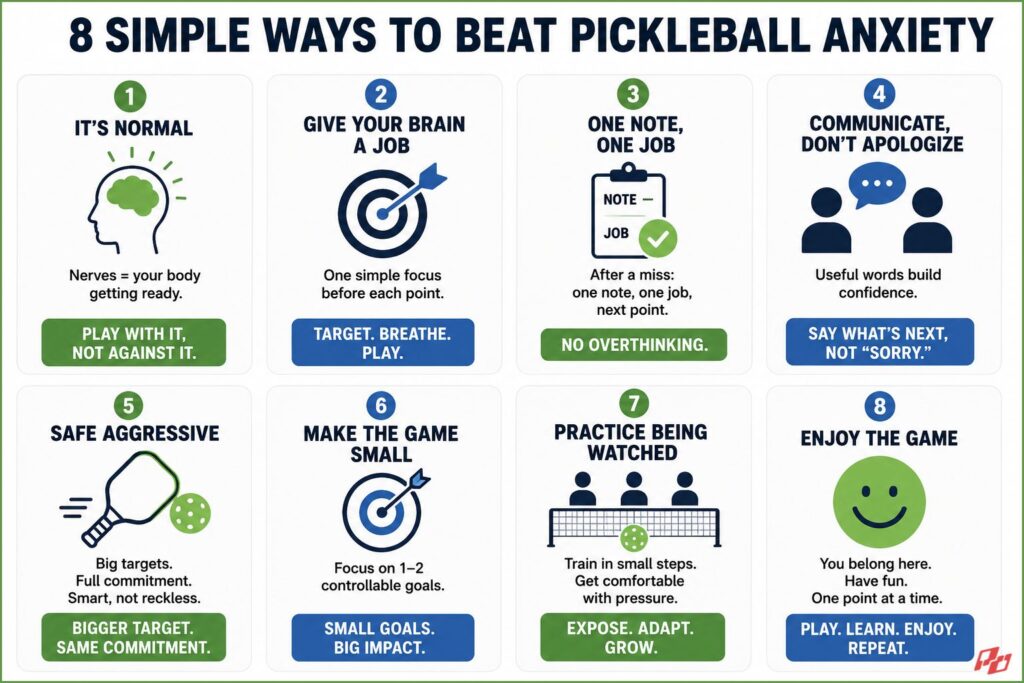
The First Fix: Stop Trying to “Calm Down”
This sounds backwards, but trying to force yourself to relax can make anxiety worse.
You feel nervous.
Then you get annoyed that you feel nervous.
Then you start monitoring whether you are still nervous.
Now you are anxious about being anxious.
Not helpful. A better approach is to stop treating nerves as a problem that must disappear.
Nerves are just activation. Your body is getting ready to perform. The issue is not the feeling itself — it is what you do with it.
Instead of saying: “I need to calm down.”
Try: “I can play with this feeling.”
You do not need to feel perfectly relaxed to play good pickleball. You need enough attention on the right thing.
Give Your Brain a Job
An anxious brain loves empty space. If you do not give it a job, it will invent one:
Don’t miss.
Don’t embarrass yourself.
Don’t let your partner down.
Don’t lose your spot.
Those are terrible jobs. They create tension because they focus on what you are trying to avoid.
Instead, give your brain one small, physical task before each point.
Not a motivational speech.
A job.
| Situation | Better Job |
|---|---|
| Nervous serve | Finish toward the target. |
| Tight return | Deep middle, full swing. |
| Dink rally | Quiet paddle, active feet. |
| Partner is better than you | Make them play predictable balls. |
| Close score | Big target, committed stroke. |
| After a bad miss | One correction, next ball. |
Pre-performance routines are widely used in sport because they help athletes regulate attention, thoughts, and emotions before performance.
For rec players, the routine can be simple: Breathe. Pick a target. Say the job. Play the point.
That is enough.
Use the “One Note, One Job” Rule
The worst time to analyze your game is immediately after a bad miss. That is when your brain wants to hold a full staff meeting.
“Why did I miss that?”
“Am I bending enough?”
“Was my grip wrong?”
“Should I stop driving?”
“Do they think I’m terrible?”
“Why am I like this?”
No.
After a miss, you get one note and one job.
Example:
Note: “Late feet.”
Job: “Move before I swing.”
Or:
Note: “Tight grip.”
Job: “Soft hand on the next dink.”
That is it. No courtroom trial. No identity crisis. No five-point spiral.
Cue: One note. One job. Next point.
This is one of the simplest ways to stop anxiety from turning one mistake into six.
Stop Apologizing for Every Miss
This one is personal because pickleball players apologize constantly. A quick “my bad” is fine. Good partner behavior.
But some players apologize after every error like they are submitting a formal written confession. At some point, the apology becomes part of the anxiety loop.
You miss.
You apologize.
You feel smaller.
Your partner says “no worries.”
You still feel watched.
You play tighter.
Try replacing repeated apologies with useful communication.
Instead of: “Sorry, sorry, sorry.”
Say:
“I’ll take middle next time.”
“I’m going deeper on the return.”
“I rushed that. I’ve got the next one.”
That gives your partner confidence because it shows you are still present. A partner does not need you to feel guilty.
They need you ready for the next ball.
The “Good Court” Mindset Shift
When you get into a stronger game, your anxiety may tell you to play smaller.
Do not miss.
Do not take up space.
Do not be the reason your team loses.
That mindset usually backfires. Strong players do not need you to be perfect. They need you to be clear, steady, and committed.
That means:
Return deep.
Call middle balls early.
Use bigger targets.
Keep your paddle ready.
Reset when you are in trouble.
Attack only balls you actually own.
That is how you contribute. Not by hiding.
The goal is not to prove you are the best player on the court. The goal is to become easy to play with.
Cue: Don’t audition. Contribute.
That one has helped a lot of players.
Play “Safe Aggressive”
Anxiety usually pushes rec players in one of two directions. They either get too careful or too reckless.
Too careful means you guide the ball, decelerate, and become attackable.
Too reckless means you speed up bad balls, overdrive returns, or try to win the point before the nerves get worse.
The better middle is safe aggressive.
That means you still swing with commitment, but you choose targets with margin.
| Anxiety Choice | Safe-Aggressive Choice |
|---|---|
| Babying the serve | Serve with full motion to a bigger target |
| Trying a perfect sideline return | Deep return through the middle |
| Flicking a low dink | Wait for a higher ball |
| Avoiding every attack | Attack feet or middle when the ball sits up |
| Playing not to miss | Hit committed shots to safer locations |
This keeps you from becoming harmless without turning you into a gambler.
Cue: Bigger target. Same commitment.
That is a great pressure cue because it gives you permission to play boldly without playing stupidly.
Make the Game Smaller
When anxiety gets loud, the game feels huge.
The score matters.
The group matters.
The court matters.
Your rating matters.
Your last miss matters.
Your next invite matters.
You cannot play well with all of that in your head. So shrink the game.
For one game, your only goal might be:
All returns deep.
No speedups from below the net.
Call every middle ball.
Reset before attacking from transition.
Breathe before every serve.
That gives you something controllable.
Experienced mental-game coaches often use routines, breathing, cue words, visualization, and pressure practice to help athletes manage anxiety and keep attention on the task instead of the outcome.
In rec pickleball, the principle is simple: You relax more when your job is smaller.
Practice Being Watched
This is the part nobody wants to hear. If you only practice when you feel comfortable, you may keep struggling when you feel judged.
So train the discomfort gently.
Play with slightly better players.
Enter a low-stakes round robin.
Ask someone to record a few points.
Serve when people are watching.
Play a drill where missed returns cost two points.
Practice calling balls loudly and early.
The goal is to teach your nervous system: I can feel exposed and still play.
That is confidence. Not feeling fearless. Knowing you can function anyway.
When It’s More Than Normal Nerves
Most pickleball anxiety is normal performance pressure.
But if you dread playing, avoid groups you want to join, feel panicky, lose sleep over games, or feel anxious in a way that spills into daily life, it may be worth talking to a mental-health professional.
That is not dramatic. It is just taking care of yourself. Pickleball should challenge you.
It should not make you feel trapped.
You Don’t Have to Earn Your Right to Enjoy Pickleball
Here is the thing I wish more rec players believed:
You do not have to be the best player on the court to belong there.
You do not have to play mistake-free to be a good partner.
You do not have to impress every advanced player to deserve good games.
And you definitely do not have to turn a missed dink into a full personality review.
Care about improving. Care about competing. Care about being a good partner.
But do not let pickleball become another place where you only feel okay if you perform well. The best version of rec pickleball is competitive and fun. Serious and social. Challenging and ridiculous.
You can want to win and still laugh.
You can feel nervous and still play.
You can miss a ball and still belong.
So the next time anxiety shows up, do not argue with it.
- Give it one job.
- Take one breath.
- Pick one target.
- Play one point.
That is how you start getting your game — and the joy — back.