To overcome fear of getting hit in pickleball, improve your ready position, read attacks earlier, and rebuild confidence with controlled body-shot drills. After a hard hit, identify what happened, use one defensive cue, and avoid retreating from every speed-up. The goal is not fearlessness—it’s having a reliable response.
One hard body shot can change an entire pickleball session.
You get drilled in the chest, shoulder, hand—or worse, near the face—and suddenly every dink looks like it might turn into another speed-up. Your paddle creeps higher. Your shoulders tighten. You start backing off the kitchen. You flinch at balls that are actually going out.
The frustrating part is that you may know you are overreacting and still feel unable to stop.
That response is not unusual. Sports-medicine research on fear after injury shows that one painful or threatening event can change how athletes move, create muscular guarding, increase distraction, and make them avoid situations associated with another hit.
Pickleball adds a particularly difficult ingredient: at the kitchen, body speed-ups are not accidents. They are legitimate tactical shots designed to reduce your reaction time and jam your paddle. Defensive block volleys are built for handling these fast attacks, while modern coaching increasingly treats body attacks as a normal part of competitive play.
So the answer is not pretending you cannot get hit again.
It is learning how to feel protected enough that the possibility of getting hit no longer controls your decisions.
Why One Body Bag Can Ruin the Next Ten Points
After a painful hit, your brain suddenly has a new piece of information: that ball can hurt me.
On the next rally, it begins searching harder for the same threat. You may notice the opponent’s paddle more intensely. You may interpret a harmless high dink as an imminent attack. You may tense before they even accelerate.
That creates a nasty performance loop. Fear makes you:
- grip tighter
- shorten or freeze your footwork
- pull the paddle too close to the body
- lean backward
- retreat from the kitchen
- react to the possibility of a speed-up instead of the actual ball
Sports-injury research describes similar fear-avoidance responses: fear can produce muscular guarding, distraction, reduced confidence, and avoidance of the movement or situation associated with the original threat.
In pickleball, that means the fear of another body shot can actually make you worse at defending the next one.
First: Separate “That Hurt” From “I’m Injured”
This is important.
A pickleball hitting your torso or leg can sting without causing meaningful injury. But face and eye impacts deserve more caution.
A 2025 JAMA Ophthalmology study estimated more than 3,100 pickleball-related eye injuries treated in U.S. emergency departments between 2005 and 2024, with more than 1,200 estimated in 2024 alone.
If you have significant pain, vision changes, head-injury symptoms, or another concerning injury after being hit, stop playing and get appropriate medical evaluation.
And if fear of getting hit in the eye is affecting your game, protective eyewear is one of the simplest ways to remove a legitimate source of anxiety.
That is not “playing scared.”
It is reducing an avoidable risk.
The Worst Response Is Backing Away From Every Speed-Up
After getting hit, many players instinctively retreat a step or two from the kitchen.
That feels safer.
Often, it is not.
Moving backward while the opponent is attacking can put the ball directly at your feet while also increasing the amount of court you must defend.
A better defensive response is usually to become more organized, not farther away. At the kitchen:
- lower your center of gravity
- keep the paddle comfortably in front
- shorten your stroke
- expect the first fast ball rather than trying to overpower it
Use a relaxed grip and compact block against pace rather than taking a full swing.
Protect first. Counter second.
You do not have to win the first body attack. Sometimes simply blocking it safely back is the best way to restore confidence.
Your Ready Position Should Make Your Body Feel Smaller
One reason body shots are effective is that the torso creates an awkward decision zone.
A ball just outside your hip may be too close for a comfortable forehand but too far across for an easy backhand. Balls around the dominant-side shoulder or elbow can create similar hesitation.
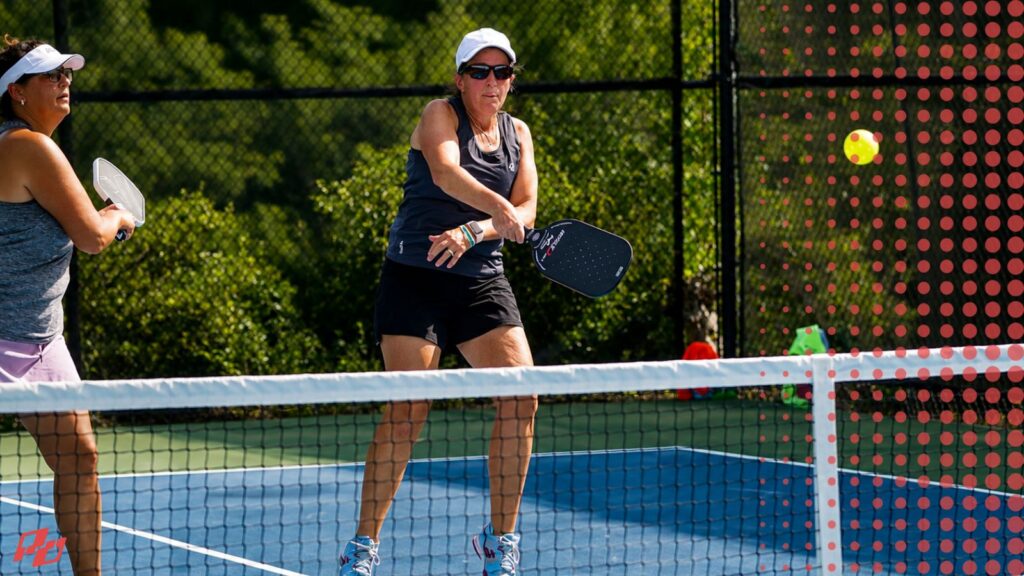
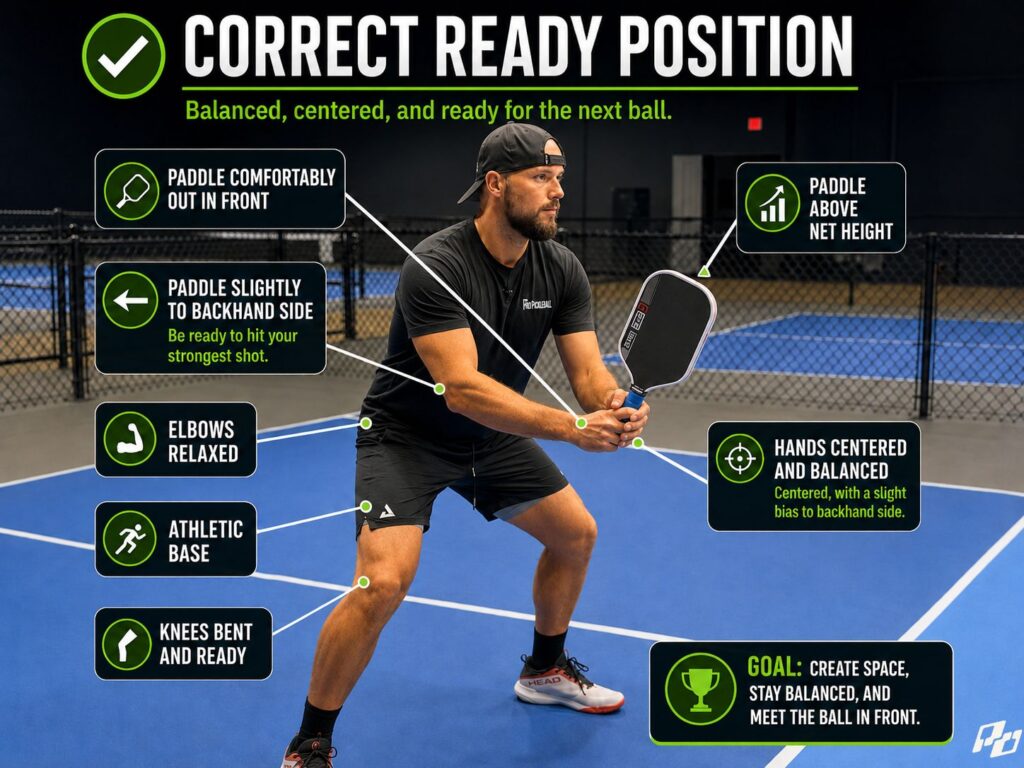
Your ready position should reduce that indecision. Keep the paddle:
- in front rather than against your chest
- roughly around lower-chest height
- close enough to move quickly
- neutral enough to access both forehand and backhand
There is no need to hold a full backhand guard across your entire torso. That can protect one lane while making another harder to reach. Coaching on body-shot defense generally favors a balanced ready position, slightly on the backhand, that preserves access to both sides.
The important part is space.
If your paddle is glued to your body, you have no room to intercept the ball.
Cue
Paddle in front, not on you.
Learn the Difference Between “At Me” and “Out”
Fear after being body-bagged often creates another expensive habit: You start swinging at everything near your torso. But some of the hardest speed-ups are going out.
If a ball is rising quickly toward your shoulders or head and the opponent contacted it from below net height, there is a good chance you do not need to touch it.
That is especially true when a player forces a speed-up from a low contact point. Balls below net height are difficult to attack effectively because the hitter has to send the ball upward to clear the net.
Practice deliberately letting these balls go.
Fear tells you:
“Defend yourself.”
Good recognition tells you:
“That ball cannot hurt me if I move my body and let it fly long.”
Learning to dodge intelligently is part of body-shot defense too.
After You Get Hit, Don’t Try to “Shake It Off”
This is where generic mental-game advice fails. Telling yourself “forget it” does not give your brain any new information.
Instead, run a short technical reset.
Step 1: Identify what actually happened
Was the ball:
- an unexpected speed-up?
- a high attack you should have anticipated?
- a ball that would have gone out?
- a paddle-position problem?
- simply a great shot?
Turn the event from “I got drilled” into something specific.
For example:
“I dropped my paddle after the dink and got jammed at the right hip.”
Now your brain has a solution instead of just a threat.
Step 2: Pick one protective cue
Not five.
Try:
“Paddle out front.”
or:
“Expect speed.”
or:
“Low contact—let it fly.”
This gives your attention somewhere useful to go on the next rally.
Step 3: Judge the next point by your response
Your goal is not immediately winning.
Your goal might simply be:
“If they speed up, I stay balanced and make one compact block.”
That is a much better confidence rebuild than trying to prove you are fearless by counterattacking the next ball at full speed.
Rebuild Confidence With Controlled Body Balls
Avoidance feels good immediately because you stop experiencing the threat. Unfortunately, it can make the situation feel even more dangerous the next time it happens.
Sports-injury literature suggests that gradual, controlled exposure to feared movements or situations can help athletes rebuild confidence rather than indefinitely avoiding them.
You can apply the same principle to pickleball without having your partner blast balls at your chest.
Start gently.
Level 1: predictable blocks
Stand at the kitchen while your partner feeds moderate-speed balls toward the body.
You know every ball is coming there. Your only job is a compact block.
Level 2: body or forehand
Your partner randomly chooses body or forehand.
Now you have to recognize the lane.
Level 3: dink or speed-up
Begin a cooperative dink rally. Your partner occasionally attacks at 50–60 percent pace.
Now you must read the attack rather than wait for it.
Level 4: live rally
Play normally, but score yourself separately:
- +1 for staying balanced against a speed-up;
- +1 for correctly letting an out ball go;
- +1 for a controlled block;
- no penalty for losing the rally afterward.
You are retraining your nervous system to associate body attacks with a response you know how to execute, not simply with getting hit.
Read the Attack Earlier Instead of Reacting Faster
Intermediate players often assume they need superhero reflexes. Usually, they need an earlier read.
Watch the opponent before contact. Common speed-up clues include:
✔️ The ball sitting higher
✔️ The opponent getting balanced behind it
✔️ Paddle acceleration increasing
✔️ The paddle face becoming more aggressive
✔️ The player taking the ball farther in front
A high, balanced contact should immediately move you into defensive readiness. A low, stretched contact should make you less worried about a clean body attack.
This is where confidence really starts returning. You stop thinking:
“I hope they don’t hit me.”
And start thinking:
“This ball is attackable. I’m ready.”
That is a completely different mental state.
Don’t Let Fear Change Your Dinking
This is one of the least obvious consequences of getting body-bagged. Players become so worried about the opponent’s next speed-up that their own dink quality gets worse.
They guide the ball.
They tighten the hand.
They leave dinks shorter and higher.
And then—ironically—they create more attackable balls.
The solution is not simply preparing better for speed. It is maintaining the shot quality that prevents good speed-ups in the first place.
If you are balanced, keep using:
- low dinks
- depth toward the feet
- inside-foot targets
- balls that force the opponent to contact below net height
The best body-shot defense often begins one shot before the body shot.
Use Equipment to Remove the Fear You Don’t Need
If you are genuinely worried about facial injury, use impact-resistant sports eyewear.
If your hands are consistently getting hit, look at your paddle position and whether your hands are too close to your torso during exchanges. But do not turn yourself into armor.
Heavy gloves, an exaggerated defensive stance, or constantly protecting your face with the paddle can interfere with movement and vision.
The goal is sensible protection plus better technique—not playing as though every point is dangerous.
What I’d Do After Getting Body-Bagged
If I took a hard shot and noticed myself getting tentative, I would not try to convince myself that getting hit does not matter.
It does matter. Nobody enjoys it.
I would give myself something more useful: proof that I know what to do next time.
I would check that I am physically okay. Then I would identify why the ball reached me, choose one defensive cue, and make the next rally about executing that cue—not proving anything to the opponent.
Later, I would drill body defense at controlled speed until the shot stopped feeling surprising.
That is the real way out of this fear.
You do not need to become comfortable with getting hit. You need to become comfortable with the fact that you have a plan when the ball comes at you.
Once that happens, the body bag stops feeling like something that could happen to you. It becomes another shot you know how to read, defend, or simply let go.