
Pickleball cliques happen when regular groups treat open play like a private court. Healthy open play has clear rotation, fair access, honest skill expectations, and welcoming regulars. Private games are fine, but they should be booked separately. Open play should feel open, not like players have to audition to belong.
Every open play has a version of it.
The same four players keep cycling together.
The “good court” somehow never has room.
New people stand around pretending not to notice they are being ignored.
Someone says, “We’re just trying to get competitive games,” which may be true — but still leaves everyone else feeling invisible.
That is the pickleball clique problem.
And yes, it is real.
Pickleball is famous for being social and welcoming, but open play can quietly become exclusive when the same players always protect their group, avoid rotation, stack paddles around newcomers, or make weaker players feel like they are interrupting “real” games.
The awkward part? Most of these players are not villains.
They just want good games.
But when that desire turns into gatekeeping, the court stops feeling like open play and starts feeling like middle school with paddles.
Why Cliques Form in Pickleball
Pickleball cliques usually form for understandable reasons.
Players want familiar partners. They want competitive games. They want rhythm. They want to avoid mismatched play. They may have waited months to find a good group and do not want every session disrupted by random pairings.
That part is human.
The problem is when private-group behavior takes over public or open-play space.
Open play is generally built around access, rotation, and mixing. Many etiquette guides describe paddle stacking or rack systems as the normal way players wait and rotate into games, with fairness depending on people respecting the order.
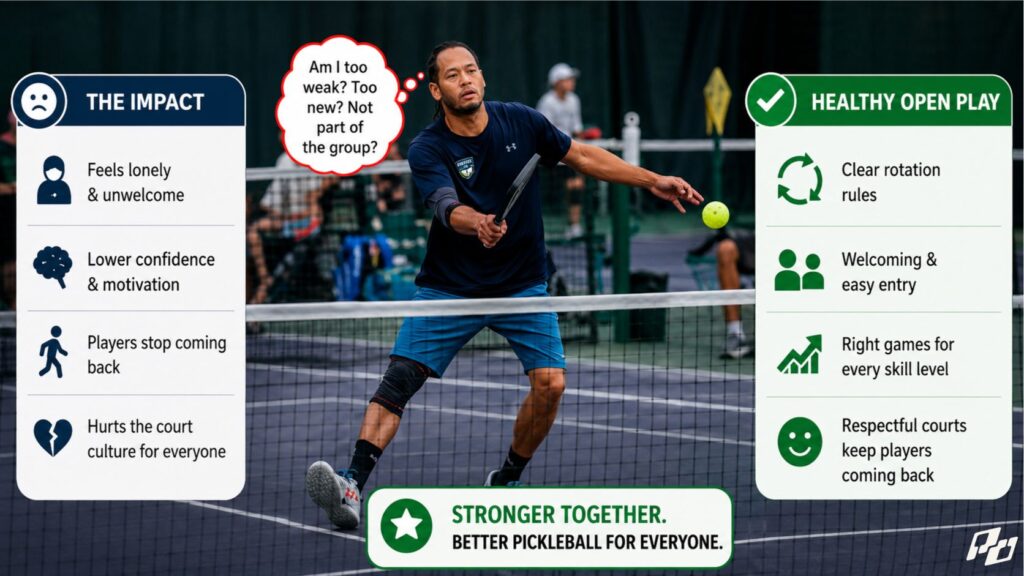
When a group ignores that system, the message is clear even if nobody says it: “This court is technically open, but not really for you.”
That is where the damage happens.
The Difference Between a Group and a Clique
Having a regular group is not the problem. A clique is different.
| Healthy Group | Pickleball Clique |
|---|---|
| Plays together but still rotates fairly | Protects the same four-player bubble |
| Welcomes new players when space allows | Makes newcomers feel like intruders |
| Communicates skill expectations clearly | Uses vague excuses to exclude people |
| Books private courts for private games | Treats open play like a private reservation |
| Helps the court culture feel better | Makes the court feel socially risky |
The difference is not whether people know each other. The difference is whether they make the space feel open or closed.
Why It Hits Rec Players So Hard
Being excluded from pickleball can feel surprisingly personal.
It is not just missing a game. It is standing there with your paddle, watching people avoid eye contact, wondering if you are too weak, too new, too old, too slow, too awkward, or simply not part of the right text thread.
That feeling matters.
Research on recreational sport consistently points to social connection and belonging as major benefits of participation. An updated systematic review found adult sport participation can support mental health and social outcomes, while research on social exclusion in experiential sports found exclusion increases loneliness and the need for social connection.
In plain English:
People do not come to open play only for exercise.
They come to belong somewhere.
So when a court feels closed off, it takes away one of the main reasons people play.
The “Good Games” Excuse
Let’s be honest: skill level matters.
Nobody enjoys every game being wildly mismatched. Stronger players need competitive reps. Newer players need room to improve. A 4.0 player does not need to spend every game feeding balls to a beginner, and a newer player should not be thrown into a game where everyone is annoyed by them.
But “we want good games” should not become a free pass to be rude.
There is a better way.
- Use skill-designated sessions.
- Book private courts.
- Run ladders or round robins.
- Create advanced open play with clear posted expectations.
- Rotate fairly within the format everyone agreed to.
If players want more controlled competition, that is completely fair. But the format should match the goal.
Open play should feel open: clear rotation, fair access, and room for people to mix in.
Private games should be private: booked courts, agreed-upon players, and no confusion about who is included.
Most court drama happens when players want the benefits of a private game while using the space and language of open play.
So if you want a private competitive environment, great. Just do not disguise it as open play.
What Healthy Open Play Actually Looks Like
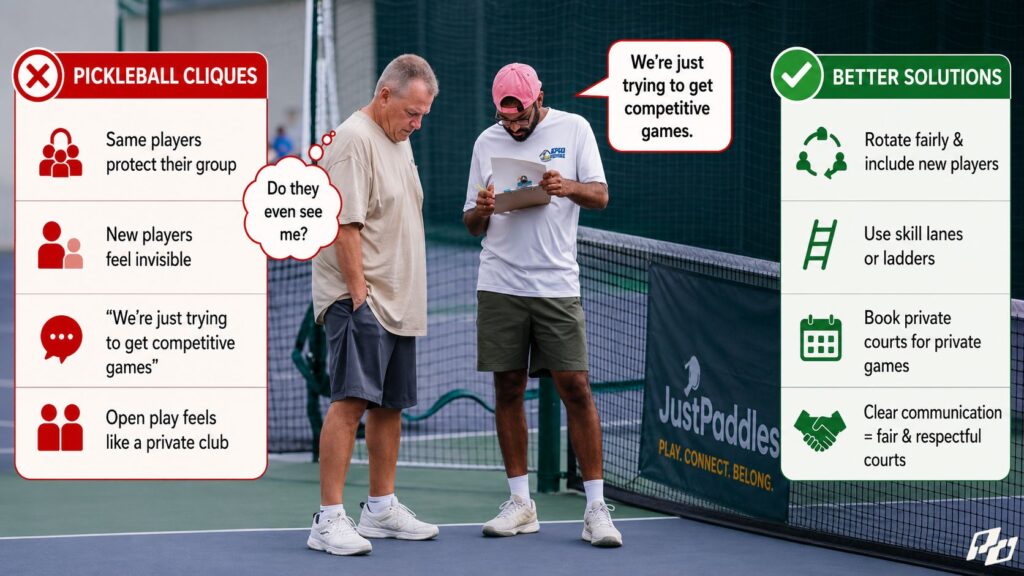
Healthy open play does not mean every game is perfectly equal. It means the system is clear and people are treated with basic respect.
A good court culture usually has:
⮕ Clear rotation rules.
Players know where to put paddles, how many games winners stay, and when everyone rotates.
⮕ Skill lanes when needed.
Beginner, intermediate, and advanced courts reduce awkward mismatches.
⮕ Friendly entry points.
New players can ask, “How does rotation work here?” without feeling stupid.
⮕ No silent gatekeeping.
If a game is private or pre-arranged, people say so clearly and kindly.
⮕ Mixing within reason.
Regulars still play with others sometimes, especially in true open play.
⮕ Leaders who set the tone.
One welcoming regular can change the entire feel of a court.
Open play etiquette sources repeatedly stress that fairness, paddle-stack order, rotation, and courtesy are what keep public and rec play functioning smoothly.
The rules matter. But the tone matters just as much.
If You’re the New Player: How to Break In Without Begging
New court? New group? Slightly intimidating vibe?
Here is the best approach. First, ask a practical question, not a social one:
“How does the rotation work here?”
That is easier than asking, “Can I play with you?” It also shows you respect the system.
Second, self-rate honestly without apologizing for existing:
“I’m around 3.5 and happy to rotate wherever it makes sense.”
That gives people useful information without making you sound insecure.
Third, become easy to play with.
Call the score clearly. Make fair line calls. Communicate middle balls. Do not coach strangers. Do not melt down after mistakes. Thank people after the game.
You do not need to be the best player to get invited back.
You need to be someone people trust on court.
If You’re a Regular: You Set the Weather
Regulars often underestimate how much power they have. If you are known at a court, your behavior tells newcomers what kind of place it is.
You do not have to play with everyone all day. But small gestures matter:
- Invite the waiting player into the next rotation.
- Explain the paddle stack.
- Say, “We’re doing one more private game, then we’ll open it up.”
- Split strong players so games are more balanced.
- Introduce the new person by name.
- Avoid making faces when someone misses.
That last one is bigger than people think.
A sigh can make a new player feel like they ruined the court.
A smile can make them come back.
What to Do When a Clique Won’t Let You In
Sometimes the healthiest move is not trying harder. Some groups are closed. Some courts are political. Some players are never going to be warm no matter how well you play.
Do not spend your entire pickleball life auditioning for people who make the game feel small.
⮕ Try another time slot.
⮕ Find a ladder.
⮕ Join a beginner/intermediate clinic.
⮕ Start your own foursome.
⮕ Ask a friendly player where the welcoming games are.
⮕ Use apps or local groups to find structured play.
⮕ Book a court with people you actually enjoy.
This is not quitting.
This is choosing a better room.
A good pickleball environment makes you want to improve. A bad one makes you feel like you have to earn the right to exist.
Big difference.
The Best Fix: Separate Open Play From Private Play
A lot of drama disappears when courts label the format clearly.
| Format | Best For | Key Rule |
|---|---|---|
| True open play | Mixing, meeting players, casual rotation | Respect the paddle stack |
| Skill-level open play | Better match quality | Post levels clearly |
| Ladder/round robin | Competitive but fair structure | Let the format decide pairings |
| Private foursome | Friends, drilling, serious games | Book a court; do not hijack open play |
| Challenge court | Winners stay, competitive reps | Make stay-on rules clear and limited |
One club guideline example limits winning partners to a maximum number of consecutive games when players are waiting, which helps balance competition with access.
That is the kind of structure that prevents social guessing. People can handle rules. What they hate is hidden rules.
Don’t Confuse Competitive With Exclusive
The best pickleball communities are not the ones where everyone plays with everyone all the time. That is unrealistic.
The best communities are the ones where people know what kind of game they are walking into.
Competitive games can be intense and still be respectful.
Advanced courts can have standards and still be clear.
Regular groups can enjoy each other and still not treat newcomers like obstacles.
The line is simple: Private games are fine. Fake-open games are the problem.
If you are a newer player, do not let one clique convince you pickleball is not for you.
If you are a strong regular, remember that someone once made room for you.
And if you are part of “the good court,” here is the real test:
When a new player walks up, do they feel like they found a place to play?
Or like they interrupted a meeting?
That answer tells you everything about the court culture.