
Screaming in pickleball isn’t automatically bad etiquette or a distraction. The key is timing and direction: celebrate toward yourself or your partner, not at opponents. If noise disrupts an opponent during play, it can cross into distraction. For rec players, the best rule is simple: bring energy without making the game about you.
Professional pickleball is arguing about screaming. A lot.
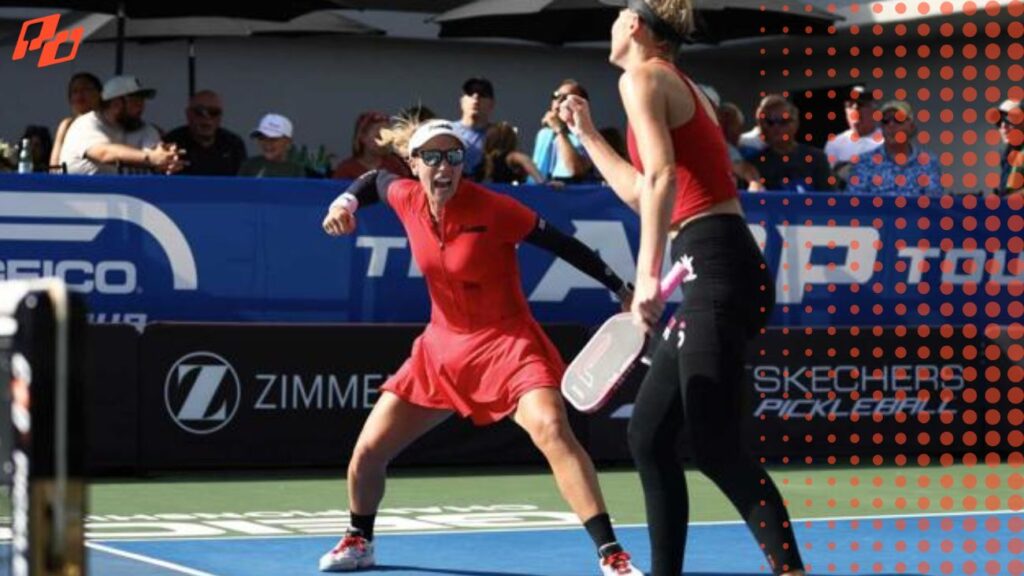
The debate intensified after Maria Ford, a rising PPA Tour singles player, repeatedly screamed after points during her October match against Genie Bouchard, the former Wimbledon finalist who now competes professionally in pickleball, at the PPA Chicago Cup. Bouchard was visibly irritated and skipped the post-match paddle tap.
@thekitchenpickleball Genie is usually very professional and friendly so Maria must have really gotten under her skin. 😒 @Carvana PPA Tour #pickleballhighlights #pickleballtournament #pickleballpro #pickleballplayers ♬ original sound – The Kitchen Pickleball
Soon after, pickleball columnist and analyst Jim Kloss proposed an anti-taunting rule. Zane Navratil, a longtime PPA pro, former top-three singles player, and multiple-time champion, pushed back publicly, arguing that emotion, screaming, and even controversy can help make professional pickleball worth watching.
Interesting debate.
But recreational pickleball has a different problem. You are not trying to grow television ratings. You are trying to play a competitive game Tuesday night without turning Court 3 into a hostage situation.
So I would not ask: “How loud is too loud?”
I would ask: “Where is the emotion going?”
That gives us a much better rec-player rule:
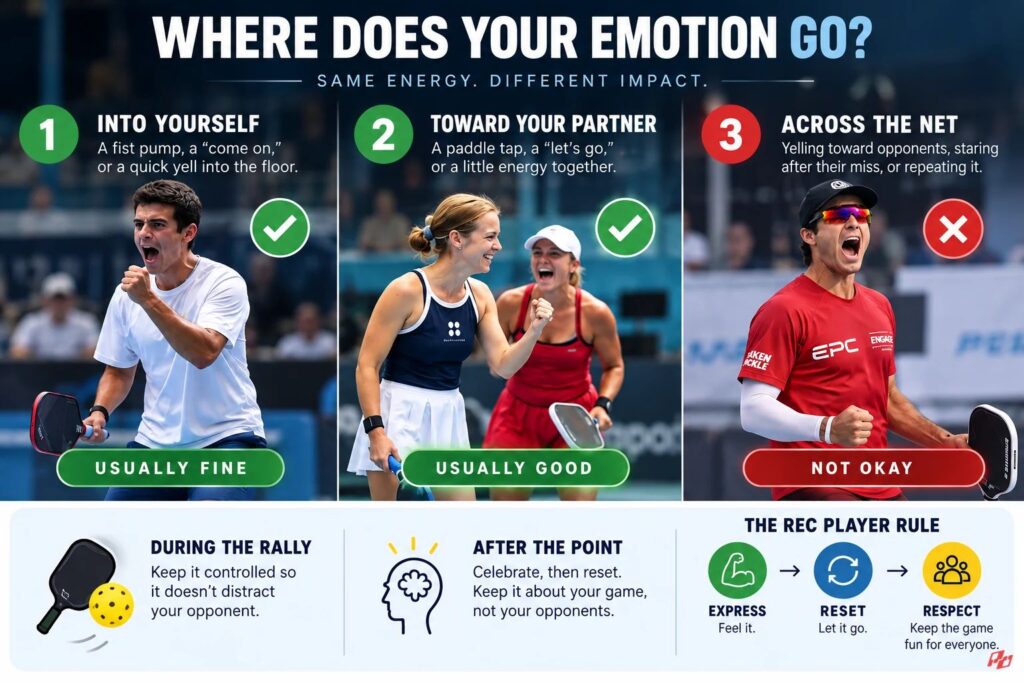
Celebrate in, not at
After you win a big point, there are roughly three places your emotion can go.
1. Into yourself.
A fist pump.
A “come on.”
A quick yell into the floor.
A breath and reset.
Usually fine.
2. Toward your partner.
Paddle tap.
“Let’s go.”
A little energy after a great rally.
Usually good.
3. Across the net.
Walking forward while yelling.
Staring at somebody after their miss.
Screaming directly toward them.
Repeating it because you can see it bothers them.
Now we have a different thing.
That is no longer just emotional release. It has become communication. And the message is being sent to your opponent.
That distinction—direction rather than volume—is probably the cleanest way recreational players can navigate this whole debate.
The pros are arguing about entertainment. You are not.
Navratil’s argument is basically that professional sports need personalities. Pickleball is competing for viewers, and he thinks controversy can help. He has even said players should be allowed to scream and taunt, leaving public reaction to sort out who went too far.
There is some logic to that if your job is entertainment.
Rec play does not work that way. Your Thursday-night 3.75 group does not become more successful because Rick develops a heel persona.
And unlike a professional event, open play depends heavily on informal cooperation.
You rotate together.
You share courts.
You make your own calls.
You see these people again next week.
That makes social friction a competitive variable.
You can technically win the point and still lose access to the games you actually want to play. That is why “the pros do it” is not a particularly useful standard for rec pickleball.
First, separate screaming after the point from noise during the point
This matters because the rules treat them differently.
We previously looked at grunting during strokes. A controlled exhale may help rhythm and relaxation, while loud or unusual noises made while an opponent is preparing to play the ball can drift into distraction territory.
USA Pickleball’s rules prohibit distracting an opponent who is about to play the ball, and loud noises are among the examples historically used in the distraction definition.
Professional UPA rules are even more explicit about keeping the threshold high: normal athletic sounds and emotional reactions can be loud without automatically becoming distractions. The key is whether the action actually prevents or alters the opponent’s opportunity to play the ball.
So keep two questions separate:
Noise during the rally:
Did it interfere with someone playing the ball?
Noise after the rally:
Was it celebration—or was it directed intimidation?
Those are different problems.
Your scream has a job
Here is the more useful technical question. What are you trying to accomplish by yelling?
Because emotional expression can serve several functions.
- It can release tension.
- It can bring your energy level up.
- It can reconnect you with your partner.
- It can mark the end of a stressful point.
- It can also provoke somebody.
Those effects should not be lumped together.
A 2026 study examining emotional regulation in pickleball found that players and coaches repeatedly described deep breathing, simple self-talk, and mentally resetting for the next point as strategies for controlling emotion during competition.
Christian Alshon, one of the top men’s players on the PPA Tour and a multiple-time professional champion, gives similar practical advice: after a lost point, take a little time, breathe, get neutral, and deliberately reset before playing again.
Notice what neither approach requires. A performance. That leads to a useful test: does the celebration leave you more ready for the next point?
If yes, it is probably doing useful work.
If you yell, turn around, breathe, reconnect with your partner, and feel settled? Fine.
If you yell, keep staring across the net, replay the confrontation in your head, and start serving before your heart rate and attention have come back down?
Your celebration just became self-sabotage.
More emotion does not automatically create more momentum
This is where the screaming debate gets interesting. Players often behave as though a huge celebration creates momentum by itself.
The evidence is not that simple.
Research in table tennis found that visible positive and negative emotional reactions did not independently predict whether the player won the next point.
Other team-sport research suggests celebrations and teammate interaction can matter in certain contexts, but the relationship depends heavily on what was already happening in the match; simply displaying more emotion was not automatically associated with better subsequent performance.
So this idea: “I need to scream to keep momentum going” is probably too simplistic.
Sometimes emotional energy helps. Sometimes it pushes you past your useful arousal level. And sometimes the best way to protect momentum is actually to get boring again.
Try the 5-second test
This is the rec-player version I would use.
After a big rally, celebrate. Then give yourself about five seconds to answer: am I ready to solve the next ball?
Not admire the last one.
Not punish the person across from me.
Solve the next one.
That might mean:
- paddle tap
- one breath
- one tactical cue
- serve
For example: “Good pressure. Next one, middle.”
That is productive emotion.
Compare it with: “LET’S GOOOOOO!” followed by ten seconds of staring at the opponent.
Same energy.
Completely different usefulness.
When yelling actually helps
There are moments where a little emotional spike makes sense.
You just survived a 25-shot rally.
You finally broke a six-point run.
Your partner has been flat and you need to wake the team up.
You hit a huge defensive get and turn the point around.
You are closing out a tournament game and tension has been building for ten minutes.
A short celebration can release that pressure.
And in doubles, positive energy can clearly be social. It tells your partner: we’re still here.
But the celebration should end before the next point begins psychologically.
When screaming becomes strategically stupid
Forget etiquette for a second. There are times when screaming is simply bad competitive management.
1. When you are already overamped
Some players play worse when they get too excited.
The backswing grows.
The speed-ups get reckless.
They rush the serve.
The hands tighten.
If you already feel like you’re playing at 9/10 emotionally, you probably do not need to scream yourself to 11.
You need to get back to 7.
2. When your partner hates it
Your emotional style is not automatically your partner’s emotional style. One player gets energized by yelling. Another finds it embarrassing or stressful.
In doubles, your emotional regulation is partly shared. The recent pickleball research specifically emphasizes that players regulate emotion not only individually but through interaction with their partner.
So before deciding your team needs more fire, notice whether your partner actually plays better with it.
3. When you are celebrating the opponent’s mistake
This is probably the quickest way to cross the rec-play line.
Huge rally?
Celebrate.
Great passing shot?
Celebrate.
Opponent dumps an easy return into the net and you scream while staring at them? Now the emotion feels less like joy and more like punishment.
That changes the social temperature immediately.
The best players often change gears
Competitive emotion does not need to stay at one setting for an entire game. Think of it like a throttle.
3/10: Normal points, routine side-out, early game.
6/10: Important rally, comeback beginning, partner needs energy.
8/10: Huge defensive point, 9-9 battle, tournament pressure.
You do not need 8/10 after every dink into the net.
That is where screaming starts to lose meaning anyway. If everything deserves a primal roar, nothing does.
What if the opponent is screaming and it is getting to you?
Do not counter-scream unless that is genuinely your personality.
A Reddit discussion from tournament players dealing with exactly this issue produced a recurring piece of advice: treat the next point as a reset and do not give the opponent feedback that their behavior is affecting you. That is good competitive advice.
Use a physical routine.
Turn away.
Touch your paddle.
One slow exhale.
Pick one target.
Then turn back.
You are giving your brain somewhere else to go.
If the yelling happens during live play and genuinely interferes with your ability to hit the ball, that is a rules issue.
If it happens after every point and is simply obnoxious, it is usually a social issue first.
And in rec play, social problems are often better handled with one calm sentence than a rulebook argument.
Try: “Hey, the yelling toward us is getting a little intense. Can we keep the celebrations on our own sides?”
Notice the wording.
Not: “Stop celebrating.”
Instead: “Celebrate over there.”
That is the entire idea.
The rec-play standard I would use
Do not measure screaming by volume. Measure it by timing, direction, and recovery.
| Ask | Usually Fine | Starting to Cross the Line |
|---|---|---|
| When? | After the rally | While opponent is preparing or hitting |
| Where? | Toward yourself, partner, sideline | Directly toward opponent |
| Why? | Release tension, team energy | Provoke, intimidate, punish |
| How often? | Big points or emotional moments | Nearly every routine point |
| What happens next? | Reset and play | Continue staring, arguing, escalating |
That gives you a much better standard than: “Was that scream too loud?”
One final distinction
Pickleball does not need to become silent. The current pro debate is right about that much.
Emotion is good.
Rivalries can be fun.
Rec games do not need tennis-library etiquette.
But there is a difference between bringing energy to the court and putting energy onto another person.
That is the boundary I would teach.
So celebrate the ATP.
Yell after the 30-shot rally.
Fire up your partner.
Pump your fist.
Have a personality.
Then turn around, breathe, and play the next point.
Celebrate in. Don’t celebrate at.
That rule is simple enough for rec pickleball—and probably better than trying to decide whether somebody’s scream was three decibels too loud.