Pickleball shoe wear patterns can reveal how you move on court. Toe wear may mean late reaching, outer-edge wear can show hard lateral braking, and one shoe wearing faster may reveal imbalance or overuse. Check your soles before replacing shoes so you can fix footwork habits before they become pain or injury.
Your shoes are giving you a scouting report.
Not a perfect medical diagnosis. Not a full gait analysis. But a useful clue about how you move, stop, push, drag, and recover on court.
And if one side of your pickleball shoes is wearing out way faster than the other, it usually means one of two things:
Your movement pattern is lopsided.
Or your shoes are no longer supporting the way you actually play.
Both matter.
Pickleball asks your feet to do a lot of short, sharp work: lateral shuffles, split steps, pivots, lunges, sudden stops, and quick recovery steps. Sports medicine sources consistently point to controlled lower-body movement, balance, and proper court footwear as key pieces of safer pickleball movement.
So before you toss those worn shoes in the garage, flip them over. They may be telling you exactly where your footwork is leaking.
First: Shoe Wear Is a Clue, Not a Diagnosis
A worn outsole can show repeated pressure patterns, but do not overread it. Shoe wear can be affected by:
- your court surface
- shoe quality
- how often you play
- your dominant side
- your foot type
- old injuries
- whether you drag, pivot, or slide
- how you brake and recover
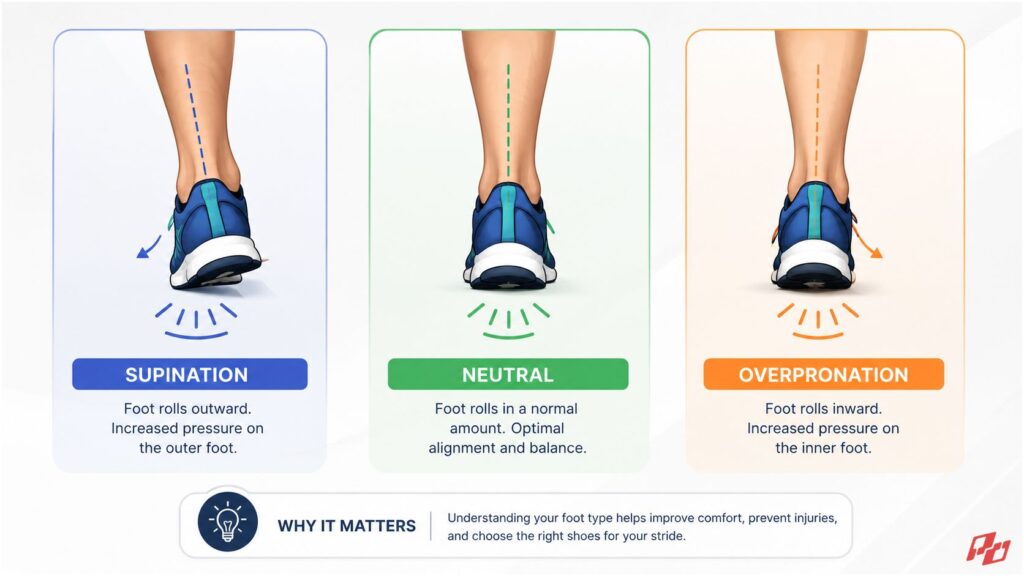
Outer-edge wear may suggest more pressure on the lateral side of the foot, often associated with supination or underpronation in walking/running contexts, while inner-edge wear can suggest more inward rolling. But pickleball is not straight-line walking. It is side-to-side court movement, so the sport itself creates different wear patterns.
The best way to use shoe wear is simple:
Do not ask, “What is wrong with my feet?”
Ask, “What movement do I keep repeating?”
That question is more useful for rec players.
The Shoe Wear Map
| Where the Shoe Wears Fast | What It May Be Telling You |
|---|---|
| Outer edge of one shoe | You load, brake, or push hard off that side repeatedly |
| Inside edge near big toe | You may be collapsing inward or over-pushing from one foot |
| Toe box / front outsole | You drag the toe, reach late, or stop with the paddle instead of feet |
| Heel outside edge | You may be landing heavy or arriving upright |
| Ball of foot only | You play on your toes but may not fully recover or distribute pressure |
| One shoe much worse than the other | Your movement pattern is asymmetrical, often tied to handedness or favorite shot patterns |
Again, this is not a medical report. It is a movement mirror.
Pattern 1: Outer-Edge Wear Means You May Be Living on Your Outside Brake
Outer-edge wear is common in court sports because players push, cut, and brake laterally. But if the outer edge of one shoe is shredded much faster than the other, look at your recovery footwork.
This often shows up in players who:
- load hard into one outside leg
- reach wide instead of taking an extra adjustment step
- push off the same foot after every dink
- plant late on wide balls
- overuse a crossover instead of shuffling back to balance
That outside edge becomes your emergency brake.
The problem is not that you use the outside leg. You should. The problem is when every wide ball becomes a hard plant instead of a controlled load and recovery.
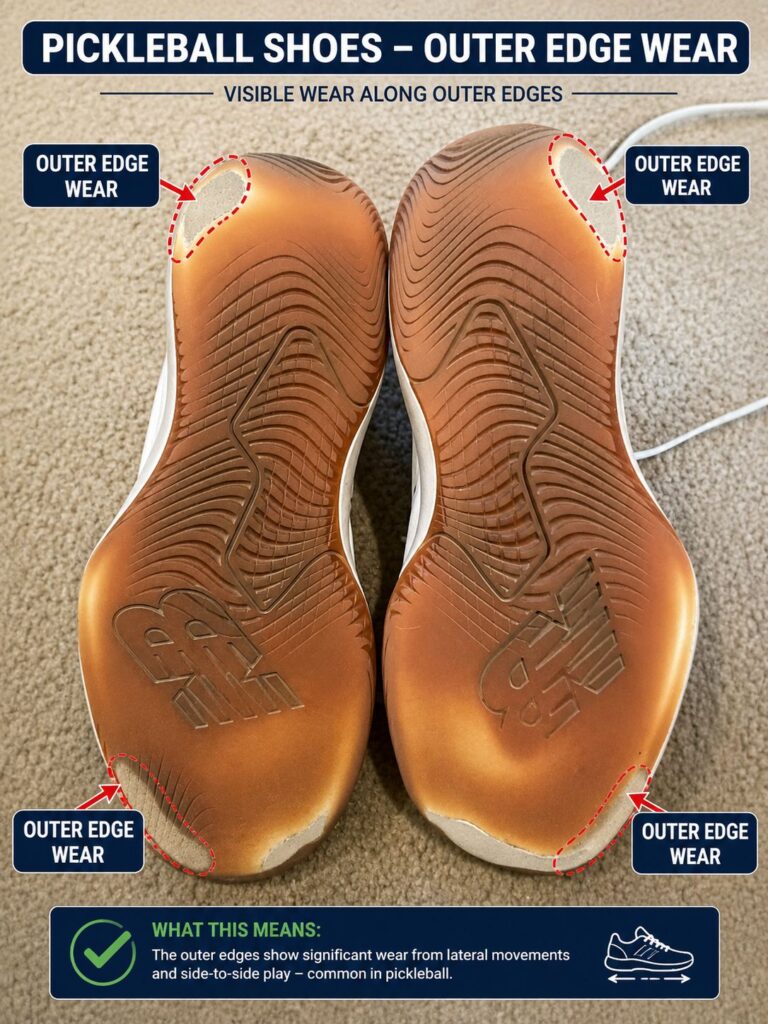
Why it matters: repeated hard lateral plants can stress the ankle, knee, hip, and Achilles. Foot and ankle specialists regularly warn that pickleball’s quick lateral movements and pivots can raise ankle/foot injury risk when players lack stability or proper footwear.
On-court fix: after a wide dink, notice whether you are pushing back to center or just falling into the next shot.
Cue: “Load, don’t crash.”
A good outside-leg load should feel like a small spring. You load into it, play the ball, then push back toward balance. That push does not have to be dramatic. It just has to happen soon enough that you are not stuck watching the next ball.
If the outside of your shoe is disappearing, your foot may be telling you that your wide-ball movement is too violent.
Pattern 2: Toe Drag Means You’re Late More Often Than You Think
Toe wear is one of the most useful clues for pickleball players. A little toe scuffing is normal. Constant toe grinding is different.
Heavy wear at the front of the shoe often means you are reaching late, lunging forward, or dragging the back foot after contact. This is especially common on:
- third-shot drops
- transition resets
- low dinks
- wide kitchen balls
- balls you should have moved to earlier
The real issue is usually not the toe. It is timing. If your feet arrive late, your toe becomes the thing that catches you. You stretch, scrape, stab, and hope.
Pickleball coaches often emphasize “move first, hit second” because shot quality and injury risk both get worse when players reach instead of getting their body organized first.
On-court fix: after low balls, ask: did my back foot drag because I was balanced, or because I was late?
Cue: “Step before stretch.”
If the toe is wearing out fast, your shoes may be saying: stop making your leg do what your first step should have done.
Pattern 3: Inside-Edge Wear May Show Collapse Under Pressure
Inside-edge wear near the big toe or arch can happen for many reasons, including natural gait, shoe structure, and pronation tendencies.
On the pickleball court, it can also show up when players collapse inward during stops and lunges.
Watch for this on:
- split steps
- side-to-side dink movement
- push-offs toward the kitchen
- deceleration after chasing a lob
- wide forehand or backhand recoveries
If the knee drops inward as the foot loads, the inside edge takes more stress. That can make balance worse and may contribute to knee, ankle, or plantar fascia irritation over time.
On-court fix: during warmups, do a few side shuffles and stop. Look down. Is your knee stacked roughly over your toes, or diving inward?
Cue: “Knee tracks where the toes point.”
This is not about perfect biomechanics. It is about avoiding sloppy collapse when the point gets fast.
Pattern 4: One Shoe Wearing Faster Often Means Your Game Is One-Sided
This one is sneaky. If your right shoe wears down much faster than your left, or the reverse, do not only blame the shoe.
Ask how you play.
Do you always push from the same leg after dinks?
Do you run around your backhand?
Do you favor one side in doubles?
Do you pivot the same way on every return?
Do you drag one toe on your reset step?
Do you always brake on the same foot after attacking?
Pickleball is full of repeated habits. Your shoes collect the receipts.
A right-handed player who runs around backhands may beat up one outsole. A player who gets pulled wide on the same side in crosscourt dinks may wear one lateral edge. A player who always plants on the same foot before driving may grind one forefoot.
On-court fix: film one game from behind. Compare the shoe wear to your movement habits. You will probably see the pattern in five minutes.
Cue: “The worn shoe is the overworked foot.”
Not always. But often enough to check.
Pattern 5: Smooth Bald Spots Mean Your Traction Is Gone
Sometimes the wear pattern is not telling you about technique. It is telling you the shoe is done.
If the outsole is bald under the ball of the foot, outer edge, or toe, your shoe may no longer grip well during lateral cuts. Do not wait until you slip.
Replace shoes when:
- the tread is smooth in high-pressure areas
- one side of the sole is compressed or tilted
- your foot slides inside the shoe
- you feel less stable on wide balls
- your knees, arches, or ankles feel worse after play
- you are suddenly “late” on movements you used to make
A shoe can look fine from the top and be dead underneath.
Cue: “If the sole is gone, the support is gone.”
The 60-Second Shoe-Wear Test
If you play often, do this once a month. Put both shoes on a table, soles up, and check:
1. Left vs. right
Are they wearing evenly, or is one shoe getting destroyed faster? Uneven wear can point to one-sided habits.
2. Toe area
Heavy toe wear usually means late reaching, dragging, or repeated lunging.
3. Outer edges
Worn outer edges often mean hard cutting, braking, or loading wide.
4. Ball of the foot
Bald spots here mean your push-off zone is losing grip.
5. Heel/midsole from behind
If one shoe is leaning, compressed, or tilted, it may be changing how you land.
That’s it. Sixty seconds.
And it may save you weeks of playing in shoes that are quietly making your movement worse.
What Coaches Would Tell You to Fix First
Do not start with a big footwork overhaul. Start with the movement habit that matches the wear.
| Wear Pattern | First Movement Fix |
|---|---|
| Toe drag | Split earlier and move before reaching |
| Outer edge shredded | Load wider balls with control and push back to balance |
| Inside edge worn | Keep knee tracking over toes on stops and lunges |
| One shoe worse | Film your movement and identify your repeated plant/push foot |
| Forefoot bald | Replace shoes before grip loss affects stops and pivots |
| Heel heavy | Stay lower and avoid arriving upright into stops |
The goal is not perfect footwork. The goal is less panic movement.
When Shoe Wear Means You Should Get Help
If your shoes wear unevenly and you also have recurring pain, do not just keep drilling. Get checked by a physical therapist, podiatrist, or sports medicine professional if you notice:
- repeated ankle rolls
- Achilles pain
- plantar fasciitis symptoms
- knee pain on one side
- hip pain after play
- numbness, tingling, or sharp pain
- one shoe collapsing dramatically faster than the other
Shoe wear is useful, but pain plus uneven wear is a stronger signal that you may need professional assessment.
Before You Buy New Shoes, Do This First
Here’s a habit worth stealing from better players. Every time you replace your pickleball shoes, don’t throw the old pair away immediately.
Put the old shoes next to the new ones and spend one minute looking at the soles.
Ask yourself: Why did they wear out like this?
- Did I drag my toe?
- Did I always push off my right foot?
- Did I keep crashing onto my outside edge?
- Did one shoe do almost all the work?
Most players never ask those questions. They simply buy another pair… and repeat the same movement pattern for another six months.
Your shoes aren’t just wearing out.
They’re collecting data.
If you learn to read that data, you can often spot bad habits before they become sore knees, tight Achilles tendons, or another frustrating injury.
The goal isn’t perfectly even shoe wear.
Every player has natural asymmetries.
The goal is making sure your shoes wear out because you played a lot—not because one movement flaw quietly took over your game.
That’s a much better reason to buy your next pair.