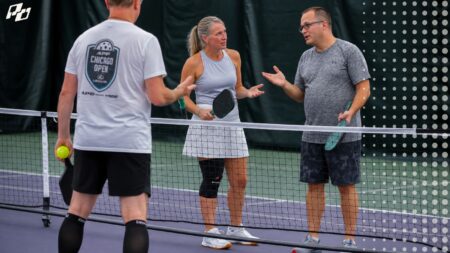

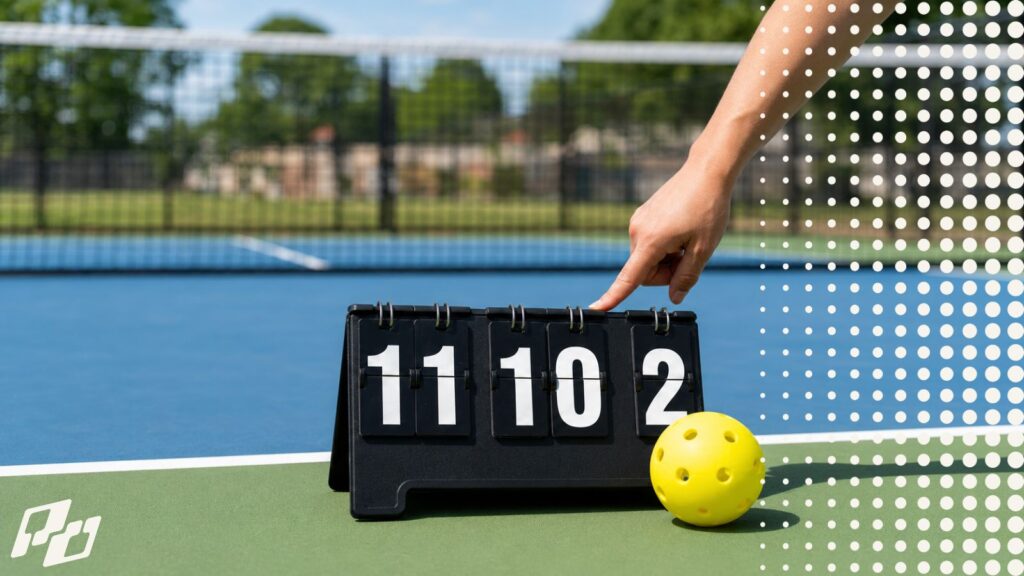
To remember the pickleball score, connect it to something meaningful: the previous rally, your court position, a pre-serve routine, the game’s momentum, or the lesson from the last point. These mental anchors reduce the strain on working memory and make it easier to recover the score after long or intense rallies.
If you’ve ever stood at the baseline wondering whether it’s 6-4-1 or 5-4-2, you’re not alone.
For many recreational players, remembering the score is surprisingly difficult. That’s not because they’re distracted or don’t care—it’s because pickleball demands a lot from your brain. You’re reading paddle angles, deciding whether to reset or attack, tracking your opponents’ positions, moving your feet, and planning your next shot.
Psychologists call this working memory—the brain’s short-term mental workspace. Research has shown that working memory can only hold a small amount of information at once. As the game speeds up, something often gets pushed out, and for many players, that’s the score.
The good news?
You don’t need a better memory.
You just need better memory anchors.
Instead of trying to memorize three numbers, attach the score to something your brain already remembers.
Here are five techniques that work surprisingly well.
1. Remember the Last Point—Not the Score
Most players try to remember three numbers. That’s hard. Instead, remember why the score changed.
Tell yourself something like:
“We won because my third-shot drop forced a pop-up.”
Or:
“They scored because I rushed a speed-up.”
Our brains naturally remember stories and events better than isolated numbers because they’re connected to meaning.
When the next point starts, the score becomes attached to the previous rally instead of floating around by itself.
Cue
No story = no score.
2. Turn the Score Into Court Position
This is one of the best tricks experienced players use. Instead of remembering 7-5-1, remember where everyone should be standing.
Every point changes someone’s position.
Before every serve or return, quickly ask yourself:
“Am I supposed to be on this side?”
If something feels off, you’ll often realize the score is off too.
This works because your brain generally remembers spatial information better than random numbers. You’re giving yourself another way to reconstruct the score instead of relying on pure recall.
Cue
Know your side before you know the score.
3. Build a “Score Check” Into Your Pre-Serve Routine
Elite athletes rely heavily on routines—not because they’re superstitious, but because routines reduce mental errors.
If your serving routine is:
- Bounce the ball.
- Take a breath.
- Pick your target.
Add one more step: check the score.
Eventually, your brain begins to expect that information before every serve, making it much harder to forget.
It takes less than a second, but it creates a reliable habit instead of hoping you’ll remember later.
Cue
Bounce. Breathe. Score. Serve.
4. Remember the Momentum, Not Every Point
Trying to remember fifteen individual points is difficult. Remembering the flow of the game is much easier.
For example:
We started down 0-3.
Then we won four straight.
They answered with two.
Suddenly, rebuilding the score becomes simple.
Sports psychologists often describe this as chunking—grouping several pieces of information into one meaningful unit. It’s the same reason it’s easier to remember a phone number in chunks than as ten separate digits.
Think of the game in runs, not individual points.
Cue
Think in runs, not points.
5. Give Every Point a Job
This is the least obvious trick—and arguably the most useful. Instead of treating every rally as just another point, give each one a purpose.
Ask yourself:
- Did our return stay deep?
- Did we reach the kitchen together?
- Did they beat us with speed-ups?
- Did our middle attack work?
Now the score isn’t just a number. It’s feedback.
If you lose three points because your opponents keep attacking your backhand, those three points become one memorable pattern.
Many high-level coaches encourage players to evaluate trends during matches rather than obsess over individual winners and errors. Ironically, thinking this way often makes the score easier to remember because every point now belongs to a larger story.
Cue
Every point teaches something. Remember the lesson, and the score usually follows.
One Bonus Habit
If you’re serving, don’t mumble the score. Say it loudly enough that all four players hear it.
Not because it’s polite. Because every player hearing the same score gives the court one final opportunity to catch a mistake before the rally begins.
That simple habit eliminates countless “What was the score?” conversations before they ever happen.
What Finally Helped Me Remember the Score
I don’t think most players lose the score because they’re careless. Usually, it’s the opposite. They’re so focused on the rally, their positioning, and the next decision that the numbers simply disappear.
That’s why the answer isn’t to “try harder” to remember. Give the score somewhere to live.
Attach it to the last rally, your court position, your pre-serve routine, the run of points, or the lesson from the previous exchange. Once the score is connected to something meaningful, it becomes much easier to recover.
You may still blank occasionally. Everyone does.
But you’ll spend less time standing around asking, “Wait, what’s the score?” and more time ready for the next ball.