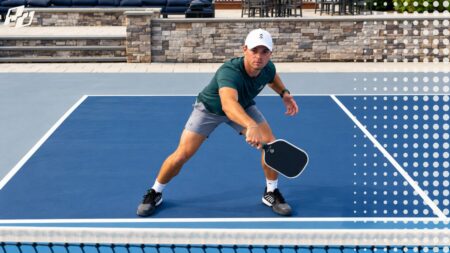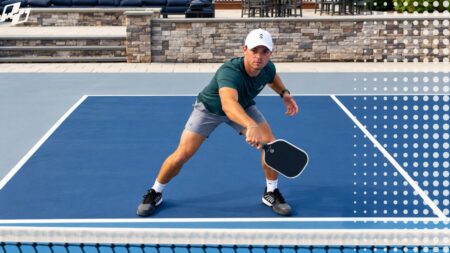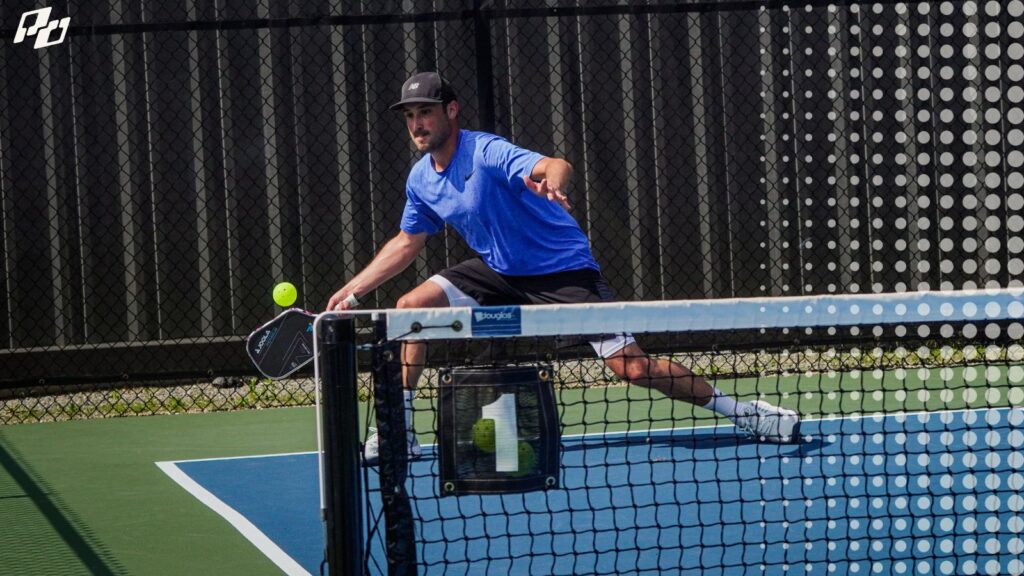
For a more powerful, consistent pickleball forehand drive, keep your chest connected to the ball and rotate through your core and torso. Your off-hand helps control spacing, while your body creates the power. The result is cleaner contact, easier pace, and a drive you can repeat under pressure.
A lot of beginner players try to hit a harder forehand by swinging their arm faster. That usually gives them exactly what they don’t want:
more effort,
less control,
and a drive that feels great once… then disappears for three shots.
The more reliable answer is built around two simple things:
1. Keep your chest connected to the ball instead of flying open early.
2. Generate the drive with your torso and core, not your arm.
Those two pieces work together.
The first gives you clean, repeatable contact.
The second gives you easy power.
Put them together and your forehand starts feeling less like a timing gamble and more like the same swing showing up over and over.
Fix No. 1: Keep Your Chest With the Ball
One of the most common 3.0–3.5 mistakes is opening the chest too early.
The ball comes.
You rotate.
But instead of staying connected to the contact point, your chest pulls away before the paddle gets there.
Now the arm has to chase the ball. That’s when you get:
- late contact
- pulled drives
- weak contact
- inconsistent spin
- shots that feel completely different from one swing to the next
The easy fix is to use your off-hand.
As the ball approaches, bring your non-dominant hand toward the incoming ball. Think of it almost like you’re measuring the contact point.
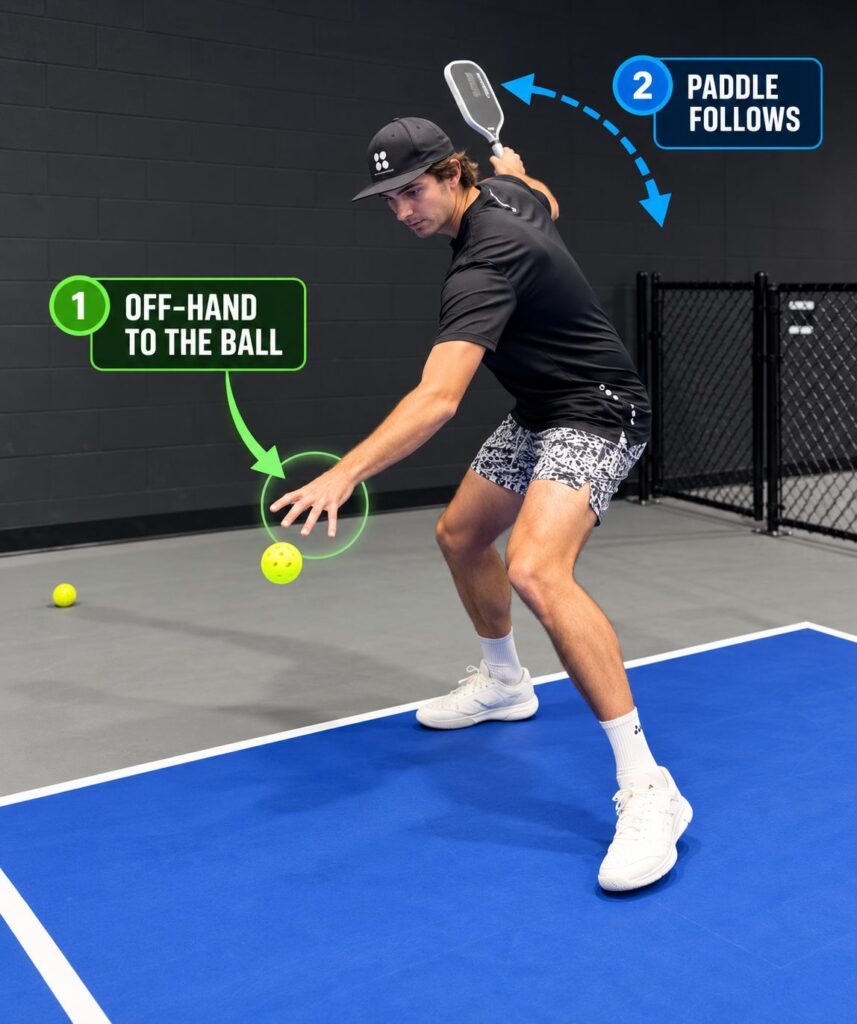
That does two useful things:
It helps keep your chest from opening too early.
And it helps you create the same spacing every time.
Cue:
“Off-hand to the ball. Paddle follows.”
That is what makes the drive more repeatable. You are giving your body a consistent reference for where contact should happen.
Fix No. 2: Let Your Body Create the Power
Once the spacing is right, the second job is power. And this is where rec players often work way too hard. The arm should not be the engine.
Your legs, hips, core, and torso start the movement. The arm delivers the paddle through the ball.
Think: body drives → arm delivers
not: arm swings → body follows
A good drive transfers energy through the body: ground → legs → hips → torso → arm → paddle
When that sequence works, you can hit a heavy ball without feeling like you’re swinging at 100%.
A while ago, we filmed a video with coach and pro player Will East, who shared three great tips for hitting more powerful, consistent drives—including how to use your legs to generate power that flows through your torso and into the shot:
And because the power comes from the same large body movements each time, it becomes much easier to reproduce under pressure.
That’s the real benefit: More power with less effort—and less variation from swing to swing.
Why These Two Fixes Belong Together
You can rotate your body perfectly… but if your chest has already flown away from the ball, the contact will still be inconsistent.
And you can keep beautiful spacing… but if you only swing with your arm, you’ll leave a lot of power on the table.
You need both.
Chest stays with the ball = reliable contact.
Core and torso drive the swing = reliable power.
That is the combination beginner to intermediate players should chase.
Not the biggest swing.
Not the fastest arm.
A drive you can hit the same way ten times in a row.
The Simple Sequence
For a right-handed forehand:
1. Move into position.
Don’t reach for the ball.
2. Turn your shoulders.
Compact preparation—no giant backswing.
3. Bring your left hand toward the ball.
Use it to judge spacing and keep your chest connected.
4. Load into the legs and hips.
5. Rotate through your core and torso.
6. Let the arm and paddle come through naturally.
7. Open the chest fully after contact.
The order matters.
You don’t want: open chest → chase ball with arm
You want: find ball → rotate through ball → finish
Cue:
“Find it. Turn through it.”
That’s probably the simplest version of the entire article.
Why This Makes the Drive More Consistent
Consistency isn’t just about repeating the same arm swing. It’s about recreating the same relationship between your body and the ball.
If the ball is always in roughly the same hitting lane…
and your chest stays connected to that lane…
and your torso provides the acceleration…
your paddle arrives at contact much more predictably. That means more consistent:
contact point
paddle angle
swing path
spin
pace
And that is why these mechanics can improve power and control at the same time, rather than forcing you to choose between them.
The Drill
Drop-feed yourself 10 forehands at about 60% power. For every ball, exaggerate two things:
Off-hand toward the ball.
Torso rotates through contact.
Don’t care how hard the ball goes. Care whether the contact feels the same.
Then have a partner feed you 10 moving balls. Your goal is to recreate the exact same relationship.
The feet adjust.
The swing stays recognizable.
If you start swinging harder with the arm as the feed gets difficult, reset.
That’s the habit you’re trying to remove.
The Takeaway
If you want a forehand drive that is powerful once, swing harder. If you want one that is powerful over and over, build it around these two things:
Keep your chest connected to the ball.
Let your torso and core create the power.
One gives you the contact.
The other gives you the speed.
Together, they give you the thing intermediate players actually need: a forehand drive you can trust.