
The most consistent way to create topspin in pickleball is to use a low-to-high swing path, starting the paddle below the ball and finishing near the shoulder. Keep the wrist quiet, let the forearm rotate naturally, and brush up the back of the ball instead of scooping underneath it.
If you’ve been trying to add topspin to your pickleball game, you’ve probably heard advice like:
- “Snap your wrist.”
- “Brush up on the ball.”
- “Finish high.”
None of those are completely wrong.
The problem is that they’re often taught in isolation.
Coach Jordan Briones recently described three ways to create topspin: using the wrist, using forearm pronation (the “windshield wiper” motion), and swinging from low to high. His main point is an important one—the more your topspin comes from your overall swing mechanics rather than your wrist, the more consistent it becomes.
After comparing that advice with instruction from other leading coaches, one clear pattern emerged: the best players don’t try to create spin. They create a swing path that naturally produces spin.
Here’s what recreational players should really focus on.
The 3 Ways to Create Topspin (From Least to Most Consistent)
Every topspin shot uses some combination of these movements. The difference is which movement you’re relying on most.
1. Wrist Flick (Least Consistent)
This is where many recreational players start. Just before contact they quickly snap the wrist upward, hoping to brush the back of the ball.
Sometimes it works.
Just as often, the ball ends up in the net or sails long.
The reason is simple.
The wrist is a very small joint. Even a tiny movement changes the paddle face dramatically, making it difficult to repeat under pressure.
That’s why you’ll rarely see high-level players consciously trying to create topspin with a wrist snap.
Cue
The wrist should stay relaxed—not become the engine of the swing.
2. Forearm Pronation (More Consistent)
A better source of topspin is forearm rotation. As your arm extends through contact, your forearm naturally rotates so the paddle finishes in a windshield-wiper motion.
Many players mistake this for a wrist flick because it happens so quickly. It isn’t.
The wrist stays relatively quiet while the forearm rotates. This creates a much more repeatable paddle path.
Cue
Rotate the forearm. Don’t snap the wrist.
3. Low-to-High Swing (Most Consistent)
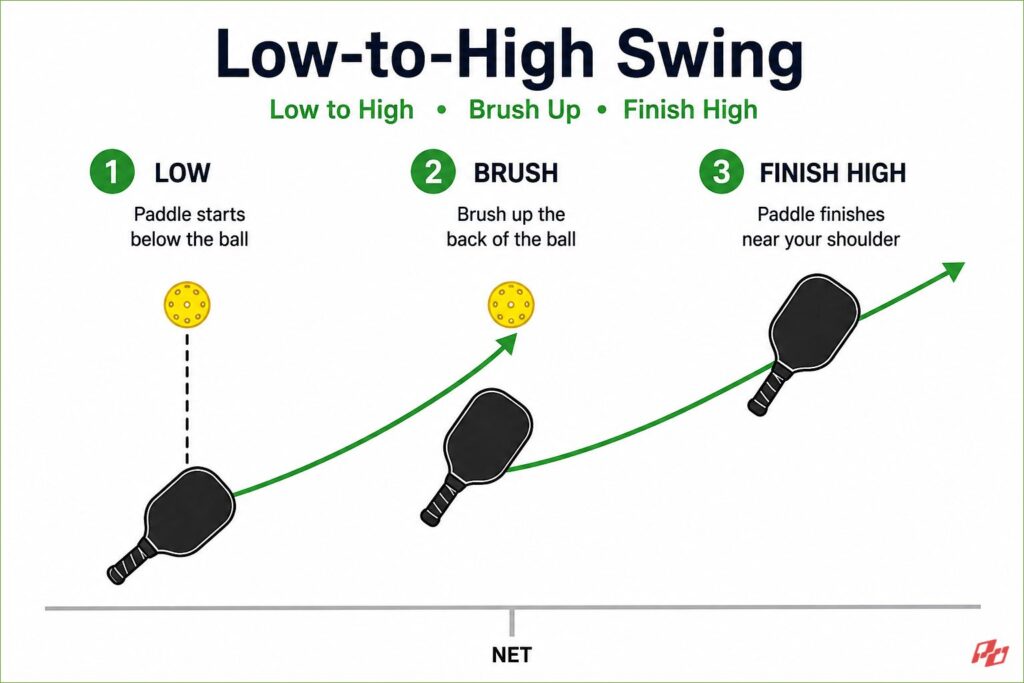
This is where consistent topspin really comes from. Instead of thinking about spinning the ball, think about creating an upward swing.
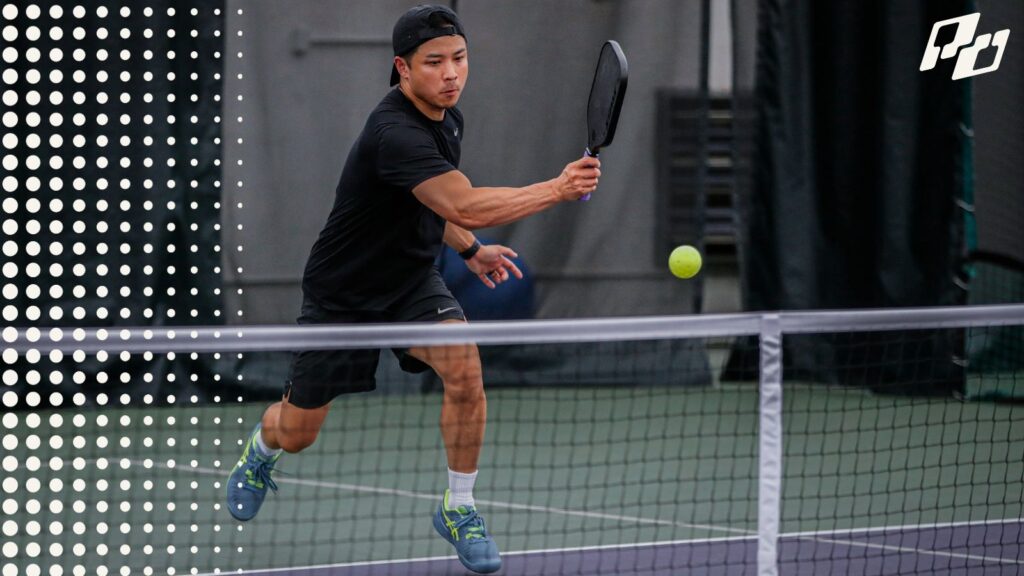
Your paddle starts below the ball, moves through it, and finishes near your shoulder or head. That movement naturally creates topspin while also producing a safer trajectory over the net.
Even better, it uses your entire kinetic chain:
- legs
- hips
- torso
- shoulder
- forearm
Instead of asking one small joint to do all the work, every part contributes a little. That’s why this is the most consistent way to generate topspin.
Cue
Low paddle. High finish. Smooth acceleration.
Watch coach Jordan Briones demonstrate three ways to create topspin, ranked from least consistent to most consistent:
Where Should You Contact the Ball?
This is one detail that often gets overlooked.
Many players hear “swing low to high” and think they should hit under the ball. That’s not what creates quality topspin.
Instead, imagine brushing up the back of the ball. If the ball were a clock, your paddle would travel from roughly 7 o’clock toward 1 o’clock.
You’re still hitting through the ball. You’re simply adding an upward component to the swing.
If you try to scoop underneath the ball, you’ll usually launch it too high.
If you swing only forward, you’ll hit a flatter shot with little spin.
The sweet spot is combining forward acceleration with upward brushing.
Cue
Brush up the back of the ball—not underneath it.
Stop Chasing RPMs. Chase Better Ball Flight.
Most recreational players judge topspin by how much the ball spins. Pros judge it by what the ball does.
A good topspin shot:
- clears the net comfortably
- dips late into the court
- forces your opponent to contact the ball below net height
Interestingly, one of the first scientific studies on pickleball ball flight found that for third-shot drops, launch angle and ball speed had a greater influence on success than spin alone. Spin still mattered, but trajectory mattered even more.
That’s an important reminder.
Topspin isn’t the goal.
A better ball flight is.
Cue
Don’t ask: “Did I create enough spin?”
Ask: “Did the ball dip where I wanted?”
Your Legs Create More Topspin Than Your Arm
Watch advanced players hitting topspin dinks or drives. Yes, the paddle moves upward. But so does the body.
They lower their center of gravity, load their legs, and rise through contact.
Many recreational players stay upright and try to manufacture topspin using only their arm. That’s much harder to repeat.
If your knees don’t bend, your paddle has very little room to travel upward.
Cue
Your legs start the swing. Your paddle finishes it.
Don’t Force the Finish
One of the biggest misunderstandings is the advice to “finish high.” Some players hear that and immediately throw their paddle toward the sky after contact.
The finish isn’t something you manufacture.
It’s evidence that your swing path was correct.
If your paddle naturally traveled low to high, the finish will happen on its own. If you’re forcing the finish, you’re probably fixing the wrong part of the swing.
Cue
Earn the finish. Don’t fake it.
My Take
One thing I’ve noticed after watching a lot of recreational players is that they often obsess over making the ball spin, but rarely pay attention to what that spin actually accomplishes.
The players who improve the fastest aren’t trying to hit the “spinniest” ball on the court. They’re trying to make life uncomfortable for the person across the net. Sometimes that means a heavy topspin drive that dips at their feet. Other times it’s a gentle topspin dink that stays low after the bounce.
In other words, topspin isn’t a skill by itself—it’s a tool.
The next time you practice, forget about impressing yourself with how much the ball rotates. Instead, watch your opponent. If your shots are making them hit from below the net, back up, or contact the ball later than they want to, the topspin is doing its job.
That’s when you’ll know you’re using it effectively—not because you can see the spin, but because your opponent can feel it.