In pickleball, play the ball first and the opponent second. Let ball height, pace, depth, and your balance determine the shot. Then use the opponent’s position or weakness to choose the target. This prevents stronger players from making you rush—and weaker players from making you sloppy.
One of the strangest things about recreational pickleball is how quickly the person across the net can change your game.
A 4.5 walks on court?
Suddenly your grip tightens, you rush your third shot, and every neutral ball feels like it needs to be perfect.
A 3.0 steps in?
Now you’re standing taller, forcing speed-ups, trying cute angles, and somehow missing balls you normally make.
Same paddle.
Same court.
Same basic shots.
Different opponent—and suddenly you’re playing like a different person.
That is the problem behind the advice:
Play the ball, not the player.
It sounds almost too simple. But for intermediate rec players—especially around 3.0 to 3.5, where open play can put wildly different styles and skill levels across the net—it’s a very useful way to separate what the ball is actually asking you to do from everything you’ve decided about the person who hit it.
And there’s an important clarification: this does not mean ignoring your opponent. In a match, you absolutely should notice weaknesses, tendencies, positioning and patterns.
The better rule is: let the ball choose the shot. Let the opponent refine the target.
That distinction is where this advice becomes really useful.
The Mistake Usually Happens Before You Hit
Imagine two identical balls. Both arrive slightly below net height to your forehand at the kitchen.
- Ball A came from the best player in your group.
- Ball B came from someone who started playing six months ago.
Technically, your response should begin the same way. The ball has the same:
height
pace
spin
depth
contact point
Yet recreational players often treat them very differently. Against the stronger player:
“I need to do something with this before they attack me.”
Speed-up.
Net.
Against the weaker player:
“I can put this away.”
Bigger swing.
Out.
The opponent changed your decision even though the ball didn’t. That is what “play the ball” is trying to fix.
This Is Especially Common Around 3.0–3.5
At this level, players usually know enough strategy to start judging everyone on court.
He’s a banger.
She’s a 4.0.
His backhand is terrible.
They’re older.
I should beat these guys.
The problem isn’t noticing those things. The problem is allowing the label to override the information arriving with the ball.
That matters because the jump toward 4.0 increasingly becomes a decision-making problem. The transition is often defined by better shot selection, fewer unnecessary attacks and more reliable choices under pressure—not simply acquiring prettier strokes.
Stronger intermediate players become better at letting the situation determine whether a ball deserves offense, instead of attacking because they feel they should.
That same logic applies here.
Against Better Players, We Start Playing the Reputation
This is the easier version to recognize. You know the player is good. So every ball feels dangerous.
A routine dink feels like it needs to be perfect.
A normal third shot suddenly feels like an exam.
You start trying to hit:
- lower
- sharper
- harder
- closer to the line
Not necessarily because the ball called for it. Because you’re trying to prevent what you imagine will happen next.
Sports-performance research gives us a useful explanation for this. Pressure can pull attention away from task-relevant information and toward consequences, evaluation and the fear of failure. Process-focused goals tend to help redirect attention toward what the athlete can actually execute.
In pickleball language:
Instead of seeing: low ball → reset
your brain sees: good opponent → I need something special
That’s how a perfectly playable ball becomes a bad decision.
The fix
Give yourself a neutral ball cue.
Try: “What did I receive?”
Not: “Who sent it?”
Then classify the ball.
High and comfortable?
Attackable.
Low?
Stay patient.
Fast at your feet?
Defend.
Short return?
Move in.
Deep return?
Respect it.
You can deal with the opponent after you’ve solved the ball.
Playing Down Creates the Opposite Mistake
This one is sneakier. Against weaker players, pressure often disappears—and so does discipline.
You stop split-stepping.
You reach instead of moving.
You speed up balls that you would dink against a 4.0.
You try the tiny angle.
You go for the line.
Then you lose two points and think: why am I playing so badly?
Experienced players talk about this constantly. When playing below your level, use the slower pace to sharpen placement, footwork, resets and consistency instead of letting your mechanics drop with it.
That gives us a useful idea: playing down doesn’t expose your ceiling. It exposes your standards.
- When the opponent stops forcing you to move properly, will you still move?
- When they stop punishing bad attacks, will you still choose good ones?
- When you know you can win with 70% quality, can you keep producing 90% habits?
That is real practice.
The Ball Gives You Four Pieces of Information
If you want to make this practical, stop telling yourself vaguely: “Focus on the ball.”
Instead, read four things.
1. Height
This is the first filter.
A ball above net height while you’re balanced gives you offensive possibilities.
A ball below net height usually forces you to hit upward first, which makes aggressive attacks riskier.
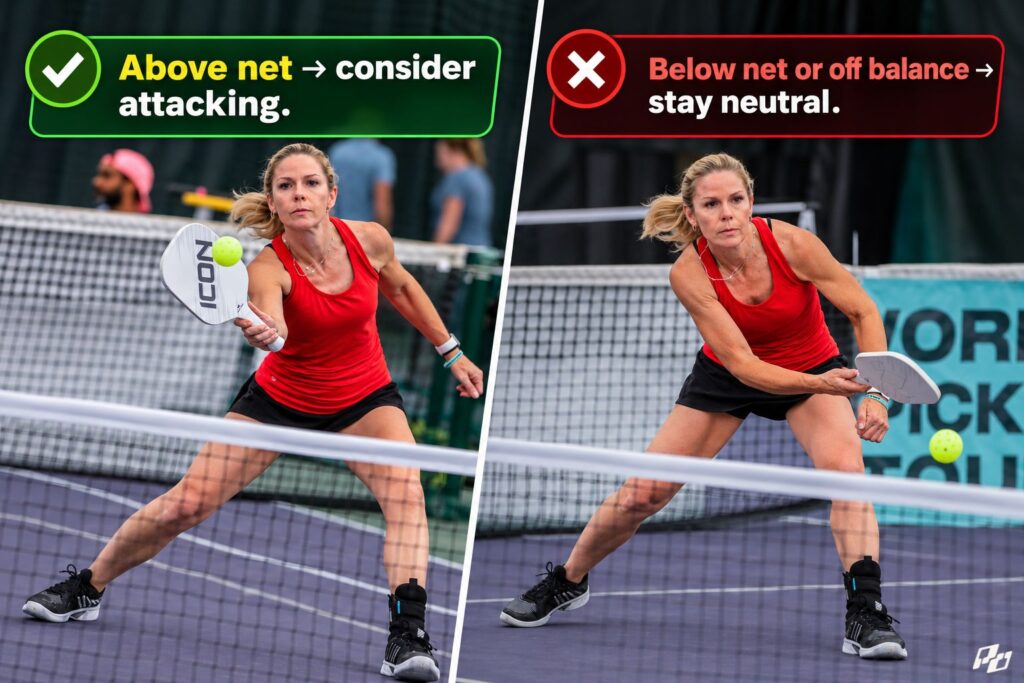
Intermediate players can use ball height + balance as their first attack-or-reset check:
Above net + balanced → consider attacking.
Below net or off balance → stay neutral.
2. Pace
Did they supply enough speed already?
- Against a hard drive, you may only need a compact block.
- Against a slow sitter, you must create the pace and timing.
Don’t swing harder simply because the hitter is dangerous. Respond to the ball that actually arrived.
Our own Pickleball Union coach, Marko Grgić, recently shared two excellent tips for blocking effectively at the kitchen line—without popping the ball up or getting frustrated:
3. Depth
Depth tells you how aggressive you can be.
A short return pulls you forward and usually gives you more time and a higher contact point. That’s when you can step in, drive, roll, or play a more aggressive drop.
A deep return near the baseline pins you back and usually forces contact lower and farther behind the court. That’s when you should prioritize depth, margin, and control—for example, a solid drive or a safer drop rather than forcing a sharp attack.
Think:
Short ball = step in and pressure.
Deep ball = stay balanced and build the point.
Who hit it doesn’t change that.
4. Your balance
This may be the forgotten one. A ball can be high and still be a poor attack if you’re:
- reaching
- moving backward
- jammed
- late
So your actual decision formula becomes: ball + balance first. Opponent second.
But Wait—Aren’t We Supposed to Exploit Weaknesses?
Absolutely. This is where “play the ball, not the player” can become bad advice if taken literally. Competitive pickleball is full of opponent-specific strategy.
You should notice:
- who struggles with backhands
- who hates pace
- who speeds up crosscourt
- who cheats toward the middle
- who struggles moving backward
- who can’t reset your drive
At around 4.0, intentional targeting and opponent patterns become an increasingly important part of strategy.
But the order matters.
Suppose you know your opponent hates their backhand.
Great.
Now a low dink arrives at your shoelaces.
The correct thought isn’t: BACKHAND! ATTACK IT!
It’s: this is a defensive/neutral ball. Can I safely place my next dink toward their backhand?
Same scouting information.
Completely different decision.
So think: the ball chooses the category. The opponent helps choose the destination.
That’s the whole framework.
Practice and Competition Should Be Slightly Different
This is another important distinction from the original tip.
In practice or rec play where improvement is the goal, playing the ball should dominate. If a stronger player is across from you, don’t avoid them. Deliberately sending more balls toward the stronger player can give you better feedback and force you to improve.
Likewise, against weaker players, use the game to demand cleaner standards from yourself rather than winning as cheaply as possible.
Practice question: “Did I execute the right ball?”
In a competitive match, opponent strategy matters more.
Match question: “What is the highest-percentage response to this ball against this opponent?”
Notice the order.
This ball comes first.
This opponent comes second.
Try the No-Identity Game
Here’s a surprisingly useful exercise.
Before one rec game, ban yourself from thinking in player labels. No:
- strong
- weak
- banger
- old
- beginner
- 4.0
- bad backhand
For the first five points, describe only the ball.
Internally call:
- high
- low
- fast
- short
- deep
- wide
- body
Then make your normal decision.
You’ll notice something quickly. The game gets quieter. You’re no longer solving the opponent’s entire reputation before every shot. You’re solving one ball at a time.
Once that feels natural, bring tactical targeting back in.
Now it becomes: low + backhand target
or: high + body
or: deep + move forward
instead of: This guy’s better than me, I need to hit something amazing.
Use One Process Goal When the Matchup Gets in Your Head
If you know you’re someone who tightens against better players or gets sloppy against weaker ones, choose one observable standard before the game.
Not: Win.
Not: Don’t embarrass yourself.
Try: Split on every opponent contact.
or: Attack only when I’m balanced.
or: Every return deep, then move forward.
or: Make every low ball neutral.
Process goals have good support in pressure-performance research because they direct attention toward controllable execution rather than the consequence of winning or losing.
And this is especially useful in mixed-level rec play because your process can stay identical even when the opponent changes completely.
The Real Test
Imagine you’re about to receive the exact same dink from two players.
One is rated half a point above you.
The other is rated half a point below you.
If you would choose a different shot only because of who hit it, stop for a second.
Ask: Did the ball change?
If the answer is no, your first decision probably shouldn’t change either.
You can still adjust the target based on the opponent.
You can still exploit patterns.
You can still play strategically.
Just don’t let reputation replace reading. That’s what play the ball, not the player really means.
Not ignoring the opponent.
Not playing brainless pickleball.
It means refusing to let fear against better players—or ego against weaker ones—make the decision before the ball does.
Ball first. Player second.
That is simple enough to use at open play tomorrow—and deep enough to change how you compete.