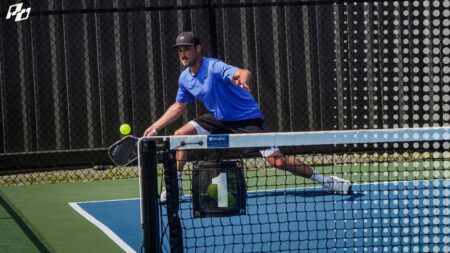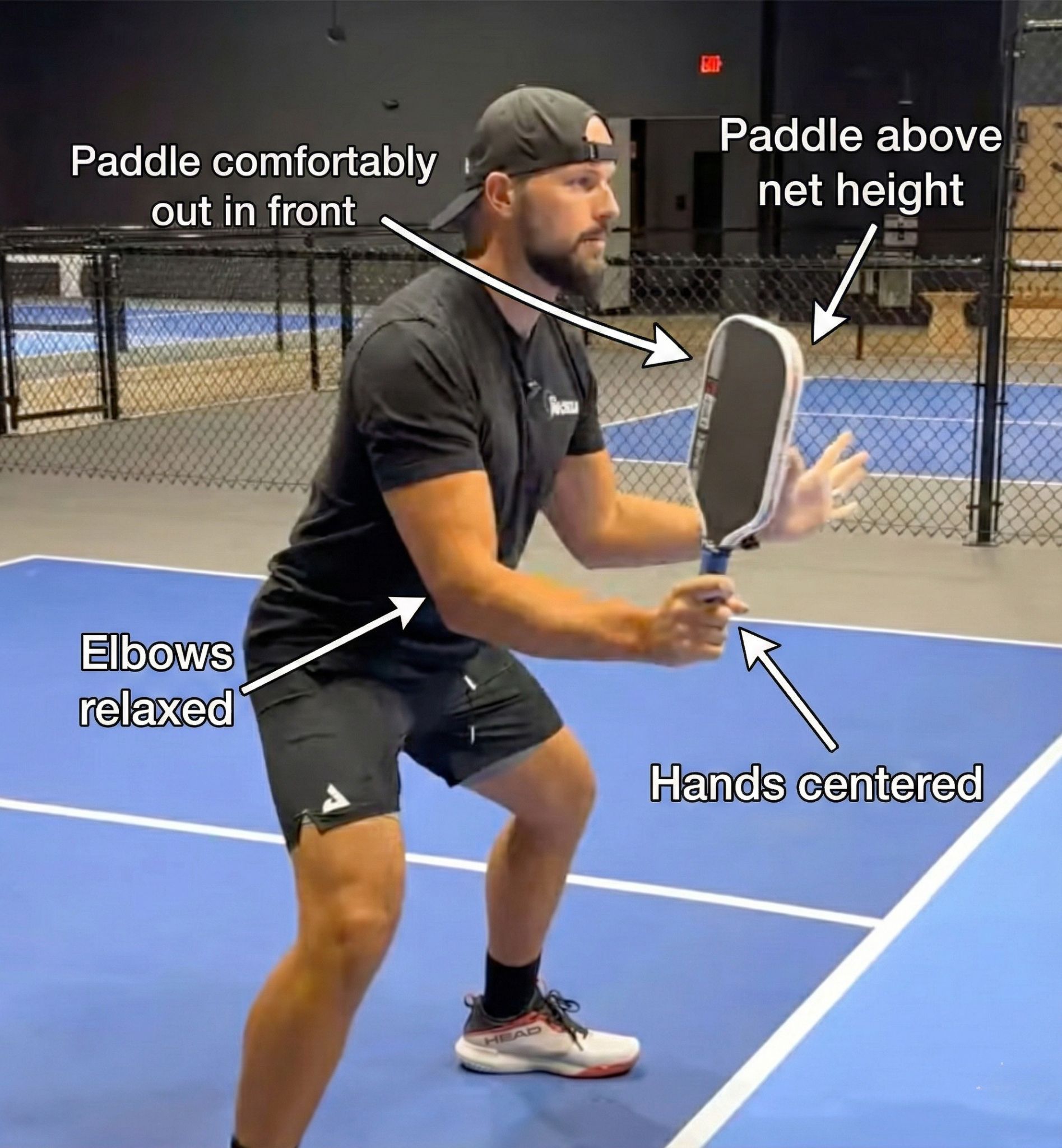

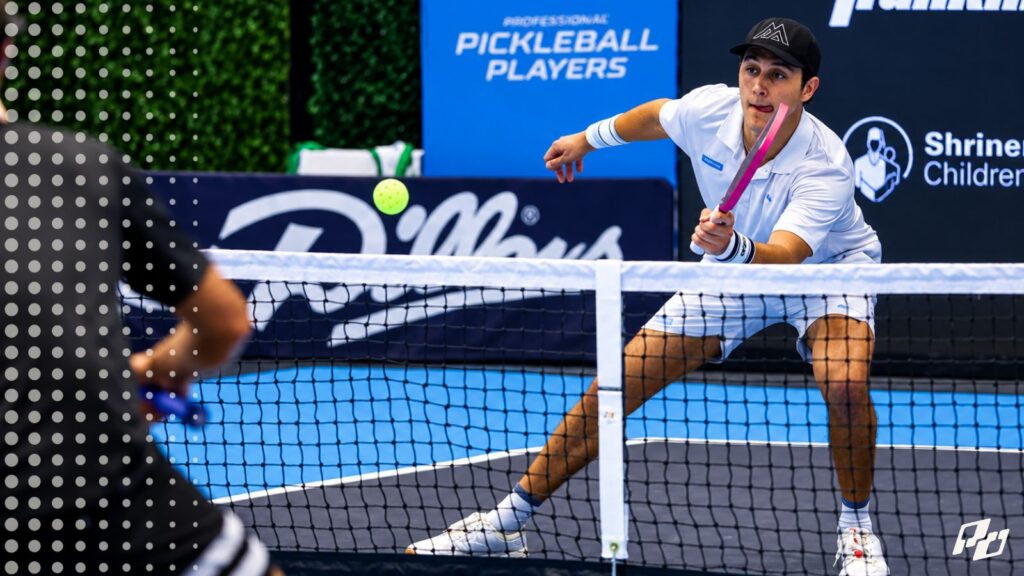
A simple volley cue can improve both reach and balance: paddle forward, hips slightly back. This keeps you athletic, creates more space in front, and helps you recover faster for the next ball without overreaching.
“Stick your butt out.”
Not exactly elegant coaching language. But as a volley cue, it’s surprisingly useful.
The idea is not to squat lower, exaggerate your posture, or lean over the kitchen. It’s to send your hips slightly back as your paddle reaches forward.
That small counterbalance can do three useful things at once:
- keep you athletic
- create more space in front of your body
- help you reach farther without tipping forward
Several pickleball coaches teach versions of this same movement. Some explicitly describe pushing the hips back as the paddle extends, while others use cues like “nose over toes,” bent knees, hips back, paddle out front to create the same balanced position.
And this matters most around the 3.0–3.5 level, where players often know they should volley in front but try to create that extra reach with the wrong body part.
They reach with the arm. What they really need is better counterbalance.
The Mistake: Your Paddle Goes Forward, So Your Whole Body Goes Forward
Picture a backhand volley at the kitchen.
The ball is slightly in front of you.
You want to take it early.
So you extend the paddle.
Then your shoulder follows.
Then your chest follows.
Then suddenly your weight is hanging over the kitchen line and your heels are almost gone. You made the contact. But now you’re:
- late recovering
- off balance
- vulnerable to the next ball
- and possibly flirting with a kitchen fault
That is exactly where the hips-back cue helps. Instead of your entire body traveling toward the ball, the motion becomes: Paddle forward. Hips slightly back.
Why It Can Give You a Few Extra Inches
This is the clever part.
You do not actually make your arm longer. What changes is how much of your existing reach you can use while staying balanced.
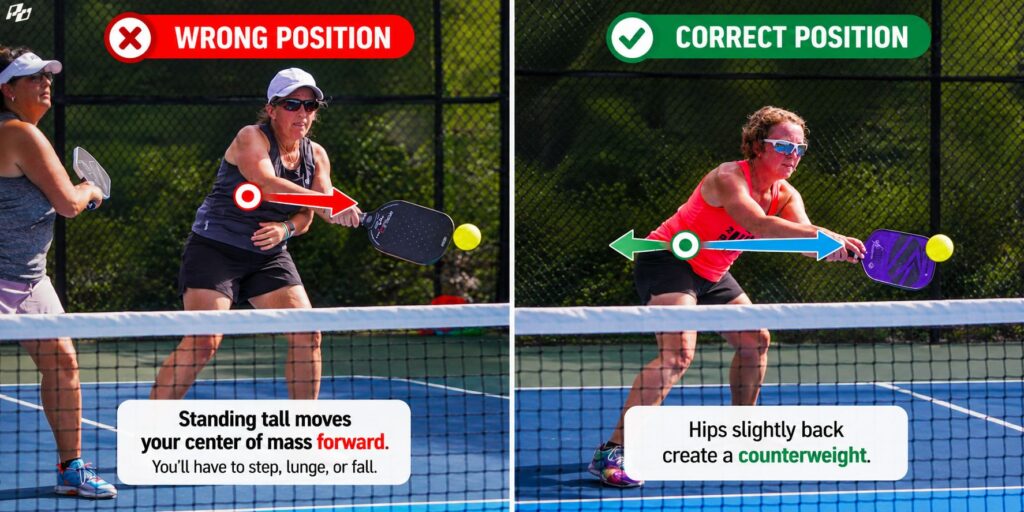
If you stand tall and reach forward, your center of mass moves forward with the paddle. Eventually your body has to step, lunge, or fall to keep up.
If you send the hips slightly backward while the upper body and paddle move forward, you create a counterweight.
That can allow the paddle to extend farther into the court without your whole body following it.
Coaching sources that specifically teach this movement describe it as creating a few extra inches of usable reach while keeping the player from tipping into the kitchen.
I would not obsess over whether it is literally two inches for every player.
The important part is: You gain usable reach, not arm length.
That is a much better way to think about it.
This Is Really a Hip Hinge
The phrase “stick your butt out” works because people understand it instantly. Technically, though, you’re creating a small hip hinge.
Your knees stay soft.
Your hips move slightly behind you.
Your chest stays balanced over your base.
Your weight remains active rather than falling onto your heels.
That distinction matters because you do not want to bend forward at the waist and collapse your chest.
Pickleball coaches consistently emphasize an athletic volley stance with flexed knees, stable hips, forward intent, and the paddle in front.
A useful feel is:
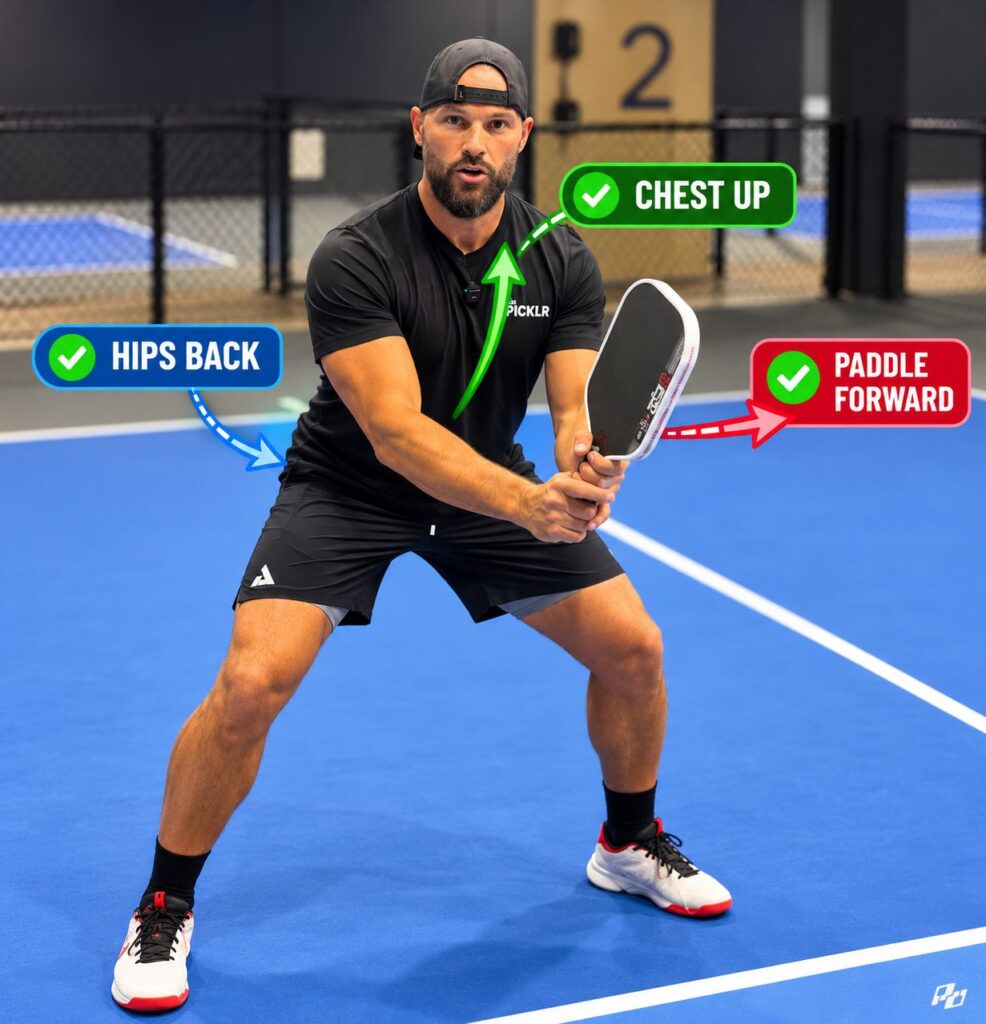
✅ hips back
✅ chest up
✅ paddle forward
Not:
❌ butt back
❌ head down
❌ back rounded
Why This Makes You More Athletic for the Next Ball
Here’s the bigger benefit.
Most players think about volley posture only in terms of the ball they are currently hitting. But kitchen exchanges rarely end there. The first volley is often just Ball 1. The second ball can come back almost immediately.
If you lunged forward to hit the first volley, you now have to recover your whole body before dealing with the next one.
If your hips stayed underneath you, recovery is much easier. You finish the volley still able to push:
left
right
back
forward
That is what “athletic” really means here. Not looking low and sporty.
It means: Can you move immediately after contact without first rebuilding your stance?
A good ready position should leave you capable of pushing in multiple directions without standing up, untangling your feet, or falling back into balance first.
That is the part intermediate players should care about.
The Mistake This Fixes: Reaching With the Shoulder
A lot of rec players hear: “Take the ball out in front.”
So they chase “out in front” by throwing the shoulder and arm toward the net. That often creates two problems.
First, the elbow becomes almost completely straight.
Second, your body is now behind the paddle rather than supporting it.
Good volley instruction usually places contact somewhere in front of the body with the elbow still naturally bent, rather than at maximum reach. One coaching source describes roughly 6–12 inches in front as a useful contact window; others emphasize the same principle without prescribing a precise number.
So the goal is not: maximum extension
It is: maximum controlled extension
Huge difference.
Try This Without a Ball
Stand at the kitchen line. Get into your normal ready position. Now hold your paddle forward as if you’re making a backhand volley.
First, reach by letting your shoulders and chest drift toward the net. Notice what happens.
You probably feel your toes gripping.
Your weight shifts forward.
Your balance gets narrower.
Now reset. This time, as the paddle goes forward, send your hips slightly backward. Not dramatically. Just enough that your body feels like a counterweight.
You should feel three things:
- your paddle gets farther forward
- your feet stay more planted
- you could still move immediately after contact
That’s the position you’re after.
Where This Helps Most
You’ll probably feel the benefit most on three kinds of balls.
1. Backhand punch volleys
This is the cleanest use.
Paddle moves forward.
Hips counter backward.
You create space and keep the arm connected rather than reaching.
2. Fast body volleys
When you’re jammed, staying athletic gives you more room to organize the paddle in front instead of standing upright and letting the ball crowd your chest.
3. Slightly stretched volleys
This is where the extra usable reach matters most.
Instead of falling forward into the kitchen just to make contact, the hip hinge can help you extend while remaining behind your base.
But there is a limit.
If the ball is too far away, move your feet or let it bounce. The hips-back cue is not permission to become a statue and reach for everything.
The Best Drill Is Almost Embarrassingly Simple
Stand at the kitchen with a partner feeding medium-paced volleys. Hit five without thinking about posture.
Then hit five with one cue: Paddle forward. Hips back.
After each volley, freeze for one second.
Ask:
Could I move left right now?
Could I move right?
Could I handle another ball without standing up first?
If not, you probably reached too far or let your torso drift.
This “freeze after contact” idea is used by coaches specifically to build awareness of stable volley posture and grounded balance.
Then remove the freeze and speed the feeds up.
Now the goal is: reach → recover → reach → recover
not: reach → fall → rebuild
The Real Lesson
This little butt-out cue sounds like it’s about getting more reach. That’s only half the story. The real advantage is that it lets you reach without spending your balance.
And at the kitchen, balance is currency.
Every time you lunge, lean, or fall forward, you spend some. Every time you stay stacked and athletic, you keep it available for the next ball.
So yes: stick your butt out a little.
But understand why. You are not trying to look lower. You are creating a counterbalance so your paddle can go forward while your body stays ready to play the next shot.
That is the part that makes the cue genuinely useful.