A bad pickleball line call should cost you one point—not the next five. Reset quickly, avoid revenge shots, and give yourself one simple job for the next rally. The key is to stop the previous call from changing your next decision.
A questionable line call should cost you one point. The real damage starts when it changes how you play the next one.
You get irritated. You rush the next serve. You aim closer to the lines. You attack a ball you normally wouldn’t. You stop talking to your partner. Maybe you decide, consciously or not, that you’re going to make the next shot so obvious nobody can possibly call it out.
Now the bad call has cost you two points.
Then three.
That’s the trap.
The goal isn’t to stop yourself from getting upset—that’s unrealistic. The goal is to keep the bad call from changing your next decision.
And for intermediate rec players, especially around 3.0–4.0, that is a very trainable skill.
The Call Hurts Once. The Carryover Hurts Again.
Most rec pickleball is self-officiated, and USA Pickleball’s rules put line-call responsibility largely on the players at that end of the court. They also make the sportsmanship principle clear: close or uncertain calls should favor the opponent, and disagreements shouldn’t become extended arguments.
But even when everyone is trying to call lines fairly, you’re going to see balls differently. And when you’re convinced a call was wrong, your brain doesn’t necessarily treat the rally as finished.
Part of your attention stays there.
That ball was in.
How did they miss that?
Are they going to do this again?
That matters because your attention is supposed to be somewhere else now:
- the serve
- the return
- ball height
- your partner
- your opponents’ position
- your own balance
Research in sport has found that anger can hurt performance through distraction—attention gets pulled away from the task that actually matters.
That gives us a better way to understand the problem: The bad line call doesn’t just make you angry. It occupies attention you need for the next rally.
The Most Expensive Reaction: Trying to Win the Point Back
This is where intermediate players often get into trouble.
You lose a point on a call you hate. And the next rally suddenly feels like it should be worth two. So you play it differently.
You hit the serve harder.
You go closer to the sideline.
You rip the return instead of making your normal deep ball.
You speed up from below the net.
You try to end the rally quickly.
It feels competitive. But tactically, you may have just lowered your percentage. I think of this as the revenge tax.
The questionable call already took one point. Then you voluntarily pay another because you’re trying to compensate for it.
Christian Alshon, one of the top players on the PPA Tour and currently ranked No. 3 in the World Pickleball Rankings, gives advice that goes in the opposite direction: when a point rattles you, slow down, get neutral, and simplify your shot selection instead of immediately going for something extreme.
That leads to a useful rule: After an emotional point, make the next point simpler—not bigger.
✔️ Deep serve.
✔️ Deep return.
✔️ Large target.
✔️ Make the first drop.
✔️ Stay balanced.
Let the rally become normal again.
The Best Question to Ask Yourself
Here’s a really useful diagnostic: Would I choose this shot if the previous point had been normal?
That question catches emotional shot selection fast.
Would you normally try that sideline return?
Would you normally speed up that low dink?
Would you normally serve at 95%?
Would you normally target the same opponent four balls in a row?
If the answer is no, the previous call is still making decisions for you. And that is exactly what you want to stop.
Don’t “Forget It.” Close It.
Players love telling each other: “Forget it.”
Not very useful. You can’t just command your brain to stop caring. A better goal is to close the previous point deliberately.
Ben Johns talks about using repeatable mental or physical triggers to get yourself back into your preferred competitive state. The point is to practice a reset until it becomes something you can access automatically under pressure.
So instead of trying to erase the frustration, give it an ending.
Use a three-part reset: Acknowledge → Reset → Refocus
1. Acknowledge
Say it once: “I saw it differently. Call stands.”
That sentence is useful because you are not pretending you agree. You’re simply separating what I think happened from what I need to do now.
Those are different problems.
2. Reset physically
Do something small and repeatable.
- Turn away from the court for a second.
- Loosen your grip.
- Take one longer exhale.
- Touch the edge of your paddle.
- Walk calmly into position.
The movement itself isn’t magic. It creates a boundary between that rally and this rally.
That’s what you need.
3. Refocus on one job
Now give your brain a concrete task.
Not: “Calm down.”
Try:
- “Deep middle.”
- “Split before contact.”
- “Big target.”
- “Make the first drop.”
- “See the ball.”
You are replacing something uncontrollable—the previous call—with something controllable—your next action.
That is a much stronger reset.
Why This Is Especially Common at 3.0–4.0
This level is interesting.
Players are skilled enough that points feel important.
They understand patterns.
They care about momentum.
They know when a call at 8-8 matters.
But many still don’t have any real between-point routine.
They practice dinks.
They practice drops.
They practice drives.
Almost nobody practices what to do mentally after:
- a bad call
- a lucky net cord
- a missed putaway
- a disagreement
- a terrible error
So the emotion itself isn’t unusual. What’s missing is the recovery skill. And that’s why one odd point can become a run of three or four.
Your Partner Can Make It Better—or Much Worse
Doubles adds another problem.
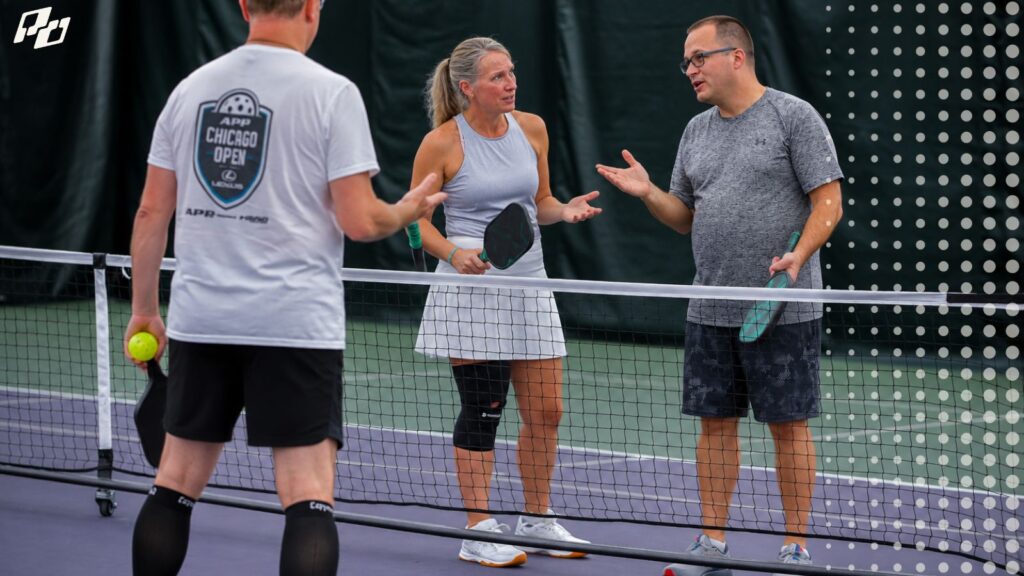
You think the ball was in. Your partner says: “That was absolutely in.” You agree. Then they mention it again while you’re walking back. Now both of you are replaying it. You’ve turned one bad call into a team project.
A much better partner rule is: One comment, then next point.
“Yeah, I saw it in too.”
Fine.
Then: “Next one.”
Done.
Your partner’s job isn’t to help you build a stronger case. It’s to help you get your attention back.
Watch the Pace Between Points
There’s another tell that you’re still carrying the call: you start moving faster.
- Grab the ball.
- Rush to the baseline.
- Call the score.
- Serve.
You haven’t actually reset. You’ve just started the next rally before your brain arrived.
Taking a few extra seconds after a frustrating point is not weakness. It’s preparation. Alshon specifically recommends slowing down enough between points to regain a neutral state before starting the next one.
The idea isn’t to drag the game out. It’s to make sure you don’t begin the next rally while still mentally arguing about the last one.
Practice This on Purpose
Mental resets get much better when they stop being something you invent during a match. Try this in practice:
Play a normal game. Once or twice, after a rally, your partner says: “Bad call.” Pretend you just lost the point on a call you strongly disagreed with.
Then immediately run your routine:
- Acknowledge.
- Physical reset.
- One simple cue for the next rally.
Then play.
It sounds artificial. That’s okay. You’re training the transition from emotion back to task.
Ben Johns’ broader point is useful here: mental toughness is something you can develop through repeated routines and triggers, not simply something you either have or don’t.
The Real Skill Isn’t Staying Calm
You do not need to become a robot. A bad call can annoy you. You can think it was wrong. You can even say, respectfully, that you saw it differently.
USA Pickleball’s sportsmanship guidance similarly allows respectful questioning while discouraging arguing and emphasizes accepting the opponent’s responsibility for calls on their side.
The performance skill is simpler: Don’t let the previous point choose your next shot.
If a bad call costs you one rally, that’s frustrating. If it changes your serve, your targets, your patience, and your communication for the next five rallies, now it has become a pickleball problem.
So after the next questionable call:
Acknowledge it once.
Reset physically.
Choose one simple job.
Return to normal margins.
A bad call should cost you one point. Make sure you don’t donate the next four.