The pickleball snake shot disguises a forehand attack inside what looks like a normal backhand dink. Keep the setup quiet, switch the paddle face late, and attack only when you’re balanced and your opponent is compromised. The key isn’t the flashy flip—it’s making the attack look like a dink until the last moment.
The snake shot has been making waves, and once you see Gabe Tardio hit it (scroll down), you understand why.
The setup looks like an ordinary backhand dink. Same posture. Same quiet paddle. Same soft-ball expectation.
Then, at the last moment, the paddle changes and the ball comes off the forehand side from what looked like a backhand setup.
It’s sneaky, flashy, and probably not the first shot a 3.5 player needs to master. But honestly—why not try it for kicks?
Best case, you add a nasty little kitchen weapon.
Worst case, you learn something even more valuable: how to make an attack look exactly like a dink until your opponent has almost no time left to react.
And that disguise is the real lesson here.
First, What Exactly Is the Snake Shot?
The snake is not defined by hitting crosscourt. Tardio often demonstrates it during a crosscourt dink exchange from the left side, which is where the shot looks especially natural.
But the defining feature is this: You show a backhand dink, then switch late and attack with the forehand side of the paddle.
That’s what creates the deception.
The opponent reads: backhand dink until very late. Then suddenly they get: forehand attack
The setup and the finish tell two different stories. That is why the shot can feel like it appears from nowhere.
Watch World No. 2 PPA pro Gabe Tardio show you exactly how to do it:
Why This Is Really a Disguise Lesson
This is more of a 3.5–4.0+ skill than a beginner shot.
At 3.0, the bigger priority is usually being able to dink reliably in the first place. At 3.5, players start adding speed-ups, but those attacks are often easy to read:
- the grip tightens
- the paddle pulls back
- the elbow moves
- the feet change
- the shoulders open early
By the time the ball is struck, the opponent already knows what’s coming.
Advanced players often “hold” the dink by preparing early with a compact paddle position, then delaying the forward acceleration until the last possible moment. That keeps the setup looking soft and gives the opponent less time to recognize the speed-up.
The snake simply takes that idea farther.
The real goal is not: “Can I flip the paddle?”
It is: “Can I make my attack look like a dink for as long as possible?”
Rule No. 1: Your Backhand Dink Has to Sell the Lie
This is where I’d start.
If your normal backhand dink and your snake setup already look different, the shot loses most of its value.
The opponent should see the same:
- stance
- paddle preparation
- grip pressure
- shoulder position
- contact window
until very late.
Coaches teaching disguised speed-ups consistently emphasize keeping the grip, footwork, paddle position, and backswing similar to the dink. Big preparation changes are exactly what opponents use to read an attack early.
So don’t practice the flashy part first.
Practice the boring part: Make your setup look painfully normal.
We recently filmed a video with our coach Marko Grgic on how to disguise a speed-up, and we strongly recommend practicing the technique he shows here:
Rule No. 2: Show Backhand, Finish Forehand
Here’s the simplest way to understand the mechanics.
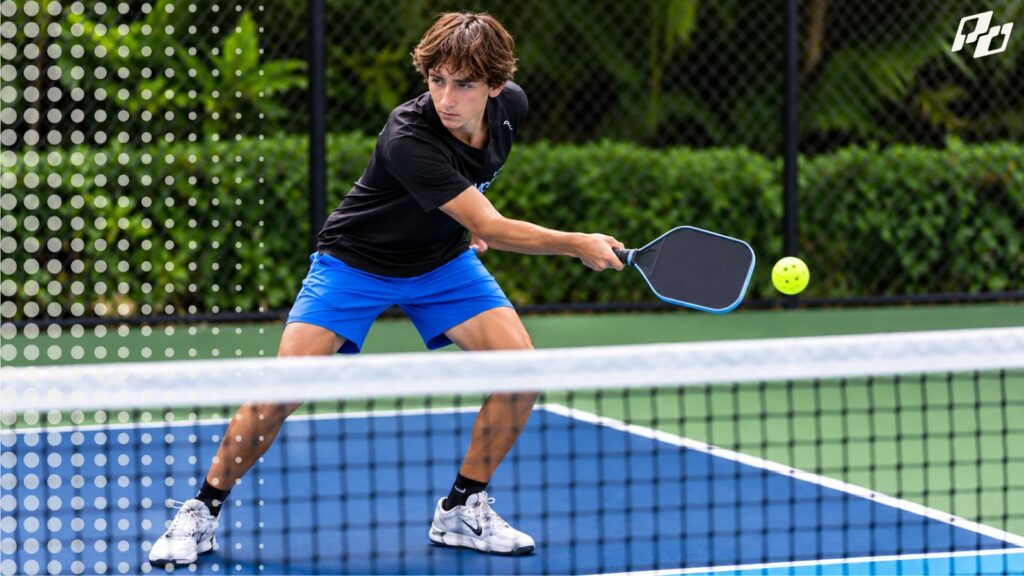
Imagine you’re set up for your normal backhand dink. The paddle stays in that familiar position while you track the ball.
Then, very late:
- rotate the paddle
- present the forehand side
- push or roll forward through the ball
The important word is late.
If you rotate the paddle too early, the opponent sees the change. If you wait too long, you rush the contact and lose control.
So the feel is: backhand look → late change → forehand attack
Not: backhand → giant flip → wild flick
@thepickleballbreakdown The snake shot is the most deceptive shot at the kitchen line. Same form + swing as a backhand dink. Then at the last second, flip the paddle down and roll a forehand on the backhand side of your body. Your opponent never sees it coming because it looks like a backhand until it is too late. Have you ever hit a snake shot? 👇 #pickleball #pickleballtiktok #pickleballislife #pickleballstrategy ♬ original sound – pickleballbreakdown
Don’t Turn It Into a Wrist Trick
This is probably where a 3.5 player will get into trouble. They see the late paddle change and think: “I need to snap my wrist harder.”
No.
The snake needs a late paddle transition, but that does not mean a huge uncontrolled wrist action.
Disguised-speed-up coaching repeatedly emphasizes compact preparation and late acceleration, not a giant arm swing.
Think of the hand as organizing the paddle face rather than violently throwing it around. You want enough change to present the forehand side cleanly.
Then the forward movement gives you the attack.
Cue:
“Turn it late. Drive it forward.”
If the paddle face is flying all over the place, simplify.
The Best Snake Looks Boring Until It Doesn’t
This may be the biggest takeaway. Great disguise is not theatrical. It is almost boring.
PPA pro Rachel Rohrabacher, one of the top doubles players in the game, is a good example of the broader principle. High-speed analysis of her kitchen game shows her using nearly identical initial motions for dinks, attacks, and even lobs, delaying the useful information opponents need to identify the shot.
That is exactly what you want from the snake.
The opponent shouldn’t see: “Here comes the snake.”
They should see: “Another dink.”
And then they’re late.
That is more valuable than simply hitting the ball harder.
When Should You Actually Try It?
This is where you need some restraint.
Don’t try the snake because: you haven’t used it in three rallies
or you want to show your friends you learned it.
Use it when the situation helps the deception. The best conditions are usually:
✔ you’re balanced
✔ the ball is comfortably reachable
✔ your opponent is expecting another dink
✔ your paddle can stay quiet until late
✔ the contact is high enough to attack with control
Opponent position matters too. The snake gets nastier when the other player is already a little compromised—leaning, reaching, recovering from a wide dink, or still looking down at the ball.
That’s your window.
They’re not fully balanced, their paddle may not be set, and they have less time to react to the late change.
So a better trigger is: “Can I sell the dink and still own the contact?”
If yes, the snake is available.
If not, dink again.
Where Should You Hit It?
Here’s where I would make the shot easier for rec players.
You do not need a spectacular sideline winner. The disguise has already done much of the work. Once the opponent is late, use a larger target.
Good speed-up targets include:
- body
- paddle-side hip
- paddle shoulder
- middle
These targets are harder to organize against than a ball the opponent can simply swing at freely, and kitchen-speed-up coaching often recommends body-oriented targets for exactly that reason.
The Sneaky Part: Don’t Use It Too Often
If every third backhand dink turns into a snake, it stops being deceptive. Now the opponent waits for it.
The same setup should sometimes produce:
- a normal dink
- another normal dink
- a redirect
- then the snake
That creates uncertainty.
Coaches who teach disguised attacks emphasize mixing identical setups with different endings so the opponent cannot map one visual cue to one predictable result.
The lesson: The snake works because your normal dink still exists.
If you remove the normal version, you remove the disguise.
Here’s How to Know If You’re Telegraphing It
This drill is extremely useful.
Stand at the kitchen with a partner. Hit normal backhand dinks and mix in occasional snakes. Your partner’s job is simple.
Before contact, call: “Dink.”
or: “Attack.”
If they can tell consistently before you strike the ball, something is giving you away.
Look for:
❌ bigger backswing
❌ earlier paddle rotation
❌ grip tightening
❌ shoulder opening
❌ different foot position
This kind of read drill is specifically recommended for disguised speed-ups because it tests what really matters: whether the opponent can identify your intention before contact.
A snake that goes in but is obvious is not really much of a snake.
A Simple 3-Step Way to Learn It
Step 1: Shadow the switch
No ball.
Set up as if you’re hitting a backhand dink.
Keep the paddle quiet.
Then practice the late transition to the forehand side.
Ten reps.
You’re trying to make the change small and late, not fast and dramatic.
Step 2: Dink or snake
Have a partner feed easy balls.
Alternate randomly between: normal backhand dink
and snake
The setup should look the same. Your partner tries to read it. If they can tell early, keep working on the disguise.
Step 3: Add it to a real rally
Now dink normally. Do not decide beforehand: “On Ball 4, I’m snaking.”
Wait.
Read the ball.
Read your balance.
Read the opponent.
Then use it when the opportunity feels natural.
That’s where the shot becomes useful instead of just rehearsed.
The Cue I’d Give a 3.5 Player
Forget all the fancy terminology.
Remember: “Show backhand. Finish forehand.”
That captures the mechanics.
And for the strategy: “Same setup. Late change.”
Those two cues are enough.
If you can do that without changing your body language, you’ll start to understand why Tardio’s version is so difficult to read.
And even if the snake never becomes a shot you use five times a game, learning it teaches something much bigger: how to hide offense inside a completely ordinary-looking ball.
That’s a skill you can use on far more than just the snake.