
A step-through pickleball serve adds power by transferring your weight from the back leg through contact. Load, move forward, rotate, then let the back foot follow naturally. The key is weight transfer first, step second—not taking a big step and hoping it creates power.
You’ve probably seen the tip: step through your serve. More momentum. More power. More consistency.
There’s something very useful in that advice—but also an easy way to misunderstand it. The step itself is not the magic.
If you simply pick up your back foot and walk through the serve, you’ve added movement without necessarily adding useful power. The better servers do something different: they transfer their weight through the ball, and the step happens naturally because of that transfer.
That distinction is huge.
The Mistake Is Most Common Around 3.0–3.5
A lot of newer players serve almost entirely with the hitting arm.
Feet planted.
Chest fairly still.
Arm swings.
Ball goes in.
That works perfectly well when the goal is simply starting the rally.
Then around 3.0–3.5, players want something more. They want the serve deeper, heavier, maybe with enough pace to stop the returner from casually strolling forward.
So they usually do the obvious thing: swing the arm harder.
That often adds effort faster than it adds ball speed.
Coach Austin Hardy emphasizes using the legs, weight transfer and a relaxed arm rather than simply muscling the paddle faster. Michael Loyd similarly teaches a staggered setup, loading the back leg and transferring into the front side as the swing begins.
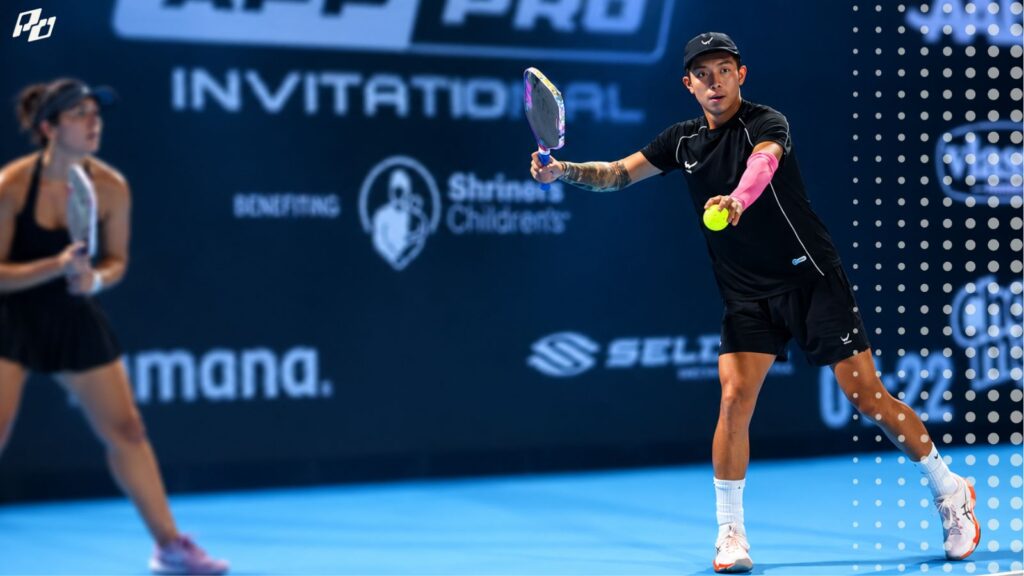
World No. 22 PPA pro Callie Jo Smith makes essentially the same point: transferring your weight forward while extending through the ball helps create both pace and direction:
Here’s the Non-Obvious Part: The Step Comes Last
Watch what happens when you throw something hard. You don’t usually:
- step
- stop
- throw
The transfer, rotation and arm action blend together. Serving should feel similar.
Your weight begins farther back. As the forward swing starts, your body pressure shifts toward the front leg. The hips and torso begin to unwind. The paddle accelerates through the ball.
Then—after that energy has already gone forward—the back foot may naturally come through.
Current instruction on serve footwork makes this timing particularly clear: the weight shift should occur during the forward swing, rather than as a separate movement before or after it.
So I wouldn’t tell a player: “Take a big step into your serve.”
I’d tell them: “Transfer first. Let the foot follow.”
That produces a very different motion:
The Step Is Better Used as a Diagnostic
Here’s a neat way to think about it. Your follow-through tells you something about what happened before contact.
If you finish with:
- all your weight still on the back foot
- your back heel glued to the ground
- your chest behind the ball
- only your arm moving
you probably didn’t transfer much energy forward.
If the serve pulls your weight onto the front side and the back foot wants to release naturally, that’s evidence that the whole motion was moving through the ball.
A visible sign that the weight is transferring rather than staying static is the back heel lifting naturally around contact.
That’s much more useful than deliberately kicking the foot forward because someone told you to “step through.”
Cue: “Let the serve move the foot.”
Not: “Move the foot to make the serve.”
Build It in This Order
This is where I’d make the technique very methodical.
1. Start Slightly Staggered
For a right-handed player, the left foot can sit slightly forward and the right foot slightly behind.
You don’t need an exaggerated tennis stance. You just want enough separation that you can load one side and transfer into the other.
A slightly closed or staggered starting position gives your body room to coil while making the back-to-front weight transfer easier to feel.
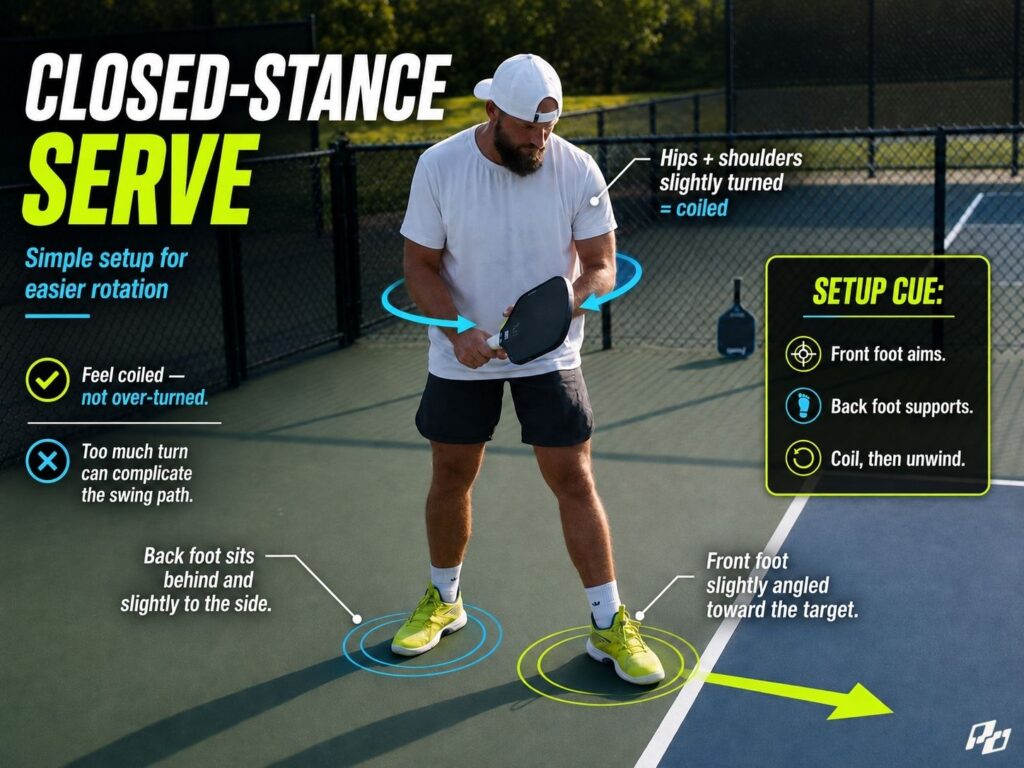
The front foot can also be slightly open rather than locked completely sideways, which can make rotation feel more natural.
2. Put Some Pressure Into the Back Leg
Not all of it.
Don’t rock dramatically backward. Just feel enough pressure in the back leg that you actually have somewhere to move from.
This is the part missing from many arm-only serves. No load means there is very little body energy available to transfer.
Think: Back leg = loaded spring.
Not: Lean backward.
You should still feel balanced.
3. Start the Transfer With the Forward Swing
Now the important piece.
As your paddle begins moving forward, your weight begins moving toward the front leg. Not earlier. If you move your body first and then swing, the two pieces become disconnected.
Not much later either. Then the arm has already done most of the work.
You want them connected: push → rotate → swing.
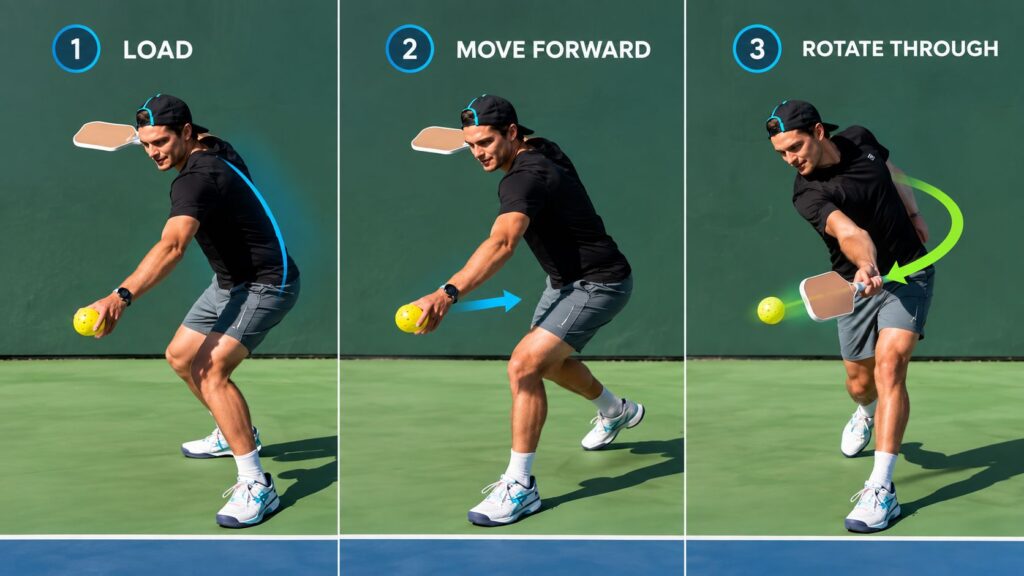
That timing is why the motion can feel easier even though the ball comes off faster. You aren’t asking one body part to provide everything.
Your Hips Should Move—But Don’t Spin Out
“Use your whole body” can create another problem. A player hears rotate and suddenly turns the serve into a full pirouette.
More rotation is not automatically more power. You want the hips and torso contributing toward the shot, while the hitting zone remains predictable.
Recent serve instruction specifically warns against excessive rotation because once the shoulders fly open, the serve can start spraying rather than traveling consistently down the intended line.
That gives us a better sequence: Load → move forward → rotate through → extend.
Not: coil → spin as hard as possible.
Your body is helping accelerate the paddle. It is not trying to win a dance competition.
The Arm Should Feel Easier, Not Harder
This is one of my favorite checks. Add the step-through mechanics.
Then ask: does my arm feel like it has to work less?
If the answer is no, something probably isn’t connecting.
A good kinetic sequence allows the larger parts of the body to contribute before the arm delivers the paddle.
Hardy specifically warns that trying to create extra pace with a tense arm can reduce the lag and fluid acceleration players are trying to generate.
Bellamy also emphasizes a loose grip and arm because that freer motion allows the paddle to accelerate rather than being dragged through the ball rigidly.
So don’t combine: big body effort + big arm effort.
Try: more body. Less arm strain.
That’s the trade you want.
Now Let the Back Foot Come Through
Only now do we really get to the “step.”
You’ve loaded.
You’ve transferred.
You’ve rotated.
You’ve struck the ball.
Your momentum is moving forward.
At this point, preventing the back leg from coming through may actually feel awkward. So let it release.
Allow your momentum to carry you forward after contact, with the step-through completing the rotation rather than starting it.
That’s the version worth copying.
Cue: “Hit through. Then walk through.”
It’s a tiny wording difference that fixes the sequencing.
But Don’t Walk Yourself Into Trouble
Here’s the other side of this tip that doesn’t get talked about enough.
You’re serving. That means the return has to bounce before you can play it.
So unlike the returner—who generally wants to get forward—you do not need to charge into the court after serving.
Be careful not to let an aggressive follow-through carry you too far forward, or a deep return can end up right at your feet. That means there are really two different kinds of forward movement:
Good: your weight travels through contact and the back foot releases naturally.
Bad: you take several steps into the court and have to scramble backward for the third shot.
That distinction matters enormously for doubles. The goal is energy transfer, not court advancement.
Also: Make Sure the Step Happens After Contact
There is an important rule detail here.
Under the current 2026 serving rules, at least one foot must be grounded in the legal serving area at contact, and no grounded foot can be touching the court or outside that serving area when the ball is struck.
So if your momentum brings a foot across the baseline, make sure that happens after you’ve contacted the ball.
A simple solution: start a little farther behind the line while learning the movement.
Don’t practice this with your toes already hanging over the baseline.
Does Every Good Serve Need a Step-Through?
No.
And this is important. There are excellent serves built from more open or more front-loaded positions with less obvious stepping.
A recent breakdown of serve mechanics notes that reducing the weight shift can actually simplify the motion for players who already generate enough pace and want fewer timing variables.
That’s why I wouldn’t turn this into: “Everyone must step.”
The step-through is particularly useful if you currently:
✔ serve mostly with the arm
✔ struggle to create depth without swinging harder
✔ finish stuck on the back leg
✔ feel tight when trying to add pace
If you already hit a deep, heavy and repeatable serve without much stepping? You may not need to manufacture more movement.
Extra movement only earns its place if it improves the ball.
Try the 70% Serve Test
Here’s how I’d learn it. Forget max power. Hit 10 serves at roughly 70% effort with your normal motion.
Then hit 10 more with one focus: back leg → front leg → natural step
Do not consciously swing the arm harder. Compare:
- depth
- pace
- effort
- misses
The goal is not for the second group to feel more violent. It should almost feel easier.
If the same arm effort is suddenly producing more depth, you’re probably starting to use the body more efficiently.
And once you can repeatedly drive the ball deep with that smoother motion, then start adding speed.
That order matters. Loyd emphasizes building a repeatable serve before chasing power, while Bellamy prioritizes depth as one of the key ways a serve puts genuine pressure on the returner.
The Serve Should Pull You Forward—not Throw You Forward
That’s the distinction I’d remember.
Stepping through can absolutely help your serve. But the benefit doesn’t come from the step by itself.
It comes from what the step represents:
a loaded back side
→ forward weight transfer
→ hip and torso contribution
→ relaxed arm acceleration
→ contact
→ natural release of the back foot
When you get that order right, you can often create a deeper, heavier serve without feeling like you’re swinging harder at all.
And for the intermediate player who has been trying to find more power by muscling the paddle? That’s the real upgrade.
Don’t force the step. Create enough forward energy that your body wants to take it.