
In pickleball doubles, your best side is the one that puts your strongest shots in the middle, reduces hesitation, and complements your partner. Left often favors a right-hander’s forehand; right demands stronger backhand dinks, counters, and resets. The goal isn’t status—it’s finding the setup that makes your team harder to beat.
I’ve seen this happen plenty of times.
A player looks completely ordinary on one side of the court. Slightly rushed. A little hesitant in the middle. Their counters feel late. Their dinks look fine, but nothing really clicks.
Then they switch sides.
Suddenly the forehand is involved. Middle balls feel obvious. Their counters clean up. They stop second-guessing who should take what.
Same player.
Same paddle.
Same partner.
Different side.
That’s because left and right in doubles aren’t just locations. They’re different jobs.
And somewhere around 3.5–4.0, this starts to matter a lot more. At lower levels, simply getting both players to the kitchen and keeping the ball in play usually matters more. But as shot quality improves, your preferred side can determine which strokes you hit most often, who owns the middle, where your attacks come from, and whether your partnership feels organized or awkward.
Instead of trying to label yourself a “left-side player” or a “right-side player,” look at what actually gets better when you switch.
Do your best shots show up more often?
Do middle balls feel cleaner?
Do you hesitate less?
Does your partner look better too?
That’s the side worth paying attention to.
Left and Right Really Are Different Jobs
Let’s start with two right-handed players.
If you’re on the left, your forehand points toward the middle.
If you’re on the right, your backhand points toward the middle.
That single difference changes a surprising amount.
For two righties, the left-side player commonly takes more middle balls, has more opportunities to poach, and can use the forehand to create pressure through the center.
The right-side player typically has to be more comfortable with backhand dinks, blocks, counters, resets and letting the left-side player occupy more of the middle.
Coaches repeatedly emphasize that doubles should not automatically be divided 50/50 after the serve; the side with the stronger middle forehand may appropriately cover more court.
But this is where rec players get themselves into trouble: left does not mean “best player.” And right does not mean “the person who keeps the ball alive while the star takes over.”
Those are role tendencies, not rankings.
Modern professional doubles has made that especially obvious. The traditional right-side role emphasized defense, resets and setup, but players such as Gabe Tardio and Hayden Patriquin have helped show how much offense can also come from that side.
So forget the ego hierarchy. You’re trying to build a pair that fits together.
A Better Way to Find Your Side: Start With the Middle
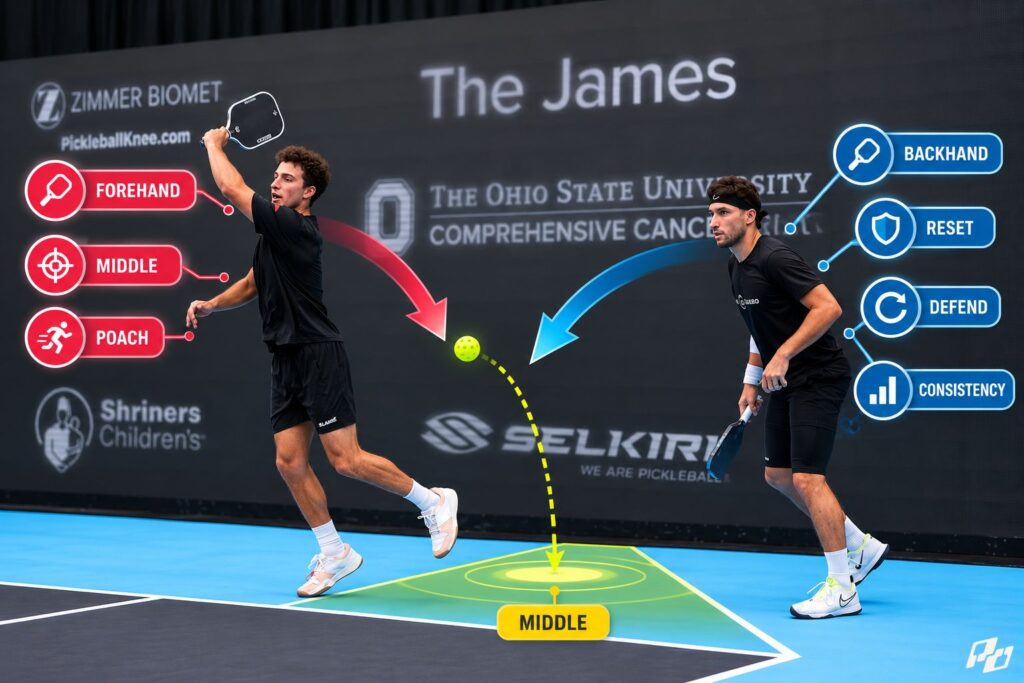
Most players choose a side by asking: “Where is my forehand more comfortable?”
I’d start somewhere else. Watch what happens when the ball comes between you and your partner. That is where side fit exposes itself quickly.
On one setup, middle balls may feel automatic.
One of you steps in.
The other gives space.
Nobody hesitates.
On another setup, every third ball produces:
“Yours?”
“Mine?”
Both paddles.
Or worse: no paddles.
That’s not just a communication problem. Sometimes it’s a positioning problem.
Stacking and side-selection systems exist partly to make middle ownership clearer and put stronger strokes into that high-traffic zone.
Here’s the first thing I’d track: which arrangement creates fewer awkward middle balls?
If one setup immediately makes the middle cleaner, don’t dismiss that as coincidence. That may be telling you more than the number of winners you hit.
You May Be a Left-Side Player If You Naturally Want More Court
For a right-hander, the left can feel fantastic if your forehand is one of your best weapons.
Not because the left is glamorous. Because the geometry gives that forehand access to the middle.
The left may suit you if you naturally:
✔ step into middle balls without hesitation
✔ create offense from dinks
✔ poach without losing your own sideline
✔ handle forehand speed-ups well
✔ recover quickly after covering extra court
✔ make clear decisions under pressure
That last one matters more than people realize. If you’re going to occupy more of the middle, your partner needs to trust your decisions.
A left-side player who wants every ball but gets jammed, overreaches, and leaves the line open is not helping merely because they are “aggressive.”
The better test is: when the ball hangs in the middle, do you want it—and are you usually better after taking it?
If yes, that is meaningful.
Right Side Is Not a Lesser Role
This is probably the biggest misconception in rec doubles.
Some players resist the right because they think it means: “I’m the weaker player.” That’s a terrible way to think about it. A strong right-side player can make an aggressive partner vastly better.
Why?
Because they stabilize the rally.
They can take a pressured backhand dink without popping it up.
They can handle a speed-up.
They can reset when the point gets ugly.
They can defend the sideline.
And importantly, they don’t manufacture offense merely because they’ve gone four shots without touching the ball.
Right-side play often depends on consistency, setup, dinking, pace control, backhand counters, and disciplined decision-making.
So if your game is built around:
✔ good backhand dinks
✔ strong blocks
✔ clean counters
✔ patience
✔ reliable resets
✔ low-error decision-making
you may be giving your team more from the right than you would by trying to become the dominant left-side attacker.
And there’s an underrated question worth asking: do I need touches to play well?
Some players get antsy when they don’t see enough balls. Others can go six shots without touching one, then calmly handle the hardest ball of the rally.
That temperament matters.
Your Backhand May Decide Your Side More Than Your Forehand
This is where the usual “strong forehand goes left” advice becomes too simple.
Suppose your forehand is excellent.
Great.
But your backhand dink is also excellent. Your backhand counter is compact. Your resets are dependable.
You may actually thrive on the right because you’re comfortable handling the balls that naturally arrive there.
Now flip it.
Suppose you have a big forehand but your backhand gets shaky when opponents speed up through the middle. If you spend a lot of time on the right, opponents may repeatedly find that backhand.
Now your “best shot” matters less than your most exposed weakness. This is why I’d evaluate three strokes together:
| Side fit | What matters most |
|---|---|
| Left side | Forehand middle, poaching, attacking, recovery |
| Right side | Backhand dink, counter, reset, sideline defense |
| Either side | Serve/return quality, footwork, communication, patience |
Your side shouldn’t just maximize your favorite shot. It should minimize how often opponents can drag you into your least reliable pattern.
Righty-Lefty Teams Change the Equation
Now things get fun.
If a right-handed player stays on the left and a left-handed player stays on the right, both forehands point toward the middle.
That is one of the classic reasons teams stack.
Instead of one player protecting the middle with a backhand, both players potentially have forehands there.
That can improve:
- reach
- power
- poaching
- middle pressure
But it introduces a new problem: both players may think the middle ball belongs to them.
Two forehands in the middle are only an advantage if you know whose forehand takes which ball.
Otherwise you’ve simply upgraded from: “Nobody took it.”
to: “We both smashed paddles together.”
Agree beforehand who owns specific middle balls, especially attacks and balls taken out in front. Good stacking guidance emphasizes that positioning should make the next ball easier to understand, not create more confusion.
Should Recreational Players Stack?
Sometimes. But not because the pros do it.
Stacking is simply a way to keep both players on their preferred side regardless of the score. For rec players, it makes the most sense when the benefit is obvious:
✔ one partner is left-handed
✔ one player clearly thrives on one side
✔ one forehand dominates the middle
✔ one partner has a weakness you can reduce
✔ your team becomes noticeably more organized in one formation
What I would not do is introduce a full stack merely because: “Advanced players stack.”
Return-side stacking creates extra movement and communication demands, and poorly executed stacking can open gaps that weren’t there before.
A side advantage has to be large enough to justify the complexity. If switching creates more confusion than it solves, don’t force it.
Stop Using “Better Player Goes Left” as the Whole Test
There is some logic behind the saying.
With two right-handers, putting the stronger forehand on the left can put that forehand into more middle balls and allow that player to cover additional court.
But rec players often turn that into an ego rule: “I’m better, therefore I play left.”
That’s backwards.
Imagine Player A is slightly stronger overall but has an excellent backhand counter and naturally calm right-side game.
Player B has a dangerous forehand, loves poaching and struggles badly when forced to defend the middle with the backhand.
Putting Player A on the left simply because they have the higher rating may make the partnership worse.
You’re not trying to assign status.
You’re trying to combine skill sets.
The correct setup is the one that makes both players easier to play with.
Try the 10-Minute Test Instead of Debating It
This is probably more useful than reading another thousand words about side theory.
Get your regular partner. Play or drill for 10 minutes with your normal sides. Then switch for 10.
Don’t count winners. Track these five things:
| What to track | What you’re looking for |
|---|---|
| Unforced errors | Which setup gives away fewer routine balls? |
| Middle confusion | Fewer hesitations, collisions and untouched balls |
| Dink comfort | Who looks more natural in extended kitchen exchanges? |
| Counters | Which player handles middle/body attacks more cleanly? |
| Offensive opportunities | Which setup creates attacks without forcing them? |
Then ask one final question: which setup made the game feel simpler?
That’s important.
Not: “Where did I hit the coolest winner?”
One huge forehand can distort your memory of ten otherwise awkward minutes. You’re looking for the side where the rally repeatedly makes sense.
Then Do Something Even Better: Switch for an Entire Game
The 10-minute test reveals mechanics. A full game reveals psychology.
Play one game normally. Then reverse sides for the next one. Afterward, you and your partner should answer separately:
Where did I hesitate less?
Where did my partner look better?
Who naturally handled the middle?
Which setup survived pressure better?
Which setup produced offense without increasing errors?
Do not answer for each other first.
You may discover something interesting. You might feel fantastic on the left while your partner feels completely crowded.
Or you may believe you’re “helping” from the middle while your partner feels they never know when they’re allowed to hit the ball.
Side choice is a partnership decision. Not a personal preference survey.
Your Favorite Side May Not Be Your Best Side
This is the part I find most interesting.
Some players love the left because they get more balls. That does not necessarily mean they play it well.
Some players prefer the right because there is less responsibility. That does not necessarily mean they help the team most there.
Preference and performance can be different.
The side that feels exciting may also encourage you to overpoach. The side that feels quieter may produce far fewer errors and much better counters.
At the professional level, side switches can meaningfully change match dynamics because they alter who controls pace, who handles the middle and what patterns opponents can target. One PPA match analysis, for example, described a side switch that changed who controlled play and how the pair functioned tactically.
You don’t need to copy professional roles exactly.
But the principle absolutely transfers: position changes the shots you are repeatedly asked to hit.
That’s why side choice deserves more thought than: “I always play right.”
The Side That Fits You Is the Side That Improves the Team
This is where I’d land it.
Don’t chase a label. You don’t need to announce that you are officially a LEFT-SIDE PLAYER after one good Tuesday night.
Instead, notice patterns.
Where does your backhand hold up?
Where does your forehand become dangerous?
Where does the middle feel clean?
Where do you stop hesitating?
Where does your partner become better?
That last question may be the most important one.
Because doubles side selection isn’t really about finding the place where you look best. It’s about finding the arrangement where your strengths appear more often, your weaknesses are exposed less often, and your partner can play naturally beside you.
So don’t ask: “Which side am I supposed to play?”
Ask: “Which side makes us harder to beat?”
That’s the side that matters.