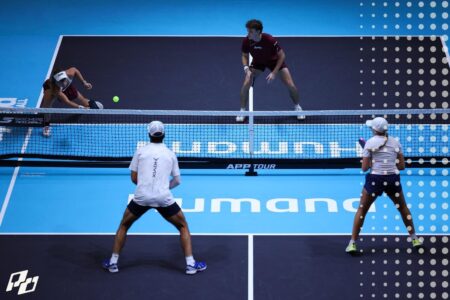

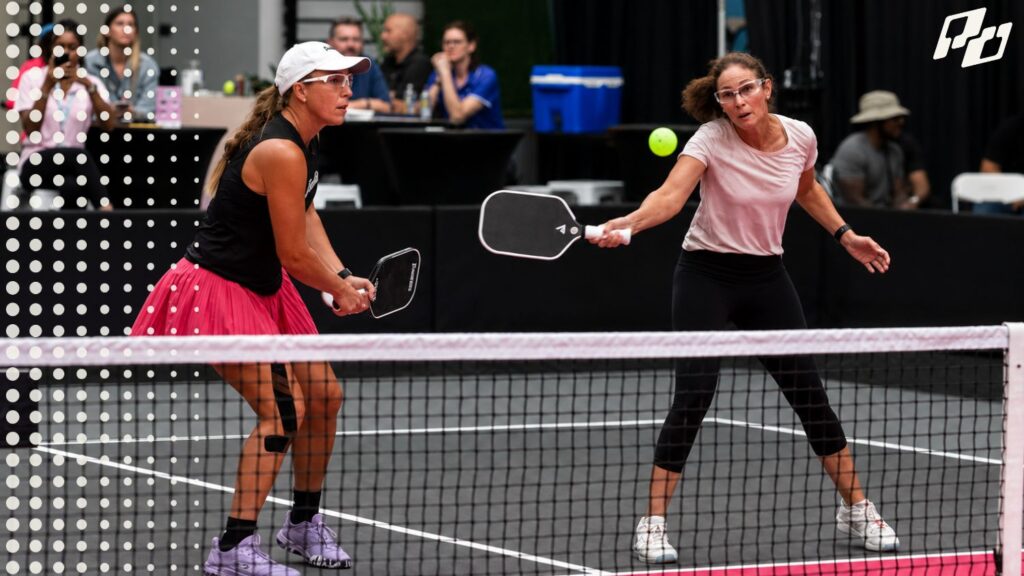
To cover the middle in pickleball doubles, use the forehand as the default, but let balance, court position, and shot quality decide. Talk before points, move as a unit, shade middle when your partner is pulled wide, and avoid reaching across their space unless you can take the ball cleanly.
Every doubles team has lived this point.
The ball floats down the middle. Both players hesitate. Or worse, both players lunge. One paddle clips the other, the ball drops untouched, and then comes the classic rec-play postmortem:
“I thought you had it.”
Middle coverage sounds simple until the ball is moving fast, your partner is drifting, your forehand is almost there, their backhand is also almost there, and nobody wants to be the person who steals the ball or leaves it.
But here’s the truth: good middle coverage is not just about saying “mine” louder. It’s about having a shared system before the point starts.
Most coaches agree on the basic starting point: the player with the forehand in the middle usually has priority. But the better coaching advice is more nuanced: the middle belongs to the player with the better angle, better balance, stronger shot, and clearer responsibility in that moment. There is no official pickleball rule assigning middle balls; it’s a team decision.
That’s the key. The middle is not “whoever wants it more.” The middle is a responsibility that shifts.
Why the Middle Causes So Much Trouble
The middle is the most tempting target in doubles because it creates uncertainty. Your opponents are not just hitting to open space. They are hitting to a decision point.
⮕ A ball down the sideline asks one player to solve the problem.
⮕ A ball down the middle asks two players to solve it at the same time.
That’s why rec teams lose so many middle balls in three ugly ways:
They both watch it.
They both swing at it.
One player overreaches and leaves a huge gap behind them.
The fix is not “be more aggressive.” The fix is knowing when the middle is yours, when it is your partner’s, and how to move as a pair without becoming two separate islands.
Rule 1: Forehand Usually Takes the Middle
This is the classic rule because it works often enough to be useful.
If both players are right-handed, the player on the left side usually has the forehand in the middle. That player can attack, roll, block, or reset more comfortably than the right-side player trying to reach with a backhand.
So yes, as a default: Forehand in the middle usually has priority.
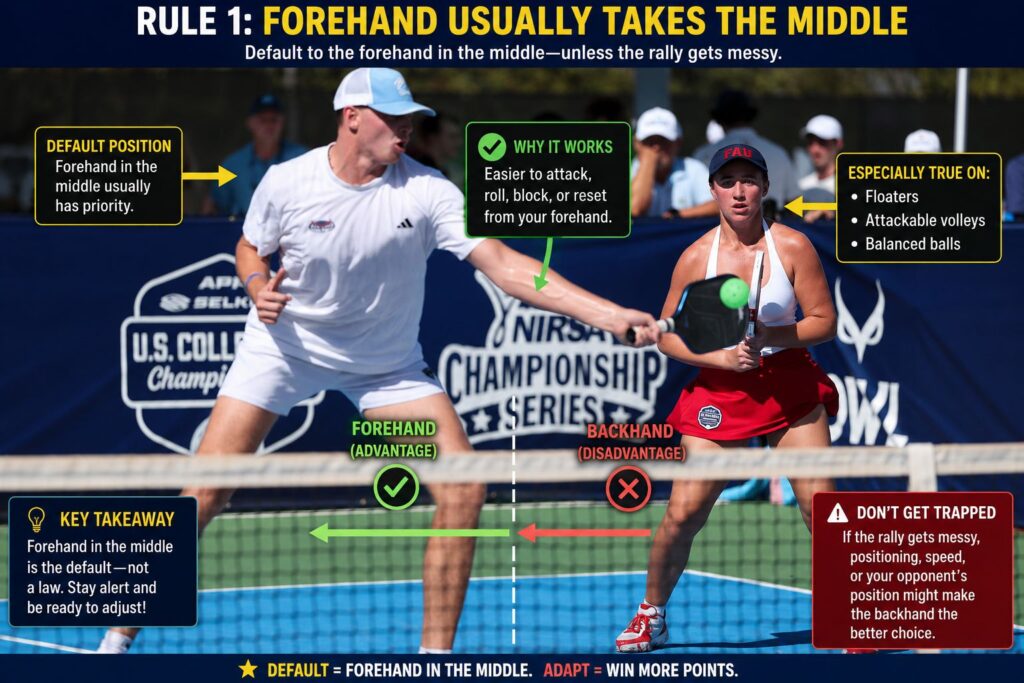
This is especially true on floaters, attackable volleys, and balls where both players are equally balanced. But here’s where rec players get into trouble: they treat the forehand rule like a law.
It isn’t.
It’s a default.
And defaults break when the rally gets messy.
Rule 2: The Balanced Player Beats the Forehand Player
Let’s say your partner technically has the forehand in the middle, but they are pulled wide, leaning, or recovering from the previous shot.
You are balanced. Your paddle is up. The ball is coming through the middle. That ball may be yours.
A balanced backhand is often better than a desperate forehand. This is where intermediate players need to get more mature. The right shot is not always assigned by paddle side. It’s assigned by who can hit the cleanest, safest ball.
Ask yourself:
Who is stable?
Who is moving forward?
Who is reaching?
Who can make contact in front?
If your partner has the forehand but is falling away from the ball, don’t blindly defer and watch the point die.
A useful cue: Forehand wins ties. Balance wins chaos.
Rule 3: Respect the X
One of the best middle-coverage concepts is often called “Respect the X.” The idea is that players should shift based on where the ball is coming from and where the natural angle is going, instead of standing in fixed half-court boxes.
Here’s the rec-player version.
When your opponent hits from one side, the most dangerous replies often travel diagonally or through the middle. Your team should tilt toward that threat together.
If the ball is in front of your partner, your partner usually takes the line and the closer middle. You shade toward the center to help cover the seam.
If the ball is in front of you, you take your line and the closer middle. Your partner pinches inward behind you.
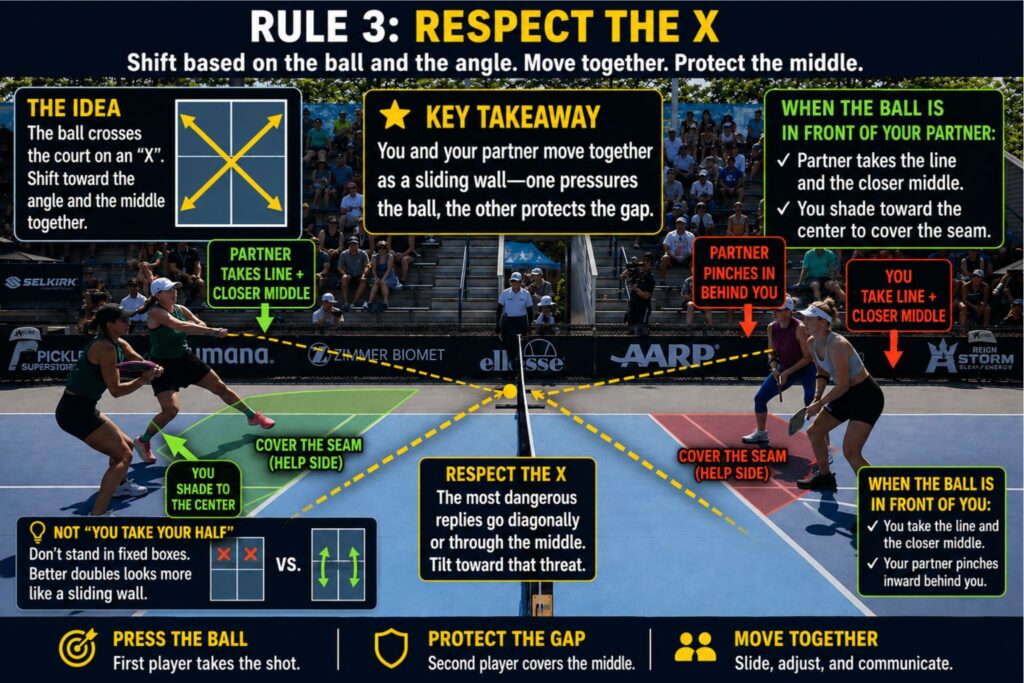
This is not “you take your half, I take my half.”
Better doubles looks more like a sliding wall.
You and your partner move together, with one player pressuring the ball and the other protecting the gap.
Rule 4: Don’t Cover the Middle by Abandoning the Sideline
This is the mistake aggressive rec players make.
They hear “cover the middle,” so they crash inward on everything. Then their opponent calmly pushes the next ball behind them down the line.
Middle coverage does not mean both players squeeze into the center like they’re posing for a team photo.
It means you bias toward the highest-probability threat while still respecting the line.
A good way to think about it: The outside player protects the line first. The inside player helps close the middle.
If your partner is pulled wide, you should shade middle — but not so far that a basic crosscourt or line ball beats you clean.
The goal is to reduce the gap, not erase your entire side of the court.
Rule 5: Communicate Before the Point, Not During the Panic
A lot of rec players wait until the ball is already in the middle to communicate. That is too late.
By the time someone yells “mine,” both paddles may already be moving. Some coaches even warn that late calls can create more confusion than silence because both players still have to process who spoke. The better approach is to establish simple middle-ball rules before the point or between points.
Before a game, say one sentence: “If it’s middle and we’re both there, your forehand takes it.”
Or: “If I get pulled wide, you help middle.”
Or: “On floaters, I’m taking middle. On low resets, you call early.”
That sounds overly organized until you realize how many points rec teams donate because they never had the conversation.
The Best Calls Are Short
You do not need a full speech during the rally. Use short, sharp calls:
Mine.
You.
Switch.
Stay.
Go.
Bounce.
Leave.
But here’s the key: call early or don’t call at all.
Late talking often becomes noise. Early talking creates clarity.
And if you play with the same partner often, you can rely more on patterns and less on shouting. Good partners eventually know who owns which ball because they’ve already agreed on the system.
Who Takes the Middle at the Kitchen?
At the kitchen line, the middle ball usually belongs to the player who can make the smallest, cleanest move.
That often means:
The player with the forehand takes attackable balls.
The player already leaning middle takes body-speedups.
The player with the stronger counter may take faster exchanges.
The player with more time takes low resets.
The player who just hit the previous ball may have responsibility if the return comes back to the same lane.
For 3.5–4.0 players, the biggest mistake is reaching across your partner for a ball you can only poke at.
If your paddle has to cross your partner’s hitting zone, you’d better be sure you’re taking a better shot than they are.
Otherwise, you’re not covering the middle.
You’re stealing space.
Who Takes the Middle in Transition?
Transition-zone middle coverage is harder because both players may not be even.
One player may be at the kitchen. The other may be moving up. One may be split. The other may still be running.
In transition, the player who is stopped and balanced usually has priority over the player who is moving.
This is where many rec teams create collisions. The back player keeps charging forward and reaches for a middle ball while the front player is already set. Or the front player overreaches backward and cuts off a ball the back player had lined up.
A good transition cue: Set player takes it. Moving player supports.
If you are still running, your job may be to stop, split, and cover the next ball — not heroically swing through your partner’s space.
Who Takes Lobs and Overheads?
Middle overheads create ego problems. Everyone wants the smash. Nobody wants the collision.
For overheads, the best rule is usually: The player moving forward or already under the ball takes it.
If one player is backpedaling and the other is moving forward, the forward-moving player usually has the better play. Backpedaling overheads are dangerous and lower percentage.
If both players can take it, forehand usually wins. But again, balance matters more than ego.
Call early: “Mine!”
Then the partner’s job is simple: get out of the way and cover the next ball.
The Poach Problem: When Covering Middle Becomes Stealing
Poaching is not bad. Good teams poach. Advanced players use controlled poaches to pressure predictable balls.
But rec players often poach for the wrong reason.
They are bored.
They don’t trust their partner.
They want to finish the point.
They think “middle” means “mine if I can reach it.”
That kind of poaching creates tension fast. A smart poach has three qualities:
It is early.
It is decisive.
It creates a better shot than your partner would have had.
If you are lunging late across the centerline and poking the ball upward, that is not a poach. That is a donation.
A useful partner-friendly rule: Poach to finish or pressure, not to rescue your boredom.
The “One Step Rule”
Here is a simple rule for rec players:
If you can cover the middle ball with one controlled step, go.
If you need two lunging steps across your partner’s space, it is probably not yours.
This rule prevents a lot of paddle clashes and awkward body contact. It also keeps you from over-covering the middle and exposing the outside lane.
One controlled step means you are still balanced enough to hit and recover. Two desperate steps usually means you are borrowing a ball from your partner.
How to Move Without Stepping on Each Other
Think of doubles movement as a connected rope.
⮕ If your partner moves wide, you slide middle.
⮕ If your partner moves middle, you hold enough outside space.
⮕ If your partner moves back, you may need to protect more court temporarily.
⮕ If your partner moves forward, you should not crash into the same lane.
Most rec players move as individuals. Better teams move as a unit.
That means you should constantly feel your partner’s position without staring at them. You see them in your peripheral vision. You know if they are pulled wide. You know if they are recovering. You know if the middle is suddenly your job.
A cue I like: Move with your partner, not after your partner.
If you wait until the gap appears, you are late.
The Three Middle-Ball Agreements Every Rec Team Needs
Before you play with a new partner, agree on these:
1. Who takes neutral middle balls?
Usually the forehand player.
2. What happens if one player gets pulled wide?
The other player shades middle.
3. Who takes overheads or floaters?
Usually the player moving forward, or the player with the forehand if both are set.
That’s it. You do not need a 20-point strategy meeting. You just need enough structure to avoid guessing.
What to Say After a Middle Mistake
This matters. If a middle ball drops, don’t turn it into a trial.
Bad reaction: “That was yours.”
Better reaction: “Let’s say forehand takes that next time.”
Bad reaction: “Why didn’t you go?”
Better reaction: “If I get pulled wide, can you pinch middle?”
Good teams use mistakes to clarify the next point. Bad teams use mistakes to assign blame.