
A high backhand putaway should use space, shoulder load, and arm extension—not a hard wrist flick. Get the ball slightly away from your body, set the paddle, and drive through contact. You’ll create more controllable power, reduce wild misses, and turn more shoulder-high sitters into reliable attacking shots.
We keep seeing this over and over again in early-to-intermediate rec games.
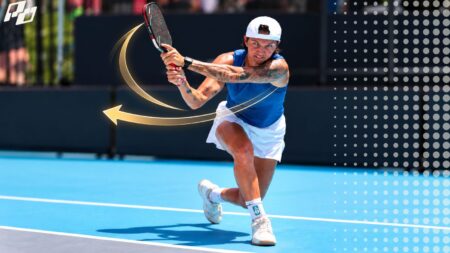
A player gets a high backhand attacking volley — the kind of ball that sits up around shoulder height at the kitchen or in transition and should be put under pressure — and instead of using the whole arm, they try to flick it hard with the wrist.
Sometimes it works. A lot of the time, it’s just a free point wasted. The ball sails long, dives into the net, or comes off the paddle with no real control.
This isn’t really a counter, because you’re not just redirecting a fast ball. It isn’t a dink speed-up either, because the ball is already sitting high enough to attack more decisively.
It’s a high backhand putaway.
And this mistake shows up constantly around 3.0–3.5, where players recognize the attackable ball but still try to manufacture too much pace from the hand.
The better version is much cleaner: create space, turn the paddle, load the shoulder, and let the arm produce the power.
Once you stop treating the shot like a wrist trick, it becomes a much more repeatable putaway instead of a 50/50 gamble.
Why This Ball Feels So Awkward
A forehand high ball is intuitive. You can rotate, extend, and swing through it without thinking much.
The high backhand is different.
Your hitting arm has less natural room to accelerate, especially if the ball gets too close to your chest. That’s when rec players start inventing power with the hand.
And the hand is a terrible place to ask for all of it.
A strong high backhand should use the whole kinetic chain, not a wrist-dominant slap. Load the body, keep the paddle face controlled, and let the legs, torso, arm, and paddle work together to create pace.
That leads to the first big idea: if the shot feels like all wrist, you probably got jammed or skipped the body turn.
The Most Important Fix: Make Room First
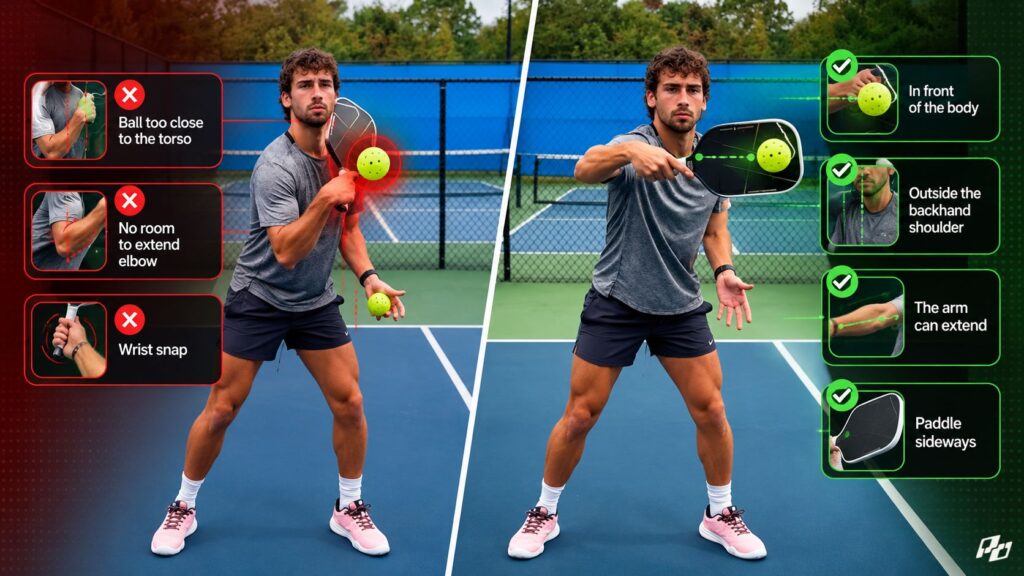
A lot of bad backhand putaways are already doomed before the swing starts.
The ball gets too close to the torso.
Now the elbow has nowhere to go.
So the player flips the wrist because that’s the only joint left with room to move.
A better contact position is:
- in front of the body
- slightly outside the backhand shoulder
- far enough away that the arm can extend
That space is what lets you use the arm and shoulder instead of improvising with the hand.
So before thinking about power, ask: “Do I actually have space to swing through this?”
If not, don’t force the putaway.
Block it.
Punch it.
Reset it.
But don’t try to create a winner from a ball that is already crowding you.
Turn the Paddle Sideways—But Don’t Misread What That Means
You are not simply rotating the paddle sideways and then swinging blindly. You are organizing the paddle so the face can stay controlled while the shoulder and arm drive through the contact.
For a right-handed one-handed backhand, that often means preparing with the paddle edge or face more turned relative to the incoming ball, then allowing the arm to extend through as the paddle face closes enough to keep the attack down.
High-backhand instruction repeatedly emphasizes controlling that paddle-face orientation so the ball does not sail long.
The sensation should be: set the paddle → load the shoulder → send the arm.
Not: set the paddle → snap the wrist.
That’s a completely different shot.
Use the Shoulder as the Load
This is the part most rec players skip.
You do not need a giant backswing. But you do need some stored energy. The shoulder and upper torso should turn slightly as the ball comes in.
That gives the hitting arm somewhere to accelerate from.
Then the arm moves through the ball. Think of it like a compact throwing motion.
One of the better descriptions from recent coaching is to think less about “flicking” and more about throwing the backhand.
That mental image helps because throwing naturally uses a sequence. You don’t throw with the wrist first.
You load.
Then release.
That is what you want here.
The Wrist Is Not Frozen—It’s Just Not the Engine
This distinction is important.
Saying “don’t use the wrist” can create a stiff, robotic shot. That’s not the goal either. The wrist can help organize the paddle face and release naturally through the motion.
What you don’t want is active wrist-generated power.
If your hand is doing most of the accelerating, you get:
❌ too much face change
❌ late contact
❌ poor directional control
❌ inconsistent depth
For a high one-handed backhand putaway, the bigger sources of usable force should be:
✅ body turn
✅ shoulder
✅ arm extension
The wrist comes along for the ride.
That’s also why these shots often feel cleaner when you loosen the grip slightly instead of squeezing the handle and trying to “muscle” the paddle.
Where Should the Paddle Finish?
A high backhand putaway is not a punch volley. It needs more follow-through.
Once you contact in front, let the arm continue through the ball rather than stopping immediately.
A strong high backhand putaway should finish with a complete follow-through while keeping the paddle face controlled through the end of the swing.
For a one-handed version, the finish will generally continue out and across/down depending on the target and contact height.
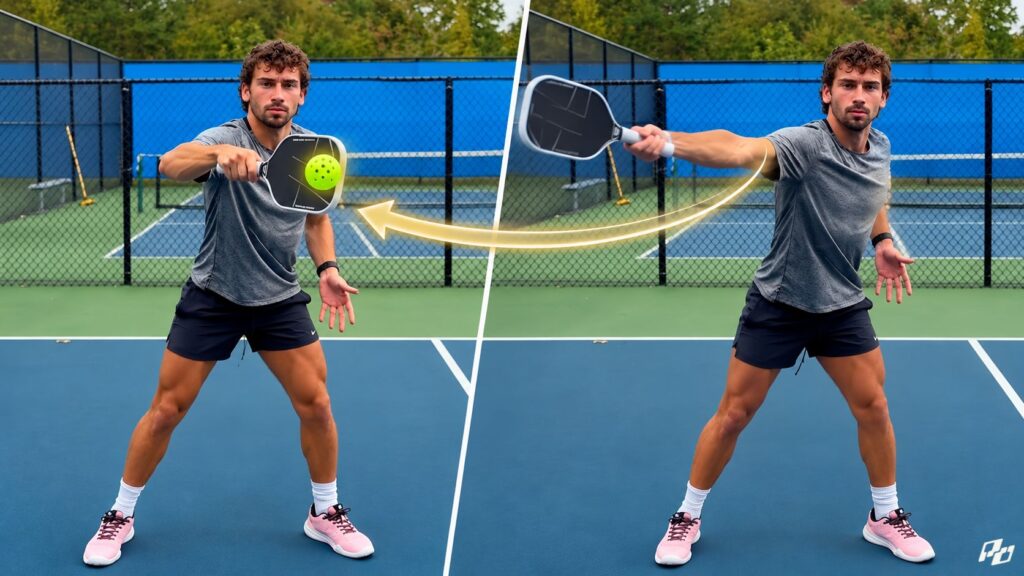
The exact endpoint matters less than this: the arm should complete the shot; the wrist should not be the thing that completes it.
If your paddle snaps violently but your arm barely moves, you’re probably back in slap mode.
This Is Not the Same as a Backhand Punch Volley
This is where players get confused. A normal backhand punch volley on a fast incoming ball is deliberately compact.
You use the opponent’s pace.
Minimal backswing.
Short extension.
Quick recovery.
@jamesignatowichpb Don’t lean back or jump on backhand volleys. Most important thing is getting the ball down, not necessarily hitting the ball hard. #pickleball #rpmpickleball #jamesignatowich ♬ original sound – jamesignatowichpb
That’s exactly how standard backhand punch-volley instruction describes it. But a high floating backhand is different.
The ball has given you time. You may need to create more of the pace yourself. That earns you:
- more shoulder load
- more arm extension
- more follow-through
So don’t use the same mechanics for both:
Fast ball into your body?
Use a compact punch.
High sitter on the backhand?
Load up and drive through it. Here’s how:
@tanner.pickleball How to Put Away a Ball That Comes High to Your Backhand in Pickleball! 🏆🥇 1️⃣ Close off your paddle face by turning your wrist in. 2️⃣ Coil your hips and obliques in preparation to hit the ball. 3️⃣ Swing OUT with the stroke, not down. #pickleball #pickleballtiktok #pickleballlife #pickleballaddict #pickleballtips ♬ original sound – Tanner.pickleball
And What About Two Hands?
If you already use a two-handed backhand, this is often an excellent ball for it.
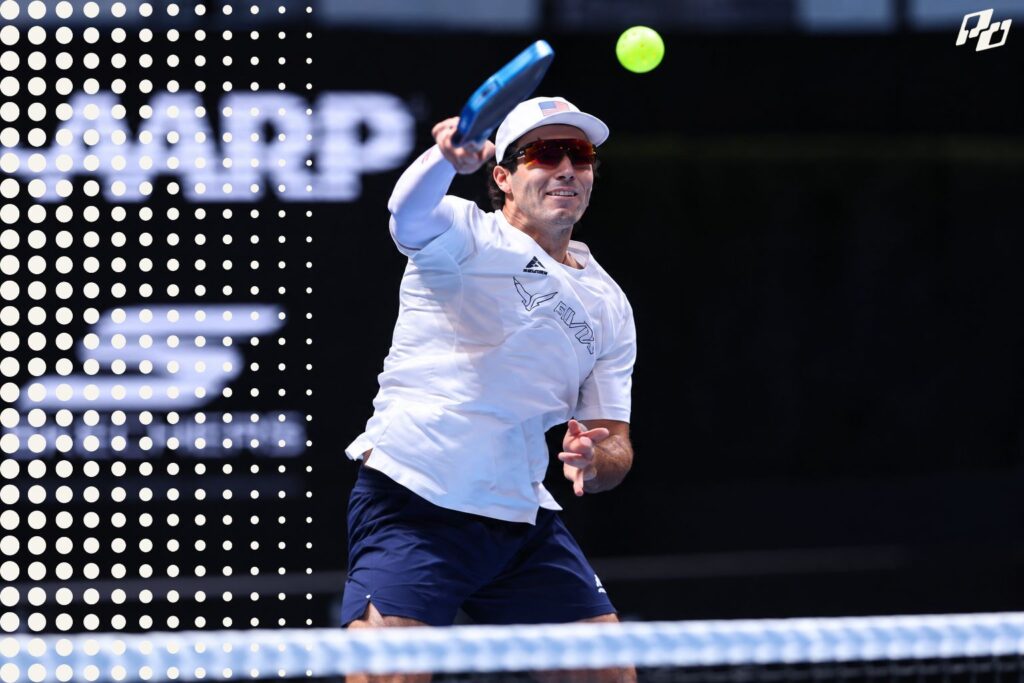
Pro player James Ignatowich, coach Jordan Briones and other high-level players have specifically discussed using two hands on high backhands because the second hand adds leverage, stability, power, and control, especially when the ball is outside the backhand shoulder.
For a right-handed player, the left hand can contribute significantly to the acceleration.
The sequence becomes: turn → create space → load → left side drives → contact in front → finish:
@brionespickleball Backhand Putaway Power in 30 Seconds!
♬ original sound – Briones Pickleball
The extra hand can make the paddle face easier to control and reduce the temptation to slap with the dominant wrist.
But I wouldn’t force two hands onto every high backhand.
- If the ball is very wide and you need reach, one hand may be better.
- If the ball is directly in front of the chest, a compact one-handed counter may be faster.
If it is truly overhead, you may be better off using an overhead rather than trying to manufacture a two-handed swing.
The Ball Still Has to Be Attackable
High does not automatically mean smash.
If the ball is high but:
then you do not really own the attack. That is another common 3.5 mistake.
Players see height and immediately think: winner
But the quality of the contact matters just as much as the height.
A much better filter is: high + balanced + space = attack.
Take away one of those three and the percentage drops quickly.
Where Should You Aim?
You don’t need to paint the sideline. If you’ve already got a ball above the net, your height advantage gives you plenty.
Good targets are usually:
- feet
- middle seam
- paddle-side hip
- open gap
Larger, body-oriented targets give you a better margin for aggression without forcing you to hit into a tiny window.
For most rec players, I’d favor: middle or feet first. You can swing with intent and still use a big target.
That’s a much better combination than max power plus a six-inch sideline window.
The Drill That Fixes This Fast
Have a partner feed you slow, shoulder-high backhand balls.
Do not hit hard at first.
Start around 50–60%.
Your only job is to feel this sequence:
- turn
- make space
- set the paddle
- load the shoulder
- extend the arm
- finish
Hit 15–20 balls like that. Then increase pace. After that, randomize the feeds:
- one at the chest
- one high and outside
- one wide
- one truly overhead
Now you have to choose between:
✔ punch
✔ high backhand putaway
✔ two-handed attack
✔ overhead
That decision-making layer is important because the technique only works if you use it on the right ball.
The Cue I’d Give a 3.5 Player
Forget: “snap it.”
Use: “Turn. Make space. Throw the arm.”
That captures almost everything.
The high backhand becomes much more reliable when the arm and shoulder create the pace and the wrist simply helps control the paddle.
And that’s the non-obvious part:
You don’t need more hand speed.
You need less desperation from the hand.
Once the ball is far enough away from your body and the shoulder can actually load, the shot starts to feel much less like a trick—and much more like a normal attacking swing.