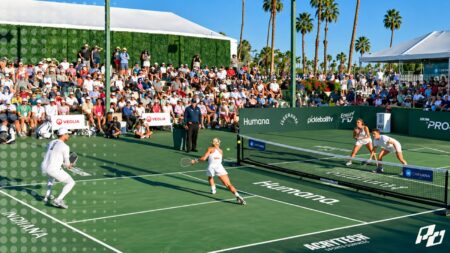
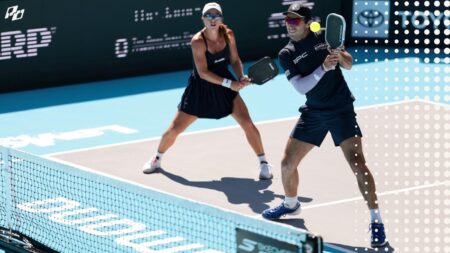
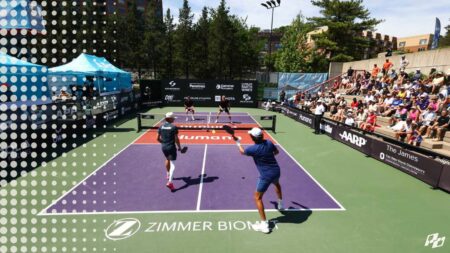
Two years ago, no one was talking about the two-handed backhand in pickleball. “That’s a tennis thing,” players would say. Even the paddle industry was primarily offering shorter handles because what do you need that extra space for?
Anna Leigh Waters changed everything.
The 18-year-old phenom didn’t just adopt the two-handed backhand (or “twoey” as it’s sometimes called), she perfected it and revolutionized professional pickleball.
Now, the twoey is here to stay! In fact, one could argue that you don’t become a 5.0 level player without mastering this technique.
What was once considered a tennis shot has become the weapon of choice for elite competitors, largely thanks to Waters’ incredible success with the technique.
The Prodigy Behind the Technique
Anna Leigh Waters has arguably the nicest two-handed backhand on tour, and at just 18 years old, she’s already rewriting pickleball history.
She currently holds the #1 ranking in all three divisions and dominated 2024 with 42 gold medals in 17 tournaments, losing only once in singles competition.
Her athletic foundation sets her apart:
- Multi-sport background – Competitive soccer and tennis experience
- Elite genetics – Both parents were Division I college athletes
- Exceptional coordination – Hand-eye skills that translate perfectly to pickleball
- Financial success – Currently earning over $3 million annually as pickleball’s highest-paid player
But it’s not just her natural talent that makes Waters special. She’s revolutionized how players think about the backhand side of the court, turning what many considered a defensive position into an offensive launching pad.
Her partnership with her mother and coach, Leigh Waters, has created a playing style that emphasizes aggressive shot-making from every position on the court. This “banging and ripping” approach moved pickleball away from traditional finesse-based play toward tennis-inspired power shots.
Watch Anna Leigh Waters break down some of her techniques:
What Makes Waters’ Twoey a Thing of Beauty
1. The fluid C-shaped swing
Waters’ two-hander off the bounce truly is a thing of beauty.
Her incredibly fluid C-shaped swing gives her effortless power and topspin that puts serious pressure on opponents. The motion looks almost effortless, but it’s the result of thousands of hours of practice and perfect biomechanical understanding.
What makes it special:
- Compact preparation – No wasted movement or excessive backswing
- Impeccable timing – Contact point perfectly synchronized with body rotation
- Effortless power – Generates massive force without appearing to strain
- Consistent execution – Repeatable under the highest pressure situations
The beauty isn’t just aesthetic, it’s functional.
Waters has perfected a technique that maximizes power while maintaining pinpoint control. This allows her to dictate play from positions where most players would be purely defensive.
2. Ultimate versatility across all situations
Waters demonstrates how much more offensive players can be with a two-handed backhand. She personally employs this shot in nearly every situation she encounters:
Offensive plays:
- Drops – Soft, controlled shots that neutralize aggressive play
- Drives – Powerful groundstrokes that push opponents back
- Speed-ups – Quick offensive attacks that end points
- Putaways – Finishing shots when opportunities arise
Defensive and transitional plays:
- Dinks – Kitchen line exchanges with superior spin and placement
- Resets – Neutralizing shots when under pressure
- Poaches – Aggressive net play to steal points from partners
- Defensive blocks – Absorbing pace while maintaining court position
Her confidence and execution in tight situations are next level. Opponents never know when she’ll switch from defense to offense, creating a psychological advantage that goes beyond pure technique.
Watch Anna Leigh Waters explain her two-handed backhand topspin dink:
The Technical Breakdown Behind Waters’ Two-Handed Backhand
Now let’s take a look at the mechanics behind Waters’ two-handed backhand.
Grip fundamentals
Getting the grip right is key for executing a devastating twoey.
According to pro player Zane Navratil, the foundation starts with a continental grip for the dominant hand, then adding the non-dominant hand above it.
Essential grip elements:
- Hand positioning – Non-dominant hand placed directly above dominant hand
- No overlap – Hands should touch but never overlap for maximum control
- Grip pressure – Secure but relaxed, allowing for quick adjustments
- Unified movement – Both hands work together as a single unit
The grip setup might feel awkward initially for players used to one-handed techniques, but it’s the foundation that enables everything else Waters does with her twoey.
The power sequence: From legs to paddle
Waters’ C-shaped swing follows a specific kinetic chain pattern:
- Leg loading and preparation – Energy generation starts from the ground up
- Hip and trunk rotation – Core muscles transfer force through the kinetic chain
- Compact arm swing – Arms add finishing power and spin control
- Follow-through – Complete motion across the body for maximum spin
This sequence creates a powerful kinetic chain where energy transfers from the lower body through the core to the paddle for max power and control. The result is shots that appear effortless but carry insane speed and spin.
Footwork: The L-shaped foundation
Proper L-shaped footwork creates a stable foundation for Waters’ backhand:
- Balanced positioning – Feet placed in perpendicular L-shape for stability
- Early preparation – Movement and positioning before the ball arrives
- Weight transfer – Proper shifting from back foot to front foot
- Recovery – Quick return to neutral position for next shot
The footwork isn’t just about getting to the ball. It’s about creating the optimal body position to unleash the full power of the twoey while maintaining balance and control.
How the Two-Handed Backhand is Revolutionizing Pickleball
There’s no denying the effectiveness of a well-executed twoey:
- More power than traditional one-handed techniques
- Enhanced stability when stretched out of position or under pressure
- Superior spin generation for both offensive and defensive shots
- Better control for strategic shot placement across the court
These advantages are clearly visible when watching elite players like Waters dominate with their two-handed backhands in high-pressure tournament situations.
Waters has proven that players with effective twoeys can be more aggressive from more positions on the court, fundamentally changing rally dynamics and forcing opponents to adjust their entire strategy.
Quick Comparison Chart: One-Handed vs Two-Handed Backhand
While Anna Leigh Waters has popularized the two-handed backhand at the pro level, many players still wonder how it stacks up against the traditional one-hander.
Here’s a quick comparison to help you understand the key differences and decide which might suit your game better:
| Feature | One-Handed Backhand | Two-Handed Backhand |
|---|---|---|
| Power | Moderate | High |
| Reach | Longer reach | Slightly limited |
| Stability under pressure | Lower | Higher |
| Spin potential | Moderate | High |
| Learning curve | Shorter | Longer |
How to Develop Your Two-Handed Backhand
Players at any level can practice the two-handed backhand using proven strategies.
Foundational elements:
- Proper L-shaped footwork used every single time
- Smooth, compact C-shaped swing path with no wasted motion
- Clean contact out in front from low to high for optimal spin
- Consistent repetition following established form principles
The key is understanding that this isn’t just adding a second hand to your existing backhand. It’s learning an entirely new stroke with its own biomechanics and timing.
Progressive development approach
Phase 1: Grip and basic motion
- Master the two-handed grip setup
- Practice the C-shaped swing path without a ball
- Focus on smooth, coordinated hand movement
- Develop muscle memory for the motion
Phase 2: Add ball contact
- Start with gentle feeds from a partner
- Emphasize clean contact and follow-through
- Focus on consistency over power initially
- Gradually increase pace as comfort develops
Phase 3: Integrate footwork
- Combine proper L-shaped footwork with swing
- Practice moving to balls and maintaining form
- Work on transitioning from preparation to execution
- Develop timing for different ball speeds and bounces
Phase 4: Tactical application
- Practice different shot types (drops, drives, dinks)
- Work on disguising shot selection
- Integrate into point play and match situations
- Develop confidence under pressure
The bottom line: It’s not impossible—just stick to the guidelines and practice consistently! Like any advanced technique, the two-handed backhand requires dedicated practice.
Pickleball Paddles for Two-Handed Backhands
Just a couple years ago two-handed backhands were being dismissed as a tennis thing, and now an entire space exists for pickleball paddles with longer handles.
Anna Leigh Waters personally uses a Paddletek Bantam ALW-C, her signature paddle developed in collaboration with Paddletek. The line of paddles is designed to provide a combination of power, spin, and flexibility.
Weight: 7.7 oz
Handle: 5.25"
Core: 12.7mm polymer (control + speed)
Face: Raw carbon fiber for spin
Grip: 4 1/4" medium cushion

What to look for in a twoey paddle:
- Extended handles for proper hand positioning
- Raw carbon fiber surfaces for maximum spin generation
- Elongated or wide-body designs to accommodate two-handed technique
- Professional-grade construction for durability during aggressive play
ALW is Changing the Sport–Are You Ready?
Anna Leigh Waters has proven that the two-handed backhand isn’t just a “tennis thing” anymore.
It’s become an essential technique, especially for high-level pickleball, and it shows how innovation can transform an entire sport in just a few years.
For aspiring competitive players, developing two-handed backhand proficiency is no longer optional. As more players develop effective twoeys, the overall level of play continues to rise, pushing the boundaries of what’s possible on a pickleball court.