
You already “know” the punch volley: compact swing, paddle out front, no backswing. But if you’re an early-intermediate to intermediate player, the real unlock isn’t how to punch—it’s when, where, and how little to move so your punch creates repeatable pressure without spraying errors.
This is a no-fuss, field-tested guide to making your punch volley the quiet weapon that tilts hands battles—and entire games—in your favor.
The Big Idea: Don’t Swing Hard—Win Early
At 3.5-ish speeds, most exchanges are lost by over-swinging and poor contact spacing, not by “slow hands.” Your goal with a punch volley is to win early by:
- Beating contact (hitting at your ideal distance, not jammed or fully extended),
- Beating target (feet, hip seam, or outside shoulder), and
- Beating readiness (finishing in front, already set for the next ball).
Small, boring mechanics beat big, heroic swings. Pros harp on this for a reason:
Mechanics That Scale Under Pressure
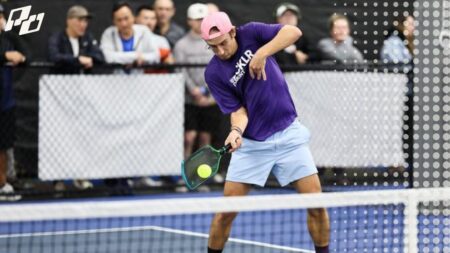
- Compact from the shoulder. Keep wrist and elbow quiet; the stroke is a 6–12 inch “push.” Finish with the paddle still in front so you’re instantly ready for the next shot.
- Lead with the right surface. Forehand = palm leads. Backhand = knuckles lead. This keeps the paddle face clean and prevents floaty pop-ups.
- Goldilocks contact zone. Not too close (jammed), not too far (loss of control). Slide your feet or torso micro-steps to meet the ball instead of reaching.
- Paddle quiet; recovery loud. No big backswing, no big follow-through. After contact, reset instantly to ready:
The Decision Tree: Punch, Block, or Roll?
Before you swing, read the ball:
- Ball low or you’re under pressure? Block. Absorb pace, aim deep middle or at feet.
- Ball in your comfort zone (chest to shoulder)? Punch. Push through the seam or feet with a compact stroke.
- Ball sitting higher or floating? Roll. Add topspin to shoulder or hip for the putaway.
Think of the punch volley as the “middle gear.” Not purely defensive like a block, not a full winner like a roll—but the bridge between them.
Be sure to check out our guide on punch vs. block volleys, too.
Targeting That Wins Hands Battles
When in doubt, pick targets that take time away from your opponent:
- Feet first. Punching down into shoelaces forces weak, defensive half-volleys.
- Seam second. The “confusion zone” between partners is your friend.
- Outside shoulder third. Especially effective against two-handers—test their non-dominant reach.
- Change feet, not lanes. Staying crosscourt but alternating inside/outside foot can dismantle timing without risky direction changes.
Footwork & Spacing: Micro-Moves, Massive Payoff
- Micro slide, don’t reach. Two-inch sidesteps save you from adding uncontrolled swing length.
- Elbow “V” stays snug. Think “V for volley”—your elbow should stay close to your torso, paddle in your vision.
- Backhand bias. At the kitchen line, the backhand volley naturally covers more area with less motion. Favor it when you can.
Common Intermediate Mistakes (and Easy Fixes)
- Over-swinging to end points. Fix: shorten to 6–12 inches. Let target and timing, not power, do the work.
- Wristy snaps. Fix: lock your wrist; generate pace from shoulder and spacing.
- Getting jammed. Fix: move early; keep contact at a comfortable arm’s length in front.
- Admiring your shot. Fix: reset immediately; always expect the ball back.
- Aiming for open court too early. Fix: go feet → seam → shoulder before thinking about hitting away.
Drills That Translate Directly to Matches
- Figure-8 Punch Volleys: Partner rallies forehand-to-forehand and backhand-to-backhand in a looping “8” pattern. Focus on compact pushes and quick resets.
- Catch-to-Punch Drill: Have a partner toss balls. Catch them out front with your hand, then replicate the same hand path with the paddle. Builds spacing and feel.
- Anti-Jam Drill: Feeder hits at your body; you must step and create room to punch from either far forehand or far backhand.
- Drive-to-Punch Transition: Partner drives from baseline; you hold the line and practice punching volleys deep. Mix in “let it go” calls to train out-ball reading.
- Speed-Up Read → Punch: Partner alternates neutral and aggressive speed-ups. You read trajectory, block low, punch anything in your strike zone.
Figure 8 volleys:
3 Pro Notes Worth Borrowing
- Less is more. Compact strokes hold up better under pressure than big swings.
- Ready beats reach. Paddle up and centered gives you options; reaching commits you early.
- Punch builds the roll. A quality punch often creates the sitter that sets up your next roll or putaway.
A Bonus Lesson I Learned the Hard Way
One thing I wish someone had told me earlier: a punch volley isn’t just about the shot—it’s about what happens right after it. The players who win more hands battles aren’t the ones with the hardest punch, but the ones who reset to ready quicker than anyone else on the court.
Here’s my little hack: after every punch, I whisper “ready” to myself as the paddle snaps back out front.
It sounds silly, but it stops me from admiring the shot or freezing. Suddenly, I’m not just trading volleys—I’m dictating the rhythm, one compact punch at a time.
Quick Reference (Save to Your Notes)
- Punch window: chest → low-shoulder, neutral/upcoming ball.
- Stroke: 6–12 in shoulder-driven push; wrist quiet; finish in front.
- Targets: feet → seam → outside shoulder.
- Legal: don’t volley while touching/landing in NVZ (Section 9).