
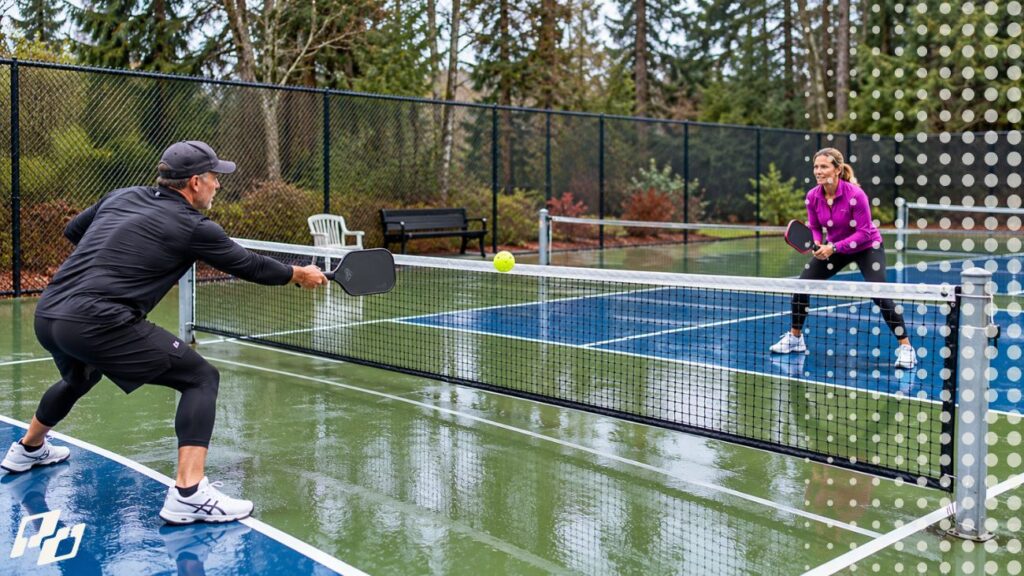
Cold weather changes both your body and your gear. Below about 50°F (10°C), pickleballs become more brittle, muscles take longer to warm, and hand control can suffer. Warm up longer, keep moving between games, store paddles and balls indoors, protect your hands, and adjust your touch as temperatures drop.
You know that first cold-weather game where everything feels slightly wrong?
Your hands feel wooden. Your drops keep popping up. The ball sounds harder. Your first few lateral moves feel suspiciously slow. And then, somewhere around Game 3, someone splits another pickleball.
That isn’t just winter grumpiness.
Cold changes the ball, the paddle, your muscles, your hands—and potentially the way you should play.
And around 50°F (10°C) is where some of those changes become difficult to ignore.
The weird part: both you and the ball are getting stiffer
Think of cold-weather pickleball as two things happening simultaneously.
The plastic ball becomes harder and more brittle, while your muscles, joints and fingers become less responsive as they cool.
Pickleball.com identifies roughly 50°F / 10°C as the point below which outdoor polymer balls become noticeably more brittle and cracking increases sharply.
Players notice it immediately. In cold-weather discussions, some describe X-40s cracking repeatedly around the 40s, while others switch to more cold-tolerant balls or simply carry a lot more of them. That’s anecdotal rather than laboratory testing, but the pattern is remarkably consistent.
Your body is changing too.
Research on muscle temperature suggests that explosive, rate-dependent muscular performance improves about 3.5% for every 1°C increase in muscle temperature within normal physiological ranges. Older research reviews have placed the effect in roughly the 2–5% per 1°C range for short-duration performance.
That doesn’t mean a 10-degree drop in air temperature automatically makes you 35% slower—air temperature and muscle temperature are completely different things.
But it does explain something pickleball players recognize instantly:
A genuinely cold muscle isn’t merely uncomfortable. It produces force more slowly.
And pickleball happens to demand exactly the things cooling can affect: explosive first steps, sudden stops, lateral movement, hand speed and tiny adjustments at the paddle.
Here’s how I’d think about the temperature
There isn’t one scientific “too cold for pickleball” number. Wind, rain, clothing, fitness, acclimatization and how long you’re standing between games all matter.
But these are useful practical zones.
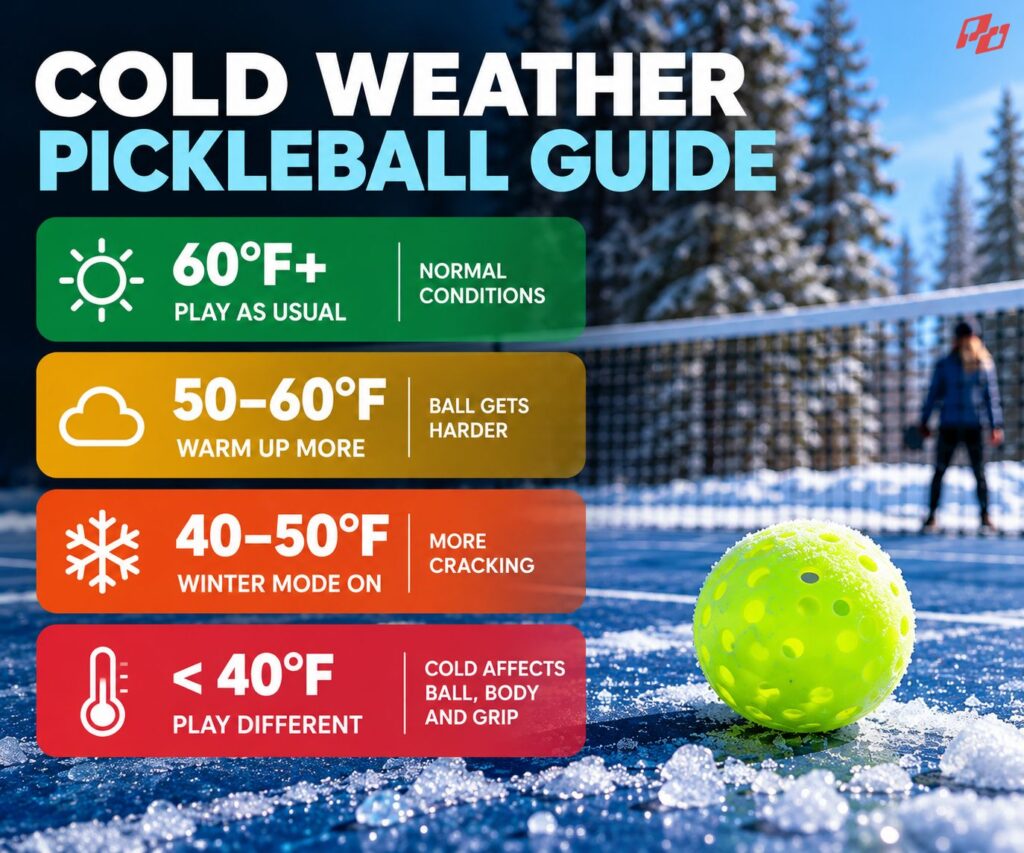
Above 60°F / 16°C: basically normal
You may feel cool before playing, but most players warm rapidly once moving.
Your normal warm-up is probably sufficient.
50–60°F / 10–16°C: start paying attention
This is where I would stop treating the warm-up as something you do while casually hitting three dinks.
You may still feel perfectly comfortable, but the ball is getting harder and your tissues take longer to reach playing temperature.
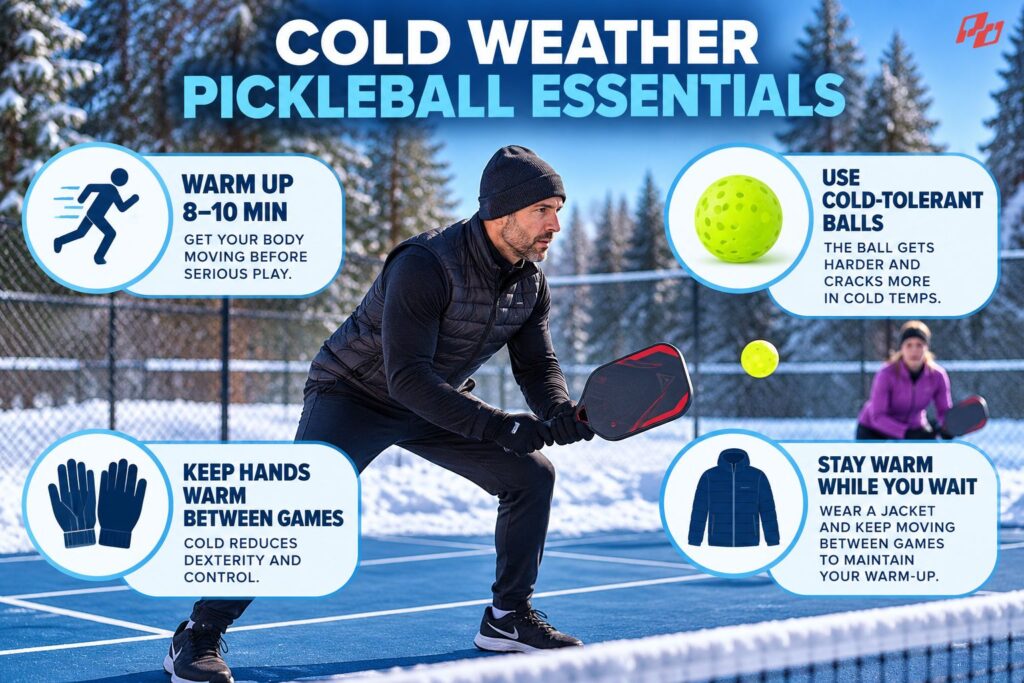
Give yourself 8–10 minutes of actual movement before serious play.
Not stretching.
Movement.
Walk or jog, shuffle laterally, perform split steps, body-weight squats, calf raises, shadow swings and progressive volleys. Then start hitting.
40–50°F / 4–10°C: pickleball is now different
Below roughly 50°F, ball cracking becomes substantially more common. This is also the range where standing around becomes your enemy.
If you warm up for 10 minutes and then wait 15 minutes for your turn, you haven’t “already warmed up.” You’re cooling down again.
Keep a jacket on between games. Walk. Shuffle. Move your fingers. Keep your paddle hand warm.
Think of warming up as something you maintain, not something you complete.
Below 40°F / 4°C: you’re playing winter pickleball
People absolutely do it. Players report sessions in the 20s°F and even light snow.
But now I would stop pretending you’re playing under normal conditions. Your ball, court, grip, muscles and hands may all behave differently.
And wind makes the temperature number deceptively comforting. The American Heart Association gives a useful example: 30°F (-1°C) with a 30 mph wind produces a cooling effect around 15°F (-9°C).
Add dampness and the body loses heat even faster. At this point, “Can I tolerate it?” is not the best question.
Ask: Can I still move normally?
If your feet feel clumsy, your fingers aren’t controlling the paddle normally or you’re shivering between points, the quality of the session is already deteriorating.
Your hands may be the first thing to betray you
This matters more in pickleball than people realize.
Researchers studying cold exposure have found meaningful losses in manual dexterity as the hands cool. One 2025 study found greater dexterity declines once finger-skin temperature fell to about 22.9°C (73.2°F) and hand-skin temperature to about 24.9°C (76.8°F).
Those aren’t outdoor-air temperatures—they’re the temperatures of your skin.
But the takeaway is extremely relevant: You can lose fine hand control before you feel “dangerously cold.”
That’s your resets.
Your grip changes.
Your paddle-face adjustments.
Your ability to soften a hard ball at the kitchen.
So here’s a winter tip I like much more than “wear gloves”:
Warm your paddle hand between games.
A bulky glove while playing can completely change your grip. Instead, consider thin racket or golf-style gloves if you like them, or keep a hand warmer in your jacket pocket and warm the paddle hand while waiting.
Some cold-weather players even use mitt-style covers that allow the paddle handle through the opening, precisely because they preserve direct contact with the handle.
Your non-paddle hand can wear a warmer glove. No fashion points are awarded.
Don’t stretch a cold body and call it a warm-up
This may be the most important change.
If you’re 52, it’s 42°F outside, you get out of the car and immediately start stretching your hamstrings against the fence, you haven’t actually warmed them. You have stretched cold tissue.
Instead, spend the first few minutes raising temperature.
Try this:
2 minutes: brisk walk or easy jog
2 minutes: lateral shuffles + backward movement
1 minute: squats, calf raises, easy lunges
2 minutes: shadow swings + split steps
3 minutes: easy hitting, gradually increasing pace
That’s ten minutes.
Your first full-speed sprint for a drop shot should not be the first explosive movement your calf has made all morning.
The National Institute on Aging specifically recommends warming up before exercising outdoors in cold weather, while sports-science reviews emphasize preserving muscle temperature for performance.
And here’s the part people forget: don’t stop moving between games.
A 12-minute paddle-stack wait can erase a lot of what you just accomplished. Put the warm layer back on immediately.
Your beautiful $250 paddle should not live in your trunk
This one is easy. Bring it inside.
Selkirk explicitly recommends avoiding extreme temperatures and storing paddles in a dry, room-temperature environment. Cold can increase brittleness; excessive heat can also damage materials and potentially contribute to delamination.
The bigger mistake is not necessarily playing one cold session.
It’s repeatedly leaving the paddle overnight in a freezing garage or vehicle, then taking a very cold paddle straight onto the court.
Carbon fiber, polymer cores, adhesives and foams do not all respond identically to temperature, and manufacturers don’t publish enough comparable data to confidently tell you that Paddle A loses exactly X% performance at 35°F. So don’t invent precision where it doesn’t exist.
Just use the simple rule: Your paddle sleeps indoors. Your pickleballs should too.
And don’t put freezing-cold balls straight into play
Keep your balls indoors until you leave. If it’s genuinely cold, don’t dump twelve balls onto the court and let eleven of them sit on frozen concrete while you play with one.
Keep the extras insulated in your bag or jacket and rotate them. That isn’t going to keep them warm forever, obviously.
But it prevents you from beginning the session with plastic that has already spent eight hours in a 25°F trunk.
Experienced winter players also experiment with different ball models because some tolerate cold better than others. Recent player discussion continues to report heavy cracking with X-40s in sub-50°F conditions, with players trying Selkirk and newer alternatives instead.
That’s an area where I’d test rather than blindly follow brand loyalty.
Your soft game may need recalibrating
This is the sneaky part.
Players often notice cold-weather pickleball feeling harder, faster and less forgiving. Combine that with colder fingers and you’ve got an annoying mismatch:
The ball may feel livelier off contact precisely when your hands are less capable of making fine adjustments.
So don’t panic if your first dozen resets sail higher than normal. I would make three winter adjustments:
✔️ Shorten the swing slightly.
Especially on resets and transition drops.
✔️ Loosen the grip consciously.
Cold players often squeeze harder without realizing it.
✔️ Spend more warm-up time at the kitchen.
Don’t just drive 20 balls and declare yourself ready. Your touch needs calibrating to today’s ball.
That’s a useful concept in general: You’re not only warming your body. You’re calibrating to the equipment.
Older players: give winter more respect than your 30-year-old partner does
This isn’t about treating older athletes as fragile. It’s physiology.
As we age, temperature regulation changes. Older adults generally have less muscle mass available to generate heat, altered blood-vessel responses to cold, and may be less sensitive to falling body temperature.
A recent review found evidence that adults 45 and older showed a steeper decline in body temperature than younger adults during two hours at 10°C / 50°F, although that should not be interpreted as a hard age cutoff.
Cardiovascular load matters too.
Cold constricts blood vessels and increases vascular resistance. A recent review cited population data associating each 1°C decrease in ambient temperature with average increases of about 0.26 mmHg systolic and 0.13 mmHg diastolic blood pressure.
For a healthy, active player, that doesn’t mean 45°F is dangerous.
But if you’re older and have heart disease, hypertension, diabetes, circulation issues or take medications that influence blood pressure or temperature regulation, cold-weather exertion deserves more thought.
The American Heart Association specifically identifies older adults and people with cardiovascular disease as more vulnerable to cold exposure.
My advice for older players is therefore slightly different:
Don’t simply add more clothing. Add more warm-up. Aim for 10–15 progressive minutes on genuinely cold days rather than going directly from car → dink → game.
Keep your warm layer on during every break. Protect your hands and head. Avoid arriving dehydrated simply because you aren’t thirsty; cold weather can blunt your desire to drink, and the AHA specifically advises maintaining hydration during cold-weather exercise.
And be more conservative with the first few explosive balls. That low, wide dink isn’t going anywhere.
Let it bounce.
One winter mistake almost nobody talks about: the court can be colder than the air
A weather app saying 42°F doesn’t mean the playing surface behaves like 42°F.
A shaded court can retain frost or moisture long after nearby pavement looks fine. That’s especially important in the morning.
Before play, drag your shoe across several parts of the court—baseline, kitchen, shaded edge, painted lines.
Look for:
- frost
- condensation
- damp leaves
- slick painted lines
- shaded wet patches
You can compensate for a hard pickleball. You cannot strategize your way out of your foot sliding six inches underneath you.
And yes, you still need water
Cold-weather dehydration is easy to miss because you’re not drenched in sweat. You may not feel thirsty. Drink anyway.
Bring water onto the court and take a few swallows between games instead of waiting until you’re noticeably thirsty. The AHA notes that thirst isn’t a reliable indicator of hydration needs during cold-weather activity.
One thing I wouldn’t use for warmth: alcohol.
It can make you feel warmer by dilating blood vessels while actually increasing heat loss, and it can impair judgment.
Save the celebratory drink for after pickleball.
My winter pickleball rule is simple
At 60°F, play normally.
Around 50°F, start changing your preparation.
Around 40°F, change both your preparation and your expectations.
Below that, decide based on wind, moisture, your body and your ability to stay warm—not pride.
And remember:
If the ball feels like a rock and your hands feel like two more rocks, this probably isn’t the morning to prove how fast your hands are.
Winter pickleball can be fantastic. Just understand that you’re not playing the exact same game you played in August.
The court is colder.
The plastic is colder.
You’re colder.
So warm the player, protect the gear, soften the hands—and maybe put three extra balls in your bag.
You’re probably going to need them.