
After 50, back-to-back pickleball is less about age and more about recovery. If soreness improves during a 5–10 minute warm-up and you’re moving normally, a lighter second day may be fine. If pain worsens, movement changes, or fatigue lingers, take a rest day before playing hard again.
A recent r/Pickleball thread asked a wonderfully simple question: how do players in their 40s, 50s and beyond survive back-to-back pickleball days?
The answers ranged from “rest every third day” to people in their late 60s and 70s happily playing five or six days a week. One 67-year-old said six days a week eventually produced multiple overuse injuries; another 62-year-old alternates hard competitive sessions with deliberately easier days.
That contradiction is actually the interesting part. There is no magic number of pickleball days you’re allowed after 50.
The better question is:
Has your body recovered enough from yesterday to tolerate today?
That sounds obvious. In practice, most of us answer it badly.
Stop counting pickleball days as if they’re all equal
Two hours of relaxed 3.5 social play and two hours of tournament-speed 4.5 pickleball are both “two hours.”
Your body does not agree.
Hard rallies mean more acceleration, deceleration, lunging, wide-ball recovery and explosive first steps. Pickleball injury research identifies those rapid directional changes and sudden stops as major sources of lower-extremity load, particularly in players over 50.
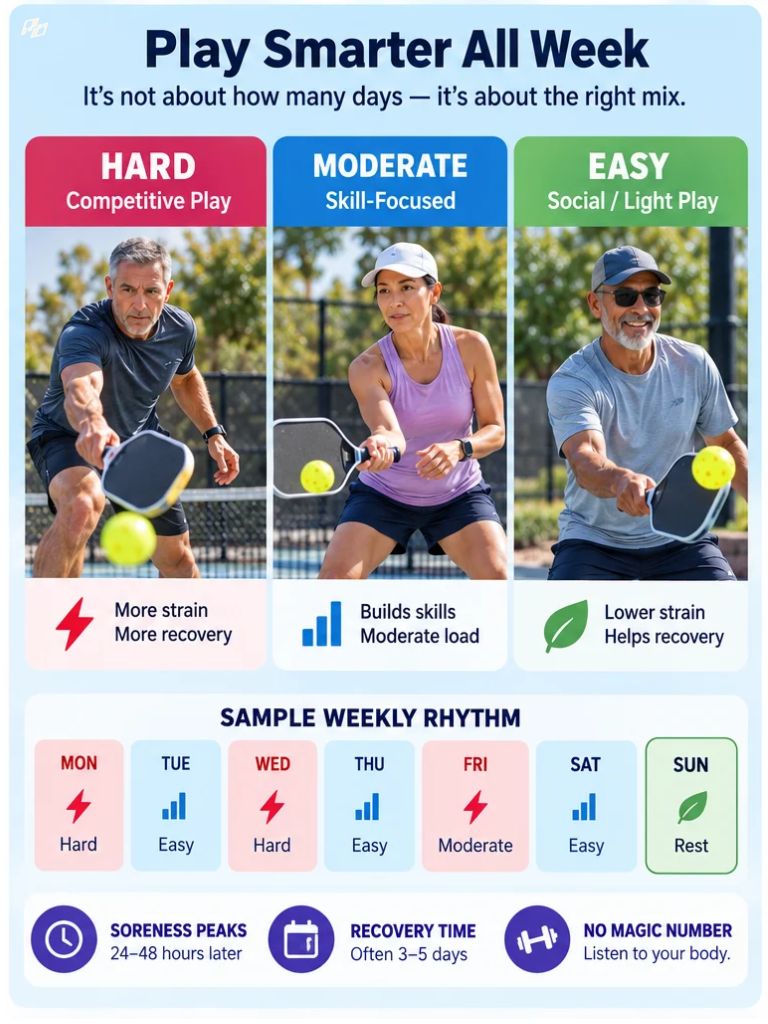
That’s why intensity matters more than the number of days on the calendar. Many experienced players handle frequent pickleball better by alternating hard competitive sessions with lighter skill-focused or social days instead of redlining every time they step on court.
For a 50+ intermediate player, that may be more useful than “take Tuesday off.”
Think: Hard day → easy day → hard day
Rather than: Hard day → hard day → hard day because the reservation was already booked.
Here’s the non-obvious part: soreness tomorrow may not be the worst of it
If you finish Monday feeling fine, Tuesday morning is not necessarily the final verdict.
Research on recovery in older adults finds exercise-related muscle soreness commonly peaks 24–48 hours later, with soreness after more muscle-damaging exercise often largely resolving within roughly 3–5 days.
Pickleball isn’t the same as a laboratory resistance workout, so don’t treat those numbers as a mandatory pickleball recovery schedule.
But they explain something familiar: Day 2 can feel worse than Day 1 even though nothing dramatic happened.
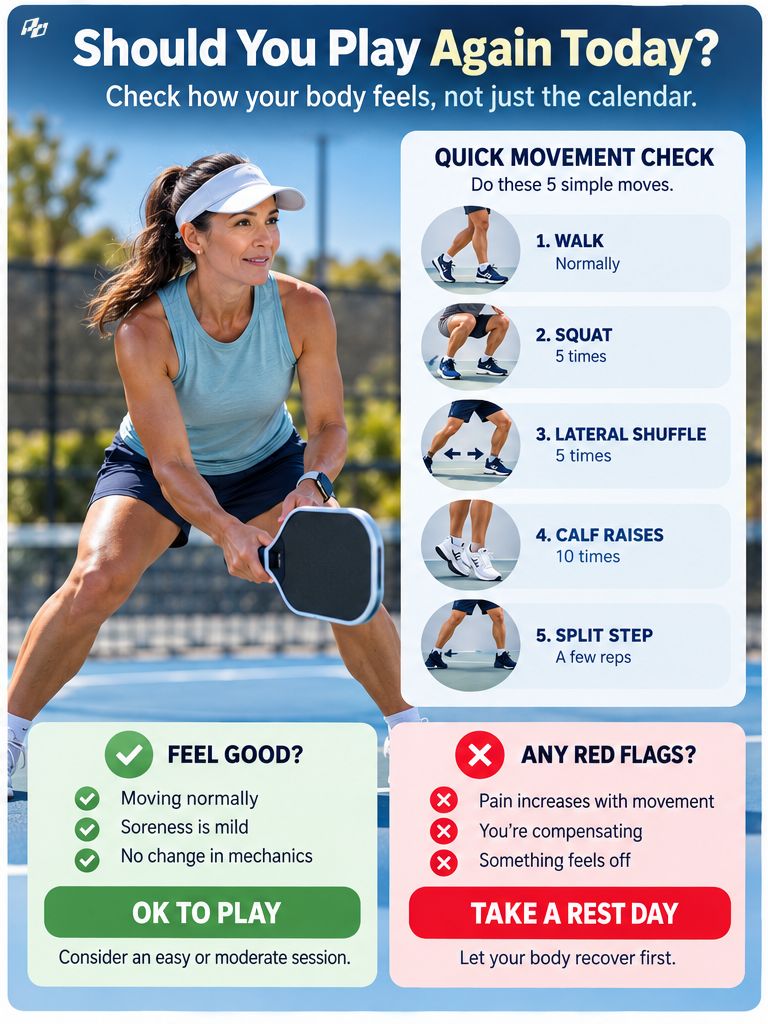
That means the dangerous question before Tuesday’s game is: “Am I sore?”
A better question is: “Am I moving normally?”
✔ Walk down stairs.
✔ Do five body-weight squats.
✔ Perform five gentle lateral shuffles.
✔ Rise onto your toes 10 times.
✔ Make a few controlled split steps.
If one calf feels protective, one knee changes your squat, or you’re shortening one stride, yesterday is still affecting today’s movement.
That’s more useful information than whether you can tolerate the ache.
Use the 10-minute rule before committing to Day 2
Here’s a practical system for back-to-back play.
Give yourself 5–10 minutes of progressive movement before deciding how hard today’s session should be.
That matches current pickleball injury-prevention recommendations emphasizing a dynamic warm-up before play. A 2026 systematic review recommends 5–10 minutes, particularly because pickleball falls, rapid directional changes, ankle loading and Achilles stress are important injury mechanisms in older players.
Start easy: brisk walking → lateral shuffle → calf raises → shallow lunges → controlled split steps → easy dinking.
Then ask: Did I loosen up—or did the problem get louder?
That’s a very useful distinction.
General stiffness that improves as you move is one thing. Pain that increases with movement, changes your mechanics, or becomes sharper as intensity rises is your stop sign.
Sports-medicine guidance for older pickleball players specifically warns against pushing through a flare-up of knee, shoulder or joint pain; adequate rest should come before returning.
One Reddit player put it even better after learning the hard way: if playing makes the pain worse, stop rather than negotiating with it. A minor back strain became weeks of rehab after they ignored that signal.
So how many days should you actually take off?
Here’s where I would avoid fake precision. There is no evidence-based rule saying every player over 50 needs exactly one day off after two pickleball days.
Fitness history, session duration, intensity, injuries, sleep and playing surface matter too much.
But a useful recreational framework is:
1. After a normal session
If you wake up with only mild soreness, normal walking and normal joint movement, an easy or moderate session the next day may be perfectly reasonable.
2. After a hard competitive session
Consider giving the heavily loaded tissues roughly 24–48 hours before another equally demanding session, especially if you are still noticeably sore or fatigued.
Older-adult strength-training guidance commonly uses at least 48 hours between demanding sessions involving the same muscles, with longer recovery when soreness or fatigue is affecting normal daily activity.
That doesn’t mean “no pickleball for 48 hours.”
It means don’t repeatedly hammer the same system at full intensity while it is still clearly recovering.
You could drill serves.
Hit controlled dinks.
Walk.
Cycle gently.
Do mobility work.
Or—radical concept—take the day off.
If soreness is still materially affecting you after 48 hours
Downgrade the next session or skip it.
If normal exercise soreness is hanging around for 3–5 days
That’s beyond the “I’m a little stiff from yesterday” territory you should casually ignore, particularly if it is localized rather than general.
Know the difference between “old-player sore” and “something is wrong”
This is where a lot of 50+ players get themselves into trouble.
Muscle soreness is usually diffuse: both quads feel tired, calves are heavy, glutes complain on stairs.
An injury often feels more specific.
Pay attention to:
- sharp or pinpoint pain
- visible swelling or bruising
- pain that worsens as you continue playing
- loss of normal range of motion
- limping or changing your swing to protect something
- pain when bearing weight
- a pop followed by pain or weakness
- persistent joint pain that isn’t settling with rest
For an ankle injury, for example, significant swelling, severe pain or inability to bear weight are reasons to seek medical evaluation rather than “see how Game 2 feels.”
And don’t use ibuprofen as permission to play.
One Reddit player described taking it so they could continue through wrist tendinitis, golfer’s elbow and widespread soreness. Other commenters correctly pointed out the obvious danger: reducing pain can make it easier to ignore the signal that caused you to take the medication in the first place.
If you need medication in order to tolerate the session, that’s a very different situation from treating an occasional ache after play.
The best recovery tool may actually be strength training
Not Theraguns.
Not ice baths.
Not magical electrolyte powder.
Get stronger outside pickleball.
Players repeatedly describe being able to tolerate more court time after adding resistance training, cycling, cardio, mobility and balance work.
The research backs the broader principle.
A 2026 systematic review of pickleball injuries recommends balance/proprioception work for 10–15 minutes, two to three times weekly for players 50+, plus ankle conditioning, calf loading and dynamic warm-ups.
That gives you a much better “pickleball gym” than random bodybuilding:
Calves: raises and controlled eccentric lowering.
Glutes/quads: squats, split squats, step-ups.
Lateral control: lateral lunges and resisted side steps.
Balance: single-leg stands and controlled landing.
Upper body: rows, rotator-cuff work and forearm strength.
One player we recently spoke with used a phrase that deserves to become a rule:
Get fit to play pickleball. Don’t play pickleball to get fit.
Pickleball gives you exercise. It doesn’t automatically prepare every tendon and joint for five consecutive days of pickleball.
A Smarter Way to Play Consecutive Days
If you are playing several days in a row, one of the best recovery strategies is to change how you play.
Slow the game down.
Play patient returns.
Defend more.
Sprint less.
Make your opponents create the spectacular shot.
Recovery is not only what you do after pickleball. You can also manage tomorrow’s fatigue during today’s game.
If this is your third day playing:
✔ Don’t chase every hopeless lob.
✔ Don’t turn every return into a full-power drive.
✔ Don’t run around your backhand just to crush a forehand.
✔ Use drops and resets.
✔ Make your opponents move.
You do not need to play every point at maximum intensity to play well.
My 50+ back-to-back rule
Forget age-based commandments. Before the second consecutive day, ask three questions:
1. Do I move normally?
No limp, compensation, protective swing or restricted joint.
2. Does discomfort improve during a 10-minute warm-up?
If it worsens, don’t bargain with it.
3. Can today be easier than yesterday?
If yesterday was intense and today must also be intense, that’s when the recovery bill gets expensive.
If all three answers look good, play.
If the body feels heavy but normal, play lighter.
If movement is altered or pain is escalating, take at least a day away from hard play and reassess. Persistent or significant symptoms deserve professional evaluation rather than an arbitrary countdown.
The goal after 50 isn’t to prove you can play six days straight. It’s to keep playing the way you want six years from now.
That means managing your workload, recovering well, and knowing when another hard session helps—and when it just adds fatigue.