
Consistent topspin comes from a stable paddle face, clean spacing, and a repeatable low-to-high swing—not extra wrist roll. Simplify the motion, control the launch angle, and your topspin becomes easier to trust under pressure.
We recently listened to John Cincola, a longtime pro pickleball player and coach with a background in Division I tennis, break down one of the most common topspin mistakes he sees at the rec level.
And one line really stuck with us: if you want more consistent topspin, stop trying so hard to hit topspin.
It sounds backwards, but the idea is smart.
A lot of intermediate players already know how to make the ball spin. The problem is that they’re manufacturing it—rolling the paddle over the ball with the hand and wrist because that movement feels like topspin.
Sometimes it works.
Sometimes the ball dives beautifully.
And sometimes the exact same motion sends the next one into the net or sailing long.
Cincola’s point is that all that extra hand action creates one big problem: the paddle face keeps changing through contact.
So, for an intermediate player, the goal isn’t simply more topspin. It’s repeatable topspin—creating the same shape, height, and dip over and over again.
That’s where consistency actually starts.
Think “shape the ball,” not “spin the ball”
Topspin requires two basic ingredients: a paddle moving upward through contact + a face angle that sends the ball forward rather than straight up.
That sounds almost too simple, but several coaches come back to exactly this.
Jordan Briones, a longtime pickleball coach, former top-20 nationally ranked player, and founder of Briones Pickleball Academy, teaches players to get the paddle below the contact point, use a low-to-high path, and keep the wrist relatively stable rather than manufacturing spin with a last-second snap. He allows natural forearm rotation but distinguishes that from actively flicking the wrist.
Ben Johns, one of the most accomplished professional pickleball players in the sport and a longtime No. 1-ranked PPA player, makes a similar distinction on drives. Some wrist movement naturally occurs, but he recommends generating more power through hip rotation because the wrist has a much larger range of possible positions—and therefore more potential variability. He also emphasizes a slightly closed paddle face, a low-to-high swing path, and contact out in front.
That gives us a much better intermediate-level cue:
Don’t ask, “How much spin did I make?” Ask, “Did the paddle arrive at the ball the same way?”
That’s the real consistency test.
The “spinny miss” is the one to pay attention to
Suppose you hit three forehands:
One is flat but lands deep.
One has heavy topspin and lands beautifully.
One has loads of topspin…and dives into the net.
Most players focus on the second ball and think: That’s the swing I want. I’d study the third.
Why?
Because it proves you did create topspin.
The problem was probably trajectory: face too closed, contact too late, preparation not low enough, or a swing that became too vertical without enough forward component.
Coaching diagnostics for topspin repeatedly point to the same hierarchy: fix spacing and contact first, then paddle face and swing path—before asking the wrist to manufacture more spin.
That’s an important distinction.
A ball can have lots of topspin and still be a terrible shot. Spin does not rescue a bad launch angle.
Your wrist can be quiet without being frozen
This needs clarification because “lock your wrist” is often taken too literally. You don’t need to turn your forearm into concrete.
There can be natural forearm rotation through a topspin stroke. Experienced players discussing this online make an important distinction between wrist flexion/snap and forearm pronation—the windshield-wiper-looking rotation that can occur without the wrist dramatically changing its angle.
For an intermediate player, I’d simplify it like this:
Let the arm swing. Let the forearm rotate. Don’t make the hand perform a magic trick at contact.
If your paddle face has to rotate wildly during the last six inches before impact, your timing requirement becomes tiny.
If the face stays relatively stable through those six inches, you’ve enlarged your margin for error.
That is what consistency feels like.
The hidden variable is actually your feet
This is where the article gets less obvious.
Players often blame their hand when one topspin drive or dink flies and the next dives. But look at where the ball was relative to their body.
One was comfortably out in front.
The next crowded the hip.
The third required a reach.
You cannot reproduce the same paddle geometry if your contact point keeps moving.
PPA pro Ashley Griffith recently emphasized creating space from the ball and meeting drives out in front; Briones and Navratil similarly teach players to establish a repeatable contact location rather than allowing the ball to jam the body:
@zanenavratilpickleball Want a better topspin dink? Start here. A few small tweaks can make a big difference in consistency, control, and pressure. Let’s clean it up 🧼 #pickleball #pickleballtips #pickleballtiktok #pickleballhighlights #sports #sportslife #sportslovers #athlete #athletesoftiktok #athletes ♬ original sound – Zane Navratil Pickleball
So before fixing your swing, try this: judge every topspin miss by your spacing first.
Ask:
Was the ball the right distance from my hip?
Was contact comfortably in front?
Could my arm swing freely, or was I improvising?
That prevents you from “fixing” the paddle mechanics after what was really a footwork error.
Stop trying to hit your maximum-spin ball
This is another intermediate trap.
You discover that aggressive brushing creates a wicked dipping drive, so naturally you try to reproduce that exact ball on every forehand.
Experienced players often report better control at something closer to 75–80% pace than at full speed; one 4.0–4.5-level discussion specifically described that range as producing better dip and noticeably better placement. That’s player experience, not a universal scientific threshold, but the principle is sound: once your swing exceeds the speed you can organize consistently, extra paddle speed stops helping.
Your goal shouldn’t be your heaviest topspin. Your goal should be the heaviest topspin you can reproduce under pressure. Those are very different shots.
A useful test: hit 20 crosscourt drives.
Don’t count how many land in. Count how many have approximately the same height over the net, same depth and same shape.
If 17 land in but six are floaters, five are missiles and six dive violently, you aren’t actually consistent yet.
You’re just surviving.
Use one swing and change the acceleration
One of the smartest comments from experienced players is this: don’t build a different technique for 50%, 70% and 90% topspin.
Keep the structure. Change the acceleration.
Same preparation.
Same contact window.
Same basic low-to-high path.
Same stable face.
Then gradually swing faster.
That matters because many intermediates accidentally create two forehands:
The safe one they trust. And the “topspin forehand” where suddenly the elbow, wrist and follow-through all become dramatic.
You want one forehand with a volume knob—not two unrelated strokes.
How Hard Should You Actually Swing?
This is where “more topspin” gets confusing.
Swing speed, ball speed, and spin are not the same thing. Swinging harder can create more spin, but only if you maintain the same contact point, paddle-face control, and low-to-high path.
Think of the percentages below as effort levels, not measured ball speed or spin rates:
| Shot | Approx. Swing Effort | Swing Size | What You Want | Follow-Through |
|---|---|---|---|---|
| Topspin dink | 30–50% | Very compact | Shape, dip, and pressure without losing control | A few inches above contact, then recover |
| Aggressive roll dink | 40–60% | Compact | More dip and push through the court | Short, upward finish in front |
| Topspin drop | 40–60% | Compact to medium | Arc over the net followed by controlled dip | Up and through, still controlled |
| Controlled topspin drive | 60–75% | Medium | Pace plus enough spin to bring the ball down | Around shoulder height |
| Aggressive topspin drive | 75–90% | Medium to full | Heavy pace and dip while maintaining margin | Shoulder height and naturally across |
| Topspin speed-up | 60–80% | Short and explosive | Quick acceleration and dip with little warning | Compact; recover quickly |
These are not universal numbers. They are a useful way to think about how much swing you can afford for each shot.
The key is that the mechanics should not suddenly change when you add speed.
A topspin dink and a topspin drive both use a low-to-high path, but the dink is a small brush while the drive has considerably more acceleration and extension.
And this is important: don’t try to create heavier topspin simply by swinging bigger.
On the dink especially, more useful spin usually comes from a cleaner, faster brush through a compact contact window, not from adding a huge backswing or wrapping the paddle around your body.
Your best topspin is the fastest version of the same swing that you can still reproduce.
Here’s the drill I’d use: the three-speed test
Forget trying to hit 100 beautiful topspin balls.
Hit five balls at 50%, five at 70%, and five at 85%. Your target is a generous deep-middle zone.
At each speed, notice only three things:
1. Did I create space before swinging?
If you’re jammed, stop diagnosing the wrist.
2. Did my paddle face feel stable through contact?
Not rigid—stable.
3. Did the ball shape stay similar as I added speed?
If the 50% and 70% balls dip nicely but the 85% ball suddenly becomes flat or sprays sideways, you’ve found your current technical ceiling.
That’s useful information.
Don’t practice above it. Spend a week making 70% boring, then increase the speed.
And don’t confuse “finish high” with “manufacture the finish.”
A high finish is useful because it often reflects a low-to-high swing. But it’s possible to hit flat through the ball and then dramatically wrap the paddle over your shoulder afterward.
That doesn’t retroactively create topspin.
As one coaching breakdown puts it: if the paddle was never meaningfully below the ball before the forward swing, you’re essentially hitting a flat shot with a decorative follow-through.
For a topspin drive, the paddle will usually finish around shoulder height or slightly across the opposite side of the body, depending on your swing path. A useful cue is to think of the paddle traveling from roughly 5 o’clock to 2 o’clock — a clear low-to-high path with enough extension through the ball to create pace and spin:
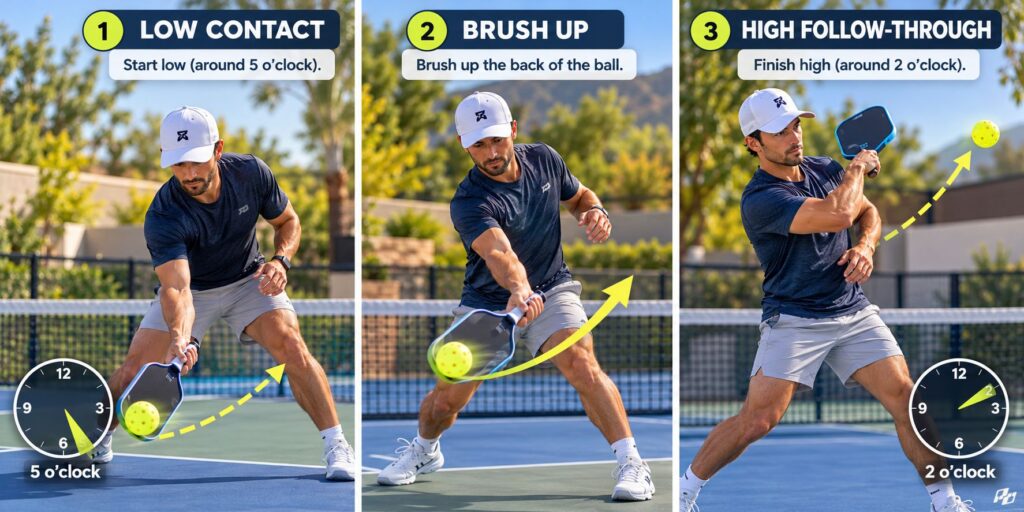
For a topspin dink, you can use the same 5-to-2 o’clock idea, but make the motion much smaller. Think a compact brush from just below the ball to a few inches above contact, with the paddle finishing in front of you rather than wrapping across your body. Same low-to-high shape, much less swing.
So stop checking where your paddle ends. Check where it was just before contact and how it traveled through the ball.
That’s where the spin was decided.
The real progression from 3.5 toward 4.0+
Beginners need to learn how topspin works. Intermediate players have a different job: remove variability.
At your level, the questions become:
Can you create it when the return is deeper than expected?
Can you produce the same shape when you’re moving laterally?
Can you hit it at 70% without adding wrist?
Can you change direction without changing the entire swing?
Can you keep the same paddle face under scoreboard pressure?
That’s why Cincola’s “stop trying to hit topspin” cue is so useful. The more consciously you try to make the ball spin, the more tempted you are to add hand action.
Instead:
Create space.
Set the face.
Start below the ball.
Swing up and through.
Let the spin happen.
Because once you already know how to make topspin, the next level isn’t making more of it. It’s making the same ball again.