
The crosscourt drop volley is a smart answer to hard hitters at the kitchen. Instead of matching their pace, absorb it with soft hands and redirect the ball short and crosscourt. It can pull opponents wide, force a low contact, and create an easier ball for your next attack.
You’re already at the kitchen. Your opponent drives or volleys the ball firmly at you. Most intermediate players do one of two things:
Hit it back just as hard.
Or panic-block it straight ahead.
A better option is to take the pace off and drop it softly crosscourt.
That can be a very good doubles shot because it does three things at once: it neutralizes pace, sends the ball away from the player in front of you, and forces someone to move laterally or forward to reach it.
But it is not a default shot.
If both opponents are already planted at the kitchen, a soft crosscourt ball may simply give them an easy dink.
The shot is most useful when someone is deeper, moving, leaning, or expecting you to volley hard.
That is the key.
Court Breakdown No. 2Drop it or attack?
Four rally situations from the kitchen line. Pick your shot, then step through the point to see why the crosscourt drop volley works in two of them and backfires in the others.
Read the breakdown step by step
Situation 1: The pattern
You and your partner are at the kitchen line. Their diagonal player is still back near the baseline. The call: Drop it. The diagonal player has to run forward and reach low, and your partner is waiting in the middle.
- A hard ball comes at you. The player across from you drives it at your body. Your first instinct is to hit it back just as hard.
- Absorb it. Drop it crosscourt. Soft grip, paddle out front. Send it short and a few feet inside the sideline, away from the player in front of you.
- They have to run and reach low. The ball has bounced, so the diagonal player can step into the kitchen to reach it. Your partner shades toward the middle to close the gap.
- The reply comes up. Contacting the ball below net height on the run, the best they can do is lift it. They scramble back out of the kitchen.
- Attack the weak ball. Your partner, feet behind the kitchen line and already in the middle, volleys it away. The soft shot did not win the point. It created the winner.
Situation 2: The hand battle
Everyone is at the kitchen line trading hard volleys. They expect the next ball to be hard too. The call: Drop it. After three hard balls, soft and short catches them leaning the wrong way.
- Hard. Fast volley at you.
- Hard. You fire it back.
- Hard. They lean back. Their weight drifts back, braced for more pace.
- Then soft and short. Same swing shape, no pace. Crosscourt into the kitchen.
- A late reach pops it up. They have to change direction and reach after the bounce. The reply floats.
- Attack the weak ball. Your partner, already shading the middle, volleys it away from behind the line.
Situation 3: The high ball
Both opponents are at the kitchen line. The ball is floating to you above net height, and your feet are set. The call: Attack it. A ball above net height with your feet set is a free chance to pressure them. Dropping it gives that away.
- The ball sits up. It is above the net and coming right to you.
- Attack it. Firm, at their hip or feet. Save the drop for a ball you can't attack.
Situation 4: Both set
Both opponents are planted at the kitchen line. Nobody is back, nobody is leaning. A firm ball comes at you. The call: Just dink or counter. The drop only works when it makes someone move. Here it hands them a routine dink.
- A firm ball comes at you. Nothing unusual about it.
- If you drop it crosscourt. The diagonal player is already right there.
- They just dink it back. One small step after the bounce, a comfortable dink. Nothing gained.
What exactly is this shot?
It is not a third-shot drop.
You are already at or near the kitchen line. The ball comes to you with pace, usually as a volley, drive, or firm ball from transition.
Instead of adding more speed, you: soften your grip, absorb the incoming energy, and redirect the ball diagonally into the opposite kitchen.
That makes it closer to a drop volley or reset than a normal dink.
Current coaching descriptions of resets use the same basic mechanics: soft grip, paddle in front, minimal swing, and absorbing the incoming ball rather than adding pace.
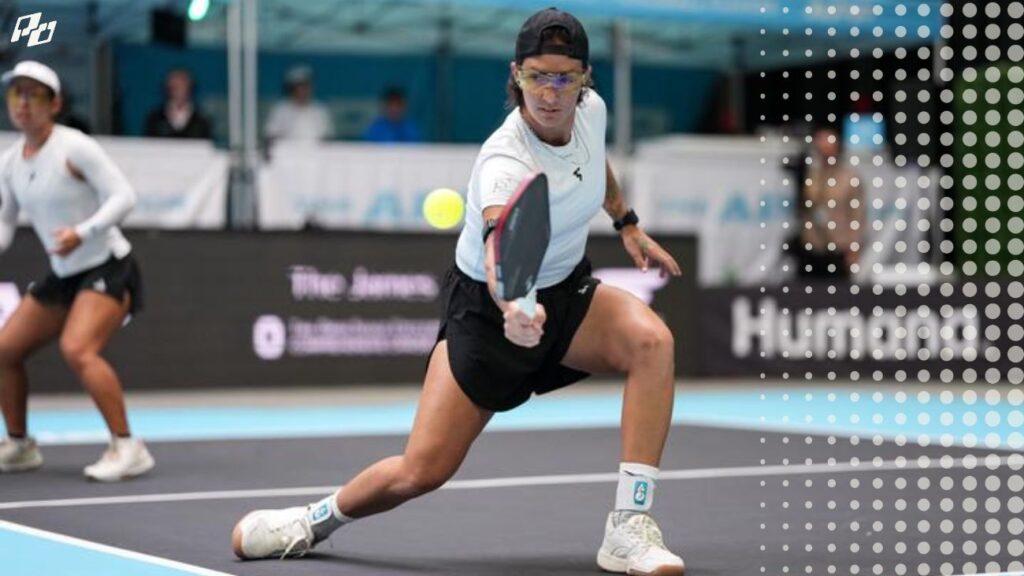
This crosscourt drop volley works on both the forehand and backhand side. The mechanics are the same: stay balanced, soften the grip, keep the paddle stable, absorb the incoming pace, and redirect it into space rather than trying to create power.
How to hit it
✅ Sink your hips
Lower slightly from the knees and hips instead of bending at the waist.
Think: wide base, quiet head.
You don’t need a deep squat. Get low enough to stay balanced and meet the ball comfortably out in front, with the paddle stable behind the ball rather than scooping underneath it.
✅ Relax your hands
A tight grip makes the paddle act like a wall. A softer grip helps absorb pace.
Think: firm enough to control the paddle, soft enough to cushion the ball.
When the ball comes faster, resist the urge to squeeze harder.
✅ Absorb, then redirect
Soft hands do not mean a floppy wrist.
Keep the paddle stable and out in front. Let your arm and shoulder absorb some of the incoming speed, then guide the ball crosscourt.
Think: catch, then redirect.
Not:
swing.
stab.
collapse.
Here’s how it’s done:
Why crosscourt?
Because straight ahead is often the easiest ball for the opponent in front of you to attack. Crosscourt changes that.
The diagonal gives you more distance to work with and sends the ball away from the closest defender.
There is a similar principle in coach Mark Price’s advice for handling difficult low balls at the kitchen. Price—a PPR-certified pro coach, three-time Georgia State Champion, and multiple 5.0 gold medalist—recommends playing a shallow crosscourt soft ball rather than forcing the ball deep, because it gives the opponent directly in front less opportunity to attack or poach.
And there is another advantage: the opponent has to move.
A good crosscourt drop volley can pull the diagonal player toward the sideline or make a deeper opponent sprint forward.
Where should you aim?
Not at the sideline. That is where intermediate players turn a smart shot into a low-percentage trick shot.
Instead, aim: crosscourt, short, and several feet inside the sideline.
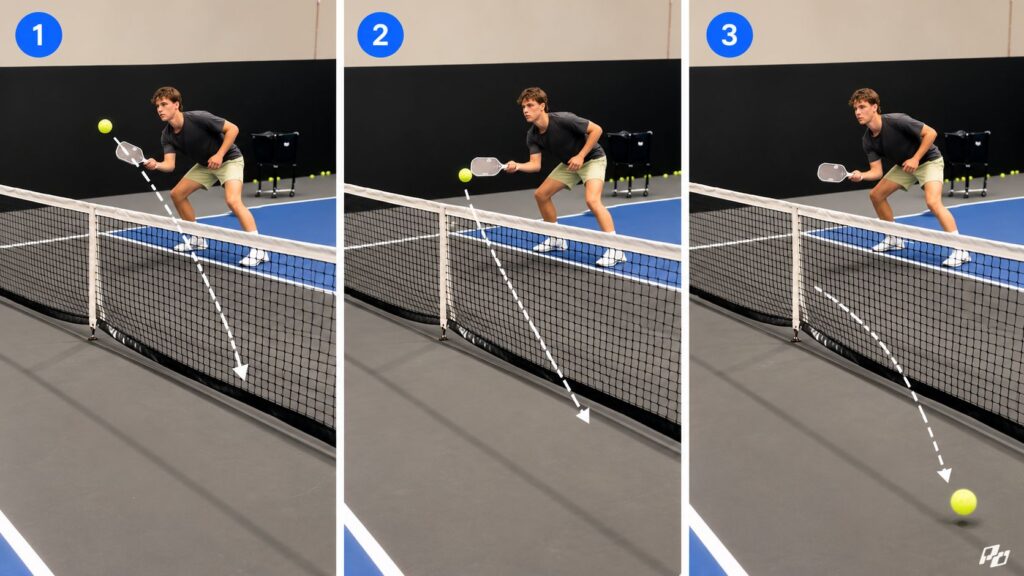
Your real target is not the paint. Your real target is: a ball that forces the opponent to move and contact it below net height.
If you can make them reach forward and sideways at the same time, even better.
When the shot is really good
1. The crosscourt opponent is still back
This is one of the best surprise uses of the shot.
You and your partner are at the kitchen, while the opponent diagonally across from you is still near the baseline or caught in transition. They send a firm ball your way.
Instead of automatically volleying deep, you deaden the ball short into the crosscourt kitchen. Now they have to change direction and move forward.
2. The opponent is leaning backward
If someone is expecting a speed-up or hard volley, their weight may already be moving back. A short crosscourt ball makes them change direction.
That is much harder than simply reacting to more pace.
3. You receive pace below net height
If the ball arrives low, counterattacking hard can be risky. You would have to hit upward, which can feed your opponent another attack.
A soft crosscourt reset turns their offensive ball into a neutral or defensive one.
4. Your opponent has become predictable
If every hard volley gets met with another hard volley, your opponents start sitting on the hand battle.
The drop volley breaks that rhythm.
Hard.
Hard.
Hard.
Then suddenly: soft and short.
That change of speed can be more disruptive than another fast ball.
When not to use it
If both opponents are already standing comfortably at the kitchen line, a soft crosscourt ball may not accomplish much.
You may simply give them a routine dink. And some advanced coaches take an even more aggressive view.
PPA pro Zane Navratil, a former top-three singles player and multiple-time champion, says players at the kitchen often reset too much. If the ball is high enough and you’re balanced, counterattacking can be the better choice.
That is a useful counterpoint.
So ask: am I softening this ball because it creates a problem for them — or because I am scared to counter?
Those are not the same thing.
If the ball is high and comfortable: attack it.
If the ball is low, jamming you, or the opponent is out of position: the crosscourt drop becomes much more attractive.
What should your partner do?
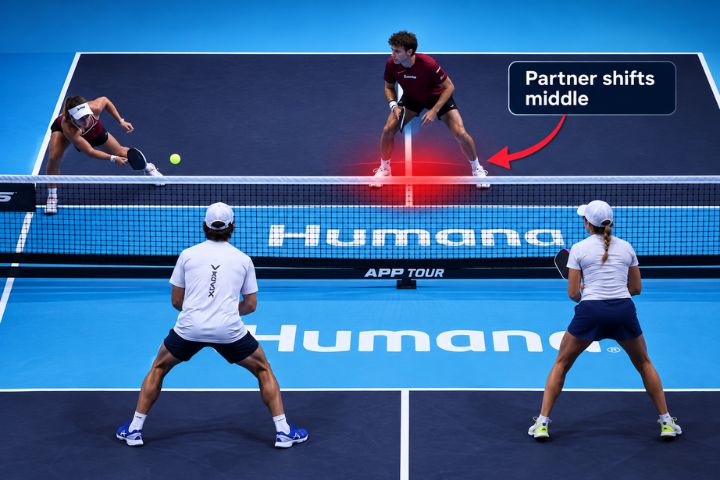
This is the doubles part that matters.
When you soften the ball crosscourt, your partner should not automatically chase the ball toward your side. They should shift with you, but their main job is to protect the middle.
Why?
Because once the diagonal opponent reaches your drop, the easiest reply is often back through the middle.
So when you go crosscourt: you protect the line and the sharp crosscourt angle. Your partner shades toward the middle.
You are still moving as a two-person unit.
A general kitchen-line rule is that when one player gets pulled wide, the partner should shift toward the middle to close the gap.
That is exactly what applies here. Do not both stare at the player chasing your drop. Close the middle first.
What are you trying to get back?
This is the smartest way to think about the shot.
You are not trying to hit a winner. You are trying to manufacture one of three replies:
A late reach,
A lifted dink,
Or
A pop-up.
Then you attack the next ball. That is why this is better viewed as a two-shot pattern.
Shot one: soft crosscourt drop.
Shot two: attack the weak reply.
That is much more reliable than trying to win with the soft ball itself.
Why older players may like this shot
This is actually a very useful option for older recreational players. It rewards:
- touch
- balance
- anticipation
- and placement
Not explosive hand speed.
If you are playing against younger players who love to bang, trying to beat them in repeated firefights may not be your best percentage.
Sometimes the smarter answer is: remove the pace entirely.
You are not trying to hit harder than them. You are making their hard ball become your soft ball.
That is a very different contest.
The biggest mistake: dropping every hard ball
Do not turn this into a reflex.
If the ball is above net height and you are balanced, you may have a better offensive volley available.
If the opponent is deep and vulnerable to a firm ball at the feet, keeping them back may also be smarter than inviting them forward with a drop.
Experienced players discussing this exact situation make that distinction: the short drop can be deadly when opponents are expecting pace, but repeatedly using it may simply help good players reach the kitchen.
So the decision becomes simple:
High ball + balanced? Pressure them.
Low ball + incoming pace? Consider softening it.
Opponent deep or leaning back? Cross drop becomes very attractive.
Both opponents already comfortable at the kitchen? Probably just dink or counter normally.
The simple rule
The crosscourt drop volley is not great because it is soft. It is great because it lets you use an opponent’s speed against their position.
When they are deep, moving, leaning back, or expecting another hard ball: sink the hips, soften the hands, absorb the pace, and send it away from them.
Then get ready. Because the soft shot is often not the winner. It is the shot that creates the winner.