
Better dinks start with better body-paddle connection. Move your feet and torso with the paddle instead of reaching with the arm alone. That creates cleaner contact, fewer pop-ups, better balance, and more consistent control under pressure.
John Cincola, a longtime professional pickleball player, coach, and former Division I tennis player who has won more than 20 pro medals, recently demonstrated a drill that looks almost too simple to matter.
While dinking, grab your paddle-side wrist with your opposite hand. Then play.
Suddenly your paddle cannot dart sideways by itself. If the ball moves right, you have to move right. If it gets low, your body has to lower. If you want to reach forward, your chest has to come with you.
Cincola calls the feeling “staying connected”—the body and paddle moving together rather than the paddle operating independently.
That sounds like a small mechanical detail.
For beginner players, I think it is actually a very useful test of whether your feet and body are doing their share of the shot.
Try this little experiment
Stand at the kitchen and imagine a dink landing 18 inches outside your forehand hip. Most 3.5-ish players can reach it. That’s the problem.
Because reaching works often enough that we get good at surviving bad positioning.
The arm extends. The shoulder drops. Maybe the wrist adds a little last-second correction. The ball clears the net, so nothing feels terribly wrong.
Then three balls later the exact same movement produces a pop-up.
That same pattern shows up often in intermediate dinking. A player gets slightly out of position, reaches instead of moving, and then asks the wrist or forearm to rescue the contact. The result is usually a paddle face that changes too much through the ball, which makes depth and height much harder to control.
Cincola’s drill takes away the escape hatch. When one hand physically holds the other wrist, the paddle can’t go wandering after the ball.
Your body has to solve the spacing.
Watch Cincola’s drill in action:
The paddle shouldn’t be your first responder
Think about the normal intermediate sequence: ball moves → paddle reaches → body follows.
Now watch a strong dink player.
The sequence often looks more like: ball moves → feet adjust → body arrives → paddle finishes the job.
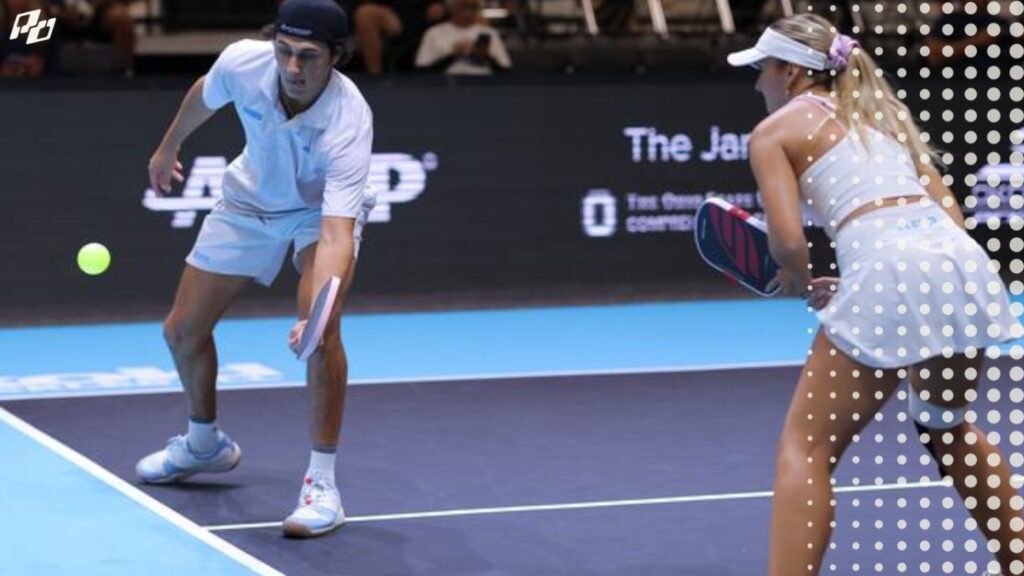
Mari Humberg, a professional pickleball player and coach known for her kitchen-line instruction, makes the same point very directly: good dinking depends heavily on moving the feet rather than standing in place and reaching.
Tony Roig, a longtime pickleball coach and instructor who focuses heavily on movement, positioning, and decision-making, similarly ties many volley errors to footwork that disrupts the shoulder and paddle at contact.
This matters because every extra rescue movement introduces another variable.
A little wrist change.
A little elbow lift.
A little paddle-face correction.
A little shoulder dip.
Do that under no pressure and you may get away with it.
Do it after six crosscourt dinks while someone is moving you from inside foot to outside foot, and those tiny compensations start showing up as balls that sit six inches too high.
What “connected” should actually feel like
Don’t turn yourself into a statue.
Your shoulder, elbow, forearm and wrist are still joints. High-level players absolutely use them, especially when adding spin, disguise or more advanced dink patterns.
Ben Johns, for example, has specifically advised players working on the backhand roll to rely more on the shoulder and less on excessive wrist action. Experienced players make a similar distinction online: wrist use can become an advanced tool, but relying on it to rescue basic mechanics creates inconsistency.
So during the drill, pay attention to the relationship between the paddle and your sternum.
As the paddle travels toward contact, your chest should generally remain involved in supporting that movement.
⮕ Wide ball? Your feet carry the body toward it.
⮕ Low ball? Your knees help bring the whole structure down.
⮕ Ball into the body? Your feet create room instead of your elbow performing emergency surgery.
The feeling is compact and organized. You should not feel as though your hand went on a field trip without you.
Why intermediate players should care
The first payoff is obvious: fewer pop-ups.
But I think the bigger benefits come later. When your body consistently arrives around the ball, your contact point becomes more repeatable. And when the setup becomes repeatable, you can hit several different shots from almost the same preparation.
- Crosscourt dink.
- Middle dink.
- Push.
- Roll.
- Speed-up.
That is one reason good footwork creates disguise. A recent analysis we published on high-level dink movement makes the same connection: when players position their body around the ball instead of reaching, they preserve more shot options and reveal less about where the ball is going.
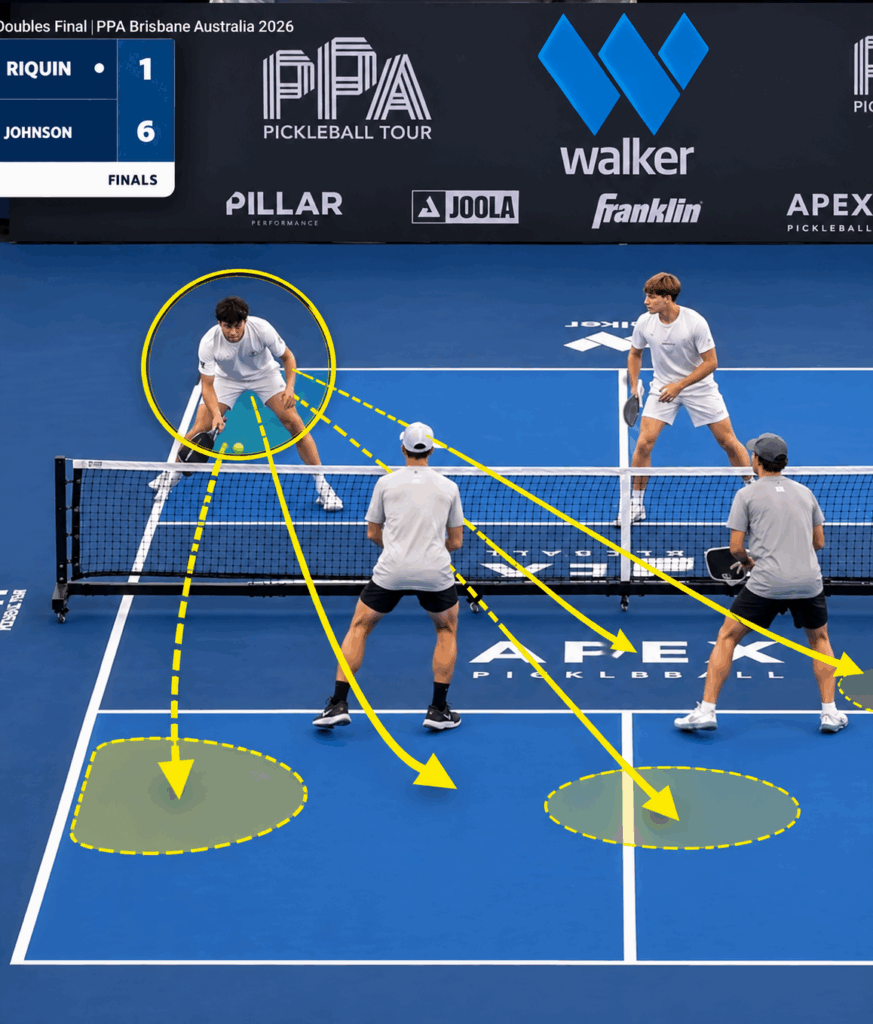
Connection also improves recovery. If you fling your paddle and upper body sideways to reach a dink, you now have to put everything back together before the next ball. If your feet and torso move with the paddle, you finish in a much more usable position.
That’s a huge difference once the dink rally stops being cooperative.
Use Cincola’s drill as a diagnostic, not a new playing style
Grab a partner and start straight ahead. For the first two minutes, gently hold your paddle-side wrist with your off hand exactly as Cincola recommends.
Don’t chase spin.
Don’t try to win the dink rally.
Let your partner move you slightly.
Your job is to notice one thing: which balls suddenly feel difficult now that your hand cannot rescue you?
Those are probably the balls where your normal footwork is late.
Then release your wrist and continue dinking while trying to preserve the same body-paddle relationship.
Next, go crosscourt.
Have your partner alternate between a comfortable ball and one that pulls you a step wider. The moment you feel the arm stretching away from your body, stop and replay the movement with an adjustment step first.
Cincola already recommends beginning practice sessions with straight-ahead dinking before working crosscourt in both directions, so this constraint fits naturally into that progression.
Finally, play normal dink points.
No wrist grabbing.
No mechanical thoughts every second.
Just notice when you start reaching again.
One important exception: sometimes you really do have to reach
Pickleball isn’t a biomechanics laboratory. There will be balls where you are late, stretched, jammed, or pulled so far wide that ideal spacing is impossible.
- Reach.
- Survive.
- Reset the point.
The goal is not to eliminate reaching from pickleball. It’s to stop reaching on balls where you had enough time to move. That distinction is surprisingly important.
A lot of intermediate players use emergency mechanics on completely ordinary balls.
The test I would use in your next dink session
Don’t count how many dinks you land. Count how many routine balls make your paddle leave your body’s working space before your feet react.
If it happens constantly, Cincola’s wrist-grab drill will probably feel restrictive at first.
Good.
That’s useful information.
Because once your hand loses the ability to solve everything by itself, your feet, torso and balance finally have to join the conversation.
And when they do, the dink usually starts looking a lot less complicated.