
In pickleball’s transition zone, don’t reset automatically. If the ball is low or you’re off balance, stay soft. If it sits up and you’re stable, a compact drive can create pressure and a weaker next ball. The key is attacking selectively—not turning every transition ball into a firefight.
James Ignatowich has a useful correction for intermediate players: the transition zone is not all about resetting.
Sometimes you should attack from there. And the key detail in his version is not “swing harder.”
It is almost the opposite: keep the swing small enough that you can attack without losing control.
Ignatowich is a four-time PPA Tour champion who has reached 13 finals and 23 semifinals, and his game has long been built around aggression and creating pressure.
In one of his transition-zone lessons, he makes the point directly: there are moments when the correct play is to swing rather than automatically soften the ball. His larger rule is to let ball height determine the decision.
That is the part rec players should steal.
Not: “I’m in transition, so I drive.”
And not: “I’m in transition, so I reset.”
Instead: “What kind of ball did I just receive?”
The transition zone is a leverage test
Most players think court location determines shot selection.
- Baseline = drive.
- Transition = reset.
- Kitchen = attack.
That is convenient. It is also too simplistic.
The more useful question is: who has leverage at contact?
If the ball is:
⮕ Below your knees
⮕ Dropping toward your feet
⮕ Stretching you
⮕ Or arriving while you are still moving
you are defending.
✔️ Reset.
But if the ball sits:
⮕ Around knee-to-hip height or higher
⮕ Comfortably in front
⮕ While you are balanced
⮕ And your opponent has given you time
✔️ you may have an offensive ball even though your feet are still in transition.
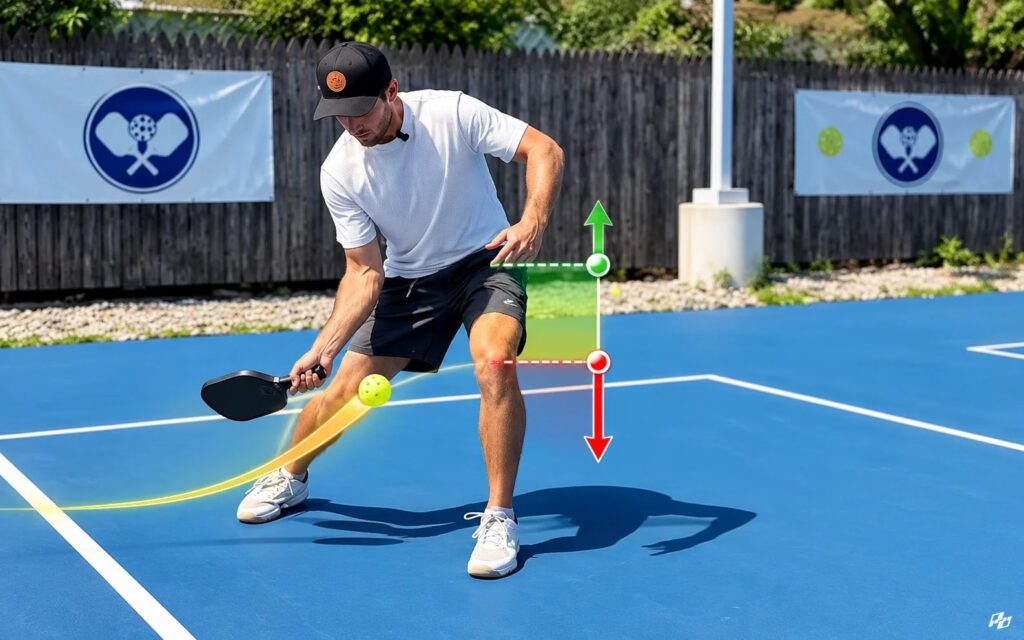
Ignatowich has previously described essentially that threshold: very low transition balls should usually be reset, while balls rising into the knee-to-hip region can become attack opportunities for players with enough control.
That is a much better framework than “never attack from no-man’s-land.”
Why the small swing matters so much
Ignatowich’s second point is arguably more important: small swing = repeatable swing. That sounds like a control tip. It is really a tactical one.
When you attack from the baseline, you have distance.
The ball has time to travel.
You often have room for a fuller stroke.
From transition, everything shrinks.
You are closer to the opponents.
The ball gets back faster.
And if they counter your attack, you may still be several feet from the kitchen.
A huge backswing therefore creates two problems:
- you lose precision
- and you delay your recovery
A compact drive lets you produce pace while getting the paddle back in front quickly enough to handle Ball 2.
That is why small does not mean passive. Small is what allows aggression to survive the counter.
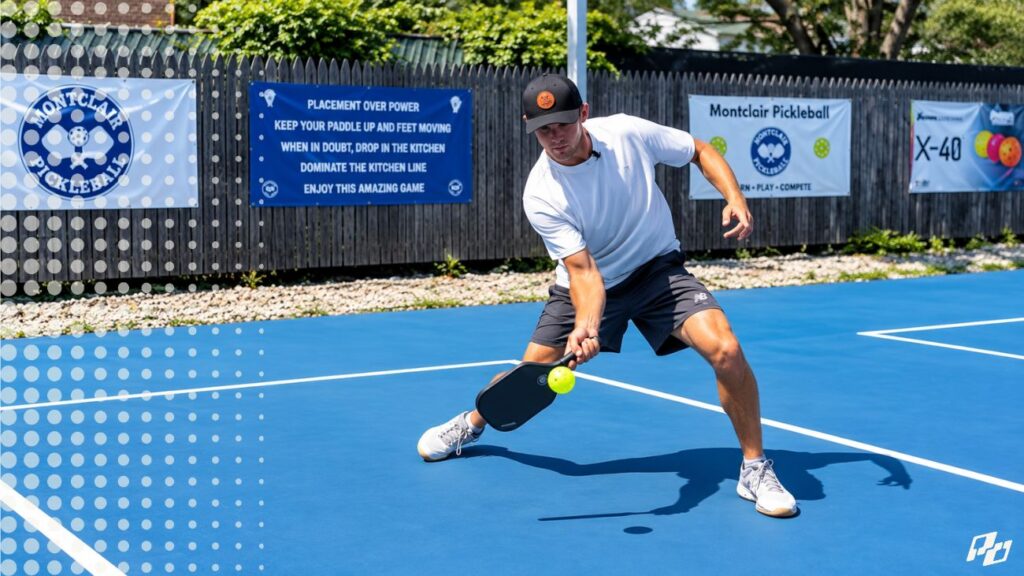
Think “punch through,” not “take a groundstroke”
This is where intermediate players often go wrong. They see an elevated ball around midcourt and try to hit their normal baseline forehand.
Big shoulder turn.
Big backswing.
Big follow-through.
The problem is that you do not need baseline-length acceleration from 10 feet closer.
A better transition drive is usually:
- compact preparation
- contact comfortably in front
- forward paddle travel
- some topspin
- and a controlled finish
You are still swinging. You are simply removing everything that does not help the ball.
A useful cue: short load, long ball.
The paddle movement can be small while the ball still penetrates.
Watch James Ignatowich break down how to attack effectively from the transition zone:
Ball height still decides first
We’ve discussed this before, and most players know the basic rule: low ball = reset, higher ball = attack.
That rule still applies in transition.
A ball below your knees usually needs to be softened. Around knee-to-hip height, you have a decision: if you’re balanced and contacting in front, a compact drive or roll may be available. Once the ball gets around hip height or higher, aggression becomes much more attractive.
The only catch: height does not give you automatic permission to attack. If you’re stretched, late, or still moving badly through contact, reset anyway.
Think:
Low = reset.
Medium = read.
High + balanced = attack.
The second filter: are you stopped?
This may be even more important for 3.0–3.5 players. Do not drive simply because the ball is high.
Ask: am I actually balanced enough to drive it?
Ignatowich has repeatedly emphasized that players should not sprint through transition while hitting. You want your core centered, legs bent, and body controlled before contact.
So the sequence is:
✔️ Move.
✔️ Split.
✔️ Read.
✔️ Then hit.
Not:
X Run.
X Swing.
X Hope.
A high ball hit while falling forward is often less attackable than a slightly lower ball hit from a stable base.
What are you trying to accomplish?
This is where the idea becomes useful for intermediate players.
You are usually not trying to win the rally with the transition drive. You are trying to create a better next ball.
That might mean forcing your opponent to:
- block upward
- contact below net height
- reach sideways
- jam themselves
- or simply give you a shorter reply
Ignatowich has made a similar point about drives more generally: the useful drive is not necessarily the hardest one. The goal is often to keep the ball low enough that the opponent must hit upward, making the next ball easier.
That translates beautifully to transition. Your aggressive ball should help you move forward.
If it merely starts a 90-mph firefight while you are still six feet behind the kitchen, you may have attacked yourself.
Why Ignatowich says this is not a third-shot drive
Ignatowich is not talking about driving a third from the baseline. By the time this shot appears, you have already moved into transition and your opponents have sent another ball back.
That changes the geometry.
From the baseline, a drive has more distance to travel and you usually have more room for a fuller swing. From transition, you are closer to the kitchen, the ball reaches your opponents sooner, and their counter can come back almost immediately.
That is exactly why Ignatowich emphasizes the small swing. You are not trying to recreate your baseline drive from six or eight feet closer.
You are taking advantage of a ball that sits up while keeping the stroke compact enough to: control the attack, recover the paddle, and handle the next ball.
So think of it as a different shot entirely:
Third-shot drive: use pace to help create your path into transition.
Transition drive: exploit a ball that gives you temporary offensive leverage while you are already moving toward the kitchen.
The second one has much less room for a big swing—and much less time to recover if you overdo it.
What should a 3.0 player do?
At around 3.0, I would still make the reset your default.
Not because aggressive transition play is “too advanced.” Because most 3.0 players are still developing the three things this shot requires:
- balance
- ball-height recognition
- and compact acceleration
If those are inconsistent, transition drives often turn into:
Long balls.
Net balls.
Or easy counters while you are stuck in midcourt.
So at 3.0, use the aggressive drive only on an obvious gift.
What changes around 3.5?
This is where I think the shot becomes genuinely useful. A solid 3.5 player should begin recognizing that transition is not automatically defensive.
Start adding aggression when three conditions are present:
- Ball: at least around knee-to-hip height.
- Body: balanced and preferably stopped.
- Opponent: not already loaded to crush the reply.
If one disappears, reset.
That gives you a very simple traffic-light system:
🔴 RED: low ball or off balance → reset.
🟡 YELLOW: medium ball, decent balance → controlled roll/drive if confident.
🟢 GREEN: high ball, in front, stable → attack.
That is much easier to use during real play than memorizing court zones.
The mistake: turning one aggressive ball into five
Suppose your transition drive works. Your opponent blocks it. Now the next ball drops below your knees.
A lot of players think: “I’m attacking now.”
So they drive again.
That is where the rally falls apart. Each ball gets a new decision. Aggression is not a mode you enter.
You can:
- drive
- reset
- drive
- reset
- then attack again
Jack Munro, another high-level coach and player who has analyzed the newer aggressive transition style, describes this as selective aggression rather than abandoning resets altogether.
That is exactly the distinction.
Try the two-ball transition drill
This is the easiest way to learn it. Start around mid-transition. Your partner feeds random balls. You have only two choices: reset or compact drive.
Before every shot, silently call: red, yellow, or green.
Then hit.
For the first session, do not even score whether the ball wins. Score whether your decision was correct.
After 20 feeds, add the next ball.
Now the real goal becomes: attack → recover → read again.
That is the skill Ignatowich’s idea is really teaching.
Not hitting harder.
Reading faster.
The transition zone is not “no-man’s-land”
That old phrase teaches players to panic.
Get out.
Rush forward.
Reset everything.
Modern pickleball asks for something more nuanced.
Sometimes the transition zone is defensive.
Sometimes it is neutral.
And sometimes your opponent hands you an attack while you happen to be standing there.
The location does not decide. The ball does.
That is why Ignatowich’s small-swing idea matters so much. A compact swing lets you exploit the green light without sacrificing the next ball.
So the rule is not: reset from transition.
And it is not: drive from transition.
It is: earn the right to swing.