
Struggling in the pickleball transition zone? Read the ball height before choosing your shot. Above the net, use a two-handed backhand or compact forehand roll to pressure the feet. Around net height, shrink the swing and keep the ball low. Below the net, reset soft into the kitchen. One height read changes every midcourt decision you make.
The midcourt is where a lot of rec pickleball games quietly fall apart.
Not because players do not know they should get to the kitchen. They do.
Not because they have never heard the word “reset.” They have.
The problem is that most players move through the transition zone with one vague plan: survive.
They creep forward, get caught between steps, see a ball coming at their body, and make a rushed decision with the paddle instead of a clear decision based on ball height, balance, and contact point.
One ball gets blocked too high. One low ball gets slapped into the net. One off-speed ball jams the body. Suddenly, the whole point feels chaotic.
Here is the cleaner way to think about it: The midcourt is not one zone. It is three different contact-height problems.
- Above the net, you can stabilize and apply pressure.
- At net height, you need compact control.
- Below the net, you must neutralize and earn your way forward.
That sounds simple, but it changes everything. Instead of asking, “What shot should I hit from the transition zone?” ask a better question:
Where is the ball relative to the net when it reaches me?
That one read tells you whether to use two hands, one hand, a block, a roll, or a reset.
And for many rec players, especially those who struggle with pace into the body, the two-handed backhand is one of the best tools for cleaning up the upper half of the midcourt.
Why the Midcourt Feels So Hard
The transition zone is brutal because you are rarely fully comfortable there.
- At the baseline, you usually have time.
- At the kitchen, you usually have position.
- In the midcourt, you often have neither.
You are moving forward, trying to split-step, watching opponents attack your feet, and deciding whether the ball is attackable, blockable, or resettable. That is a lot to process in half a second.
The biggest mistake rec players make is treating the midcourt like a place they should rush through.
Yes, the goal is usually to reach the kitchen. But you do not get there by sprinting through contact. You get there by winning one height battle at a time.
⮕ If the ball is above net height, you may be able to absorb or counter.
⮕ If the ball is at net height, you need to control the paddle face and avoid over-swinging.
⮕ If the ball is below net height, you are no longer attacking. You are buying time.
That is the midcourt height rule. The ball tells you your job.
Start With Ball Height: The Midcourt Decision System
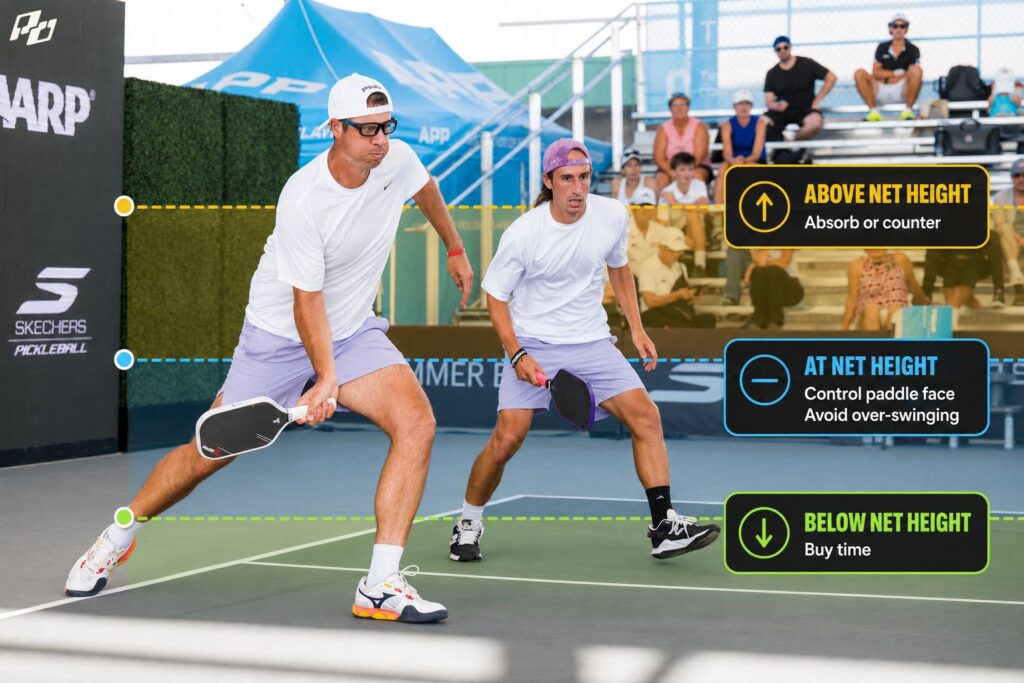
Before you decide forehand, backhand, twoey, block, roll, or reset, make the first read:
Is the ball above the net, at net height, or below the net?
That answer should organize your whole decision.
The mistake most rec players make is using the same paddle response for all three balls.
✖️ They attack low balls.
✖️ They baby high balls.
✖️ They get jammed on net-height balls.
✖️ They use two hands when they need reach.
✖️ They use one hand when they need structure.
✖️ They decide too late, and by the time the ball is on them, the paddle is just reacting.
Read the height first. Then choose the tool.
Above the Net: Stabilize First, Then Pressure
Above-net balls in the midcourt are tempting.
They look attackable. They feel like a chance to punish. And sometimes they are.
But this is where rec players get into trouble. A ball being above the net does not automatically mean you should swing big. Your balance, spacing, and contact point still matter.
The right mindset is: Stabilize first, then pressure.
If your feet are quiet and the ball is in front, you can apply pressure.
If your feet are moving, your body is stretched, or the ball is jamming you, your first job is to control the paddle face and keep the ball from floating.
From the forehand side, that usually means a compact counter-block or short roll. Not a full drive. Not a giant windshield-wiper swing. A short, firm movement that sends the ball back down toward feet, inside hip, or middle seam.
From the backhand side, this is where the twoey often shines.
The Twoey Belongs on Above-Net Backhand-Side Balls
The two-handed backhand is not just for ripping drives. In the midcourt, its best use is often structure.
When the ball is above net height — especially if it is coming fast, into your body, or near your backhand hip or chest — two hands give you a stronger frame. The second hand helps quiet the paddle face, reduce wrist collapse, and keep the ball from floating when pace is coming at you.
That matters because many transition-zone errors are not caused by terrible swing paths. They are caused by weak paddle structure.
- The ball comes hard.
- The player reaches.
- The wrist gives.
- The paddle face opens.
- The ball floats.
- Point over.
The twoey helps solve that.
But here is the important part: the twoey belongs on balls that are high enough to control or pressure and close enough to fit your frame.
⮕ If the ball is below the net, two hands often become forced.
⮕ If the ball is too far outside your body, two hands may cost you reach.
⮕ If the ball is at your feet, it is probably not a twoey ball.
The sweet spot is a ball that is above the net, near your body, and fast enough that a one-handed paddle face might wobble.
Two hands when the ball is high enough to hold your ground and fast enough to challenge your paddle.
The Forehand Counterpart: Compact Roll or Counter-Block
The forehand version of the above-net midcourt ball is not a twoey, obviously — but it has the same job.
Stabilize the paddle. Keep the swing compact. Send the ball back with pressure but not panic.
For many rec players, the forehand side is actually where they overdo it. The ball sits a little high, and suddenly they take a full backswing from the transition zone. That is usually too much.
In the midcourt, the forehand counter should feel more like a firm redirection than a baseline drive.
- Your paddle stays in front.
- Your elbow stays connected enough that the swing does not get loose.
- Your contact is out front.
- Your finish is short.
⮕ If the ball is coming fast, block it firmly and guide it down.
⮕ If the ball sits up with time, roll it with shape toward the opponent’s feet.
⮕ If you are off balance, do not force the attack. Stabilize and recover.
Forehand above the net: short swing, heavy target.
The goal is not to blast the ball through the court. The goal is to make the next ball come up.
The Contact Point That Makes Above-Net Midcourt Balls Work
Whether you are using the twoey or the forehand counter, contact point is everything.
If the ball gets beside you or behind you, the paddle face usually opens. That is when balls pop up, sail, or sit high enough for opponents to attack.
For the twoey, think “front pocket contact.” You want the ball slightly in front of your lead hip, where both hands can support the paddle and your shoulders can stay connected.
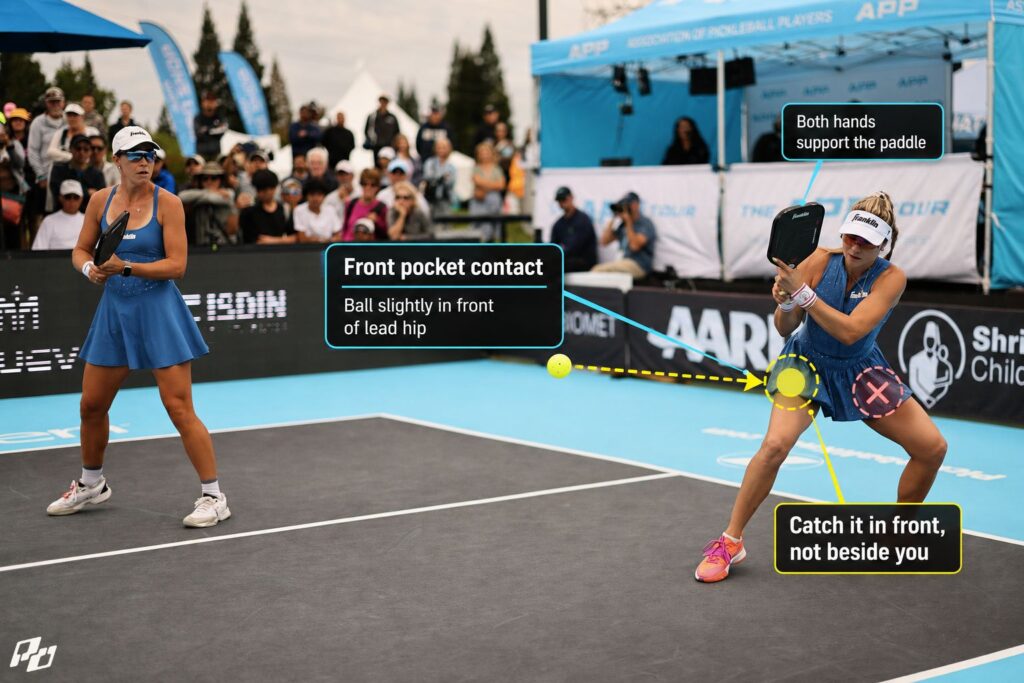
For the forehand, think “front thigh contact.” You want the ball in front of your body, not next to your hip. The swing should feel short and connected, not stretched or late.
If the ball is coming hard, the swing may be almost invisible. You are not taking the paddle back. You are presenting the face, absorbing, and sending the ball to a safer zone.
If the ball has a little more time and sits above net height, you can roll it with a short upward-and-forward path.
But the contact point stays disciplined.
Catch it in front, not beside you.
That cue alone can clean up a lot of transition-zone errors.
At Net Height: Use Compact Control, Not a Big Swing
Balls around net height are often the most confusing in the midcourt.
They are not high enough to attack cleanly, but they are not low enough to make the reset decision obvious. They often come off-speed, into the body, or with weird depth.
This is the gray zone.
On the backhand side, a compact one-handed backhand often works better than the twoey here because it gives you more reach and adjustability. You can soften the paddle face, guide the ball into the kitchen, or keep it low through the middle without forcing a two-handed swing from an awkward contact point.
On the forehand side, the equivalent is a soft block, short roll, or controlled guide. Again, not a full swing. You are trying to keep the next ball from being attackable.
The goal is not to win the point. The goal is to stop the opponent from attacking downward.
Think small:
- Short backswing.
- Contact in front.
- Slightly open or neutral paddle face.
- Quiet wrist.
- Small finish.
At net height, shrink the swing and win the paddle-face battle.
Most rec players lose this ball because they treat it like an attack ball. It is usually not. It is a control ball.
Below the Net: Reset From Either Wing
Once the ball drops below net height, your job changes. You are no longer trying to pressure. You are trying to neutralize.
⮕ Backhand below the net? Reset.
⮕ Forehand below the net? Reset.
The simple rule: if you cannot hit down, do not pretend you are attacking. For most rec players, attacking from below the net is just a pop-up with confidence.
This is reset territory — but your paddle angle should depend on where the ball is relative to your body.
If the ball is outside your body, keep the paddle more sideways. You have room to create a normal reset shape, so there is no need to force the paddle tip down.
If the ball is inside your body or coming right at you, especially on the backhand side, turn the paddle tip down. This helps you absorb the ball without awkwardly trying to move out of the way, and it keeps the paddle face from popping open.
@marihumberg.pb Remember this the next time you try resetting 🫵🤓
♬ original sound – Mari Humberg
This is also where a two-handed backhand reset can help. When the ball is low, close, and into your body, two hands can stabilize the tip-down paddle face. You are not swinging with two hands — you are using the second hand to control the face, soften contact, and guide the ball back into the kitchen.
Think:
Outside your body: paddle sideways.
Inside your body: tip down.
Jammed backhand reset: two hands can help.
Stay athletic, bend your knees, and make contact as far out in front as possible. The reset should feel like you are catching and redirecting the ball, not scooping it upward.
Outside ball, sideways paddle. Body ball, tip down.
Moving Forward After the Reset
A reset is not finished when the ball leaves your paddle. The reset is supposed to buy your next step.
- Sometimes it buys one step.
- Sometimes two.
- Sometimes none, if the reset is too high.
But you have to read the quality of your own ball and move accordingly.
⮕ If your reset lands low and unattackable, take ground.
⮕ If it floats, stop and defend.
⮕ If it forces the opponent to lift, move in.
⮕ If it is too high, do not rush into your own mistake. Split and defend.
Reset, read, then rise.
Do not automatically crash after every reset. Earn the next step.
Where to Aim From the Midcourt
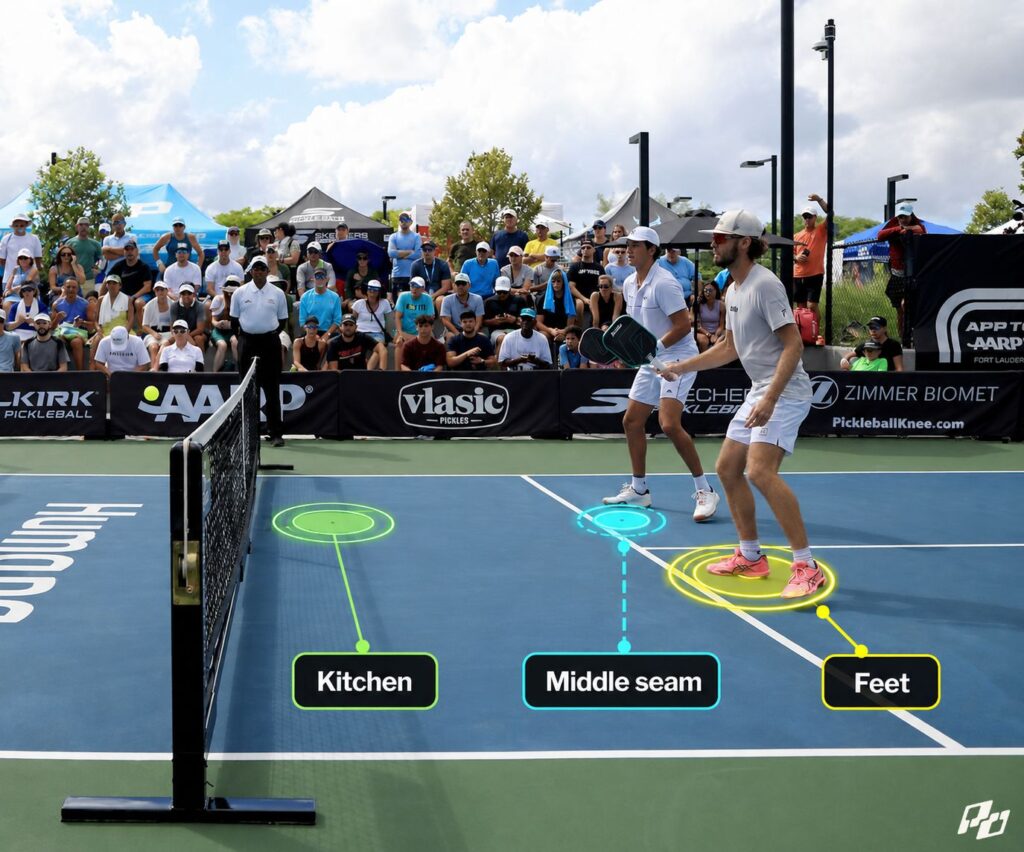
Midcourt targets should be boring on purpose.
✓ The middle is your friend.
✓ Feet are your friend.
✓ The kitchen is your friend.
Sharp sidelines are usually not your friend unless you are balanced and have a clear opening. Your target should match your contact height.
When the ball is above the net, use either the twoey or forehand counter to pressure the opponent’s feet, inside hip, or middle seam. You want the next ball to come up.
When the ball is around net height, aim low into the kitchen or middle kitchen. You want to prevent a downward attack.
When the ball is below the net, aim for a soft kitchen landing with enough arc to clear the net but not so much that the ball sits up.
The system is simple:
- Above net: pressure feet or body.
- Net height: neutralize low.
- Below net: reset soft.
That is how you stop guessing.
A Practical Midcourt Decision Table
| Contact Height | Backhand Tool | Forehand Tool | Main Goal | Best Target | Key Cue |
|---|---|---|---|---|---|
| Above net | Two-handed backhand, firm block, compact roll | Forehand counter-block or compact roll | Stabilize and pressure | Feet, inside hip, middle seam | Low base, firm frame |
| Net height | One-handed guide/block | Soft forehand block or short roll | Neutralize awkward balls | Low kitchen, middle kitchen | Shrink the swing |
| Below net | Backhand reset | Forehand reset | Take pace off and regain position | Soft kitchen landing | Paddle up early, body down late |
This table is not meant to make you robotic. It is meant to stop the panic. When the ball enters the midcourt, classify the height first. Then choose the tool.