
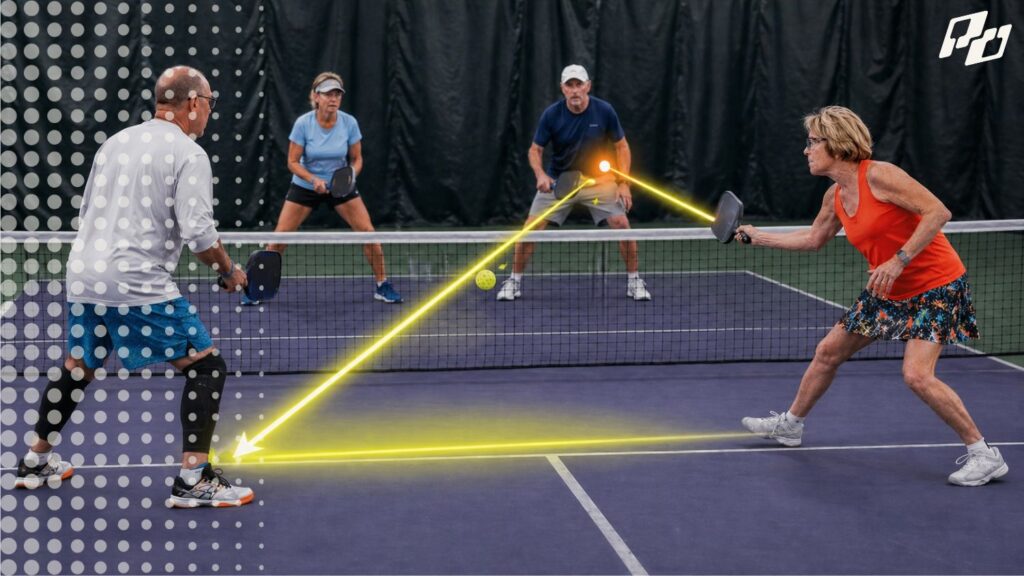
The pickleball triangle pattern is a doubles strategy where you attack one player’s jam zone, then anticipate the likely counter lane. Instead of speeding up randomly, you target the inside hip, shoulder, chicken wing, or lower body to create a predictable next ball for you or your partner.
In the past few weeks, we’ve talked about the triangle pattern in pickleball — what it is, why it shows up in fast doubles exchanges, and how to recognize when the next ball may come back through a predictable lane.
But recognizing the triangle is only step one.
Today, let’s talk about how to attack it.
Because this pattern is not just something you notice after the ball comes back. It is something you can create on purpose. When you attack the player in front of you in the right spot — usually across the body, into the inside hip, or near the chicken-wing zone — you can often force a predictable counter.
That is where the real advantage is.
You are not speeding up just to “win the point right now.” You are speeding up to create the next ball. And if you and your partner understand where that next ball is likely to go, hands battles suddenly feel a lot less random.
What Is the Triangle Pattern in Pickleball?
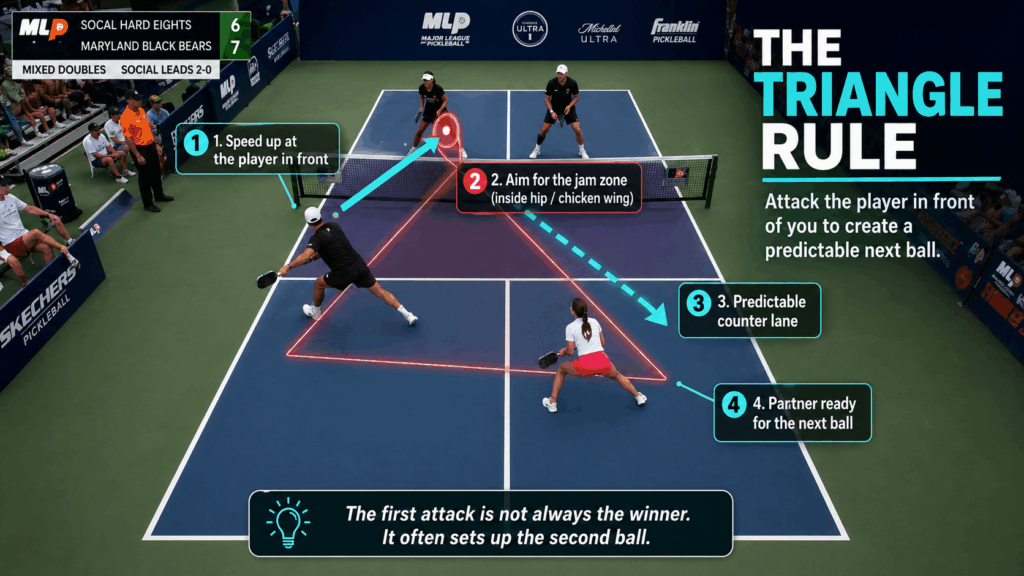
The triangle pattern is a kitchen-line attack pattern where you speed up at the player in front of you, usually across their body or into a jammed body zone, and then anticipate the direction of their counter.
In doubles, the pattern often works like this:
- You get an attackable ball.
- You speed it up at the opponent in front of you.
- You target a spot that makes them late, jammed, or stretched.
- Their counter naturally comes back along a predictable lane.
- You or your partner are already ready for that next ball.
That is the key.
The triangle is not just about the first attack. It is about the first attack plus the next ball.
A lot of rec players attack and then admire the shot. Better players attack and immediately prepare for the counter they just created.
Why This Pattern Works
In a fast kitchen exchange, your opponent does not have unlimited options.
When you attack the right body zone, they usually do not have time to fully disguise, reset their feet, change their paddle angle, and choose any target they want.
Their reply is shaped by:
- where the attack hits them
- whether they are early or late
- whether the ball jams their body
- whether their paddle is forehand- or backhand-oriented
- whether they can extend or are cramped
- whether the ball is high enough for them to counter down, or low enough that they have to block, punch, or lift
That is why the return ball often follows a pattern.
If you hit a bad speedup into their comfortable paddle zone, they can counter wherever they want.
But if you hit a good speedup across their body — into the inside shoulder, hip, ribs, elbow, chicken-wing zone, or lower body — you reduce their options. The ball often comes back where their paddle face, timing, and body position naturally send it.
The height of the attack matters, too.
A higher triangle attack can work if it jams the inside shoulder or chicken-wing area before the opponent is ready. But if it floats into their comfortable strike zone, they can punch down or redirect aggressively.
A lower triangle attack — toward the hip, thigh, knee, or feet — usually creates a different kind of pressure. It makes the opponent block, punch forward, or lift the ball instead of swinging down on it. That often makes the counter more predictable and easier for you or your partner to sit on.
That is anticipation.
Not guessing.
Not gambling.
Not “I hope this works.”
It is using the physics and geometry of the exchange to your advantage.
The Big Misunderstanding: The Triangle Is Not Just “Hit the Middle”
This is where a lot of rec players get confused.
The triangle pattern is not the same as blindly attacking the middle or ripping the ball between two opponents.
Yes, middle pressure matters in doubles. Yes, attacking the seam can create confusion. But the triangle pattern is more specific.
It is about attacking one player in a way that makes their counter predictable.
The goal is not always to split both opponents. The goal is often to jam the player in front of you and know where the next ball is likely to go.
That is the difference between random aggression and pattern-based aggression.
A random speedup says: “I’m going to hit this hard and hope they miss.”
A triangle-pattern speedup says: “I’m going to hit this spot, expect this counter, and be ready for the next ball.”
That is a completely different level of pickleball.
The Basic Triangle Pattern
Here is the simple version.
If you attack across the opponent’s body, especially toward the hip, inside shoulder, or chicken-wing area, their counter often comes back toward the opposite lane.
So if you attack the player in front of you, the next ball may come back toward your partner’s side, middle, or the natural counter lane created by their paddle angle.
That does not mean it happens every time. This is a pattern, not a law.
But at the rec level, especially in fast hands battles, players often counter along the line their paddle naturally allows. They do not always have time to make a perfect decision.
That is what you are exploiting.
You are not hoping they miss the first ball.
You are setting up the second ball.
Step 1: Attack the Player in Front of You With Purpose
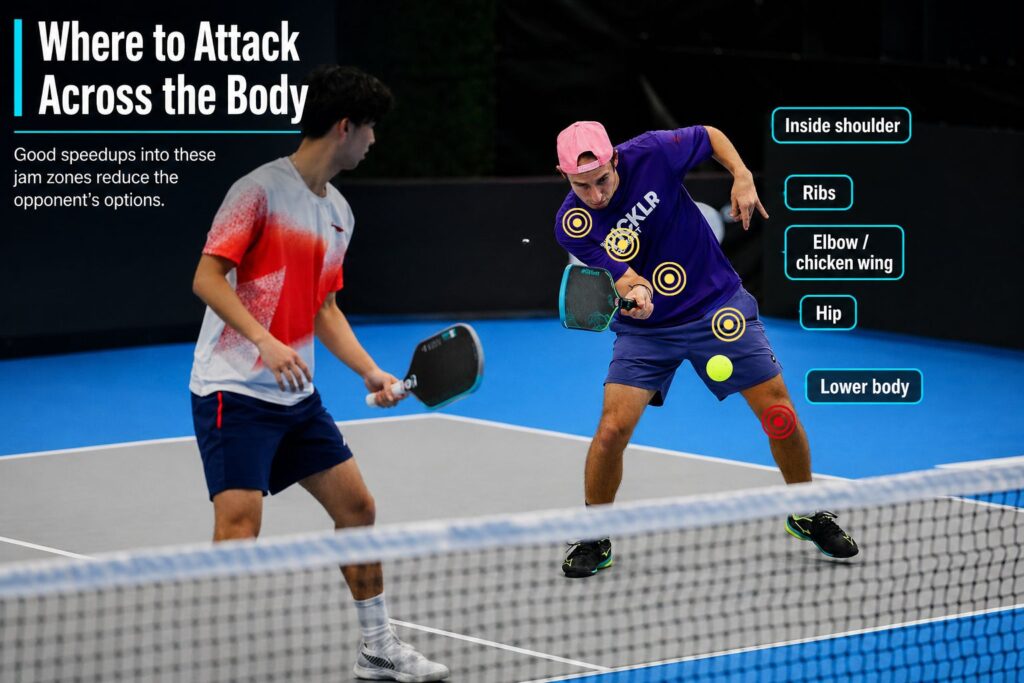
The first mistake rec players make is attacking too randomly. They see a slightly high ball, panic a little, and slap it at whoever looks open.
That is not the triangle pattern.
To use the triangle pattern, your first attack needs to be intentional. You are usually attacking the player more directly in front of you, but not into their clean strike zone.
You are trying to make contact awkward.
Good targets include:
⮕ The inside hip
This can jam the player and make it hard to decide forehand or backhand.
⮕ The inside shoulder
This creates a cramped counter, especially if their paddle is not already set.
⮕ The chicken-wing zone
This is the awkward area near the paddle-side elbow/hip where the player cannot extend cleanly.
⮕ The low body zone
Hip, thigh, knee, or feet — especially if you can keep the ball from rising.
The key is that you are not just attacking “at them.” You are attacking a body zone that limits their options.
A medium-speed attack to the right spot is often better than a hard attack to a comfortable paddle.
Step 2: Match the Target to the Ball Height
This is huge.
The triangle pattern falls apart when your attack enters the opponent’s comfortable strike zone.
That can happen if the ball floats too high, sits too cleanly on their paddle, or gives them time to punch down, roll over it, or redirect with power.
The better attack targets the body zone that matches the ball you have. If the ball is higher, you may be able to jam the inside shoulder or chicken-wing area. If the ball is lower, the better target is often the hip, thigh, knee, or feet.
Think of it this way:
A high speedup gives them choices.
A low body attack reduces their choices.
That is exactly what you want.
For most rec players, the practical target is not “as hard as possible.” It is: firm enough to pressure them, low enough to keep them from attacking down.
If you can attack through the hip, thigh, knee, or feet area with a compact stroke, you are much more likely to get the counter you expect.
Step 3: Know What Counter You Are Trying to Create
This is the whole point.
Before you attack, you should already have a rough idea of where the counter might go.
Not perfectly. Not every time. But enough that you are ready.
Here are the common reads.
If you attack across their body
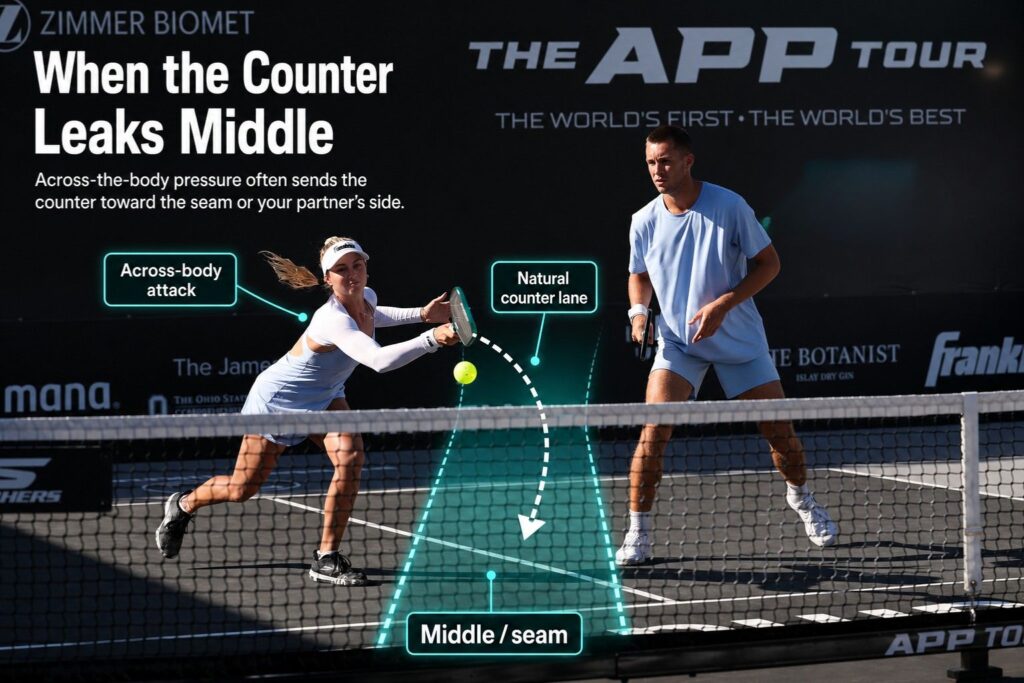
Their counter often comes back toward the natural lane created by their paddle angle. If they are late or jammed, the ball may leak toward the middle or toward your partner’s side.
That is why your partner has to be awake.
A good triangle attack is not a solo move. It is a team pattern.
If you attack into their clean forehand
Be careful. If they have space and time, the counter can come back sharper and harder.
This is not always a good triangle attack. Sometimes you are just feeding their best shot.
If you attack into a prepared backhand block
Expect the ball to come back quickly.
Many players at 3.5–4.0 are very comfortable blocking or punching from the backhand side at the kitchen. If their paddle is already there, your speedup may simply activate their counter.
If you attack into the chicken wing
This is often where the pattern works best.
The opponent has to decide quickly: forehand, backhand, body block, or partner help. If they are late, their counter is usually less controlled and more predictable.
Step 4: Your Partner Has to Expect the Next Ball
This is the part rec teams miss the most.
If you use the triangle pattern correctly, the next ball may not come back to you. It may go to your partner. That is not a problem. That is the pattern.
But your partner needs to understand what you are doing.
If you speed up across the opponent’s body and your partner is surprised when the counter comes toward them, your team loses the advantage you just created.
Before a game, you do not need a long strategy meeting. Just use simple language: “If I speed it up across the body, be ready for the counter to come your way.”
That one sentence can change a lot. Now your partner is not reacting late. They are waiting in the right window.
This is how doubles teams start looking faster without actually moving faster.
Step 5: Do Not Take a Huge Swing on the Second Ball
The first attack creates the pattern. The second ball usually wins the point.
But that second ball does not need to be huge.
In fact, this is where many rec players ruin the pattern. They hit a smart first attack, get exactly the counter they wanted, and then overswing on the finish.
Remember: if the first ball created pressure, the next ball often already has pace on it. You do not need to create all the power again. You need to control the angle.
Good second-shot options include:
⮕ Compact punch through the middle
Great if both opponents are split or late.
⮕ Counter behind the player who reached
Useful when one opponent is pulled across their body.
⮕ Roll down at the feet
Smart when the opponents are leaning back or off-balance.
⮕ Soft reset
Underrated. If the counter is better than expected, reset and restart instead of forcing.
⮕ Let it go
Very underrated. If you jam someone and their counter is sailing long, do not save them.
The second ball should be short, compact, and decisive.
Think: paddle ready, small move, clean finish.
The Best Balls to Attack With the Triangle Pattern
Not every ball should be attacked.
That is the difference between a smart triangle attack and a random speedup. You want to attack when the ball gives you permission — when you are balanced, the ball is high enough to attack, and you can target the opponent’s awkward body lane without feeding their strongest counter.
The goal is not always to hit low. The goal is to hit a jam zone that makes their reply predictable.
Sometimes that means the inside shoulder or chicken wing.
Sometimes that means the inside hip.
Sometimes that means the thigh, knee, or feet.
Use this simple guide:
| Signal | What It Means | Should You Attack? |
|---|---|---|
| 🟢 Ball sits slightly high | You can contact it in front and attack the inside body lane with control | Yes — attack |
| 🟢 Opponent is late or not fully set | Their paddle or feet are not ready for a clean counter | Yes — attack |
| 🟢 Their paddle is outside the body | The inside shoulder, hip, or chicken-wing zone is more vulnerable | Yes — attack |
| 🟢 Your partner is ready | If the counter comes crosscourt, middle, or into their lane, your team is prepared | Yes — attack |
| 🟡 Ball is attackable, but you are not fully balanced | You might create pressure, but you may be late for the next ball | Maybe — be careful |
| 🟡 Opponent’s paddle is already up | You can still attack, but avoid feeding their prepared counter | Maybe — change the target |
| 🟡 Inside shoulder is open, but the ball is high | This can work, but if you float it, they may counter down | Maybe — jam, don’t feed |
| 🔴 Ball is below net height | You are likely attacking upward into trouble | No — dink or reset |
| 🔴 You are reaching or falling backward | You cannot recover quickly enough for the counter | No — reset |
| 🔴 Your partner is out of position | The next ball may go into the open court | No — stay patient |
| 🔴 Opponent is waiting on the counter | You are not surprising them; you are feeding them | No — move them first |
The simple rule: green means attack. Yellow means choose carefully. Red means don’t force it.
If the shoulder or chicken wing is open, jam it.
If the hip is open, squeeze the ball through that lane.
If the ball is lower, aim toward the thigh, knee, or feet instead of lifting it into their paddle.
The triangle pattern works best when you attack the right body zone for the ball you actually have — not when you force the same target every time.
What to Watch Before You Attack
A good triangle attack starts before the swing. Look at the opponent in front of you and ask:
Is their paddle outside their body?
If their paddle is too far to one side, the body attack becomes more effective. They have to bring the paddle back across their frame, which makes them late.
Are they leaning?
If they are leaning outside, reaching, or recovering from a previous dink, they are more vulnerable to a body attack.
Are they sitting on one side?
Some players cheat forehand. Others sit backhand. If they are clearly protecting one side, attack the jam zone that makes them uncomfortable.
Is their partner close enough to create confusion?
Even though the triangle pattern is about attacking one player, doubles spacing still matters. If the partner is close, the counter or block may create hesitation between them.
Can I stay ready after this?
This may be the most important question.
If your attack pulls you off-balance or drops your paddle, do not attack. The triangle pattern only works if you are ready for the next ball.
How This Looks in Real Rec Play
Let’s say you are on the right side at the kitchen. A dink floats a little high to your forehand.
Instead of blasting straight at the open court, you attack across the body of the opponent in front of you, aiming low near the inside hip or chicken-wing zone.
Because they are late, they cannot freely redirect. Their counter naturally comes back toward the middle or your partner’s side.
If your partner knows the pattern, they are already sitting on that ball.
That is the point.
Now imagine the same thing from the left side. You get a ball you can attack with your backhand. You speed it up low across the opponent’s body, forcing a cramped counter. The ball pops or leaks into the predictable lane. You or your partner take the next ball with a short punch.
Again, the first attack did not have to be a clean winner.
It created the finish.
That is the triangle pattern at work.
The Mental Shift: Attack and Expect
Here is the phrase I would give every rec player: attack and expect.
Do not attack and watch.
Do not attack and admire.
Do not attack and hope.
Attack and expect.
Expect the ball to come back.
Expect it to come back quickly.
Expect it to come back along the lane your attack created.
That mindset alone will make your hands feel faster.
A lot of players lose firefights because they emotionally treat their speedup like the final shot. Then when the ball comes back, they are surprised.
Better players treat the speedup like the first move in a two- or three-shot pattern.
That is why they look calm.
They are not shocked by the counter. They invited it.
Common Mistakes Rec Players Make With the Triangle Pattern
Mistake 1: Attacking too high
This is the big one.
If your attack rises into the opponent’s chest or shoulder, you are giving them leverage.
Better fix: attack a true jam zone. That might be the inside shoulder or chicken wing on a higher ball, or the hip, thigh, knee, or feet on a lower ball. Make them hit from a cramped, upward, or neutral position.
Mistake 2: Attacking a prepared paddle
If their paddle is already sitting exactly where you are attacking, you are not creating a pattern. You are feeding the counter.
Better fix: attack the jam zone, not the clean paddle.
Mistake 3: Forgetting your partner
If the counter is likely to go crosscourt or toward your partner, they need to know that.
Better fix: communicate the pattern before play or between points. Keep it simple: “Be ready when I attack across the body.”
Mistake 4: Taking too big a swing
Big swings create slow recovery. Slow recovery loses hands battles.
Better fix: use a compact speedup and return your paddle immediately to the ready position.
Mistake 5: Trying to finish too early
The first attack often sets up the finish. It is not always the finish.
Better fix: expect the second ball and be willing to win with the follow-up punch.
Mistake 6: Using the pattern from bad positions
If you are late, low, or off-balance, the pattern becomes a gamble.
Better fix: wait for a better ball. Dink, move them, and attack when the contact point is cleaner.
The Real Goal: Make the Next Ball Predictable
The triangle pattern is one of the smartest ways to improve your hands battles because it gives your attacks a purpose.
You are not just trying to hit harder.
You are trying to hit a specific target, create a predictable counter, and have your team ready for the next ball.
That is the real win.