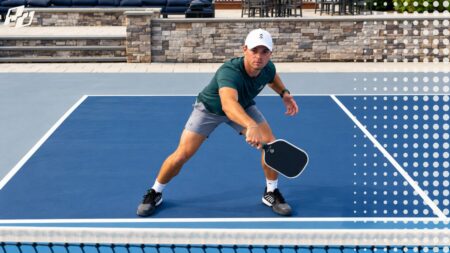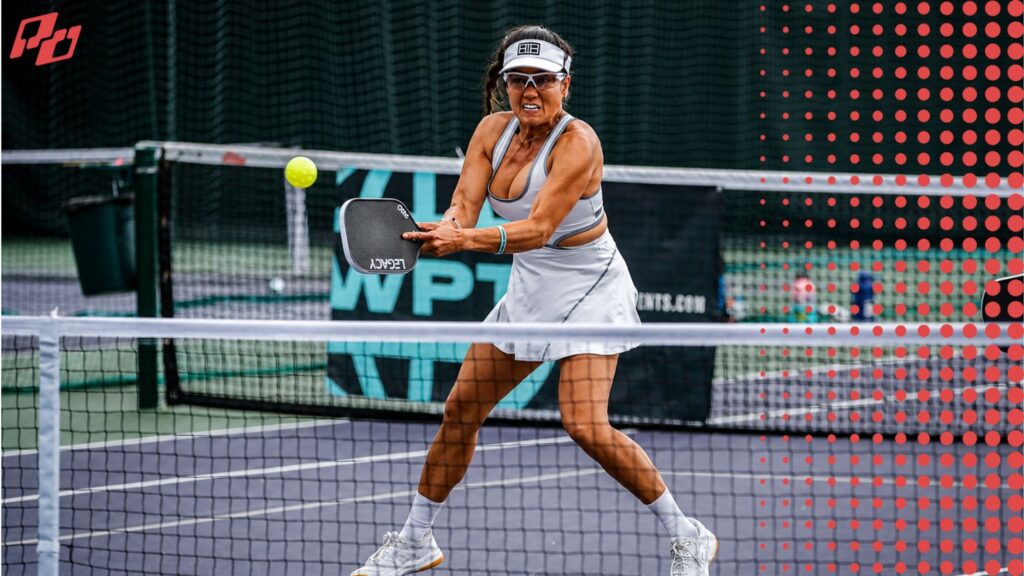
To turn a pickleball punch volley into a winner, take the ball early, keep your wrist stable, stay compact, and move the paddle forward through contact. Aim at the opponent’s feet, hip, middle seam, or open space instead of swinging harder. The goal is controlled pressure, not a big backswing.
The punch volley is one of those shots that separates a solid 3.5 player from someone who can actually end points at the kitchen.
Most rec players already have a punch volley. They can block a ball. They can poke it back. They can win the occasional hands battle.
But turning that punch volley into a true finish shot? That takes a different level of control.
It is not about swinging harder. It is not about slapping with the wrist. And it is definitely not about taking a big backswing from the kitchen line.
A winning punch volley is compact, early, forward, and intentional. The paddle leads. The wrist stays stable. The body stays balanced. And the target is chosen before contact, not after the ball is already on you.
The core technical issue many improving players run into is simple: they read the ball well enough to get there, but then their wrist breaks, the paddle drops, the elbow flies out, or the ball gets played too late and too far behind the body. That turns an attacking volley into a soft reset, a pop-up, or a ball that comes right back.
So let’s make the punch volley more dangerous.
First, Know What a Punch Volley Is Supposed to Do
A punch volley is not a block. A block absorbs pace and keeps the ball in play.
A punch volley adds a short, controlled forward move through the ball to redirect pace and apply pressure.
And a finish punch volley is the offensive version: you are using compact technique to end the point or force such a weak reply that the next ball is easy.
The key word is compact. Coaching resources consistently describe the punch volley as a short net shot built around quick reflexes, controlled contact, and minimal swing — not a full stroke.
For a 3.5 player, that distinction matters.
A bad punch volley says: “I’m going to swing at this.”
A good punch volley says: “I’m going to take this early, stay stable, and send it to a target they cannot handle.”
That is the difference.
The Biggest Mistake: Your Wrist Tries to Win the Point
Most missed punch volleys come from the same problem: the wrist gets too involved.
The wrist breaks backward.
The paddle face opens.
The player flicks across the ball.
The elbow flies away from the body.
The paddle finishes outside the frame.
The ball floats instead of driving through the target.
At kitchen speed, that is a problem.
Your wrist is not strong enough or stable enough to be the main engine of a finish volley. When the wrist takes over, the paddle face changes too much, and the ball either pops up, sprays wide, or dies without enough pressure.
Instead, think: stable wrist, paddle leads, body supports.
The punch should feel like the paddle is moving forward as one unit with your hand and forearm. Not frozen stiff, but firm enough that the ball does not push your paddle around.
A good cue: show the paddle face to your target longer than feels natural.
That keeps you from rolling the wrist too early.
@corielliott.pb learn that punch volley folks 👊 . . . . . . . #pickleball #pickleballtips #pickleballcoaching #punch #volley ♬ original sound – corielliott.pb
The Contact Point: Cut the Ball Off Before It Gets Past You
This is the first technical upgrade.
A punch volley becomes weak when you let the ball travel too far back.
If the ball gets even with your shoulder, hip, or back foot, you are no longer punching. You are surviving.
At the kitchen, your best punch volleys happen in front of your body, with the paddle already set and the contact slightly out front.
That does three things:
- It gives you cleaner direction.
- It lets you use the opponent’s pace.
- It helps you recover before the next ball.
Think of it like closing a door early. You are not waiting for the ball to invade your body and then fighting it off. You are cutting it off while your paddle is still in front.
A simple cue: no ball past the front shoulder.
That does not mean you will literally intercept every ball that early. But as a training cue, it helps 3.5 players stop getting jammed and late.
If the ball is already past your body, do not force a finish. Reset, block, or defend.
Finish volleys come from early contact.
Paddle Angle: Slightly Up, Not Floppy Open
Here is where the punch volley gets tricky.
A lot of rec players hear “punch down” and immediately point the paddle face down. Then they dump the ball into the net.
Others open the face too much and float the ball high.
The correct paddle angle depends on the ball height.
If the ball is high
You can use a flatter or slightly downward paddle face because you have leverage. This is where you can punch more directly down into open court, feet, or the gap.
If the ball is chest height
You usually want the paddle face slightly stable and slightly tilted — not wide open, not chopped downward. Your goal is to drive through the ball and send it down through the target.
If the ball is lower
Be careful. If the ball is dipping or below net height, a punch-volley finish may not be the right shot. That might be a reset, a controlled block, or a roll/flick if you have the skill and shape.
The practical rule: finish high balls. Pressure medium balls. Respect low balls.
That one sentence will save a lot of errors.
Your Paddle Tip Matters More Than You Think
One non-obvious cue that helps many intermediate players: keep the paddle tip from collapsing downward.
When the paddle tip drops, the wrist usually breaks with it. Then the paddle face gets unstable, and the punch turns into a scoop, swipe, or slap.
Instead, keep the paddle tip slightly up and the paddle face organized in front of your chest.
This does not mean the paddle is vertical like a wall on every ball. It means the paddle head stays controlled enough that you can push through the shot instead of flipping at it.
Good cue: paddle tip up, wrist quiet, push through.
This is especially useful on balls around the stomach, ribs, and chest — the exact zone where 3.5 players often get jammed and lose structure.
The Elbow Should Stay Close Enough to Stay Strong
Watch a lot of rec players miss punch volleys and you will see the same pattern:
The elbow lifts.
The arm reaches away.
The wrist breaks.
The player loses leverage.
That is usually because they are trying to create power with the outside of the arm instead of using a compact structure.
You do not want the elbow pinned to your ribs. But you also do not want it flying out like a chicken wing.
The best position is compact and athletic: elbow slightly bent, hand in front, paddle inside your frame, and enough space to push through contact.
Professional instruction on punch volleys often emphasizes avoiding both extremes: do not stop at contact, but also do not overextend into a powerless, dead-wall position. The arm should move through contact while staying compact.
A simple feel: punch from your frame, not outside your frame.
If your hand disappears outside your peripheral vision, your swing is probably too big.
The Finish Shot Is a Push-Through, Not a Slap
This is the part that makes the ball heavier.
A weak punch volley stabs at the ball and stops. A better punch volley moves through the ball.
But “through” does not mean a big follow-through. It means the paddle continues forward after contact just enough to send the ball with depth, direction, and weight.
Think of punching through a second invisible ball just beyond contact.
Not a backswing.
Not a wrist flick.
Not a full stroke.
Just a short, firm push through the ball.
That gives you the easy power you want without losing control.
A great 3.5 cue: small backswing, strong extension.
Most rec players do the opposite: big prep, weak contact.
Flip it.
Your Weight Should Go Forward, Not Back
If your punch volley floats, check your feet.
A lot of players think their mistake is the paddle, but the real problem is that their weight is drifting backward.
When your weight goes back, the paddle often opens. The ball floats. You lose the ability to drive through the target.
For a finish volley, you want to hold your ground and lean slightly into the shot.
Not lunge.
Not jump.
Not overrun the kitchen line.
Just a small forward pressure through your legs and chest.
The feeling should be: I am meeting the ball, not letting it hit me.
That is one of the biggest differences between a defensive volley and an attacking punch volley.
Where to Aim If You Want the Punch Volley to End the Point
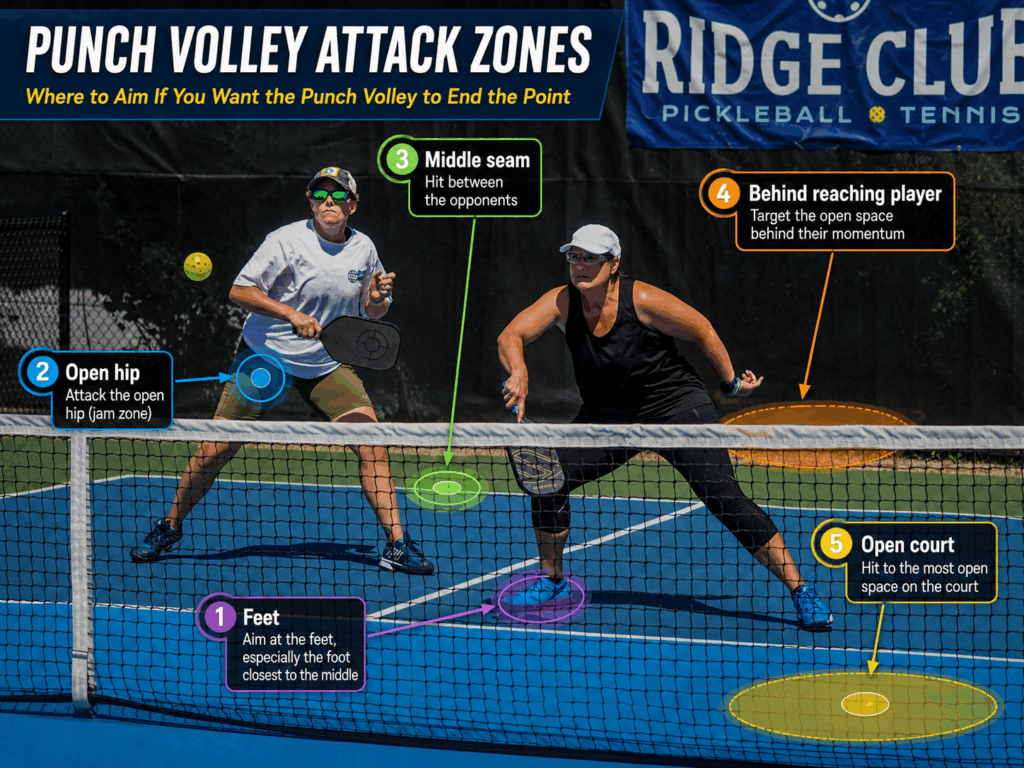
A punch volley does not become a winner just because you hit it hard.
It becomes a winner because you hit the right target.
At 3.5, most players aim too generically. They punch “at the court” or “at the opponent.” That gives the other team too many playable balls.
Better targets:
1. The opponent’s feet
This is the safest attacking target. If they are moving, jammed, or stuck in transition, feet are brutal.
Aim especially at the foot closest to the middle or the foot they are stepping with.
2. The open hip
If the opponent is leaning one way, punch behind the lean or into the hip that jams their paddle.
This does not need to be nasty. It just needs to make them late.
3. The middle seam
In doubles, a firm punch between partners can create hesitation. This is especially effective when both players are upright or not communicating.
4. Behind the reaching player
If someone stretches wide to block, the next punch behind them can finish the point.
This is a great target because their momentum is already going the wrong way.
5. Down through the open court
Use this only when the ball is high enough and you are balanced. If you try this from a medium or low ball, you will often miss into the net or hit it long.
The best finish target is not always the flashiest target.
It is the target that makes the next ball impossible or weak.
When Not to Punch for a Winner
This may be the most important section.
A lot of 3.5 players want to turn every volley into offense. That is how they lose hand battles they should have survived.
Do not try to finish with a punch volley when:
- the ball is below net height
- you are reaching outside your body
- your wrist is unstable
- your weight is falling back
- the opponent’s ball is dipping hard
- you are jammed at the hip
- or your partner is out of position and the counter could expose the court
In those moments, the smart shot is often a block, reset, or controlled placement. A finish shot has to be earned.
Good rule: if you cannot punch forward with balance, do not try to finish.
That is not conservative. That is high-level shot selection.
The Punch Volley Decision Tree
Use this during games.
Ball above net height and in front?
Attack. Punch through the feet, seam, or open space.
Ball chest height but coming fast?
Pressure. Keep the wrist stable, punch compact, and aim at feet or body.
Ball dipping below net height?
Do not force it. Reset, block, or roll only if you have the shape.
Ball jamming your hip?
Turn the paddle, shorten the motion, and protect the middle. Do not slap.
Ball already past your shoulder?
You are late. Defend first.
This decision tree helps you stop treating every volley the same.
How to Make It Feel More Like a Finish Shot
Here is the compact technical checklist:
Paddle starts in front.
If your paddle drops before the shot, you are already late.
Wrist stays stable.
No broken wrist, no floppy face, no last-second scoop.
Elbow stays connected.
Not pinned, not flying. Compact and strong.
Contact is early.
Cut the ball off before it gets beside or behind you.
Paddle moves forward.
The paddle leads the shot. The wrist does not throw the paddle.
Body leans in.
Small forward pressure from the legs and torso.
Target is chosen early.
Feet, seam, hip, or open court — not random power.
If you can do those things, your punch volley will immediately feel heavier.
The 3.5 Player’s Biggest Upgrade: Stop Trying to Do Too Much
If you are around 3.5, the path to a better punch volley is not more violence.
It is less noise.
Less backswing.
Less wrist.
Less body turn.
Less panic.
Less trying to hit the perfect winner.
More structure.
More forward contact.
More target discipline.
More balance.
More recovery.
The punch volley should feel almost boring when you do it right.
Short. Clean. Firm. Directed.
Then the opponent misses, pops it up, or watches it hit the floor.
That is when you know the shot is working.