You probably saw the headline last week. Pickleball Inc. raised $225 million. “A seismic day,” said Connor Pardoe, the PPA Tour founder who now runs the whole operation. CNBC covered it. CBS covered it. Yahoo Sports covered it.
What none of them covered is what the deal actually means for the 24 million people who play this sport recreationally. People who will never watch a PPA match but who register for tournaments, buy paddles, track their rating, and play at an indoor facility.
Pickleball Inc. Now Touches Nearly Every Part of the Sport
Because here’s what Pickleball Inc. actually is now, after this deal closes.
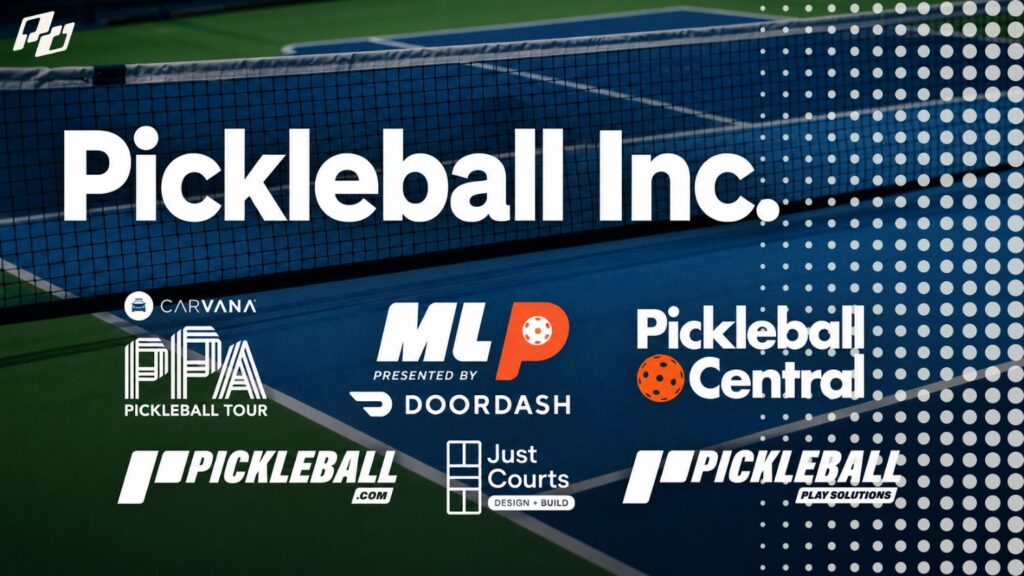
It owns the PPA Tour and Major League Pickleball, the two dominant professional leagues. It owns Pickleball Central, the largest retail platform in the sport, shipping over a million orders since 2006. It owns PickleballTournaments.com, the software that runs roughly 90% of all organized tournament and league play in America. It owns Just Courts, one of the country’s largest pickleball court installers. It has a significant investment in Picklr, the largest indoor pickleball facility chain with over 500 locations worldwide.
And it has a significant investment in DUPR, the rating system used by over a million players to track their skill level.
This Isn’t Just Pro Pickleball Anymore
Think about your own pickleball life for a second. The tournament you registered for last month. The paddle you bought online. The indoor facility you play at on Tuesdays. The DUPR rating you checked after your last match.
There’s a real chance Pickleball Inc. touched, powered, owned, or partnered with some part of it.
To be clear: none of this is inherently sinister. Consolidation happens in every maturing industry, and there’s a reasonable argument that bringing these assets under one roof with serious institutional capital behind them could actually improve the recreational experience. Better software, more courts, lower retail prices through scale. That case exists and it’s worth acknowledging.
But consolidation at this scale also creates something worth paying attention to: a single entity with pricing power across nearly every point where recreational players spend money. Tournament registration fees. Facility memberships. Equipment retail margins. Rating system subscriptions. Court time.
When one company has influence across that much of the stack, the question of how it services its obligations matters to you directly. Not as an investor. As a player.
Why Recreational Players Should Care About the Money Structure
Which brings us to the part of last week’s announcement the business press got wrong, or at least incomplete.
The CNBC headline called it a “$225 million investment.” The official press release called it a “$225 million structured investment.” That word, structured, got dropped from most coverage. It shouldn’t have.
A structured investment is not a $225 million check deposited into a company’s account. It’s a financial arrangement with layers: preferred debt, asset rollovers, obligation payoffs, convertible instruments. The headline number and the actual fresh capital entering a business are often two different things.
How Much New Money Actually Came In? We Don’t Know
Here’s what we know from public reporting. One of the two named investors is Tom Dundon, who was already a majority stakeholder in the business before this deal. Part of the transaction involves Dundon rolling assets he already owned, Pickleball Central, PickleballTournaments.com, and Just Courts, into the Pickleball Inc. portfolio. That’s not new money coming in. That’s existing holdings being consolidated and given a valuation.
How much of the $225 million represents genuinely fresh capital versus Dundon’s existing assets being rolled in isn’t disclosed anywhere in the public coverage. Apollo Sports Capital, the outside investor, is presumably the source of the new money. But the split isn’t broken out.
The Outside-Money Question Nobody Asked
Which raises a question the coverage didn’t ask.
If the growth story is as compelling as the announcement suggests, if 24 million players, five straight years as America’s fastest growing sport, $140 million in combined revenue, and broadcast audiences hitting record numbers can’t attract outside institutional capital, why not?
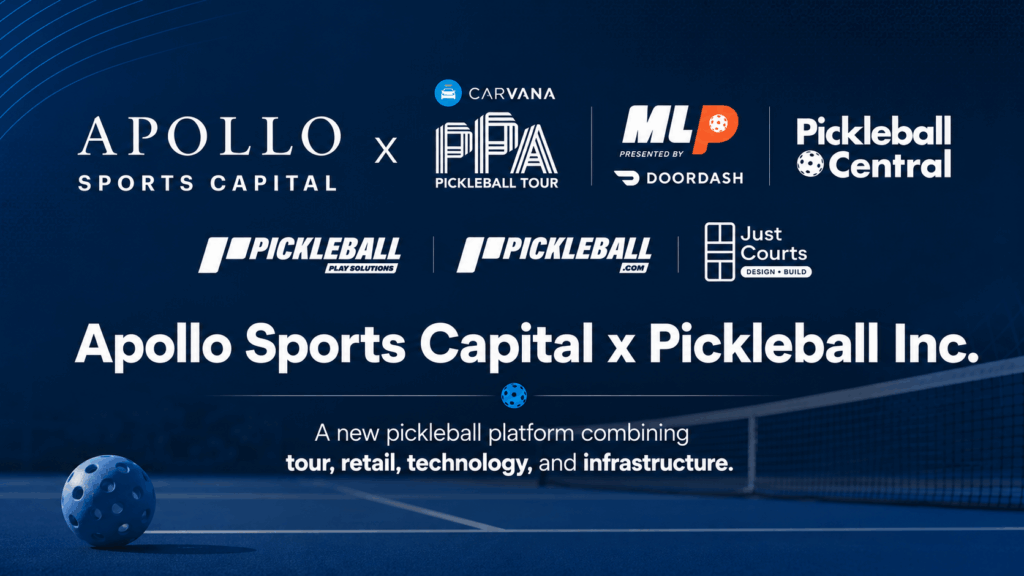
Apollo Sports Capital is an outside institutional investor, but it is also a new sports investment platform. Dundon is already a majority owner rolling in assets he already controlled. So the cleaner question is not whether there is outside money — there is — but how much of the headline $225 million is fresh outside capital, how much reflects existing assets being rolled in, and what terms come with that structure.
That may mean nothing. New funds need anchor deals, and Apollo may simply have moved faster than competitors. Or it may mean that the institutions who looked at this passed, and the people who ultimately wrote the checks are the people who were already too invested to walk away.
We don’t know which. And that’s the point. The announcement didn’t say, and nobody asked.
A $750 Million Valuation Built on Limited Public Detail
The $750 million company valuation cited in every report? Per CNBC, that figure came from a single unnamed source “who asked to remain unnamed because they were not authorized to speak publicly.” One anonymous source. For the number that anchors the entire story.
Again, none of this means the deal is problematic. Structured transactions are completely standard at this level. But “standard” and “fully explained” are different things, and the coverage treated the headline number as settled fact when it isn’t.
What About the Players?
The player question is the one that got the least attention of all.
A week before the $225 million announcement, The Dink published a piece examining what professional pickleball players actually earn, as opposed to what the press releases suggest. The picture is more complicated than the tour’s official numbers imply. Averages in a sport where a handful of top players command enormous appearance fees tell you very little about what the median signed player takes home.
This isn’t a new tension. In December 2023, MLP sent a letter to its signed players acknowledging that over 85% of Premier Level players had accepted pay cuts, with proposed reductions running to 40% across the board. The letter blamed previous leadership for signing “unsustainable and unauthorized contracts.” Those cuts happened. They’re public record.
The $225 million announcement put average annual player earnings at $260,000. What it didn’t address is how the new capital will reach players outside the top tier, or whether the consolidation of obligations that comes with a raise of this structure changes the calculus on player compensation going forward.
The ‘Partners’ Documentary Drop Wasn’t Random
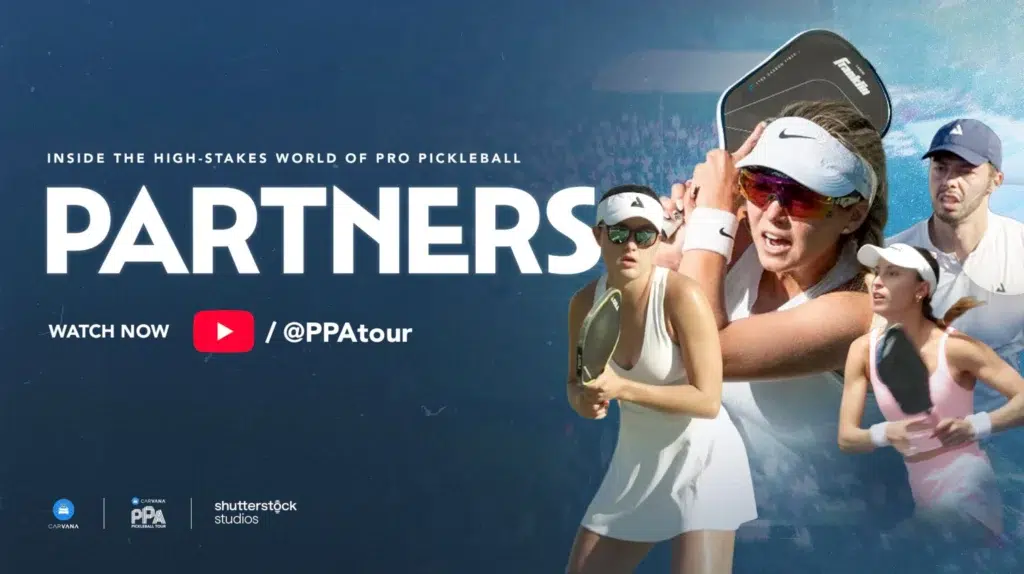
Four days after the investment announcement, on May 5, a six-part docuseries called Partners (watch trailer) premiered on Prime Video, the PPA Tour YouTube channel, and PickleballTV.
The series was produced by Shutterstock Studios. Their own press release describes it as “brand-funded entertainment,” with Carvana, the PPA Tour’s title sponsor, paying for it. The PPA Tour granted access for the production. Distribution runs through Prime Video, the tour’s own YouTube channel, and PickleballTV.
A brand-funded documentary about the tour, produced with tour-granted access, distributed through tour-owned or tour-affiliated platforms, dropping four days after a headline investment announcement. That’s a coordinated narrative campaign, and it’s a sophisticated one. The sport has never seen anything quite like it.
None of that is illegal or even unusual in modern sports marketing. But it’s worth knowing, as a viewer, what you’re watching and who made it.
Pickleball Inc. is a real and growing business. The participation numbers are genuine. The sport’s cultural momentum is real and it belongs to the 24 million people playing it, not to any single company.
The Rec Player Bottom Line
That’s exactly why the questions matter.
You are paying $200 or more for a paddle. You’re paying $85 to enter a local tournament, $500 or more for a PPA event. At least $100 per month for a facility membership and $15 a month to maintain a DUPR rating. The company that just announced a landmark raise now has a stake in most of those transactions.
Where does the money go? Who does this deal actually serve? What does this level of consolidation mean for what you pay to play two years from now?
Those are recreational player questions. And so far, nobody’s asked them.
We will.