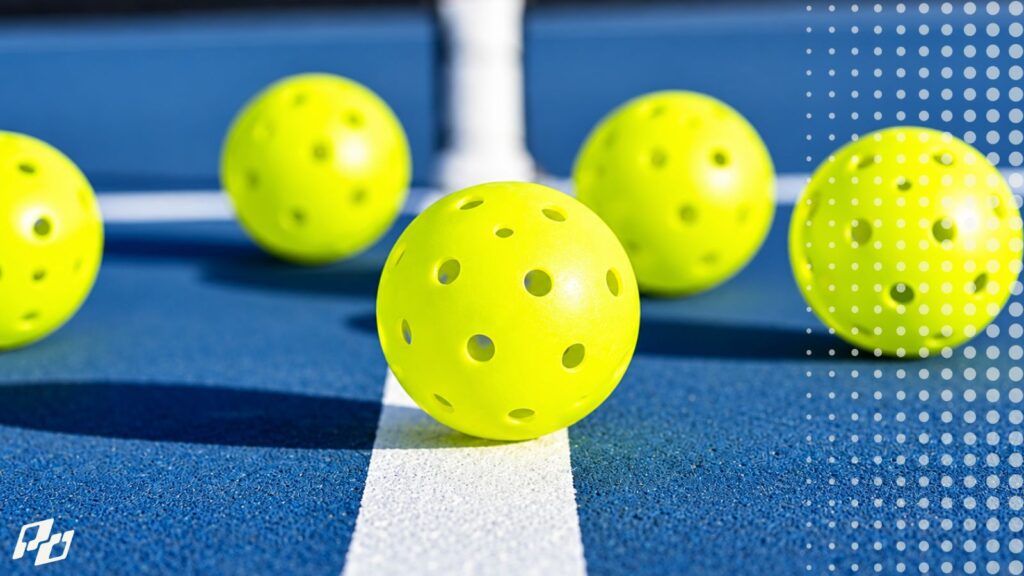
A pickleball can be worn out before it cracks. Replace it when it wobbles, loses bounce, feels unusually soft, flies inconsistently, or develops distorted holes or flat spots. The simplest test is to compare it with a newer ball of the same model—if the old one no longer behaves predictably, it’s done.
There’s a pickleball in almost every rec player’s bag that should have retired three weeks ago.
No crack.
No chunk missing.
Looks perfectly respectable.
But then you play with it. One drive seems to float. A dink barely comes up. Somebody hits a clean return and the ball takes a strange little sideways hop.
Everyone looks at each other.
“Is this ball dead?”
Probably.
Because a pickleball doesn’t have to crack to stop being a good pickleball. It can get: soft, warped, lopsided, slow, flat-bouncing, or inconsistent.
And the annoying part is that deterioration happens gradually enough that you can start adjusting your strokes to a bad ball without realizing it.
So forget the crack-only test.
Here’s how to know when a ball is actually done.
Start With the Test Nobody Uses: Roll It
Put the ball on a smooth, flat surface and give it a gentle roll.
Don’t launch it.
Just watch.
A healthy ball should roll reasonably cleanly.
If it: wobbles, hops, repeatedly wanders to one side, or seems egg-shaped, you’ve found one of the biggest non-crack failure modes.
USA Pickleball’s equipment standard actually limits how far an approved ball can vary from perfectly round: maximum out-of-round diameter variance is ±0.020 inch.
You’re obviously not bringing calipers to open play. But the standard tells you something important: roundness matters.
An out-of-round ball changes both flight and bounce.
And players do notice it. Experienced players commonly describe worn balls as wobbling in flight or taking strange bounces even without a visible crack.
My rule:
If everyone keeps saying, “That bounced weird,” stop blaming the court after the third time.
Check the ball.
Then Compare the Bounce—Don’t Guess It
A ball doesn’t need to feel completely dead to have lost enough rebound to change the game.
USA Pickleball’s equipment test requires an approved ball to bounce 30–34 inches when dropped from 78 inches onto a granite plate, tested around 70°F.
You do not need to recreate that in your garage.
A much more useful rec-player test is: Take a suspect ball and a newer ball of the same model. Hold them side by side. Drop them from the same height onto the same hard surface.
Do it a few times.
If the old ball consistently rebounds noticeably lower, you’ve learned more than you would by squeezing it and saying:
“Eh, seems okay.”
The comparison matters because different ball models naturally feel and bounce differently.
Don’t compare an old indoor Jugs to a brand-new outdoor X-40 and conclude one is dead. Compare like with like.
The Squeeze Test Is Useful—but Look for Unevenness
Pick up a new ball.
Press lightly around several areas.
Now do the same with the questionable ball.
You’re looking for two things: overall softness and, even more importantly, one area that gives more than another.
That localized soft spot is a bigger red flag than a uniformly slightly softer feel. Why? Because the ball is no longer reacting symmetrically.
One side may compress differently on impact, which can contribute to inconsistent rebound and flight.
USA Pickleball’s rules explicitly recognize a ball that has become degraded or soft as something that can be replaced.
So no, “soft but not cracked” isn’t just players being picky. It’s recognized equipment degradation.
Listen to It
This one sounds almost silly until you compare two balls back to back.
Bounce a newer ball.
Then bounce the old one.
Tap both lightly against your paddle.
A healthy ball generally produces a sharper, livelier response. A worn, softened ball often sounds duller.
I would never retire a ball only because it sounds different. But if the sound has changed and the bounce is lower and the shell feels softer?
That’s no longer imagination. You have three clues pointing in the same direction.
Watch the Holes
Cracks often begin around the holes because those areas experience repeated stress. But don’t only look for a dramatic split. Rotate the ball slowly under good light.
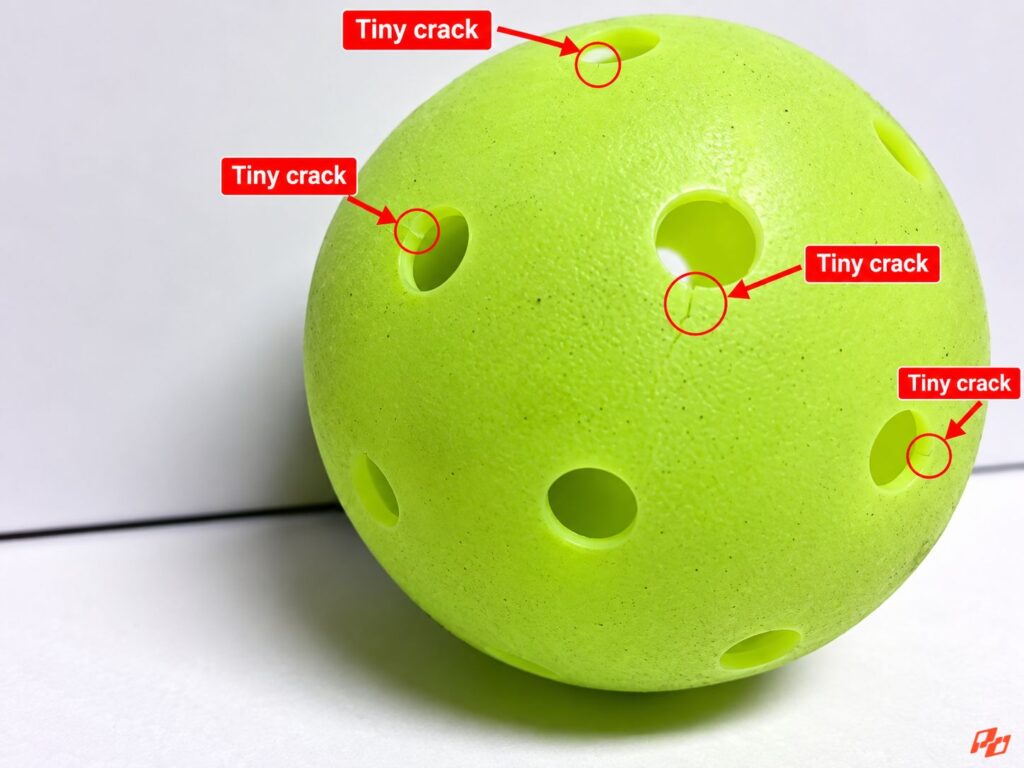
Look for:
- hairline fractures
- stretching or distortion around individual holes
- a seam beginning to separate
- or one side that no longer looks circular
If you find an actual crack, the discussion is over. Retire it.
Here’s the Sneaky One: The Ball Suddenly Plays Slower
Some worn balls don’t wobble dramatically. They simply become mushy.
Drives stop penetrating.
Counters feel dull.
Dinks seem to sit.
This is particularly easy to miss because the change happens gradually.
Players who use Franklin X-40s, for example, frequently describe older balls as becoming softer and slower before cracking, while some other models are more commonly criticized for going out of round. That’s player experience rather than a universal engineering rule, but the pattern is common enough to be useful.
The best diagnostic is not: “Does this still work?” Of course it works.
Ask: “Does this still play like another good ball of the same model?”
That’s a much tougher test.
Indoor Balls Usually Die Differently
Indoor balls often don’t fail as dramatically.
They generally use a softer construction and are played on smoother surfaces, so cracking can be less common than with harder outdoor balls. Outdoor-style balls are typically harder and heavier, while traditional indoor balls are softer, lighter, and often use larger/fewer holes.
That means an indoor ball may stay physically intact while gradually becoming: too soft, too slow, or too inconsistent in bounce.
So if you wait for a traditional indoor ball to crack before replacing it, you may be using it well past its best playing life.
Pay more attention to:
- bounce loss
- softness
- surface wear
- deformation
But “Indoor” and “Outdoor” Can Be Misleading
Here’s a surprisingly useful equipment detail. The roof over the court doesn’t necessarily decide the ball. The surface matters enormously.
If you’re playing inside on a tennis-style acrylic hard court, many facilities still use an outdoor-style ball.
If you’re on a smooth gym floor, traditional indoor balls make more sense.
Pickleball Central and Onix both emphasize that ball choice should be driven heavily by playing surface, not simply whether the court is physically indoors or outdoors.
So when assessing wear, think: What ball is this? What surface has it been living on?
Not simply: Was I indoors?
Don’t Judge a Cold Ball Too Quickly
Temperature can fool you. Cold plastic gets stiffer and more brittle. Cracking risk rises noticeably once temperatures drop below roughly 50°F / 10°C.
That also means a cold ball can feel and bounce differently than the same ball at room temperature.
So if you’re testing a questionable ball after leaving it in a freezing car overnight, warm it first. Likewise, extreme heat can make some balls noticeably softer and more prone to deformation.
Experienced players routinely report certain balls becoming mushier or going out of round in high heat, while cold weather produces more cracking in other models.
Important distinction:
Temporary temperature change isn’t necessarily permanent wear.
Let the ball normalize before condemning it.
The 30-Second Ball Autopsy
If something feels off, don’t debate it for six points.
- Look: Crack, seam opening, flat spot, or distorted hole? Done.
- Roll: Wobbling or wandering? Retire it.
- Bounce: Noticeably lower or less consistent than a good ball of the same model? Downgrade it.
- Press: Clearly softer overall—or one obvious soft spot? Downgrade or retire it.
- Replace: Play one point with a fresh ball. If everyone immediately says, “Yep, that’s better,” you have your answer.
You don’t need laboratory certainty. You need a ball that behaves predictably.
“Done” Doesn’t Always Mean Trash
You don’t need to throw out every ball the moment it loses a little life. Think of balls in three stages:
- Game Ball: Round, firm, consistent, and predictable. Use it for competitive rec games, leagues, and tournament prep.
- Drill Ball: Slightly softer or worn, but still round and reliable. Great for serves, drops, dinks, repetitive feeds, and ball-machine work.
- Retired: Cracked, badly warped, inconsistently bouncing, unusually soft, or failing at the seam. That one’s finished.
So don’t think: Brand new → garbage.
Think: Game ball → drill ball → retired.
One Thing I Wouldn’t Do: Replace Balls on a Fixed Schedule
You’ll see recommendations like: “Replace every three sessions.”
Or: “Ten games and it’s done.”
I don’t love that.
You’ll sometimes see recreational replacement estimates around 3–10 sessions, but ball life can vary a lot based on court surface, temperature, hitting pace, and storage conditions.
Those ranges are useful for expectations. They are poor retirement rules. A ball might crack in its first cold-weather session. Another may remain perfectly playable for weeks.
Judge the ball, not the calendar.
What About the Official Rules?
Here’s something many rec players don’t realize. USA Pickleball doesn’t only address cracked balls. The rulebook also covers balls that become: broken, cracked, degraded, or soft.
In non-officiated play, if both teams agree that the ball is degraded or soft, replace that pickleball before the next serve. A degraded or soft ball does not retroactively create a replay of the previous rally; cracked/broken-ball situations are treated differently.
That is useful etiquette for rec play too.
Finish the rally.
Then check the ball.
Don’t stop mid-point because you suddenly think it feels soft.