
You were in control a minute ago.
Then a couple points go by, the score tightens, and suddenly the match feels different. Nothing dramatic happened. No huge meltdown. No obvious disaster. But you can feel the momentum shifting, and now your brain is doing that very pickleball thing where it starts talking too much.
A lot of rec players respond by “trying harder.” That is usually the beginning of the real problem.
When the score tightens, the best players do not just tell themselves to relax. They get organized. They slow the moment down, refocus on what is actually happening, and make one simple adjustment instead of five.
That approach lines up with current sports psychology too: athletes perform better under pressure when they use routines, focus cues, and task-based thinking rather than spiraling into outcome thoughts or emotional overreactions.
Why does a game suddenly feel like it is slipping?
Because pressure usually shows up as a loss of clarity before it shows up as panic.
That is important. Most players think choking starts when they feel nervous. But often it starts earlier than that. It starts when they get a little tighter, a little less decisive, a little more reactive, and a little less committed to the patterns that were working.
Sports psychology research describes this as a problem of attentional control: under pressure, athletes can drift away from task-relevant cues and toward threat, outcome, or self-judgment.
In pickleball, that often looks like:
- taking a safer but worse target
- rushing a ball you normally reset
- waiting for the opponent to miss instead of running your pattern
- or trying to force a winner because the score suddenly feels heavy
So when a game feels like it is slipping, the problem usually is not that your opponents turned into superheroes. It is that your attention moved from playing the point to protecting the lead.
Why is “try harder” often the wrong answer?
Because under pressure, “try harder” often turns into “do more.”
And “do more” is how rec players start overhitting, over-aiming, and overcomplicating simple points.
Structured routines, focus cues, and controlled responses tend to help performance under pressure more than emotional forcing does. Pre-performance routines in particular have strong support as a way to stabilize execution.
For pickleball players, “trying harder” often means:
- bigger swing
- greedier target
- riskier speed-up
- less patience
- and worse spacing
That is not intensity. That is leakage. The better move is not to care less. It is to remove the extra noise.
What should you tell yourself when the score tightens?
You should tell yourself something small enough to obey. That is the key.
A lot of players fill their head with useless pressure phrases:
- “Do not choke.”
- “We have to win this.”
- “Do not miss.”
- “I need to take over.”
- “Come on, lock in.”
Those thoughts are dramatic, but they are not very helpful.
The best self-talk under pressure is short, specific, and tied to the task. Stanford sport psychologist Kelli Moran-Miller points to focus cues and instructional self-talk as useful tools for helping athletes stay in the moment under stress.
Good examples:
- Next ball
- Big target
- Soft hands
- One more shot
- Middle first
- Crosscourt
- Breathe and set
Bad examples:
- Do not blow it
- We always do this
- I cannot miss
- This is getting away from us
One kind of self-talk gets you into the point. The other gets you into your own head.
What is the first thing you should do when momentum shifts?
First, admit that something changed. That does not mean panic. It means awareness.
A lot of players are so committed to “staying positive” that they never actually diagnose the problem. But you need both. You need to reset emotionally and figure out what changed tactically.
A very simple between-point routine works well here:
- Exhale.
- Loosen your grip.
- Say one cue.
- Ask one tactical question.
- Pick one adjustment.
This kind of short reset routine is very much in line with current research on emotional regulation, focus, and coping under pressure. Controlled breathing, routines, and symbolic or instructional cues can help athletes interrupt stress escalation and refocus attention.
Your tactical question can be simple:
- Are we losing because of execution or decision-making?
- Did they change something, or did we?
- Are we rushing?
- Did we abandon the pattern that got us the lead?
If you do not know the answer, simplify first.
Should you call a timeout?
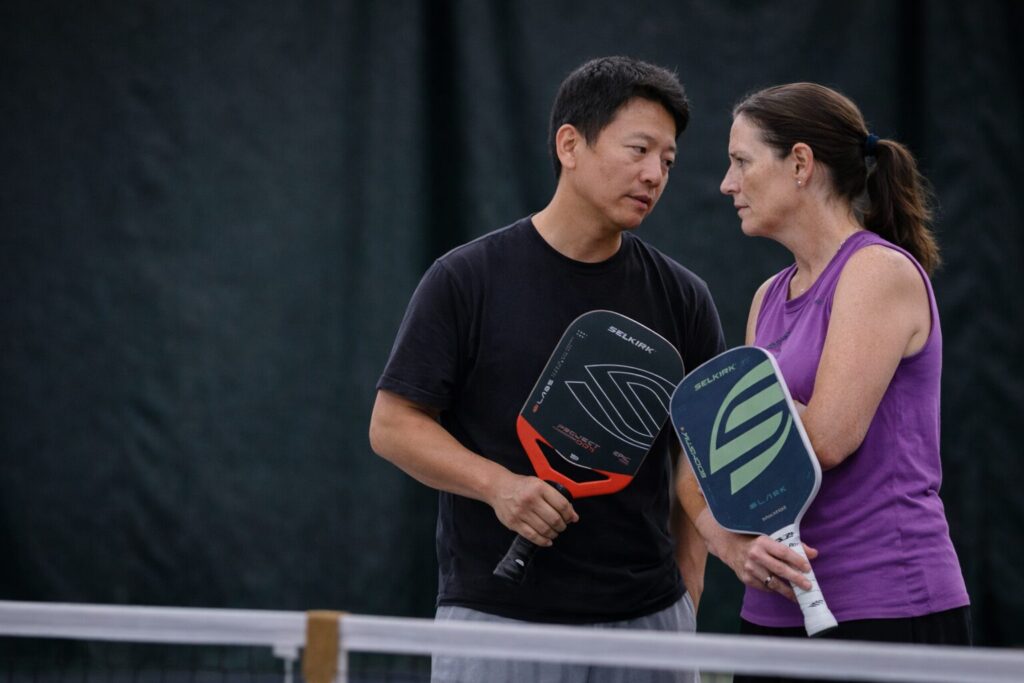
Yes, sometimes that is exactly the right move. A timeout is useful when:
- both partners are sped up
- communication has gotten sloppy
- a bad pattern is repeating
- or one of you is carrying the last point into the next one
What a timeout is not for:
- blaming your partner
- inventing six new strategies
- or holding a court-side therapy session
The best timeout is short and specific:
- What got us the lead?
- What changed?
- What is one thing we do next?
That is enough.
What usually changes first when players start choking a lead?
Usually, they either get too passive or too complicated. Those are the two classics.
The passive version
You stop running your pattern and start waiting for the other team to miss. You play not to lose instead of playing to keep asking good questions.
The complicated version
You decide the answer is to add more. More spin, more pace, more lobs, more speed-ups, more surprise. Under pressure, that usually creates less clarity, not more.
So when the score tightens, ask:
- Am I getting too safe?
- Or am I getting too cute?
Both can look like effort. Both can cost you the game.
What should you actually do on court when the game tightens?
Here is the practical answer: Shrink the game, not your courage.
You do not need to become timid. You need to become clearer. For most rec players, the best response usually comes from four moves:
1. Return to your winning pattern
Go back to what built the lead. Deep serve to the backhand. Middle ball. Patient crosscourt dink. Target the weaker reset. Whatever was working, revisit that first.
2. Increase margin, not passivity
Margin does not mean bunting the ball. It means giving yourself a safer target and shape while still making the opponent hit a real shot.
3. Slow the rally before you speed it up
If the point is getting frantic, reset the tempo. More neutral balls. More patience. Make them hit one more shot.
4. Choose one adjustment
Not five. One.
Examples:
- Serve deeper to the backhand.
- Stop speeding up from transition.
- Dink crosscourt first.
- Target middle until they prove they can handle it.
- Stop aiming near the lines.
One simple adjustment is easier to trust than a menu.
Tight-Game Reset Cheat Sheet
If you want a simple in-match reminder, this is the cheat sheet to come back to when the score tightens and your brain starts getting loud.
| Problem You Feel | What It Usually Means | What to Tell Yourself | What to Do Next |
|---|---|---|---|
| The game suddenly feels fast | You are losing clarity, not just time | Breathe and set | Exhale, loosen grip, pick a big target |
| You want to try harder | You are about to do too much | Simple first | Stop forcing, choose margin over hero shots |
| You are rushing balls | Your body is sped up | One more shot | Slow the rally down, reset if needed |
| You do not know what changed | You have not diagnosed the leak yet | What changed? | Ask: execution problem or tactical problem? |
| You are getting passive | You are protecting the lead | Run our pattern | Go back to what built the lead |
| You are getting too fancy | Pressure is making you search for magic | One adjustment | Pick one change, not five |
| Your partner is spiraling too | The team needs simplicity | Even game | Use one short cue: “Next ball” or “Big target” |
| You feel tense between points | Your arousal is too high | Long exhale | Inhale 3, exhale 5, drop shoulders, reset |
| Momentum is slipping | The match is getting noisy | Get clear again | Slow down, simplify, return to patterns |
| You want to save the game with one shot | Pressure is pulling you into outcome-thinking | Win this point | One point at a time + one adjustment at a time |
How much does breathing really matter?
More than most rec players think.
Breathing is not just a relaxation gimmick. It is a practical way to regulate arousal so your next decision is not made from tension.
A simple rule: Longer exhale = better chance of not rushing the next ball.
Try this between points:
- inhale for 3
- exhale for 5
- drop your shoulders
- loosen your jaw
- then say your cue
It is not magic. It just gives your brain a better place to operate from.
What should doubles partners say to each other in that moment?
Less than you think — but better than you usually do. Short, useful partner language helps:
- Next ball
- Big target
- Middle first
- One more ball
- Our pattern
- Even game
What does not help:
- “You keep—”
- “Why did you—”
- “Just do not miss.”
- “We’re choking.”
A tight game is not the time to coach your partner mid-collapse. It is the time to make the match feel smaller and simpler.
Is “one point at a time” enough?
Not by itself. It is a good start, but it needs one more piece: One point at a time + one adjustment at a time.
That is the real formula.
Because pressure moments in pickleball are never purely mental or purely tactical. You need enough emotional control to stop the spiral, and enough tactical awareness to stop the leak.
How do you practice this before it happens again?
You practice the reset, not just the shots.
That is the part most rec players skip.
Research on performing under pressure supports the value of routines, self-talk, imagery, attentional refocusing, and simulated pressure practice.
A few useful ways to train this:
Play score-pressure games
Start at 8–8, 9–9, or 10–8. Make tight scores feel normal instead of dramatic.
Rehearse one between-point routine
Exhale. Cue. One tactic. Every time.
Train your default pattern
Know what your safest strong pattern is when the game gets messy.
Review your matches
Some of your tight-score habits are invisible in real time. Video can expose where you stop playing your game and start protecting the score.
So what is the real fix when a game starts slipping?
The real fix is not to become more intense.
It is to become more organized.
That is the big lesson. When the score tightens, the best response is usually:
- slow down
- keep it simple
- identify what changed
- return to the winning pattern
- and stop trying to rescue the whole game with one heroic shot
So the next time you are up 8–5 and it becomes 8–8, do not tell yourself the match is slipping away.
Tell yourself this instead: The game got noisy. My job is to get clear again.
That is a much better place to play from.