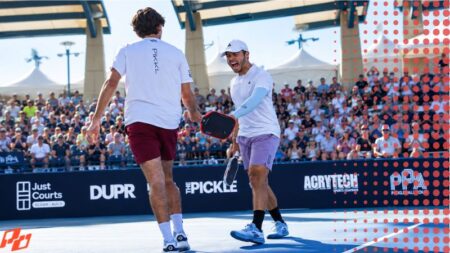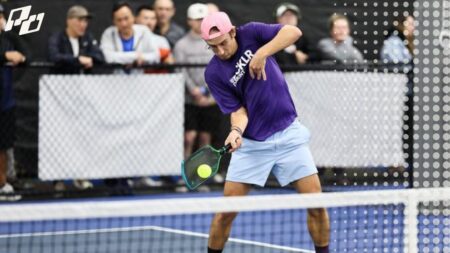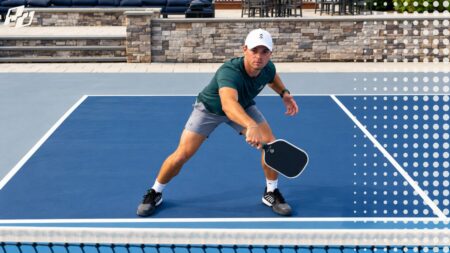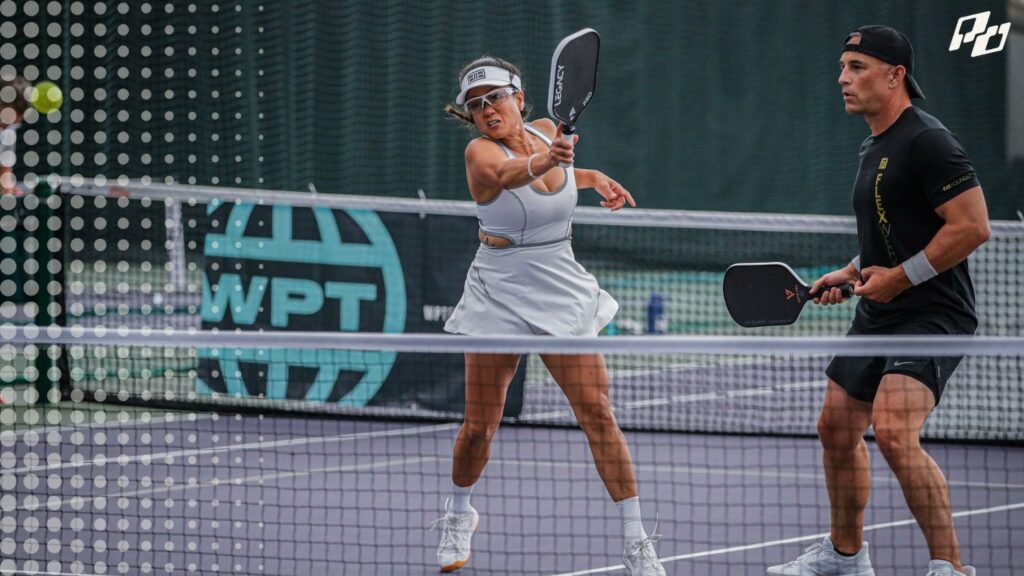
To counter in pickleball like a higher-level player, keep your paddle out front, use a stable wrist, stay balanced, and cover likely attack zones. Counter balls into your prepared paddle or chest-height zone, but reset or let go balls that are low, late, outside your frame, or sailing long.
At 3.5, a lot of players think “fast hands” means reacting faster. At 5.0, countering is not just reaction speed.
It is preparation.
It is paddle position.
It is knowing which balls are actually yours.
It is letting out balls go.
It is taking away the opponent’s best two options instead of trying to cover the whole court.
That is the big difference.
A 3.5 player often sees a speedup and thinks: “Oh no, here it comes.”
A stronger player thinks: “I know where this is likely going, and my paddle is already there.”
That is how you start countering like a higher-level player.
Not by swinging bigger.
Not by panicking faster.
Not by trying to win every hands battle with raw reflexes.
You counter better by simplifying the court, stabilizing your paddle, and making the attacker pay for speeding up into your zone.
First, What Is a Counter?
A counter is not just “getting the ball back.”
That is a block.
A counter is when your opponent attacks first, and you use their pace against them to turn the rally back in your favor.
A good counter can:
- punish a bad speedup
- stop opponents from crashing recklessly
- force them to respect your hands
- turn defense into offense
- or end the point outright
At higher levels, counters are essential because players attack more often and from more places. Modern coaching around speedup defense emphasizes that simply blocking everything back allows aggressive players to keep coming forward; players need to learn when to block, reset, reload, and counter so they can take back control of the rally.
For rec players, that matters because many 3.5/4.0 games are full of speedups.
Some are good.
A lot are bad.
And if you can counter the bad ones, opponents stop getting free pressure.
That is when the whole game changes.
The 5.0 Counter Mindset: Take Away Zones, Not the Whole Court
Here is the mistake most rec players make: they try to cover everything. They try to protect line, middle, body, crosscourt, forehand, backhand, roll, dink, lob, and speedup all at once.
You cannot do that.
The court is small, but in a hands battle, it is still too big to cover everything equally.
Higher-level players play percentages. They know that based on where the ball is, where the opponent is contacting it, and what angle is available, some attacks are much more likely than others.
Instead of thinking, “I need to be ready for anything,” think, “What are the two most dangerous balls from here?”
That is a 5.0-style mental shift.
When the opponent is attacking from crosscourt, the ball has a likely lane.
When they are attacking from in front of you, your body and middle become bigger targets.
When they are stretched wide, their options shrink.
When they attack from below net height, some counters are more likely to float or sail.
Your job is not to guess perfectly. Your job is to remove the obvious attack and be ready for the next most likely one.
That is anticipation.
Stop Leading With the End Cap
This is a technical detail that matters a lot.
Many rec players prepare for counters with the paddle handle or end cap leading. The paddle is there, but the face is late. That means when the ball comes fast, they have to flip, open, or manipulate the paddle face at the last second.
That is where pop-ups happen.
Instead, think: Paddle tip first. Face organized. Wrist quiet.
If the paddle tip is leading and the face is already oriented toward the likely contact zone, you need less movement to counter. Less movement means fewer errors.
You do not want the paddle dangling, twisting, or arriving late. You want it already in front of your body, ready to move forward through the ball.
A simple cue: Tip first, wrist second.
In other words, the paddle gets to the ball before the wrist tries to do anything fancy.
For most rec players, this one cue immediately cleans up counters because it prevents the late wrist flip that sends balls floating upward.
Your Wrist Should Be Stable, Not Dead
A 5.0 counter is not wristy. But it is also not stiff like a board.
The wrist should be stable enough that the ball does not push your paddle face around. You are not flicking wildly. You are not scooping. You are not letting the paddle collapse open.
The power comes mostly from a short forward extension through the ball — shoulder, forearm, and paddle moving as one compact unit.
Coaching on counterattacks and volleys consistently emphasizes a stable wrist, compact motion, and paddle out front because excessive wrist movement changes the paddle face too much under pressure.
Think of your wrist like a hinge that is locked just long enough to deliver the counter.
Not frozen forever.
Not floppy.
Stable through contact.
A good cue: Firm wrist, fast extension.
That is very different from: Loose wrist, last-second slap.
At 3.5, that slap might occasionally win a point. Against better players, it becomes a pop-up machine.
Closed Face vs. Open Face: Why Your Counters Keep Floating
A lot of rec counters float because the paddle face is too open. That open face works when you are blocking or resetting. It helps lift the ball and absorb pace.
But if you are trying to counter an attack, especially against someone crashing forward, an open paddle face often gives them exactly what they want: a soft ball they can attack again.
That is why higher-level counters often use a more neutral-to-slightly-closed face.
Not violently closed.
Not chopped down.
But organized enough that the ball goes forward or down instead of floating up.
The important distinction:
Open face = absorb or lift.
Neutral face = block or redirect.
Slightly closed face = counter with pressure.
If the ball is high enough, you can close the face more and drive it down.
If the ball is chest height, stay closer to neutral and push through.
If the ball is low, be careful. A strong counter from low contact is possible only if you have balance, paddle stability, and enough incoming pace to work with. Otherwise, reset.
That is the 5.0 decision. Not every attacked ball should be countered.
The Three Counter Zones Around Your Body
This is where things get more technical — and more useful.
At the kitchen, you do not want to decide forehand or backhand after the ball is already on you. You need a default system.
Think of your body in three zones.
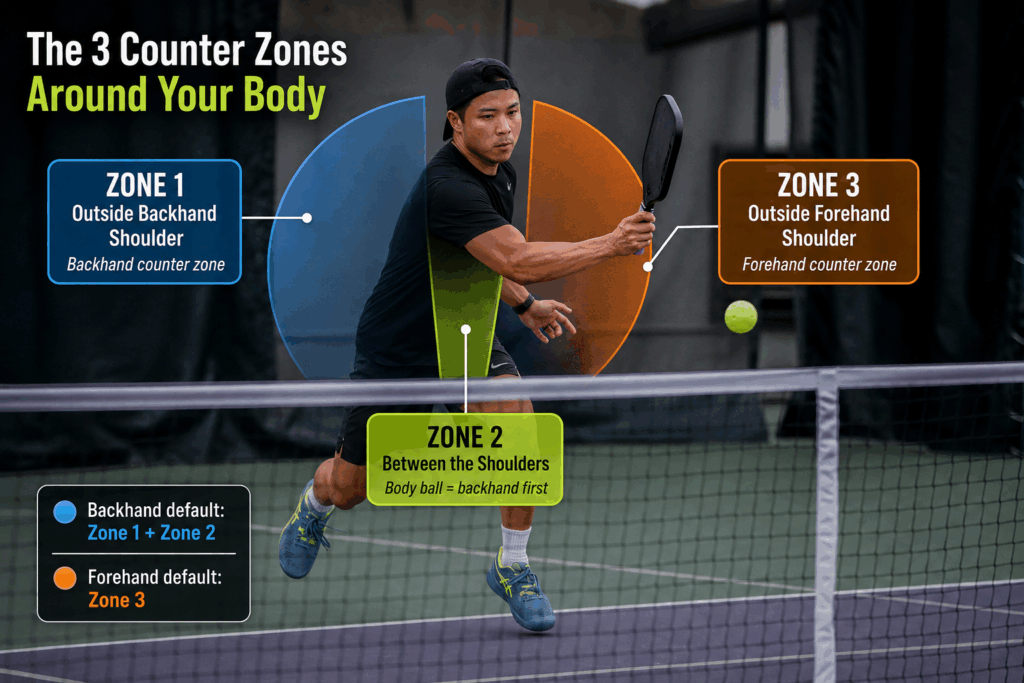
Zone 1: Outside Your Backhand Shoulder
This is the ball to the backhand side, outside your body.
For many players, especially two-handed backhand players, this is a strong counter zone. If the ball is wide enough on that side, two hands can give you structure, power, and stability.
This is especially useful when you dink wide and expect the opponent to speed up down the line.
If you know the likely attack is coming to your backhand side, you can preload the paddle there. Not by guessing wildly, but by recognizing the pattern.
The cue: If I create the down-the-line speedup, I prepare the down-the-line counter.
That is how better players look faster. They are not magically reacting from neutral. They are preparing for the ball their own shot made likely.
Zone 2: Between the Shoulders
This is the body ball.
For many players, this should be a backhand counter zone, especially when the ball is coming into the chest, stomach, or inside shoulder.
Why?
Because if you try to hit a forehand from the middle of your body, you often get jammed. The elbow gets trapped. The paddle face opens. The ball pops up.
A compact backhand counter in front of the body usually covers this zone better.
The cue: Body ball? Backhand first.
Not always. But as a default for rec players, it solves a lot of chicken-wing problems.
Keep the elbow tucked enough that the paddle can move quickly. If your elbow flies away from your body, your hand speed slows down and your paddle path gets too big.
Think: Elbow in. Paddle in front. Punch through.
Zone 3: Outside Your Forehand Shoulder
This is the ball far enough to your forehand side that you can extend and counter cleanly.
This is where your forehand counter makes sense. But the key is “outside your forehand shoulder.”
If the ball is actually at your body or inside shoulder, forcing a forehand can jam you. If it is outside the shoulder, now you have room to swat or punch forward.
The cue: Forehand only when there is space.
A lot of rec players want to use their forehand for everything because it feels stronger. But at the kitchen, the fastest counter is often the shot that requires the least movement.
Sometimes that is the backhand. Often, it is the backhand.
Paddle Position: Neutral Does Not Mean Passive
Many players cheat too hard to one side.
They hold the paddle way over on the backhand side, then get jammed on the forehand shoulder. Or they cheat forehand and get burned through the middle.
The better ready position is neutral but informed.
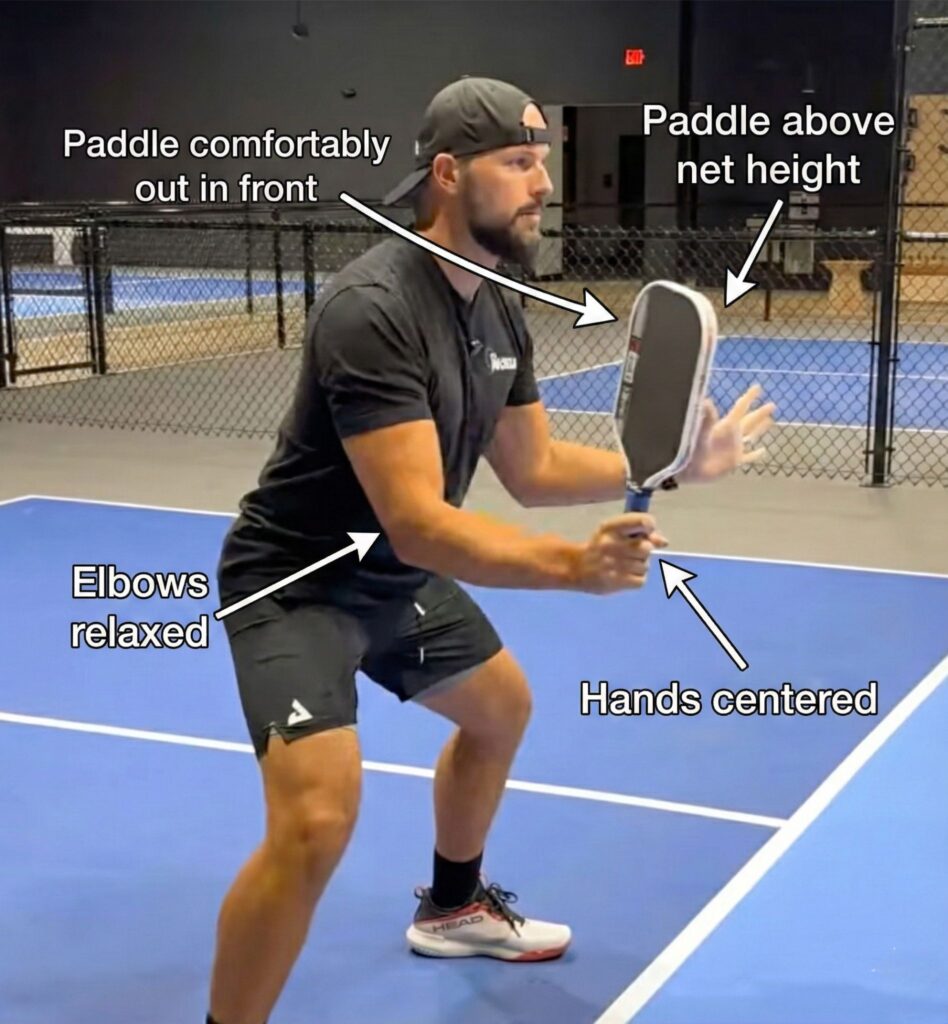
Your paddle should be out front, elbow connected, and tip angled toward the most likely attack lane.
That last part matters.
If the ball is directly in front of you, your paddle can be more centered. If the ball is crosscourt, your paddle tip should subtly track that direction because the attack is likely to come along that angle.
The idea is not to turn your whole body early or wave the paddle around. It is to reduce the distance the paddle has to travel.
High-level countering uses less motion, not more.
A simple cue: Point the paddle tip toward the danger.
Not the whole paddle face.
Not your shoulders.
The paddle tip.
That keeps you ready without overcommitting.
Quiet Feet Make Faster Hands
This is one of the least obvious countering tips. When someone is about to attack, your lower body should become quiet.
That does not mean flat-footed. It means stable.
A lot of rec players are still sliding, drifting, hopping, or backing up when the speedup comes. Then they wonder why their hands feel slow.
Your hands are slow because your body is still moving.
At the kitchen, you want to split or settle before the opponent contacts the ball. Bend the knees. Lower the center of gravity. Get still enough that the paddle can react.
The cue: Move early. Get quiet before contact.
This is why better players look calm in firefights. Their feet did the work before the attack happened. Once the ball is coming, their base is already set.
If your feet are late, your paddle has to save you.
That is not a good long-term plan.
The Counter Is Not Always Yours
This is huge for doubles.
A 5.0-style counter is not just about hitting better. It is about knowing which balls to leave.
Some attacks are yours.
Some are your partner’s.
Some are going out.
Rec players lose a lot of points by touching balls they should leave.
Especially balls attacked toward the backhand-side shoulder or outside the body from certain lanes. Many of those balls are rising, drifting, or traveling out. But because they feel fast, players panic and save the opponent.
Better players are comfortable saying: That ball is not mine.
This is not passive. It is disciplined.
A strong counter game includes the ability to let balls go.
Ask yourself:
- Is the ball rising?
- Is it above my shoulder?
- Is it moving away from the court?
- Is my paddle reaching outside my frame?
- Is my partner in a better position?
- Did the opponent attack from too low?
If yes, you may not need to hit it. Sometimes the best counter is a duck.
Countering Below Net Height: Be Careful, But Don’t Be Scared
This is where advice gets confusing.
Some coaches say never counter below net height. Others show players taking lower balls aggressively with a closed face and fast extension.
Both ideas can be true.
For most rec players, attacking from below net height is risky because you are usually hitting up. If your paddle face opens, the ball floats. If you swing too big, it sails. If you are off balance, you miss.
But a lower counter can work if:
✓ the ball has pace coming in
✓ your paddle face is stable
✓ your contact is in front
✓ your body is balanced
✓ and your target is smart
The goal is not to smash a low ball. The goal is to redirect it with enough forward pressure that it does not sit up.
A slightly closed or neutral face can help keep the ball from floating. But if you are reaching, falling back, or late, reset instead.
The simple rule: Low and stable? Counter carefully. Low and rushed? Reset.
That is a much better rule than “always counter” or “never counter.”
Stop Resetting Balls You Should Punish
Many improving players have the opposite problem. They learned to reset, which is great. But now they reset everything.
That keeps them safe, but it also lets aggressive opponents keep attacking.
At some point, if your opponent speeds up a bad ball into your prepared zone, you have to make them pay.
If every speedup gets softly reset, the opponent learns: “I can keep attacking and nothing bad happens.”
A 5.0 counter sends a different message: “If you attack this zone, the ball is coming back harder
That does not mean you counter every ball. It means you punish the right ones.
| Situation | Counter or Don’t Counter? | Why |
|---|---|---|
| Speedup comes into your prepared paddle | ✅ Counter | Your paddle is already in position, so you can punch through the ball without rushing. |
| Attack is at chest height | ✅ Counter | You can meet it out front and send it back with pressure. |
| Ball comes into your backhand counter zone | ✅ Counter | This is usually a strong, compact counter position, especially on body attacks. |
| Attack from below net height sits up | ✅ Counter | If it rises into your strike zone, you can punish the weak speedup. |
| Opponent speeds up while off balance | ✅ Counter | They are less ready for the next ball, so a firm counter can expose them. |
| Your feet are quiet and paddle is out front | ✅ Counter | A stable base and ready paddle give you control. |
| Ball is already past you | ❌ Don’t counter | You are late; block, reset, or defend instead. |
| Ball is below net height while you are falling back | ❌ Don’t counter | You will likely pop it up or miss because your balance is moving away. |
| Attack is outside your frame | ❌ Don’t counter | Reaching creates weak, unstable contact. |
| Ball is your partner’s better take | ❌ Don’t counter | Let the player with the better angle and balance handle it. |
| Speedup is clearly sailing long | ❌ Don’t counter | Do not save your opponent’s mistake. |
| Your wrist has to save the shot | ❌ Don’t counter | If the shot requires a last-second wrist flick, you are not in a strong counter position. |
The better you get, the more you understand the difference.
Aim Counters at Better Targets
A counter is not automatically good because it is fast.
A lot of rec players counter hard right back to the opponent’s paddle. That just starts a firefight they may not win.
Better targets are more specific:
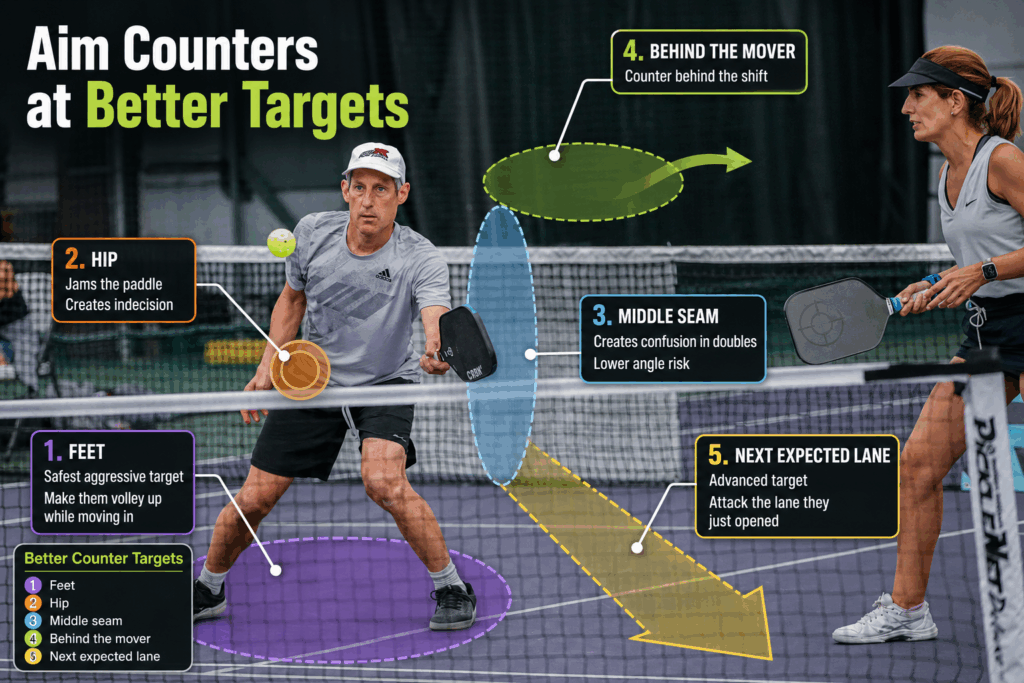
1. The feet
This is the safest aggressive target.
If the attacker is moving forward, hit at their feet. Make them volley up while their momentum is coming in.
2. The hip
The hip jams the paddle and creates indecision. Forehand or backhand? Swing or block? That hesitation is valuable.
3. The middle seam
In doubles, the middle can create confusion. It also reduces your angle risk.
4. Behind the mover
If someone attacks and shifts hard one way, counter behind the movement.
5. The next expected lane
This is more advanced. If your first counter pulls them across, expect the next reply and counter into the lane they just opened.
That is how hands battles become patterns instead of chaos.
The “Hot Read” Concept: Cover the First Two Threats
Here is a simple way to think like a higher-level player. Before the opponent attacks, ask:
Ask yourself what their hot read is—in other words, what is the most likely attack—and then ask what the second most likely attack is.
You dink wide to your opponent’s forehand.
Their likely speedup is down the line or into your body.
So you prepare your paddle for that lane.
Example:
You hit middle and your opponent is reaching.
Their likely counter may leak middle or body.
So you and your partner pinch that space.
Example:
The opponent is attacking from below net height.
Their ball may sail long or come up.
So you prepare to counter, but you do not automatically save every high ball.
This is how you reduce panic.
Common Counter Mistakes That Keep Players at Lower Lowels
Mistake 1: Big backswing
There is no time.
Fix: Start out front. Stay out front.
Mistake 2: Floppy wrist
The paddle face changes and the ball floats.
Fix: Stable wrist through contact.
Mistake 3: Open face on every counter
Good for blocks. Bad for pressure.
Fix: Neutral or slightly closed face when countering.
Mistake 4: Trying to cover the whole court
You become late everywhere.
Fix: Take away the highest-percentage lanes.
Mistake 5: Moving during opponent contact
Your hands feel slow because your base is unstable.
Fix: Move early, get quiet, then counter.
Mistake 6: Countering out balls
You rescue bad speedups.
Fix: Read height, trajectory, and contact point. Let more balls go.
Mistake 7: Resetting every attack
You never punish bad speedups.
Fix: Reset under pressure. Counter when prepared.
The 5.0 Counter Checklist
Before the speedup:
Am I balanced?
Is my paddle out front?
Is my elbow connected?
Is my paddle tip tracking the likely lane?
Do I know my hot read?
During contact:
Stable wrist.
Compact punch.
No backswing.
Face neutral or slightly closed.
Extend through the ball.
After the counter:
Reload.
Stay low.
Expect the next ball.
Do not admire it.
That is the whole system.
What This Looks Like in a Real Rec Rally
You dink crosscourt to your opponent’s backhand. They lean in and look ready to speed up.
A 3.5 reaction is: “I hope I can react.”
A better read is: “From that position, they probably speed up down the line or into my body. My paddle tip tracks that lane. My elbow stays in. I’m ready for backhand/body first. If it goes high and wide, I may let it go.”
Now the ball comes.
If it is into your body, you counter compact through the middle or at their feet.
If it is outside your frame and rising, you leave it.
If it is low and dipping, you reset.
Same speedup. Different brain. That is what “counter like a 5.0” really means.