
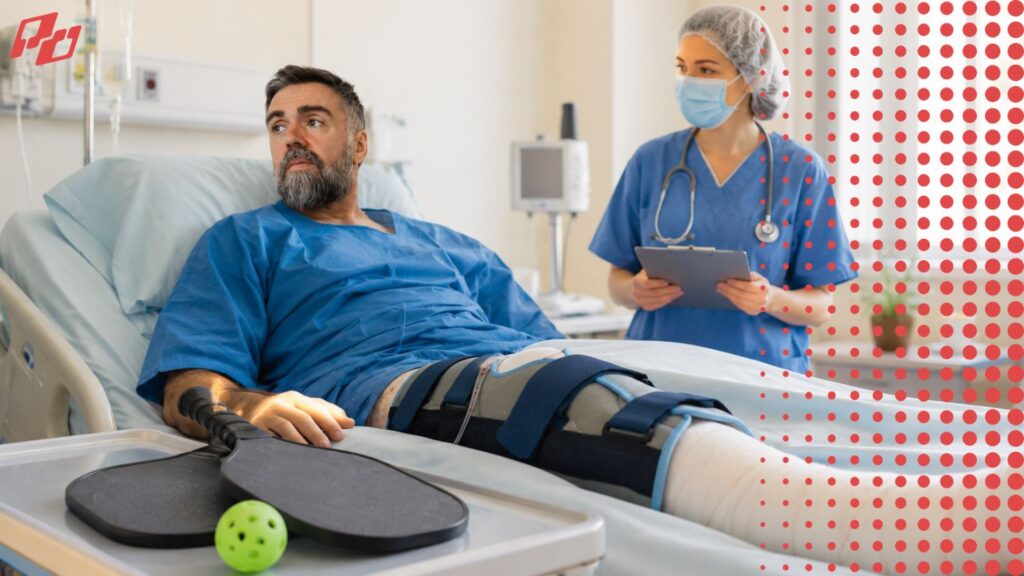
Most rec players can return to pickleball after surgery, but timelines vary. Knee or hip replacements often take 3–6 months for controlled doubles, while meniscus repairs, rotator cuff repairs, and ACL surgery may take longer. Return should depend on pain, swelling, strength, balance, clearance, and pickleball-specific movement.
For a lot of 55+ rec players, the scariest part of surgery is not just the surgery.
It is the question that comes after: “When can I get back on the pickleball court?”
Not just walking around the block.
Not just doing stairs.
Not just “normal daily activity.”
Pickleball.
Dinks, drives, kitchen movement, lateral shuffles, sudden stops, awkward reaches, overheads, balance checks, and the occasional moment where your brain says “don’t chase that ball” and your body says “too late.”
Here’s the honest answer: most players can return after common orthopedic surgeries, but the timeline depends heavily on the surgery, the repair, your rehab, your strength, your balance, and how smartly you restart.
A surgeon clearing you for “activity” is not the same as being ready for competitive open play.
Pickleball may look low-impact compared with tennis or basketball, but it still demands quick lateral movement, deceleration, trunk rotation, shoulder control, and balance. That is why return-to-play should be based on both time and function, not just a calendar date.
So let’s walk through the realistic timelines for the most common surgeries older rec players ask about — knees, hips, shoulders, meniscus tears, rotator cuffs — and what the comeback actually feels like.
Important note: This is educational, not personal medical advice. Your surgeon and physical therapist get the final say, especially if your surgery involved complications, a revision, a tendon repair, bone quality issues, or restrictions specific to your implant or repair.
The Quick Timeline: When Most Rec Players Can Expect to Return
These are broad, realistic ranges for recreational doubles pickleball, not singles, tournament play, or full-speed aggressive open play.
| Surgery / Procedure | Light Court Activity | Controlled Doubles | More Competitive Play | Big Caution |
|---|---|---|---|---|
| Total knee replacement | ~10–12+ weeks | ~3–6 months | ~6–12 months | Swelling, stiffness, lateral movement, endurance |
| Total hip replacement | ~10–12+ weeks | ~3–6 months | ~6–12 months | Pivoting, falls, hip precautions, strength symmetry |
| Partial meniscectomy | ~4–8 weeks | ~6–12 weeks | ~3+ months | Depends on swelling, arthritis, quad strength |
| Meniscus repair | ~3–4+ months | ~4–6+ months | ~6+ months | Repair healing; slower than meniscectomy |
| Rotator cuff repair | ~4–6 months for light hitting | ~6–9 months | ~9–12 months | Tendon healing; overheads and hard counters |
| Shoulder replacement | ~4–6+ months | ~6+ months | ~6–12 months | Implant protection, overhead volume, strength |
| ACL reconstruction | ~6+ months for controlled drills | ~9+ months | ~9–12+ months | Cutting/pivoting; re-injury risk if rushed |
For hip and knee replacements, Hospital for Special Surgery notes that many surgeons allow return to pickleball after recovery, typically around 3–6 months, with surgeon and PT clearance first. A 2025 joint arthroplasty study found that most recent racket-sport players returned after joint replacement at the same skill level by six months, with no increased reoperation rate reported in the study population.
That is encouraging.
But it does not mean everyone should sprint back at month three.
Why Pickleball Return Is Different From “I Feel Fine”
This is where a lot of players get tricked.
You may feel good walking.
You may feel good biking.
You may feel good doing PT exercises.
You may even feel good hitting easy dinks.
Then the first real game starts.
Someone lobs.
Someone speeds up.
You backpedal.
You plant and twist.
You reach for a wide dink.
You forget you had surgery because the point is live.
That is the difference between rehab movement and pickleball movement.
Most setbacks happen not because a player cannot hit the ball. They happen because the player returns to the wrong version of pickleball too soon.
The first version back should not be “two hours of open play with whoever shows up.” It should be controlled, boring, and progressive.
That is how you stay back.
1. Returning After Total Knee Replacement
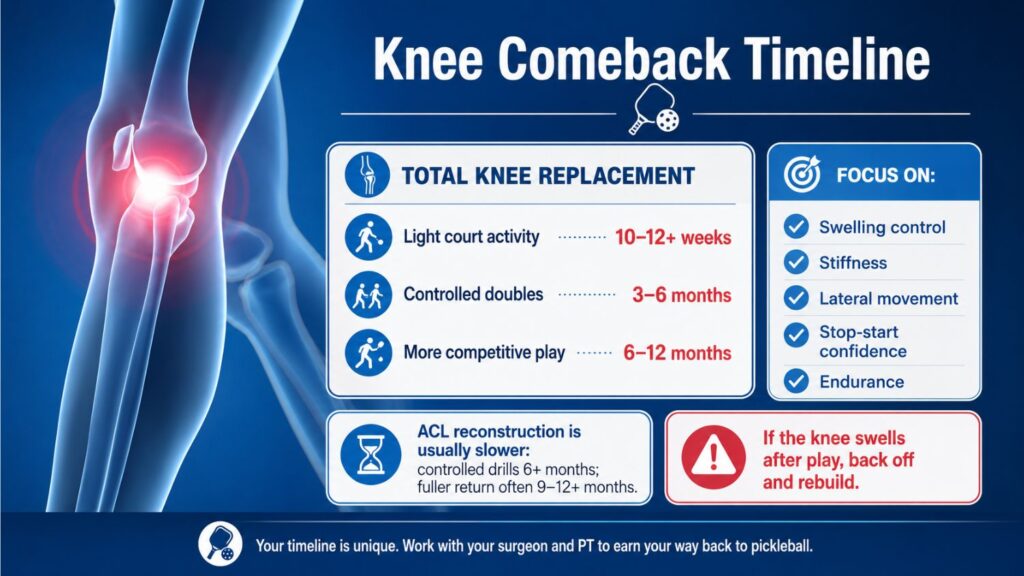
For many 55+ players, knee replacement is the big one.
The good news: many players do return to pickleball after total knee replacement. The better news: some feel better than before because the arthritic pain that limited them is gone.
The catch: the new knee still has to earn pickleball movement. A knee replacement has to tolerate:
- repeated bending
- side-to-side movement
- quick stops
- getting low at the kitchen
- step-back volleys
- and fatigue late in games
Most orthopedic guidance puts return to pickleball after knee or hip replacement around 3–6 months, assuming the player has recovered well and received clearance. In the 2025 racket-sports joint replacement study, a majority of recent racket-sport players returned by six months at the same skill level, which is a useful benchmark for expectations.
What to expect
The first thing you may notice is not pain. It may be stiffness, swelling, hesitation, or poor confidence changing direction.
That matters because confidence is a physical skill after surgery. If you do not trust the knee, you may stand taller, avoid bending, reach instead of moving, or overuse the other leg.
Green lights before you play
You should generally be able to:
✓ walk briskly without limping
✓ go up and down stairs confidently
✓ squat or sit-to-stand without compensation
✓ balance on the surgical leg
✓ shuffle side-to-side under control
✓ stop and start without swelling afterward
✓ and tolerate a full rehab session without next-day flare-up
How to restart
Start with no-game court work first:
- Dinks only
- Controlled volleys
- Serve and return practice
- Gentle third-shot drops
- Half-court skinny singles without hard movement
- Doubles with no lobs and no chasing
- Normal doubles with clear limits
Avoid singles early. Avoid tournaments early. Avoid “just one more game” when the knee is already swelling.
The big warning sign
If your knee swells after play, do not ignore it.
Swelling is information. It usually means the tissue was not ready for that load yet.
2. Returning After Total Hip Replacement
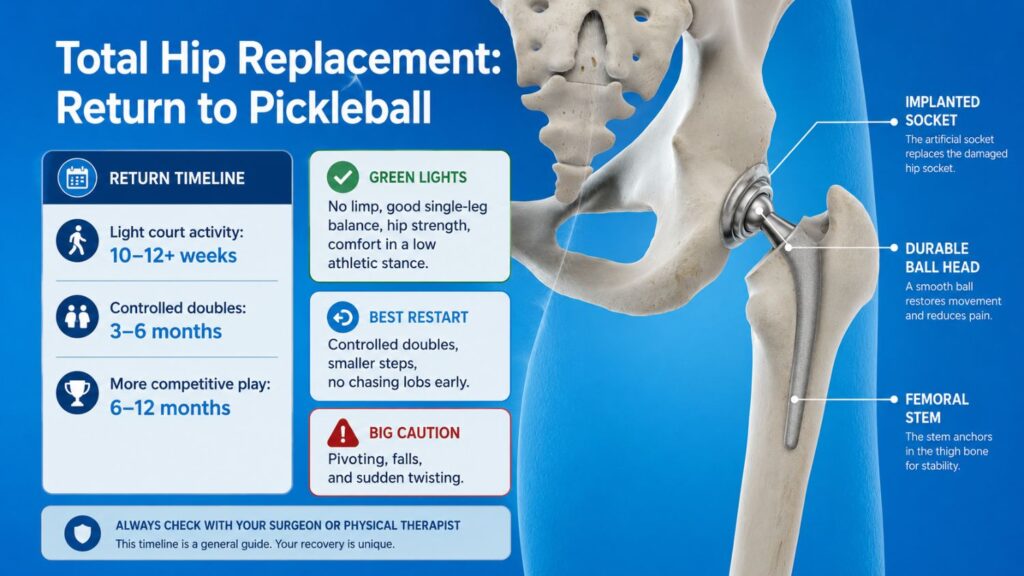
Hip replacement can be very successful for active players, especially if arthritis was limiting movement before surgery.
But pickleball still asks a lot from the hip:
- lateral push-off
- hip rotation
- lunging
- low dinks
- backpedaling
- and balance recovery
Most guidance for recreational pickleball after hip replacement is similar to knee replacement: many players may be allowed back around 3–6 months, depending on recovery and clearance.
What feels different
Hip players often say walking comes back before court trust. You may feel fine straight-line walking but notice hesitation when:
- lunging wide
- rotating for a backhand
- planting after a split step
- or recovering from a ball behind you
That is normal. Straight-line strength and court confidence are not the same.
Green lights before you play
Before real doubles, you want:
✓ no limp
✓ good single-leg balance
✓ good hip abductor strength
✓ safe pivoting mechanics
✓ no sharp groin pain
✓ no instability sensation
✓ and comfort getting into a low athletic stance
How to restart
The safest early version is controlled doubles.
Not singles.
Not chasing lobs.
Not playing with reckless partners who leave you covering the whole court.
Early goals:
- smaller steps
- no deep lunging
- let unreachable balls go
- avoid backpedaling
- turn and move instead of twisting hard
- play with partners who understand you are returning
The big warning sign
A fall is one of the biggest risks after joint replacement.
So the question is not just “Does the hip hurt?”
It is: Can I move safely when surprised?
That is pickleball.
3. Returning After Meniscus Surgery
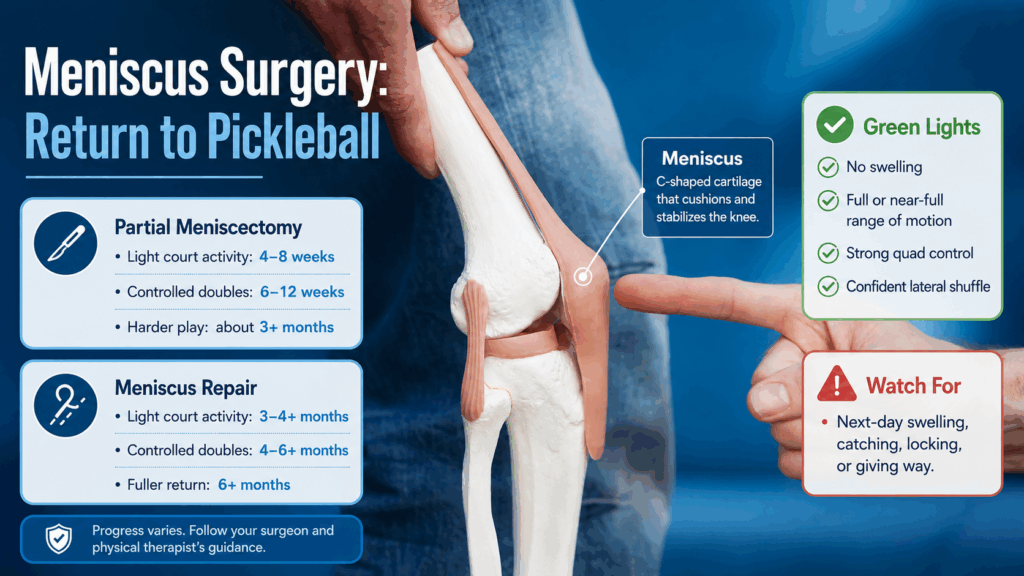
Meniscus surgery timelines vary a lot because there are two very different situations:
- Partial meniscectomy — damaged tissue is trimmed.
- Meniscus repair — torn tissue is stitched and must heal.
These are not the same comeback.
A partial meniscectomy usually has a faster return than a meniscus repair. A prospective study on post-meniscectomy patients found return-to-sport timing varies based on symptoms, function, and other factors, while meniscus repair protocols often use longer timelines because the tissue needs protection while healing.
For meniscus repair, return-to-play reviews commonly cite six months as a frequent time point, and current consensus emphasizes both time-based and criteria-based return, not time alone.
Partial meniscectomy: common rec timeline
Many players may start light court activity around 4–8 weeks, then controlled doubles around 6–12 weeks, but this depends heavily on swelling, arthritis, quad strength, and surgeon guidance.
The tricky part is that some players feel better quickly, then overdo it.
Pickleball is full of small knee twists. If the joint is still irritated, it will tell you.
Meniscus repair: common rec timeline
Meniscus repair is slower.
Light activity may begin earlier in rehab, but pickleball-style pivoting and lateral work often waits much longer. Many protocols do not consider return to sport until around 4–6+ months, with six months commonly cited in return-to-play literature.
Green lights before you play
You want:
✓ no joint-line pain
✓ no swelling after exercise
✓ full or near-full range of motion
✓ strong quad control
✓ confident lateral shuffle
✓ controlled deceleration
✓ and no catching, locking, or giving way
What to avoid early
- deep lunges
- hard pivots
- singles
- twisting while reaching
- long open-play sessions
- and playing through swelling
The big warning sign
After meniscus surgery, swelling the next day is one of the clearest signs you did too much.
Do not “tough it out.” Reduce load, talk with your PT, and rebuild.
4. Returning After Rotator Cuff Repair
Rotator cuff repair is a different kind of comeback because the major issue is not footwork.
It is tendon healing. And tendon healing does not care how much you miss pickleball.
Rotator cuff surgery often requires a long, staged rehab process. General medical guidance commonly describes full activity around 6–9 months, with some patients needing up to a year for full recovery depending on tear size and repair.
Pickleball-specific shoulder surgery data are emerging; a 2025 retrospective case series reported high return-to-play rates after shoulder surgery, with arthroscopy patients returning faster than shoulder arthroplasty patients.
Why this surgery is easy to rush
Pickleball does not feel like an overhead sport until it does.
You may think:
“I’ll just dink.”
“I won’t smash.”
“I’ll only play easy games.”
Then someone lobs.
Or you reach late for a backhand.
Or you counter hard with the arm away from the body.
Or you serve too much too soon.
Rotator cuff repairs hate surprise load.
Typical progression
A very general progression often looks like:
- 0–6 weeks: protection and passive motion phase
- 6–12 weeks: active motion returns gradually
- 3–5 months: strengthening becomes more meaningful
- 4–6 months: very light hitting may begin for some players
- 6–9 months: more realistic return to recreational play
- 9–12 months: stronger play, overheads, and higher volume if cleared
The exact timeline depends on tear size, tissue quality, repair type, surgeon protocol, and strength recovery.
Green lights before you play
You should have:
✓ pain-free daily shoulder use
✓ near-full range of motion
✓ strong external rotation
✓ good scapular control
✓ no night pain flare-ups
✓ no pain with light paddle swings
✓ and strength that holds up when tired
What to avoid early
- overhead smashes
- hard serves
- high-volume drives
- reaching behind the body
- late one-handed backhand counters
- and long sessions where fatigue ruins mechanics
The big warning sign
Night pain after playing is a shoulder red flag.
If your shoulder aches later that night or the next morning, that is not “just rust.” It may mean the tissue load was too high.
5. Returning After Shoulder Replacement
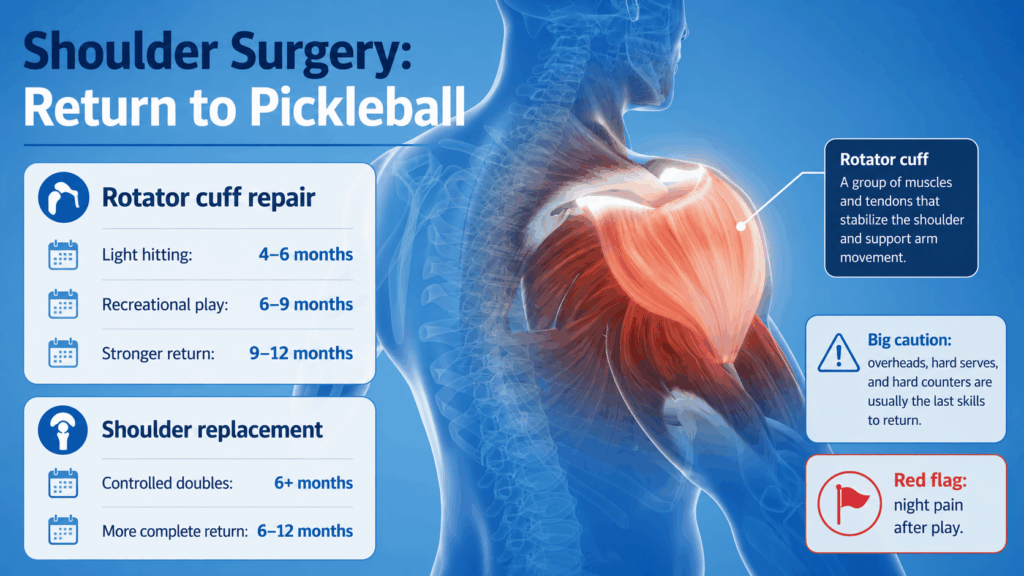
Shoulder replacement is different from rotator cuff repair.
Instead of a tendon repair being the main issue, the concerns may include implant protection, range of motion, strength, and long-term load management.
There is less pickleball-specific research here than for hip/knee joint replacement, but recent shoulder-surgery pickleball data suggest many players do return, with arthroscopy patients generally returning faster than shoulder arthroplasty patients. Orthopedic guidance for racket sports after shoulder replacement generally emphasizes preparation, warmups, gradual return, and shoulder-protection habits.
Realistic expectation
Many players are not thinking about serious play until around 6+ months, with more complete return often taking 6–12 months, depending on surgeon clearance and strength.
What changes in your game
You may need to modify:
- overhead frequency
- serve intensity
- high backhand reach
- hard counters away from the body
- and how often you play
A shoulder replacement player may absolutely return, but the smarter version of the game is usually more controlled: better footwork, less reaching, less panic swinging.
6. Returning After ACL Reconstruction
ACL surgery is less common than knee replacement in the 55+ rec crowd, but it does happen — especially for active players.
Pickleball is not usually classified like soccer or basketball, but it still has cutting, pivoting, and reactive deceleration. That matters for ACL return.
General ACL return-to-sport guidance often places full sport return around 6+ months at the earliest, but many sports medicine professionals are more cautious with pivoting sports, often looking closer to 9–12 months depending on strength testing, hop testing, confidence, and movement quality. Returning too early has been associated with higher reinjury risk in ACL populations.
Green lights before you play
You want:
✓ no swelling
✓ full range of motion
✓ strong quadriceps and hamstrings
✓ good single-leg balance
✓ controlled cutting and deceleration
✓ confidence changing direction
✓ and formal return-to-sport testing when appropriate
The big mistake
Feeling “normal” while walking or biking does not mean the knee is ready for reactive pickleball.
ACL comeback should be criteria-based.
The 5-Phase Pickleball Comeback Plan
No matter the surgery, the return should happen in phases.
Not: “Doctor cleared me, so I’m back.”
More like: “I’m going to earn each layer.”
Phase 1: Daily-Life Readiness
Before pickleball, daily life should be easy.
You should be able to walk, climb stairs, sleep, do basic strength work, and handle normal errands without a flare-up.
If daily life still irritates the joint or repair, pickleball is not the next step.
Phase 2: Court Reintroduction
This is the boring phase, and it is important.
Start with:
- walking on court
- shadow footwork
- easy dinks
- gentle volleys
- light serves
- short sessions
- no chasing,
- no games
Your goal is to see how your body reacts to the court surface, shoes, stops, and small movements.
Phase 3: Controlled Skill Work
Now add structure.
- Dinks
- Drops
- Blocks
- Serves
- Returns
- Controlled volleys
- Half-court movement
- Partner-fed balls
Still no chaotic open play.
This phase tells you whether your body can tolerate pickleball skills without the emotional stupidity of a live point.
And yes, we all have emotional stupidity during live points.
Phase 4: Modified Doubles
This is your first real test. Rules should be clear:
- doubles only
- no singles
- no tournaments
- no chasing lobs
- no sudden marathon sessions
- no playing with reckless groups
- stop before fatigue changes mechanics
Start with 20–30 minutes. Then 45. Then maybe one full session.
Do not jump from “PT cleared me” to “three hours of open play.”
Phase 5: Full Return With Guardrails
Full return does not mean careless return. For the first several months back, keep guardrails:
- warm up longer
- play doubles first
- limit back-to-back days
- avoid wet or dusty courts
- choose stable court shoes
- keep strength training
- stop if swelling appears,
- and build volume slowly.
The goal is not one heroic comeback session.
The goal is still playing six months later.
The Return-to-Play Checklist
Before you consider real rec play, run through this quick checklist:
✓ Pain: Can I do light drills without pain during or after?
✓ Swelling: Does the joint stay calm that night and the next day?
✓ Range of motion: Can I get into a low athletic stance without compensation?
✓ Strength: Is the surgical side close enough to the other side for safe movement?
✓ Balance: Can I stop, start, and change direction without wobbling?
✓ Reaction: Can I handle surprise balls without twisting, reaching, or falling?
✓ Endurance: Can I play while tired without my mechanics falling apart?
✓ Confidence: Do I trust the body part enough to move naturally?
If several answers are no, you are probably not ready for full play yet—but you may be ready for controlled drills, and that is still progress.
What Older Pickleball Players Often Underestimate
1. The first game back is not the problem
The problem is the third, fourth, or fifth game.
Fatigue changes movement. After surgery, your mechanics may look fine early and sloppy later.
That is when falls, swelling, and compensation happen.
2. Doubles is safer than singles, but not automatically safe
Doubles reduces court coverage, but it still has quick reactions, poaches, lobs, and partner confusion.
Choose partners wisely.
3. Pain during play is not the only signal
Watch for:
- swelling that night
- stiffness the next morning
- increased limp
- loss of range of motion
- sharp pain
- night pain
- or new instability
The body often gives the report card later.
4. Your brain may be ahead of your tissue
You remember how to play. Your repair may not be ready for how you remember playing.
That gap is where setbacks happen.
5. “Cleared” does not mean “conditioned”
Medical clearance means you are allowed to progress. It does not mean your game conditioning is back.
You still need to rebuild pickleball volume.
A Smart First-Month Back Plan
Once cleared for controlled pickleball, this is a safer progression.
| Week Back | Court Plan | Intensity | Goal |
|---|---|---|---|
| Week 1 | Dinks, serves, easy volleys, short movement | 30–40% | Test court tolerance |
| Week 2 | Add drops, returns, controlled half-court games | 40–50% | Build rhythm |
| Week 3 | Light doubles, no chasing, short games | 50–60% | Add decision-making |
| Week 4 | Longer doubles with rest breaks | 60–70% | Build volume slowly |
If swelling, sharp pain, night pain, or limping appears, drop back a phase.
That is not failure. That is intelligent load management.
Red Flags: Stop and Call Your Medical Team
Do not play through these:
❌ sudden sharp pain
❌ new swelling
❌ calf pain or unexplained calf swelling
❌ chest pain or shortness of breath
❌ joint giving way
❌ catching or locking in the knee
❌ fever or incision changes
❌ new numbness or weakness
❌ shoulder night pain after return
❌ pain that worsens each session
❌ or a limp that returns after play
Especially after lower-extremity surgery, calf swelling/pain or shortness of breath can be urgent because blood clots are a known post-surgical concern. When in doubt, get medical help.
The Mental Side: You May Feel Weird at First
This part matters. A lot of players come back and feel disappointed.
They think:
“I’m slower.”
“My timing is gone.”
“I’m scared to move.”
“I’m not playing like myself.”
“Maybe I came back too soon.”
“Maybe I’ll never be the same.”
Some of that is normal.
Your brain is protecting you. Your body is relearning. Your timing is rusty. Your endurance is not game-ready yet.
Do not judge your comeback by the first week. Judge it by whether you are trending in the right direction over several weeks.
The first goal is not to dominate.
The first goal is to leave the court thinking: “I played, I stayed safe, and I can build from here.”
That is a win.
So, How Long Will It Really Take?
Here is the most practical answer.
If you had a knee or hip replacement
Expect controlled pickleball somewhere around 3–6 months if recovery is smooth and you are cleared. Expect a more complete return over 6–12 months, especially for stamina, confidence, and lateral movement.
If you had a meniscus trim
Some players may return to controlled activity in 6–12 weeks, but swelling and arthritis can slow things down. Competitive play may take longer.
If you had a meniscus repair
Think more like 4–6+ months, often around six months for return-to-sport decisions, because the repair needs time to heal.
If you had rotator cuff repair
Think 6–9 months for meaningful return to play, with 9–12 months for more complete strength and confidence, especially with overheads and hard counters.
If you had shoulder replacement
Expect a cautious return, often around 6+ months, with full confidence and higher-volume play potentially taking 6–12 months, depending on your surgeon’s restrictions and strength recovery.
If you had ACL reconstruction
Expect a longer return: controlled work may begin earlier, but true cutting/pivoting confidence often belongs closer to 9–12 months, depending on testing and clearance.