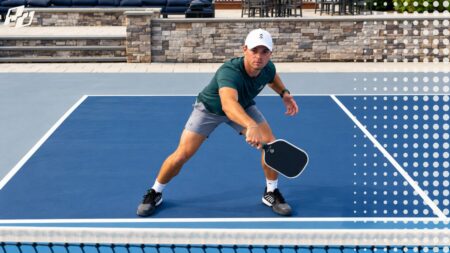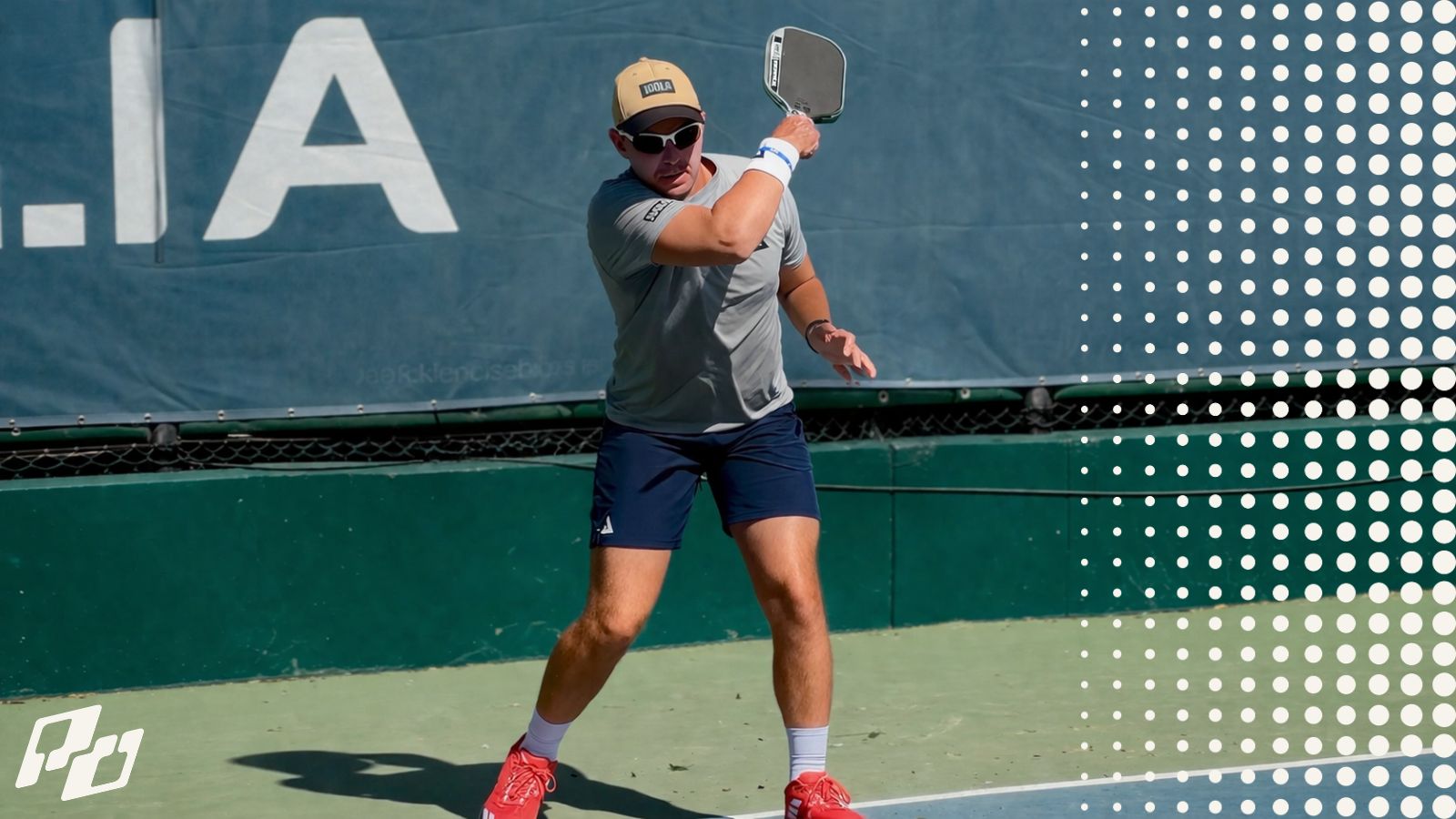
Recently, pro player Collin Johns talked about a shot that a lot of rec players do not think about enough: the defensive drive.
Most players think of the drive as an attacking shot. You drive to pressure your opponents, speed the ball up, or try to create offense. But Johns was talking about something different — a drive you hit not to attack, but to survive.
And that matters more than most players realize.
Sometimes you are not in a good position to drop or reset softly. You are late, stretched, leaning back, off balance, or just trying to stay alive in the rally. In those moments, the goal is not to win the point with one swing. It is to buy yourself one more playable ball.
That is what the defensive drive is for.
It is a compact, controlled survival shot — not a big swing, not a power play, and not a bailout rip. For intermediate rec players, this is a really useful concept, because a lot of errors happen when players are in defensive situations but still swing like they are attacking.
So let’s break down what a defensive drive actually is, when it works, when it does not, and how to use it the right way.
First, What Is a Defensive Drive?
A defensive drive is a compact, controlled drive hit from a compromised position, usually when a softer shot is harder to execute and a full offensive swing would be too risky.
That is the key idea.
It is still a drive because the ball is being hit more directly and with some pace. But it is defensive because your intention is not to create offense. Your intention is to survive, neutralize damage, and give yourself another chance to improve your court position on the next shot.
That is exactly what Collin Johns is getting at when he says you have to be very intentional about hitting a defensive drive.
This is not just a normal drive that happens to come from a tough spot. It is a different shot decision with a different mindset. The purpose is:
- keep the rally alive
- keep the ball low enough that the opponents cannot punish you easily
- reduce the chance of a miss
- buy time for the next ball
- wait for a shorter, easier, or slower reply that you can handle better
So the first thing to understand is this: a defensive drive is not about turning defense into immediate offense. It is about stopping defense from becoming a lost point.
That is a very different job.
Why This Advice Matters So Much for Intermediate Players
Intermediate players are usually at the point where they understand that resets and drops matter. They know blasting every ball is not good pickleball anymore. But they are still inconsistent at choosing the best “emergency” shot when under pressure.
That is where defensive driving becomes important. A lot of intermediate players make one of two mistakes:
Mistake 1: They try to drop balls they are not stable enough to drop
The idea is good, but the situation is wrong.
They are leaning back, reaching, or moving too fast, and they try to feather a reset from an unstable base. The ball pops up, falls short, or catches the net.
Mistake 2: They try to attack from a defensive posture
They see a ball around waist height and think, “I can drive this.”
Technically, maybe they can. But the real question is: can they drive it while off balance, late, and under pressure without giving up the point?
Usually not. So the defensive drive gives you a middle option.
It says: “I am not in a great position, but I can still make a solid, simple, compact contact and send back a ball that is tougher to attack than a weak pop-up or a wild miss.”
That is why this concept is valuable. It helps you choose a shot that actually matches your situation.
The Core Logic Behind the Defensive Drive
The logic is simple, but powerful: when you are under pressure, choose the easiest ball you can execute cleanly.
That sounds obvious, but a lot of players do the opposite. They choose the most ideal shot in theory, not the most realistic shot in the actual moment.
Collin Johns’ advice basically says this:
- You are on defense.
- You are not trying to create offense.
- You are trying to survive for one more shot.
- So choose the shot you can make most reliably from that position.
That last part is the heart of it.
Sometimes the easiest shot is a block reset. Sometimes it is a lob. Sometimes it is a flicked counter. Sometimes, especially on waist-high balls, the easiest shot is a short, compact defensive drive.
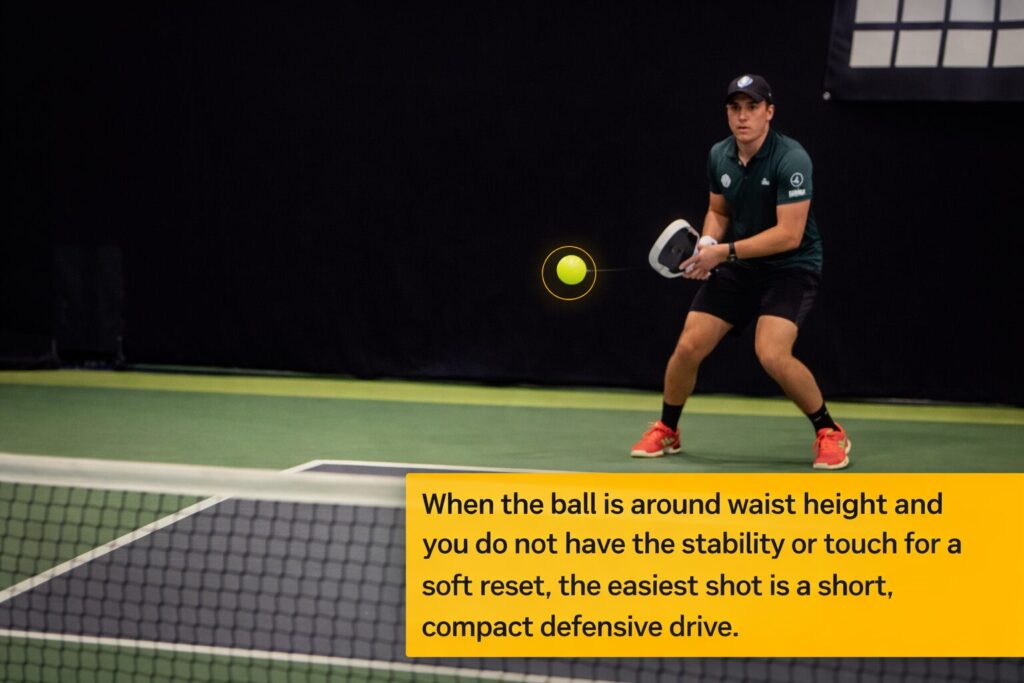
Why can this work? Because a controlled drive often gives you:
- a cleaner contact point than a touch reset from a scramble
- a simpler swing shape
- less chance of decelerating into the net
- less need for perfect feel
- a more predictable trajectory under pressure
In other words, when you are scrambling, simple can beat fancy.
What a Defensive Drive Is Not
It helps to get very clear on what this shot is not. A defensive drive is not:
- a full-power putaway
- a drive meant to overwhelm the opponent
- a big spin shot
- a “see what happens” bailout rip
- a panic swing with your feet flying everywhere
If you use a big backswing, try to create extra pace, or try to thread a tiny window, you are no longer really hitting a defensive drive. Then you are just attacking from a bad position. And that usually goes badly.
The shot only works when you accept its job: low risk, solid contact, stay alive.
The Technique: How to Actually Hit It
Now let’s get into the mechanics.
The biggest mistake players make here is overcomplicating the shot. The whole point is that this is a compact survival swing.
1. Keep the backswing short
This is probably the most important cue.
A long backswing is a luxury shot. It needs time, spacing, and balance. Defensive drives usually happen when you have less of all three.
Keep the paddle relatively close to the body. Think compact, direct, and quiet. A good cue is:
“Set early, keep it tight, punch through.”
Not a slap. Not a windshield-wiper rip. Just a compact forward send.
2. Prioritize clean contact over pace
You are not hunting a winner. You are hunting a playable, reliable ball. That means your focus should be:
- meet the ball in front
- stay as balanced as possible
- send it with enough pace to be firm, but not reckless
- keep the contact solid and centered
When players miss this shot, it is often because they are still emotionally attached to offense. They want the ball to do more than the situation really allows.
3. Keep the ball around net height or lower over the tape
The success of this shot depends heavily on not leaving the ball easy to attack.
If you hit a medium-paced ball that sits up, you are just feeding the opponent. If you hit a medium-paced ball that stays low and gets through, it can do its job.
So the trajectory matters more than the raw speed.
4. Stay through the shot, not around it
You do not need a giant wraparound finish. In many cases, a shorter, more linear finish is better.
Think of driving through a lane, not carving a dramatic winner.
5. Stabilize the body as much as you can
Sometimes you will be leaning or scrambling. That is fine. But even then, try to quiet the body at contact.
A useful cue is: “Move, plant what you can, then hit.”
Even a half-second of better stability can make a huge difference.
Best Contact Height for a Defensive Drive
This shot is usually best when contact is around thigh to waist level.
That is high enough to drive with some margin, but not so high that you get seduced into overattacking.
If the contact gets significantly higher, players often start trying to do too much.
If it gets significantly lower, the drive gets riskier and the reset becomes more attractive.
So a good self-check is:
- Below knees? probably not a defensive drive.
- Thigh to waist? strong candidate.
- Above waist? maybe, but watch your urge to overattack.
Where Should You Aim It?
This matters a lot. If you are already under pressure, you should not be aiming for lines. The best defensive-drive targets are usually boring on purpose:
- Through the middle: Reduces angle, creates hesitation, and gives you more margin. Often the smartest target when you are in trouble.
- At the feet of the player in front of you: If the opponents are up at the kitchen, a controlled ball near their feet can be hard to attack cleanly.
- At a backhand hip or body lane: Jamming a player is often better than trying to pass them.
The worst targets are usually:
- Sharp crosscourt angles
- Sideline hero shots
- Low-percentage winners
When you are on defense, choose geometry that helps you, not geometry that flatters your imagination.
When the Defensive Drive Works Best
This shot is useful in a very specific family of situations.
1. When you are late or stretched, but the ball is still reachable at a reasonable height
This is probably the most common scenario.
You are in transition or getting pushed around by pace. The ball is not ideal, but it is not below your knees either. Maybe it is around thigh-to-waist height. Maybe you are leaning back or slightly off balance. A soft reset feels difficult, but you can still meet the ball cleanly.
That is a classic defensive drive situation.
2. When you are scrambling and need the simplest contact possible
Under stress, simpler mechanics usually hold up better.
A compact drive is often easier to execute than a delicate reset if your feet are messy, your balance is shaky, or the incoming pace is uncomfortable.
3. When you need a ball that stays relatively low without requiring touch perfection
A lot of players overestimate their reset skill under pressure. The defensive drive gives you a more direct ball path. If you keep it controlled and low, you may avoid the kind of high, soft miss that gets crushed.
4. When you are not trying to advance immediately, just stabilize
This is a huge mindset shift.
A defensive drive may not improve your position right away. In fact, often it does not. But if it gets you to the next ball, and the next ball is easier, that is still a win.
5. When one solid defensive drive can set up a better fifth shot or next-ball drop
This is one of Collin’s smartest points.
Sometimes the defensive drive itself does not change the rally much. But if you hit one that stays low and deep enough, the opponent’s next ball is a little shorter, a little slower, or a little more predictable. That next ball is the one you can drop and move in behind.
So think of the defensive drive not as the winning shot, but as the bridge shot.
When It Does Not Work Well
Just because the shot is useful does not mean it is always correct.
1. When the ball is too low
If the ball is below knee level and you try to drive it, you are often asking for trouble.
From that height, the margin is poor. You will usually lift too much and pop it up, or catch too much net.
A reset, a higher-arcing neutral ball, or even a defensive lob may be the better choice depending on the situation.
2. When you have time and balance for a better neutralizing shot
If you are actually stable and set, and the better shot is a soft reset or drop, then hit that. Do not default to driving just because it feels easier emotionally.
The defensive drive is a solution for compromised positions, not a replacement for all transition play.
3. When you turn it into an attack swing
The moment you try to add too much pace, too much spin, or too much ambition, the shot loses its value.
A lot of rec players say they are hitting a “controlled drive,” but their swing says otherwise.
If your torso is flying open, your backswing is huge, and your contact is inconsistent, that is not a defensive drive anymore.
4. When the opponents love pace and counter well
Some teams are extremely comfortable redirecting pace. Against those players, a poorly chosen defensive drive can feed their hands.
That does not mean never hit it. It means you must be even more disciplined about keeping it low, directed well, and modest in pace. If you float it or leave it attackable, good hand fighters will punish it.
5. When you use it over and over instead of transitioning to something better
This is important.
The defensive drive is not supposed to become your permanent transition identity. If every tough ball becomes another medium-paced drive, you may stay pinned back forever. The shot is useful because it helps you survive until you can hit the better neutralizing shot.
If you never make that transition, you are just delaying the loss instead of building toward control.
How to Use the Defensive Drive Within a Point
This is where intermediate players can really level up.
Do not think of the defensive drive as a standalone shot. Think of it as part of a two-ball or three-ball recovery plan. Here is a common pattern:
⮕ You are scrambling in transition.
⮕ You hit a compact defensive drive to the middle.
⮕ The opponent cannot attack hard, so their next ball is a little shorter or more neutral.
⮕ Now you have a better chance to hit a drop or reset and move forward.
That is the real value.
A lot of smart pickleball is not about hitting one magical shot. It is about using one shot to create a slightly better next situation.
The defensive drive often works exactly like that.
Key Cues to Remember
If you want simple on-court reminders, use these:
✔ “Survive, don’t attack.”
This keeps the intention honest.
✔ “Short swing, solid contact.”
This keeps the mechanics simple.
✔ “Low through the middle.”
This keeps the target smart.
✔ “One more ball.”
This keeps your expectations realistic.
Those four cues are enough for most players to execute this shot much better.