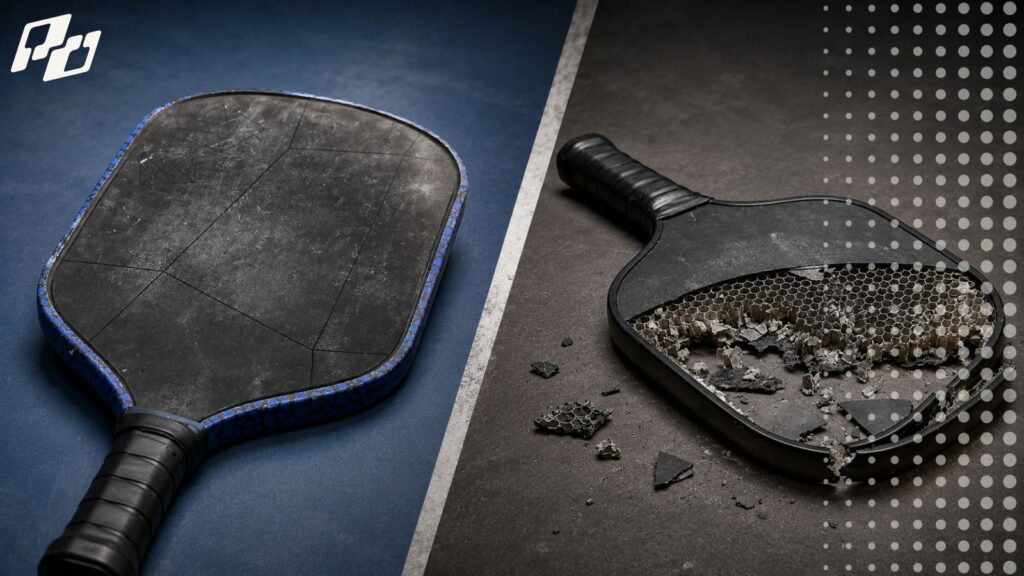
A pickleball paddle may be dirty if cleaning restores spin and grip. It may be dead if it still feels muted, hollow, springy, inconsistent, or has dead spots after cleaning. Spin loss usually points to surface buildup; weird rebound, core crush, or delamination points to structural breakdown.
Every pickleball player eventually has this moment. You pull your paddle out of the bag, start warming up, and something feels wrong.
The ball is not jumping off the face the same way. Your rolls are not grabbing. Your counters sound weird. Your drops feel mushy. You clean the face, hit a few more balls, and still think:
Is this paddle just dirty… or is it done?
That distinction matters because a dirty paddle face and a dead paddle are two completely different problems.
A dirty paddle can often be fixed in 30 seconds.
A dead paddle cannot.
And if you confuse the two, you can waste weeks blaming your technique, your grip, your ball, your shoes, the wind, your partner, and possibly Mercury retrograde — when the real issue is that your paddle’s surface or internal structure has changed.
Let’s make this practical.
The Simple Rule: Clean First, Diagnose Second
Before you decide your paddle is “dead,” clean it properly.
This is especially important if you use a raw carbon, peel-ply, or high-friction surface paddle. Those faces are designed to grip the ball, but that also means they collect tiny ball fibers, court dust, and residue. that buildup can reduce spin, feel, and overall performance over time.
So your first test is simple: Clean the face. Then see what changes.
If your spin comes back, your paddle was probably contaminated.
If your spin does not come back — or the paddle still feels muted, inconsistent, unusually hot, or trampoline-like — now you may be dealing with something structural.
That is the difference.
Dirty face = surface problem.
Dead paddle = structure problem.
What a Dirty Paddle Usually Feels Like
A dirty paddle usually does not feel broken. It feels slightly worse. You may notice:
- Your topspin rolls are not dipping as much.
- Your serves feel a little less grabby.
- Your slice return floats more.
- Your drops skid off the face instead of holding for a split second.
- Your paddle looks gray, chalky, or shiny in the sweet spot.
That last one is important. On raw carbon paddles, the wear-looking patch in the center is not always true wear. Sometimes it is ball residue packed into the texture.
Think of the paddle face like the tread on a tire. If the tread is full of mud, the tire has less grip. That does not mean the tread is gone. It means it is clogged.
Same idea here.
Your paddle face may still have texture, but if the texture is filled with plastic ball residue, it cannot grab the ball as well.
The “Clean and Compare” Test
Here is the easiest rec-player test.
⮕ First, hit 10 controlled topspin rolls or serves before cleaning.
Pay attention to three things:
- How much the ball dips
- How much control you have over shape
- How much the ball feels like it “grabs” the paddle face
Then clean the paddle with the right method for your surface.
For raw carbon paddles, that usually means:
✅ Dry microfiber wipe.
✅ Paddle eraser or cleaning block.
✅ Light final wipe.
Do not start by soaking the paddle or spraying liquid into the face and edges. A dry-first approach helps remove loose dust and ball residue before you turn it into paste.
Now hit the same 10 shots again.
If the ball grabs better, dips more, and feels cleaner off the face, congratulations: your paddle was dirty, not dead.
That is the best-case scenario.
What a Dead Paddle Usually Feels Like
A dead paddle is different. It does not just lose a little spin. It loses its identity.
The most common signs are:
- The ball comes off inconsistently from similar contact.
- The sweet spot feels smaller or unpredictable.
- Blocks and resets feel mushy.
- Drives lose normal pop.
- Counters sound dull or hollow.
- Some spots on the face feel hotter than others.
- The paddle feels springy in a weird way, almost like the face is flexing too much.
A “dead” paddle does not always mean one exact failure. It can come from core crush, delamination, disbonding, foam breakdown, face wear, edge separation, or internal adhesive failure.
Paddle troubleshooting guides commonly separate these issues because they can create different symptoms: core crush often causes dullness and inconsistency, while delamination can create a more extreme trampoline effect.
The key is this: Cleaning fixes friction. It does not fix structure.
If the paddle’s core or face bonding has changed, no eraser is going to bring it back.
Dirty Face vs. Dead Paddle: The Practical Difference
A dirty paddle usually has a spin problem.
A dead paddle usually has a response problem.
That is the easiest way to remember it.
If your main complaint is, “I can’t shape the ball like I used to,” start with cleaning.
If your main complaint is, “The ball comes off weird,” “my resets feel unpredictable,” or “one spot feels hotter than another,” start suspecting structural failure.
Here’s the cue:
Spin missing? Clean it.
Feel missing? Test it.
A clean paddle face should restore some bite. But if the paddle still feels strange after cleaning, the problem probably lives below the surface.
The Delamination Problem: When a Paddle Gets Too Hot
Delamination happens when layers inside the paddle stop bonding correctly. In simple terms, the face can begin separating from the core. When that happens, the paddle can start acting like a trampoline.
That sounds fun until you realize it can make the paddle unpredictable.
You may get sudden extra pop on counters. Your drives may jump. Your dinks may launch. Your blocks may fly deeper than expected.
Some players mistake this for “my paddle got better.” Be careful.
A paddle that suddenly gets hotter, louder, or springier may not be breaking in. It may be breaking down. USA Pickleball equipment standards regulate paddle surface and performance characteristics, including surface roughness, friction, and coefficient of restitution, because excessive spin or rebound can create performance problems and compliance issues.
For rec play, the bigger issue is consistency. If the ball flies differently from one part of the face to another, you cannot trust the paddle.
And if you cannot trust the paddle, your soft game usually suffers first.
Core Crush: The Opposite Problem
Core crush is different from delamination.
Instead of the paddle becoming too springy, it may feel dull, soft, or inconsistent. The internal core can collapse or lose structure in certain areas, especially after lots of hard impacts.
- For rec players, this often shows up as:
- “My paddle feels tired.”
- “I’m swinging the same, but the ball is not going anywhere.”
- “My blocks used to feel solid, now they feel dead.”
- “My sweet spot feels smaller.”
That is not a cleaning issue. That is an internal support issue.
A paddle eraser can remove residue from the face. It cannot rebuild a crushed honeycomb cell, repair foam breakdown, or re-bond a separated face.
The Tap Test: Useful, But Not Perfect
A lot of players use the tap test. You tap around the paddle face with your knuckle or a ball and listen for changes in sound.
⮕ A healthy paddle usually sounds fairly consistent across similar zones.
A suspicious paddle may have:
- A dull thud in one area.
- A hollow pop in another.
- A noticeably louder or springier spot.
- A crunchy or crackly sound.
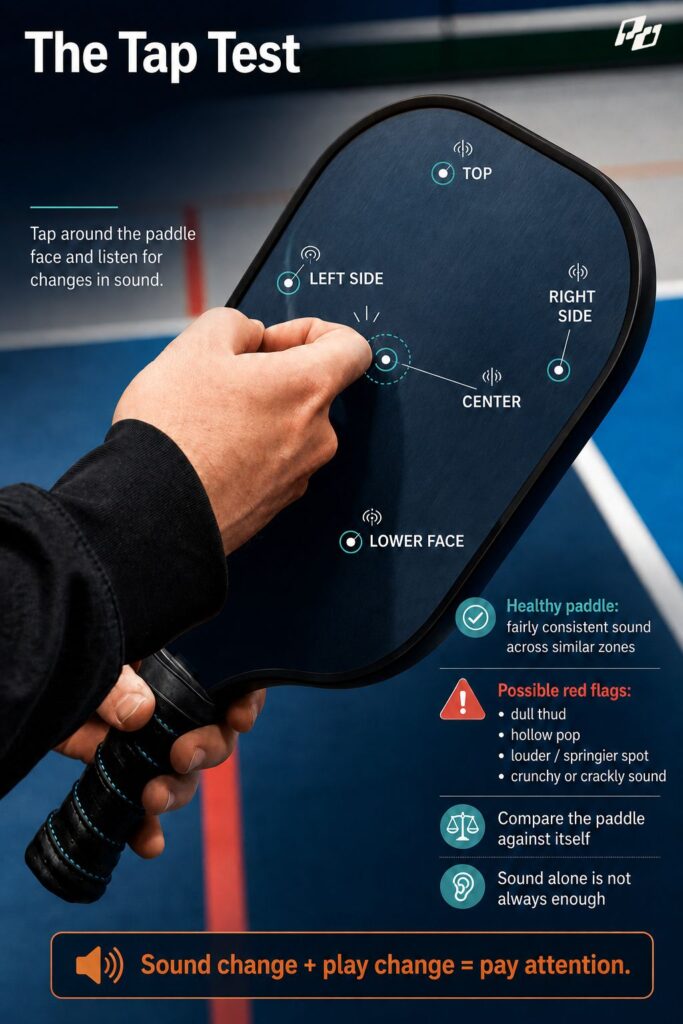
This can help, but do not treat it as a laboratory test. Paddles naturally sound different near the edge, throat, and sweet spot. Different builds also have different acoustics.
The tap test is most useful when you are comparing the paddle against itself.
Tap the left side, right side, top, center, and lower face. If one area sounds dramatically different and also plays differently, that is a red flag.
Cue: Sound change plus play change = pay attention.
Sound alone is not always enough. But sound plus weird ball response is worth taking seriously.
The Bounce Test: Better for Rec Players
Here is a more useful test. Hold the paddle loosely and bounce a ball gently on different parts of the face.
Check:
- Does the ball rebound evenly?
- Does one area feel mushy?
- Does one area launch higher?
- Does the center sound different than before?
- Does the paddle vibrate strangely?
Then do the same with a friend’s similar paddle if possible.
This test is not perfect either, but it helps you feel consistency. A paddle does not need to be identical everywhere, but it should not feel like three different paddles depending on where the ball lands.
If the sweet spot feels normal but the surface is slick, clean it. If the sweet spot itself feels unpredictable, the paddle may be breaking down.
The Thumb-Press Test: A Red Flag for Core Crush
Another quick check is the thumb-press test.
Hold the paddle firmly and press both thumbs into the face around the sweet spot and nearby areas. You are not trying to crush the paddle — just apply steady, moderate pressure and feel for anything unusual.
A healthy paddle should feel firm and consistent.
A suspicious paddle may:
- make a faint crunching, crackling, or clicking sound
- feel softer in one spot than another
- flex more than expected
- feel like something is separating under the surface
- produce a “crushed” sensation when you press near the sweet spot
That can be a warning sign of core crush, delamination, or internal breakdown.
The key is comparison. Press different areas of the face and notice whether one zone feels dramatically different. If the sweet spot feels mushy, crunchy, or unstable — and the paddle also plays muted, inconsistent, or weirdly springy — cleaning is not the fix.
Cue: If it crunches and plays strange, investigate.
Face Wear: When Cleaning Stops Helping
Sometimes the paddle is not internally dead. The face is just worn.
This is especially common in the primary contact zone, where you hit most drives, serves, rolls, and counters.
A worn face may look smoother, shinier, or flattened. On some paddles, the texture wears down over time. On others, the grit or coating fades.
The practical test is simple: If cleaning used to restore spin but now barely changes anything, the face may be worn.
That does not always mean the paddle is unusable. It means your spin ceiling has dropped.
You can still dink, block, reset, and play good pickleball. But if your game depends heavily on topspin rolls, dipping drives, slice returns, or aggressive spin serves, you may notice the loss more.
Cue: Cleaning restores clogged texture. It does not restore missing texture.
That is the line.
When Cleaning Actually Makes a Big Difference
Cleaning is worth doing when the paddle still feels structurally solid but the face feels slick.
You will usually notice improvement in:
✅ Topspin serves
✅ Rolling volleys
✅ Dipping drives
✅ Crosscourt dinks with shape
✅ Slice returns
✅ Reset control
The improvement may not be dramatic, but it should be noticeable. You should feel the ball hold a little better and leave with more predictable shape.
That is why regular maintenance matters. You are not making the paddle “new.” You are keeping the surface from being masked by residue.
For raw carbon paddles, a cleaning block or paddle eraser is commonly recommended because it can lift ball residue from the surface texture without sanding the paddle.
Just remember: gentle is the point. You are cleaning the surface, not modifying it.
What Not to Do
❌ Do not sand the face.
❌ Do not use harsh solvents.
❌ Do not soak the paddle.
❌ Do not pressure-wash it.
❌ Do not scrape it with metal.
❌ Do not try to “restore grit” by roughing it up.
That last one is especially important. Paddle surfaces are regulated, and modifying roughness or friction can create compliance issues. USA Pickleball’s equipment manual specifically addresses surface roughness and friction testing, along with other performance standards.
Your job is to remove contamination. Not create a new surface.
A clean paddle is legal maintenance. A modified paddle is a different conversation.
The Rec Player’s Diagnostic Checklist
1. Clean it first
For raw carbon, go dry wipe → paddle eraser → light final wipe.
2. Test the spin
Hit serves, rolls, and topspin drives. If spin comes back, it was probably surface buildup.
3. Test the feel
Hit dinks, resets, blocks, and counters. If it still feels muted, hollow, springy, or inconsistent, keep checking.
4. Tap, bounce, and press
Listen for odd sounds and feel for dead spots, hot spots, mushy areas, or crunching under thumb pressure.
5. Compare it
Try a friend’s paddle or backup paddle. The difference often makes the issue obvious.
6. Check warranty or retire it
If it’s newer, contact the manufacturer. If it’s old and heavily used, it may simply be done.
How Often Should Rec Players Clean Their Paddle?
You do not need to baby your paddle after every rally, but you also should not wait until the face feels slick and lifeless. Use your playing volume as the guide:
| How Often You Play | What to Do | Why It Matters |
|---|---|---|
| Once a week | Light microfiber wipe after play; eraser clean occasionally | Prevents light dust and ball residue from building up |
| 2–3 times a week | Wipe after each session; use a paddle eraser every 1–2 weeks | Keeps raw carbon texture from getting clogged |
| 4+ times a week | Wipe after every session; erase weekly | Heavy play creates faster ball-fiber buildup |
| Outdoor play | Dry wipe first, then erase as needed | Court grit can get pushed into the face if you start with liquid |
| Drilling / ball machine | Clean more often than usual | Repeated ball contact leaves more residue in less time |
Simple rule: Wipe after play. Erase when spin feels slippery. Diagnose when feel gets weird.
When Should You Replace the Paddle?
Replace or retire a paddle when the physical structure starts showing signs it can no longer perform consistently.
Look for:
- A smooth, shiny sweet spot where the surface texture has worn down
- Visible face wear that cleaning no longer improves
- Soft or mushy spots when you press around the sweet spot
- Crunching, clicking, or crackling sounds under thumb pressure
- Dead zones where the ball comes off flat or weak
- Hot spots where the ball suddenly jumps more than expected
- A hollow or dramatically different sound in one area of the face
- Edge guard separation, cracks, gaps, or loose areas
- Signs of delamination, like bubbling, lifting, or a trampoline-like response
- Core crush symptoms, where the face feels unstable, compressed, or inconsistent
The biggest warning sign is not age — it is structural inconsistency.
If one part of the paddle feels dead, another feels springy, and the face no longer gives you predictable rebound, cleaning will not fix it. At that point, the paddle is not just dirty. It is physically breaking down.
The Best Way to Think About It
A dirty paddle loses bite. A worn paddle loses grip. A dead paddle loses trust. That is the whole article in one sentence.
If your ball is not dipping like it used to, clean the face first.
If your paddle still feels strange after cleaning, do not keep blaming your mechanics. Test the response. Listen to the sound. Feel the bounce. Compare it against another paddle.
Because sometimes your paddle does not need a cleaning. It needs retirement.
And honestly, knowing the difference can save you a lot of frustration — and maybe a few very confused third shot drops.