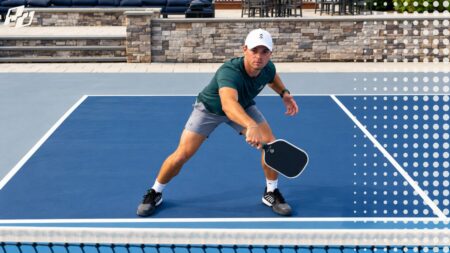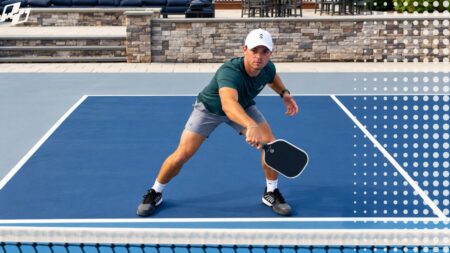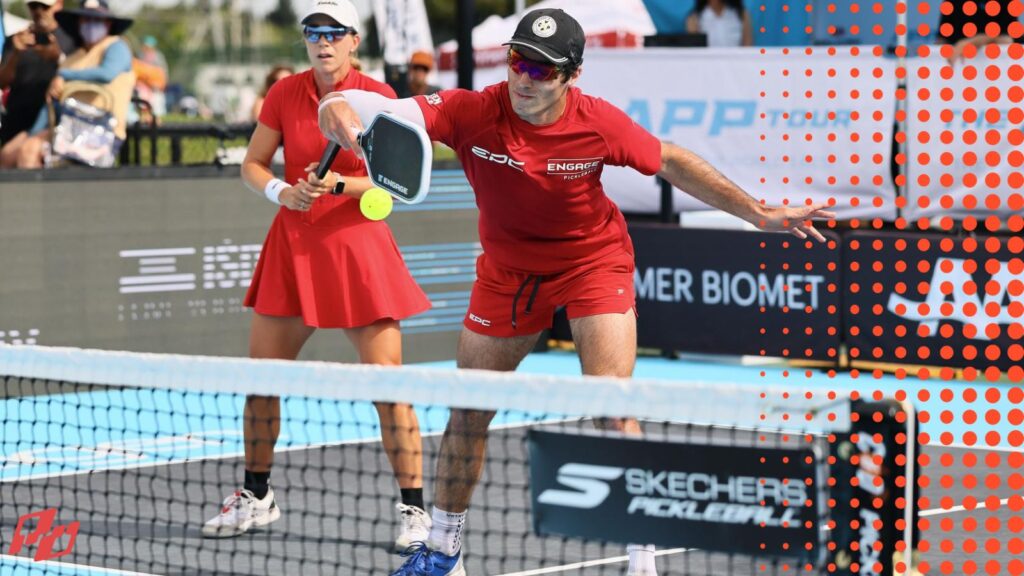
At the intermediate level, the flick is where a lot of players start to feel dangerous. Not because they suddenly hit harder.
Because they finally learn how to make a soft-game ball feel unsafe.
That is the real value of a good flick. It turns a neutral dink exchange into a question your opponent has to answer quickly:
Are they leaning middle?
Are they sitting backhand?
Are they protecting the line?
Are they ready for the body ball?
Can they defend the same setup going four different directions?
For a left-side player in doubles, this matters a lot. The left-side player usually has more middle responsibility, more chances to initiate pressure from the kitchen, and more opportunities to disguise attacks from a compact backhand-ready position.
But that also means opponents are watching you. If your flick always goes to the same place, better defenders will start sliding, countering, and sitting on it.
So the goal is not just “learn a flick.” The goal is to build a small flick menu.
For this guide, we’re focusing specifically on backhand flicks — the compact one-handed or two-handed attacks that let left-side players pressure from a disguised kitchen setup without needing a full swing.
First: A Flick Is Not Just a Wrist Snap
This is where intermediate players often get themselves into trouble.
They hear “flick” and think the wrist has to do everything. Then the shot becomes loose, late, and inconsistent. One ball looks amazing. The next one flies long, dumps into the net, or lands perfectly on the opponent’s paddle.
A good flick is not a desperate wrist slap.
It is a compact acceleration pattern.
The power comes from a short chain:
- stable base
- quiet shoulder
- loaded forearm
- small wrist release
- clean contact in front
- and immediate recovery
The wrist may be involved, but it should not be the whole engine. Think of the wrist as the final release, not the entire shot.
The better cue: Load small. Release late. Recover fast.
That cue is more useful than “snap your wrist” because it keeps the shot compact and repeatable.
Why Flicks Become Important Around 3.5–4.0
At lower levels, players can win by simply waiting for pop-ups.
At intermediate levels, better opponents stop giving you as many obvious attack balls. They dink lower. They reset better. They block your drives. They know how to sit in a soft rally without panicking.
That is when you need pressure tools that do not require a full sitter. A flick gives you a way to attack balls that are not smashable but are still pressurable.
That might be:
⮕ a dink that sits slightly high
⮕ a ball near the outside foot
⮕ a dink that enters your middle/backhand attack window
⮕ a ball where the opponent is leaning
⮕ or a neutral-looking kitchen ball where your setup can disguise the speedup
This is why flicks matter for intermediate players. They bridge the gap between passive dinking and obvious attacks.
But that also means they are risky if you use them on the wrong ball. A flick is not a bailout. It is a pressure shot from structure.
The Real Secret: Your Flick Is Only as Good as the Ball After It
Intermediate players often judge a flick by whether it goes in. That is too low a standard.
A good flick should either:
- win the point
- force a weak block
- jam the opponent
- create a predictable counter
- or give your partner a ball to finish
A bad flick can land in and still be tactically bad.
For example, if you flick right into a player’s loaded backhand counter, the ball might be “in,” but you just started a fight from a worse position. If you flick down the line and expose your sideline without recovering, the shot might look aggressive but leave your team vulnerable. If you flick into a player’s favorite speedup lane, you are feeding them pace.
So ask yourself: What reply am I inviting?
That question should decide which flick you use.
The Four Flick Lanes Every Left-Side Player Should Understand
From the left side, you generally want four backhand flick lanes:
- Cross-body crosscourt
- Crosscourt body jam
- Cross-body at the player in front
- Down the line
These are not just different directions. They attack different defensive habits.
The best part is that they can all come from a similar early setup. If your opponent cannot tell which lane is coming until late, your flick becomes much more dangerous.
Flick 1: Cross-Body Crosscourt
This is probably the most important flick for a left-side player.
This is a backhand flick that travels across your body and crosscourt, usually attacking the opposing left-side player’s backhand-side space. In many doubles patterns, the opposing left-side player wants to protect middle because middle balls are dangerous. That creates a small exposure on the crosscourt backhand side.
The cross-body crosscourt flick uses that exposure.
Instead of attacking straight ahead, you send the ball diagonally through the opponent’s backhand-side window.
Why it works:
✔️ The diagonal court gives you more net clearance.
✔️ The angle helps you keep the ball lower.
✔️ The opponent is often leaning middle.
✔️ The backhand counter is usually less dangerous when stretched.
✔️ Your shot can pull the defender away from their ideal counter position.
This is not just about hitting away from someone. It is about hitting through the space their body has already started to abandon.
The Technical Feel
Your paddle starts in a position that still looks like you could dink. The contact is slightly in front. Your forearm rotates through the ball, but the paddle does not take a giant backswing. The finish should travel through the crosscourt target, not dramatically around your body.
The common miss is over-wiping across the ball. That creates spin but not enough forward direction, so the ball floats or goes wide.
The better feel: Brush through the angle, not around the ball.
When to Use It
Use this when the opposing left-side player is leaning middle, sitting forehand, or overprotecting the center. It is also useful when the ball is high enough that you can shape it low through the diagonal lane.
Do not use it when you are late, falling left, or contacting too close to your body. The crosscourt flick needs enough space to send the ball through the angle. If the ball jams you, choose a body jam or reset instead.
Risk Level
🟡 Medium.
It is more forgiving than a down-the-line flick because you have more diagonal space, but it still becomes risky if you try to make it too sharp.
Flick 2: Crosscourt Body Jam
This flick goes crosscourt into the opponent’s right shoulder, hip, elbow, or paddle-side body pocket.
The goal is not a clean winner. The goal is to make the defender uncomfortable.
At intermediate levels, many players are fine if you hit the ball to their forehand or backhand. What they dislike is a ball that lands in the decision zone between them.
Should they backhand counter?
Should they forehand block?
Should they move their feet?
Should they chicken-wing it?
Should they slide?
That hesitation is the value of the body jam.
Why the Shoulder/Hip Pocket Matters
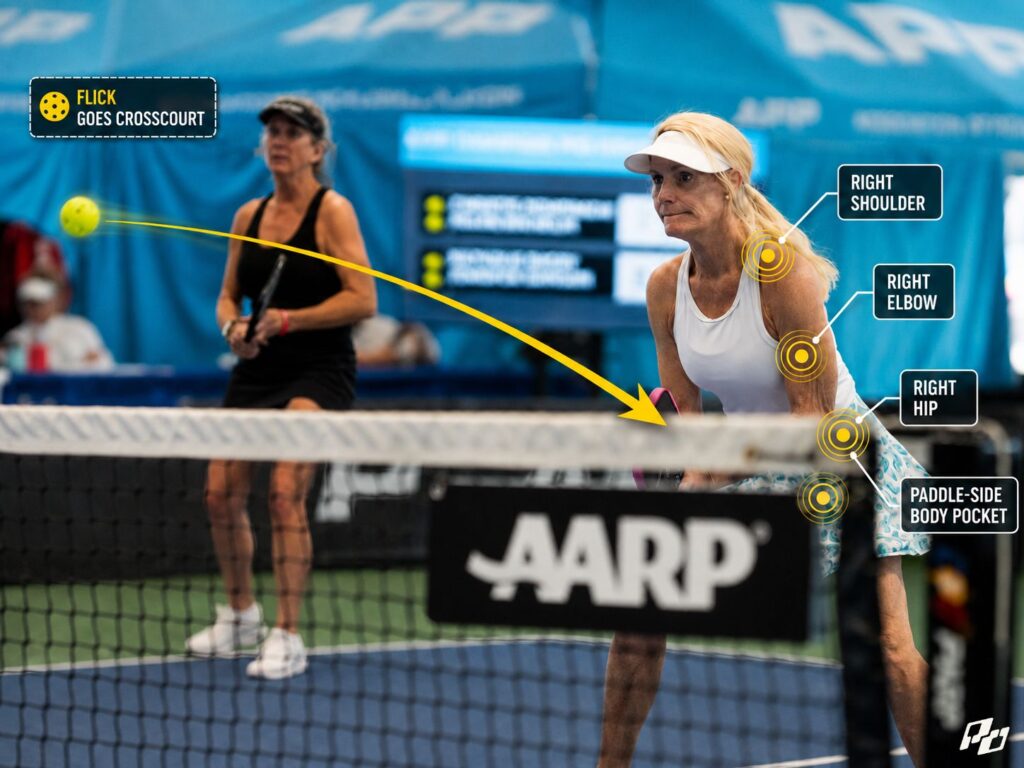
A body flick that is too low may sit up into their paddle. A body flick that is too high may become an easy counter. The shoulder/hip pocket is awkward because it interferes with clean paddle spacing.
The right shoulder can jam a player who wants to counter with a backhand. The hip can jam a player who likes to extend. The inside elbow is especially annoying because it forces a late decision.
Think less about “hit at the person” and more about “hit where their paddle spacing gets ugly.”
The Technical Feel
This flick is more compact than the crosscourt angle flick. You are not trying to create a dramatic diagonal winner. You are sending a firm, shaped ball into a body window.
The paddle path should be short and direct. The face cannot open too much, or the ball floats into their counter zone. The finish should stay small so you can reload for the next ball.
The cue: Jam the spacing, not the person.
That keeps the shot tactical instead of reckless.
When to Use It
Use this when the opponent is leaning, sliding, or camping on a backhand counter. It is also strong when the opponent’s paddle is extended away from their body, because the jam forces them to shrink their swing.
Avoid it if the opponent has elite hands and is already loaded for a body counter. Some players love being attacked at the body because they are compact and fast. Against those players, the jam must be better disguised or aimed lower.
Risk Level
🟡🟢 Medium-low if targeted well.
You are not painting a sideline. You are attacking a body zone. That gives you more margin. But if you leave it shoulder-high and predictable, you may get countered hard.
Flick 3: Cross-Body at the Player in Front
This is one of the most natural backhand flicks for many left-side players because the paddle can accelerate across the body from a compact, disguised position.
You see a ball slightly in front of your body, often near the middle/backhand-side window. Your paddle loads quietly, then works across your body toward the player directly in front of you or slightly through their inside lane.
It feels simple. That is the danger.
Because it feels natural, many players overuse it. And once opponents know it is coming, the right-side defender can slide backhand and take it away.
At higher rec levels, this is one of the most common counters to a predictable left-side backhand flick: the defender shades middle/backhand, sits on the cross-body speedup, and blocks or counters before you recover.
Why It Works When Timed Correctly
This flick is still useful because it is fast, compact, and easy to disguise from a dink setup. It can catch the player in front before they fully organize their paddle.
It works especially well when:
- their paddle is low
- their feet are still
- they are expecting a soft dink
- they are leaning toward the sideline
- or your previous dinks have made them relax
This shot is not about hitting the fanciest target. It is about stealing time.
The Technical Feel
The swing should be compact and slightly across the body, but not a huge wrap. Your contact should stay in front enough that the ball does not drag wide or float into the counter zone.
The common mistake is pulling the flick across too much. That sends the ball into the opponent’s wheelhouse or wide of the target. Keep the face stable and use a smaller finish.
The cue: Across the body, through the target.
When to Use It
Use it when the player in front is not sitting on it. If they are upright, late, or paddle-low, it can be very effective.
Do not use it repeatedly against a right-side player who is sliding backhand and waiting for it. If that defender is already cheating into the lane, you need the down-the-line backhand flick or a hold-and-dink variation.
Risk Level
🟡 Medium.
Technically natural, tactically dangerous if predictable.
Flick 4: Backhand Down the Line
The down-the-line flick is the counterpunch.
It punishes defenders who over-slide into the middle to take away your cross-body or crosscourt flick. It does not need to be crushed. In fact, it is often better when it is placed cleanly outside the right hip of the right-side player.
This shot is less about power and more about making the defender pay for cheating.
If the right-side player is sliding backhand into the middle, their outside hip/line-side pocket becomes vulnerable. A well-placed down-the-line flick can freeze them because their momentum is moving the wrong way.
Why It Feels Riskier
The line is shorter. The net feels less forgiving. If you miss wide, it looks bad. If you leave it high, the player in front may counter. If you overhit, it sails.
That is why many intermediate players avoid it. But if you never show it, smart opponents will sit on your cross-body flick all day.
The down-the-line flick is not your highest-volume flick. It is your “keep them honest” flick.
The Technical Feel
The key is not to swing bigger. The key is to hold the setup a split second longer, keep the paddle face stable, and send the ball through the outside hip/window.
Do not pull across your body. Do not try to make it dramatic. The shot should feel like a compact backhand line punch with a little disguise, not a big wrap across your body.
The cue: Hold the look. Send the line.
When to Use It
Use it when the right-side defender is sliding hard toward the middle, when they are overprotecting your cross-body flick, or when their outside hip is open.
Avoid it when the ball is too low, when you are off balance, or when your partner is not ready for the counter. If the line flick comes back, it often comes back fast.
Risk Level
🟡🔴 Medium-high.
But strategically necessary. You do not need to hit it often. You just need to prove it exists.
The Flick Menu: Which One Should You Choose?
| Situation | Best Flick | Why |
|---|---|---|
| Opposing left-side player leans middle | Cross-body crosscourt | Attacks the exposed backhand-side angle. |
| Opponent has clean paddle spacing | Body jam | Takes away extension and forces a rushed decision. |
| Player in front is upright or paddle-low | Cross-body in front | Steals time with the most natural acceleration path. |
| Right-side defender is sliding backhand | Down the line | Punishes the cheat and keeps them honest. |
| Ball is low and below your reliable attack window | No flick | Reset or dink; do not donate a counterattack. |
| Your partner is not ready for the next ball | No flick or safer body target | A flick is only good if your team can handle the reply. |
| Opponent is countering everything cleanly | Change target or stop flicking | Predictable pace is feeding them. |
The Contact Window: What Makes a Flick Actually Attackable?
The most useful intermediate upgrade is learning the difference between “flickable” and “tempting.”
A flickable ball usually has at least two of these three:
- Enough height.
- Enough space from your body.
- Enough opponent imbalance.
If you only have one, be careful.
A slightly low ball can still be flicked if the opponent is leaning badly and your target is big.
A slightly cramped ball can still be flicked if it is high and you can jam the body.
A neutral-height ball can still be flicked if the defender is overcommitted.
But if the ball is low, cramped, and the opponent is ready, that is not a flick. That is a donation.
Cue: Two green lights before you go.
Height, spacing, opponent imbalance. Look for two.
The Disguise Problem: Your Setup Must Stay Boring
A flick works best when it starts like a dink.
Many intermediate players telegraph the attack early. They raise their paddle, change their grip, widen their eyes, load the wrist, or stop their feet. The opponent reads it before the ball crosses the net.
The best disguise is not acting. It is keeping your preparation boring.
✔️ Same paddle height.
✔️ Same shoulder calm.
✔️ Same dink posture.
✔️ Same early contact look.
✔️ Late acceleration only after the defender has committed.
If your opponent can see your flick before you swing, you are not flicking. You are announcing.
Cue: Dink face first. Flick decision late.
Why Target Variety Matters More Than Power
If your flick is hard but predictable, better defenders will counter it. If your flick is moderate but well-targeted, you become much harder to read.
The four-lane menu matters because each lane punishes a different defensive adjustment.
⮕ Crosscourt punishes middle leaning.
⮕ Body jam punishes clean spacing.
⮕ Front-player flick punishes paddle-low hesitation.
⮕Line flick punishes backhand slide.
That is why the goal is not to master one huge flick. The goal is to make one setup create four problems.
This is how intermediate players become advanced attackers: they stop relying on speed and start controlling defensive guesses.
How Risky Are These Flicks?
Flicks are worth learning, but they are not worth forcing. A useful way to rank them:
| Flick | Risk | Reward | Best Use |
|---|---|---|---|
| Backhand body jam | Lower | Forces awkward blocks | Reliable pressure option |
| Backhand cross-body crosscourt | Medium | Opens angle and attacks backhand lean | Best all-around left-side flick |
| Backhand cross-body in front | Medium | Fast and natural | Great if not overused |
| Backhand down the line | Higher | Punishes middle cheating | Use selectively to keep defenders honest |
If you are building this into your game, start with body jam and crosscourt. Then add the line flick once opponents begin sliding to take away your natural patterns.
That order matters.
Do not start with the riskiest shot and call the whole skill unreliable.
What Happens After the Flick?
This is where many rec players fail. They flick and admire it.
But a good defender may get the ball back. And if they do, the next ball often comes fast to the middle, hip, or open line.
So every flick needs a recovery plan.
⮕ After a crosscourt flick, expect a block back middle or counter crosscourt.
⮕ After a body jam, expect a weak pop-up or reflex block.
⮕ After a front-player flick, expect the right-side player to slide backhand if they read it.
⮕ After a line flick, expect a fast counter down the same line or middle.
The cue: Flick, then reload.
Your paddle should return to the front of your body immediately. Do not let the flick finish carry your paddle outside your recovery window.
The Partner Factor
A flick is not an individual shot in doubles. Your partner needs to know what kind of chaos you are creating.
- If you flick crosscourt, your partner should be ready for the middle ball.
- If you jam the body, your partner should hunt the pop-up.
- If you go line, your partner should protect the middle counter.
- If you attack the player in front, your partner should be ready for the slide block.
This is why flicks become more effective with a steady partner. You are not just trying to win the point yourself. You are creating a predictable defensive response that your team can finish.
A great flick does not always end the rally. Sometimes it gives your partner the ball that ends the rally.
Common Flick Mistakes
- Using the wrist as the whole shot
The paddle gets loose, and the face changes late.
Fix: Load the forearm and use the wrist as the final release.
Cue: Wrist finishes; forearm starts. - Flicking from below the window
You are attacking a ball that still needs to be lifted.
Fix: Wait for a better height or choose a dink/reset.
Cue: Do not flick upward into trouble. - Only flicking at the player in front
The shot becomes predictable, and defenders start sliding.
Fix: Add crosscourt and line options from the same setup.
Cue: Same look, different exit. - Going line too hard
The line flick sails or feeds a counter.
Fix: Place it outside the hip with compact pace.
Cue: Line is placement, not power. - Not recovering after contact
You watch the flick instead of preparing for the counter.
Fix: Bring the paddle back to center immediately.
Cue: Flick, then reload. - Ignoring your partner’s readiness
You start a speedup while your partner is still recovering.
Fix: Attack when your team shape can handle the next ball.
Cue: Team ready before trigger.
A Smart Practice Progression
Start with target, not speed.
Stage 1: Same setup, two exits
Practice a soft dink setup, then alternate between a body jam and a crosscourt flick. Your goal is to make the first half of the motion look identical.
Stage 2: Add the line hold
Now use the same setup and occasionally send the ball down the line. Do not hit it hard. Place it outside the hip.
Stage 3: Add defender reads
Have your partner defend with one of three looks: leaning middle, sitting body, or sliding backhand. You choose the flick based on the defender, not based on your favorite shot.
Stage 4: Play it live
Start with crosscourt dinks. You may flick only when you have two green lights: height, spacing, or opponent imbalance. This prevents random speedups and teaches shot selection.
Build the Menu, Not Just the Shot
The left-side backhand flick is not one shot. It is a pressure system.
If you only have one lane, opponents eventually sit on it. If you have four lanes from the same boring setup, the rally changes. Now the defender has to protect crosscourt, body, front-side, and line — without knowing which one is coming.
That is where flicks become powerful at the intermediate level.
Not because you hit them harder. Because you make the same ball create multiple defensive problems.
So build the menu. Start with the safer targets. Learn when the line flick is worth showing. Stop flicking from bad windows. Reload after every attack.
And remember: the best flick is not the one that looks the fastest. It is the one your opponent reads too late.