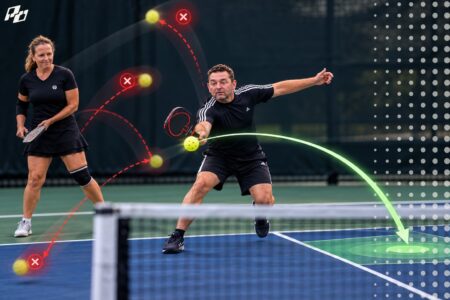
Intermediate pickleball players lose volleys not from slow hands but from late contact. Once the ball reaches your body line, your downward angle disappears. Meet the ball inside your front triangle — between your shoulders and paddle tip — before it reaches your hip. Early contact lets you direct and drive. Late contact just lets you survive.
There is a moment in pickleball when a volley goes from “attackable” to “survivable.”
It happens fast.
The ball is coming toward you. You feel like you still have time. You wait half a beat. Maybe your feet are shifting back toward the middle. Maybe your paddle is centered but not loaded. Maybe you are expecting one more soft ball.
Then the ball gets even with your body. And suddenly the shot is not the same anymore.
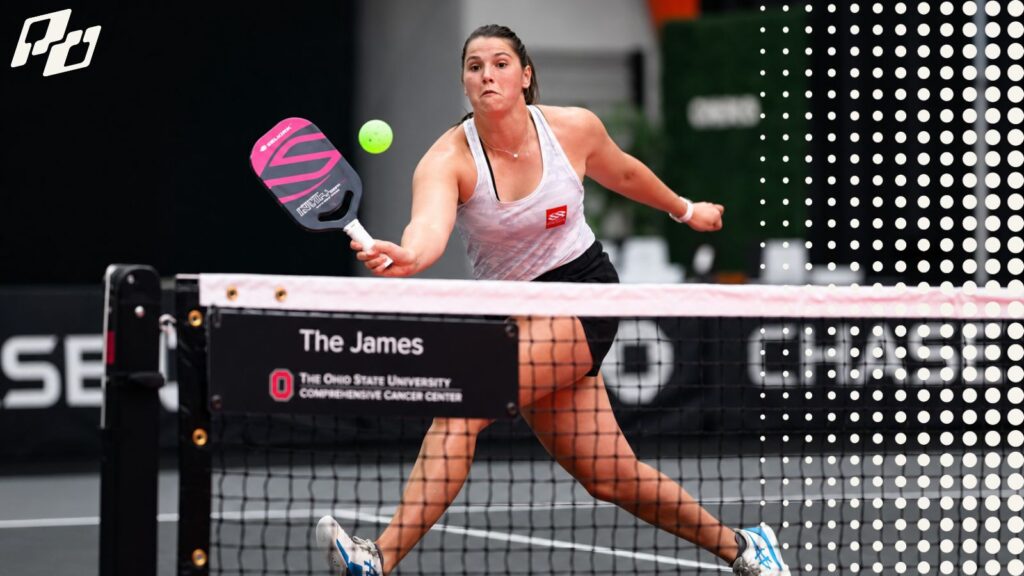
You are no longer punching through the ball. You are swatting beside yourself. Your paddle face opens late. Your elbow gets jammed. The ball floats instead of drives. Or worse, you mishit it and give your opponent exactly what they wanted.
For intermediate rec players, roughly 3.25–4.0, this is one of the most underrated volley problems: not bad hands, not slow reactions, not weak paddle skills — but losing the contact window before you realize it is gone.
The better volley is not just “paddle up.”
It is about owning the space between your body and the net before the ball reaches your side pocket.
That little window is where your angles, leverage, and control live.
Why the Contact Window Matters More Than Hand Speed
A lot of rec players think volleys are mostly about quick hands. Quick hands help. But hand speed only matters if your paddle is in a useful place.
If the ball is still in front of your body, you can direct it. You can punch through it. You can close the face slightly. You can send it down. You can use your body behind the paddle.
Once the ball gets level with your torso, the geometry changes.
You are no longer hitting through the front of the court. You are catching the ball beside you. That does three bad things:
- It removes your downward angle.
- It makes the paddle face harder to stabilize.
- It turns a compact punch into a late arm swing.
That is why a late volley often feels rushed even if the ball was not that fast. You did not run out of time because the ball was impossible. You ran out of usable space.
A better way to think about it: Your volley window closes before the ball passes you.
That is the part many intermediate players miss.
The “Front Triangle” Concept
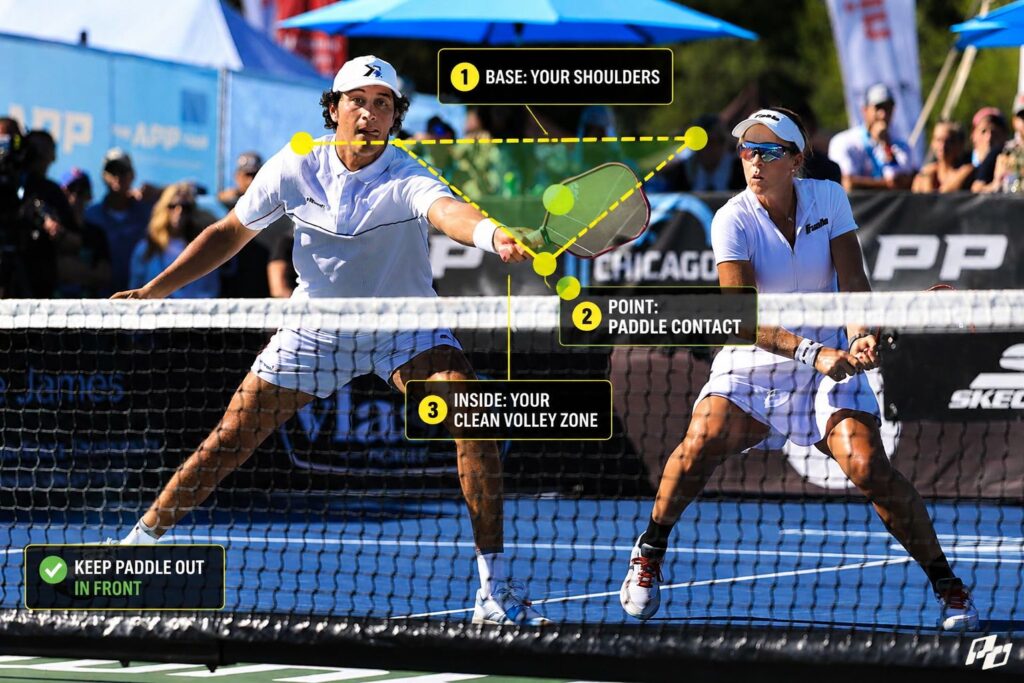
Instead of thinking only “hit out front,” picture a triangle in front of your body.
⮕ The base of the triangle is your shoulders.
⮕ The point of the triangle is your paddle contact point.
⮕ The space inside that triangle is your clean volley zone.
Inside that zone, your paddle can stay connected to your body. Your elbow can remain slightly bent. Your wrist can stay organized. Your punch can be compact.
Outside that zone, things get messy.
✖️ Too far out to the side, and the shot becomes a reach.
✖️ Too close to the body, and the elbow gets jammed.
✖️ Too late, and the paddle has to rescue the ball.
✖️ Too far forward without body support, and you lose control.
The goal is not to lunge your paddle as far in front as possible. The goal is to meet the ball early enough that your body is still behind the shot.
Cue: Own the front triangle.
The Downward Angle Disappears Late
This is the tactical reason the contact point matters.
When the ball is in front of you, especially around chest to shoulder height, your paddle can work slightly forward and down through the ball. That gives you access to aggressive targets:
- feet
- paddle-side hip
- inside elbow
- middle seam
- or open court
But when the ball gets beside you, your paddle path changes. Now you usually have to push across, lift, or block defensively. You cannot drive the ball down with the same control because the ball is no longer in front of your hitting shoulder.
That is why late contact often creates one of these outcomes:
✖️ a floating volley
✖️ a ball left too high
✖️ a weak block into the middle
✖️ a mishit off the edge
✖️ or a counterattack feed
The ball did not become harder. Your angle disappeared.
A simple rule: Early contact lets you hit down. Late contact makes you hit out.
And “out” is usually exactly what your opponent wants.
Why This Shows Up When You Shift Back to the Middle
This mistake often happens after you move laterally.
You reach to one side, make a shot, then start recovering back toward the middle. During that recovery, many players let the paddle drift neutral, low, or backhand-heavy. Then the next ball comes fast to the forehand-side body window, and they are late.
The problem is not just where your feet go. It is what your paddle is doing while your feet are going there.
Better players recover with a paddle bias. They do not just move to the middle. They move to the middle with the paddle already prepared for the most likely threat.
That is a much more advanced idea than “get back to ready.”
The Forehand-Side Bias: Why Neutral Isn’t Always Neutral
A perfectly centered ready position sounds good, but in fast kitchen exchanges, “neutral” can be too slow.
If you are shifting back toward the middle and the ball is likely to arrive in your forehand-side strike zone, you should not recover with the paddle dead-center and then rebuild the forehand at the last second.
You want the paddle slightly available on the forehand side so the next volley is a punch, not a swing.
This does not mean your paddle is way outside your body. That would expose the backhand and make you slow in the middle.
It means the paddle face is already organized in the forehand lane:
✔️slightly in front
✔️ slightly to the forehand side
✔️ wrist quiet
✔️ paddle head above the hand
✔️ elbow relaxed
✔️ face ready to punch forward
Think of it as a forehand-loaded ready position, not a big forehand backswing.
Cue: Recover with the paddle already answering the next ball.
That is a big difference.
Why Winding Up Ruins the Volley
At the kitchen, a volley usually fails when the player tries to create power after the ball has already arrived.
That creates a backswing. The backswing creates timing risk. Timing risk creates pop-ups.
A good punch volley does not need a windup because the ball already has incoming pace. Your job is to redirect that pace with a stable face and a short forward path.
The paddle should feel like it moves from “ready” to “through,” not from “back” to “forward.”
A clean volley is usually:
- shorter than you think
- firmer than a dink
- less swingy than a drive
- and more body-supported than a wrist slap
The power comes from three things:
- early contact
- stable paddle face
- small body weight transfer
Not from taking the paddle back.
Cue: No lag. Just punch.
The Difference Between a Punch Volley and a Swing Volley
Intermediate players often mix these up.
A punch volley is compact. It uses a short forward movement, stable wrist, and controlled paddle face. It is best for quick exchanges, body balls, counters, and balls where you already have incoming pace.
A swing volley has a larger motion. It can work when you have time, space, and a ball that sits up — but it is much riskier at the kitchen line.
If the ball is moving fast and you are close to the net, the punch volley is usually the better tool.
If the ball is slow, high, and comfortably in front, you may have time for a larger attacking motion.
The problem comes when players use a swing volley on a punch-volley ball. That is when the ball gets too deep, too high, or too late.
A useful test: If the ball can rush you, punch it. If the ball waits for you, swing only if you are balanced.
The Best Contact Zone by Ball Type
Not every volley wants the same contact point, but the principle is similar: keep it in front enough that you can control the face.
| Ball Type | Ideal Contact Feel | What Goes Wrong Late |
|---|---|---|
| Fast body ball | Paddle in front of sternum or slightly forehand-side | Elbow jams, paddle face opens, ball pops up |
| Forehand volley | Slightly in front of front hip/shoulder line | Turns into a side slap |
| Backhand block | In front of chest, compact and firm | Wrist collapses or paddle gets trapped |
| High attackable volley | In front and above net height with downward path | Ball gets hit flat or long |
| Low volley | In front with open face and soft lift | Late contact forces a scoop |
| Middle ball | In front of body with early call/commitment | Both players hesitate and the ball passes through |
The contact zone is not a fixed dot. It is a moving window.
But once the ball reaches your hip line, you are usually no longer choosing your best shot. You are surviving the shot you waited too long to take.
Why “Between You and the Net” Is a Better Cue Than “Out Front”
“Out front” is useful, but many players misunderstand it.
They reach too far. They lock the arm. They stab at the ball. They make contact early but disconnected.
A better cue is: Keep the ball between you and the net.
That means the ball should still be in front of your body line, but not so far away that you lose structure. You are trying to preserve leverage.
When the ball is beside you, your body is no longer helping much.
How to Train the Contact Window
Do not just drill generic volleys. Drill the specific mistake.
Drill 1: Hip-Line Awareness
Have a partner feed medium-speed volleys. Your job is to call “early” if you contact the ball before it reaches your hip line and “late” if it gets even with your body.
This builds awareness. Most players are shocked by how many volleys they contact late.
Drill 2: No-Backswing Punches
Start with the paddle already in front. Your partner feeds firm balls to your forehand-side body lane. You are not allowed to take the paddle back.
Punch forward. Short finish. Reset.
Goal: 20 clean contacts without a backswing.
Drill 3: Recover and Punch
Start one step wide. Shuffle or slide back toward the middle. As you recover, your partner feeds a ball into your forehand-side volley window.
Your goal is to arrive with the paddle already prepared, not arrive and then prepare.
Cue: Move and load together.
Drill 4: Angle Loss Drill
Have your partner feed two balls: one slightly in front, one slightly late. Hit both and notice the difference.
The early ball can be directed down or through a target. The late ball usually becomes defensive.
This helps players feel the tactical cost of waiting.
Common Mistakes
1. Dead paddle recovery
Your feet move back to the middle, but your paddle hangs neutral or low.
Fix: Recover with the paddle already in the likely strike lane.
Cue: Paddle arrives first.
2. Taking the paddle back
You try to create power with a backswing and end up late.
Fix: Start in front and punch through the ball.
Cue: Ready to through.
3. Contacting beside the body
You wait too long and lose your downward angle.
Fix: Meet the ball while it is still between you and the net.
Cue: Beat it to the window.
4. Overreaching out front
You make early contact, but your arm locks and your body disconnects.
Fix: Keep the elbow slightly bent and the body behind the paddle.
Cue: Early, not stretched.
5. Being too forehand-biased
You load the forehand so much that your backhand side gets exposed.
Fix: Use only a slight forehand bias while keeping both sides protected.
Cue: Forehand ready, backhand available.
The Best Cues to Remember
| Cue | What It Means |
|---|---|
| Own the front triangle. | Keep the ball in your clean contact window. |
| Early contact lets you hit down. | Do not wait until the ball reaches your body. |
| Recover to the threat. | Move back to the middle with your paddle prepared for the likely reply. |
| Forehand ready, backhand available. | Use a slight forehand bias without overcommitting. |
| No lag. Just punch. | Avoid backswing on quick volleys. |
| Ready to through. | Move from prepared position directly through contact. |
| Beat it to the window. | Contact the ball before your angle disappears. |
The clean volley lives in the space between you and the net. That is where you can still shape the ball, control the paddle face, hit down, and recover for the next shot.
Once the ball gets level with your body, you are often no longer attacking. You are bailing out.
So stop thinking only about “being ready.” Be ready in the right window.