
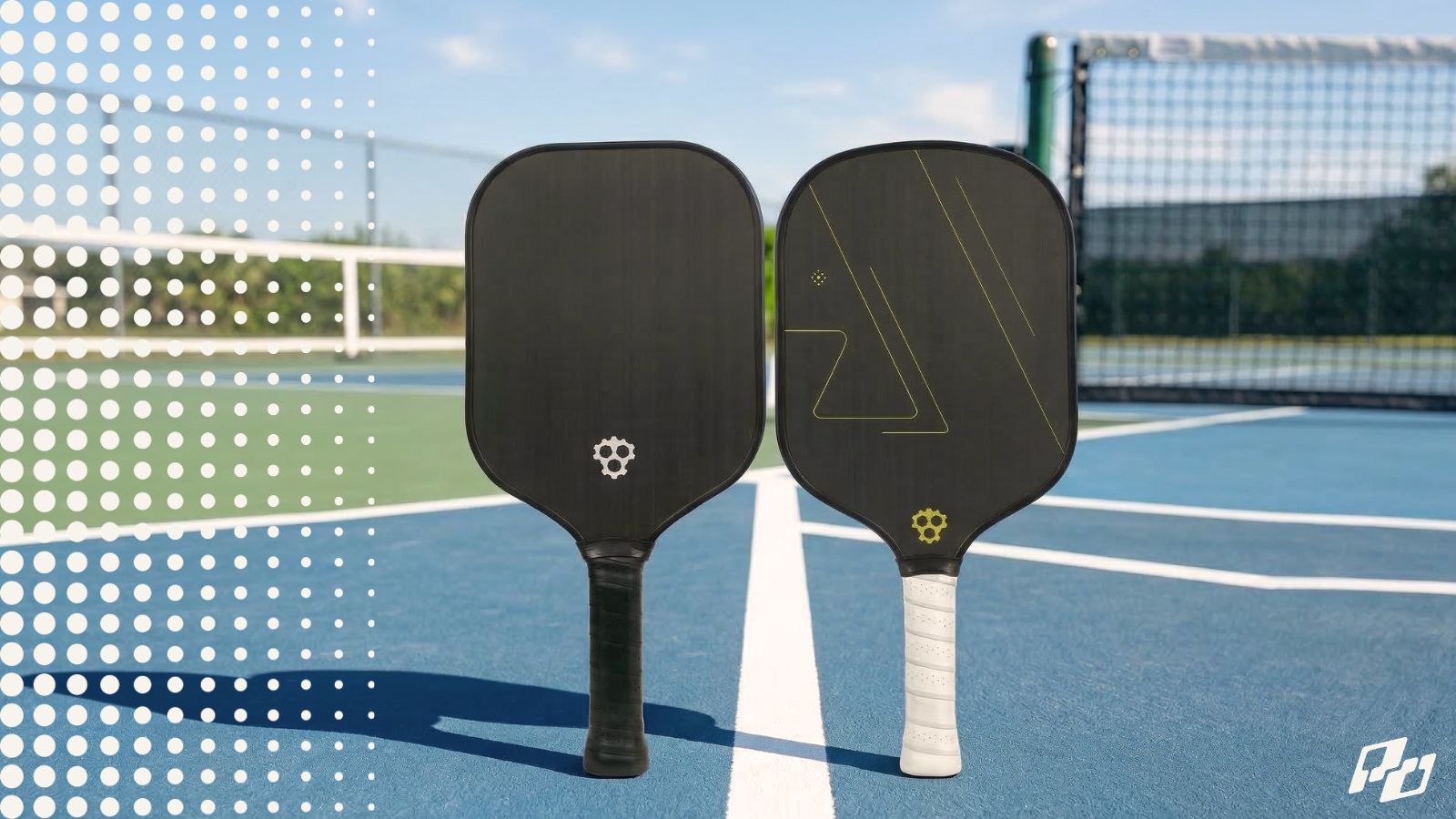
Elongated paddles offer more reach and power but are less forgiving. Hybrid paddles provide better control, a larger sweet spot, and faster hand speed—making them ideal for most doubles players.
If you’ve been testing or upgrading paddles lately, you’ve probably run into the same issue: brands throw around terms like elongated, hybrid, all-court, power, control—but rarely explain what those actually feel like on court.
If you would rather skip the theory, the paddle quiz turns your answers into three lab-scored picks in about 90 seconds.
At a certain level, you already know your game. The problem isn’t understanding the words—it’s understanding what really changes when you switch shapes.
But paddle shape really does matter.
Not because one shape is universally better.
Not because pros always know best.
And definitely not because “hybrid” automatically means “best of both worlds.”
It matters because shape changes the way a paddle behaves in a few very specific ways: reach, sweet spot, leverage, hand speed, and how demanding the paddle feels when contact isn’t perfect. That’s the part most recreational players don’t fully understand.
So let’s break this down the right way.
This guide focuses on the two shapes many improving players are comparing right now: elongated and hybrid paddles.
I’ll explain what they really are, what brands and reviewers mean when they use those terms, what usually changes on court, and who should actually lean one way or the other.
Ten questions, three paddles matched to how you play, scored on lab data.
First, What Do “Elongated” and “Hybrid” Actually Mean?
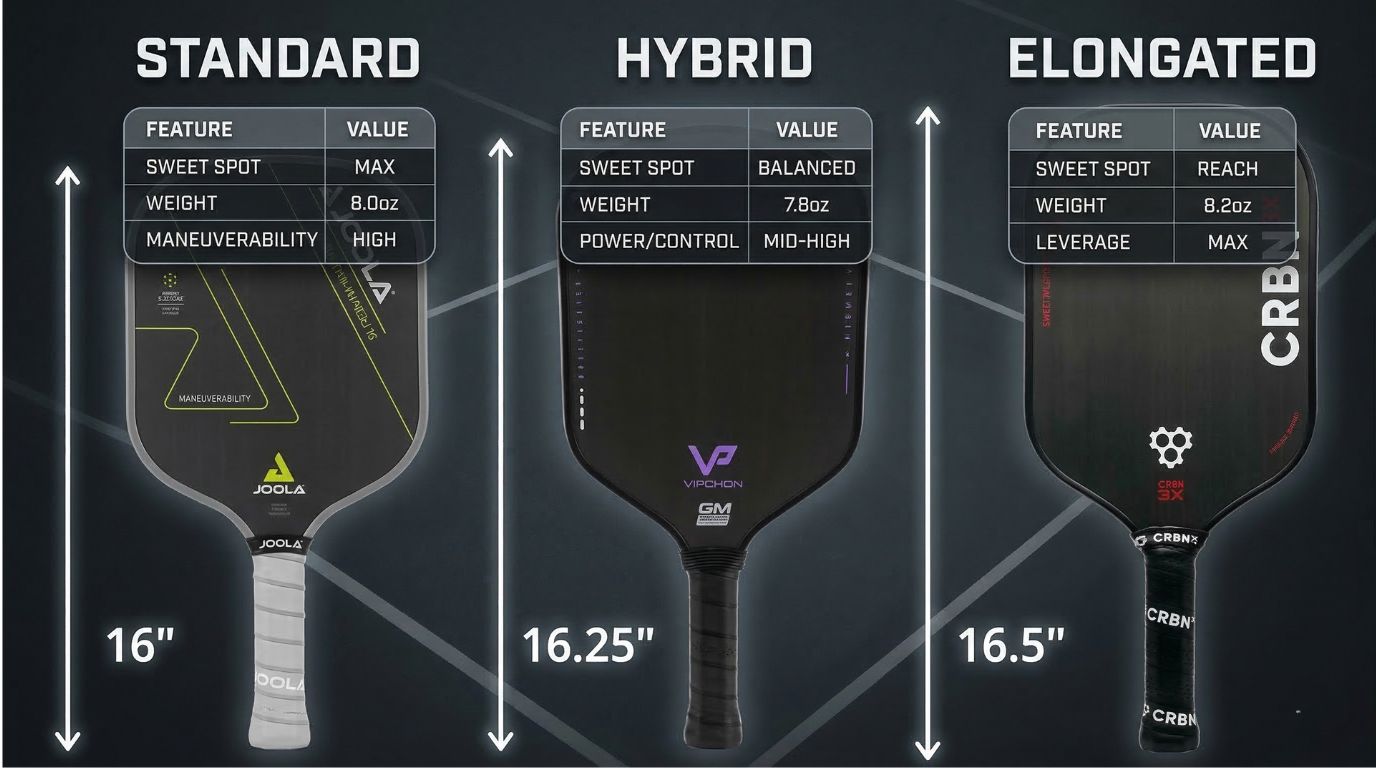
At a basic level, an elongated paddle is longer and narrower. A classic elongated shape is usually around 16.5 inches long and gives you extra reach and leverage. Brands like Selkirk explicitly position their elongated shape for intermediate to advanced players and players with previous racquet-sport experience.
A hybrid paddle sits between elongated and widebody/traditional shapes. It usually gives back a little width to the face, slightly shortens the overall profile, and aims for a more balanced relationship between reach and sweet spot. Hybrid paddles are described as a balanced middle ground between power and control.
That sounds simple enough. But here’s the first thing most rec players don’t realize: “Hybrid” is not a fully standardized category.
This is one of the biggest sources of confusion.
“Elongated” is relatively consistent across the market: longer, narrower, more reach-oriented.
“Hybrid,” on the other hand, is more of a design intention than a perfectly fixed shape standard. One brand may mean a slightly shorter elongated paddle with a little extra width. Another may mean a balanced all-court profile. Another may use a curved upper shape to make an elongated-style paddle feel more forgiving.
You can see that in public descriptions already:
- Selkirk frames hybrid as a balanced middle ground with moderate energy absorption and a decent sweet spot plus some added reach.
- Six Zero frames hybrid as a balanced reach-to-sweet-spot ratio.
- Engage describes the Engage Hybrid as feeling like a blend of widebody and elongated, with a large sweet spot, great control, and surprisingly good power.
So when you’re comparing paddles, don’t stop at the word hybrid. You need to look at the actual dimensions, handle length, and on-court feel.
The easiest way to picture the difference
If you want the simplest possible mental image:
⮕ An elongated paddle stretches the shape vertically.
⮕ A hybrid paddle gives some of that length back to the face width.
That shift sounds small, but it affects a lot.
In general, elongated paddles tend to give you:
- more reach
- more leverage on drives and counters
- a more power-oriented feel
- a narrower face
- often a more demanding sweet spot
In general, hybrid paddles tend to give you:
- a more balanced all-court feel
- a little more forgiveness
- quicker hand speed in fast exchanges
- a slightly more compact, maneuverable feel
- a better blend of reach and face stability
That doesn’t mean every elongated paddle is a power monster or every hybrid paddle is soft and forgiving. But those are the trends reviewers and brands consistently describe.
A quick shape comparison table
| Feature | Elongated Paddle | Hybrid Paddle |
|---|---|---|
| Typical feel | Longer, narrower, more stretched out | Balanced, in-between profile |
| Reach | Higher | Moderate to high |
| Sweet spot feel | Usually smaller or more precise | Usually more forgiving |
| Hand speed | Can feel slower in firefights | Usually quicker and easier to maneuver |
| Leverage on drives | Stronger | Good, but usually less extreme |
| Best fit | Aggressive players, singles, players who like extension | All-court doubles players, balanced styles |
| Risk | Can feel demanding on mishits | Might not excel at one extreme trait |
This is the table version. Now let’s talk about what actually matters on court.
What elongated paddles do well
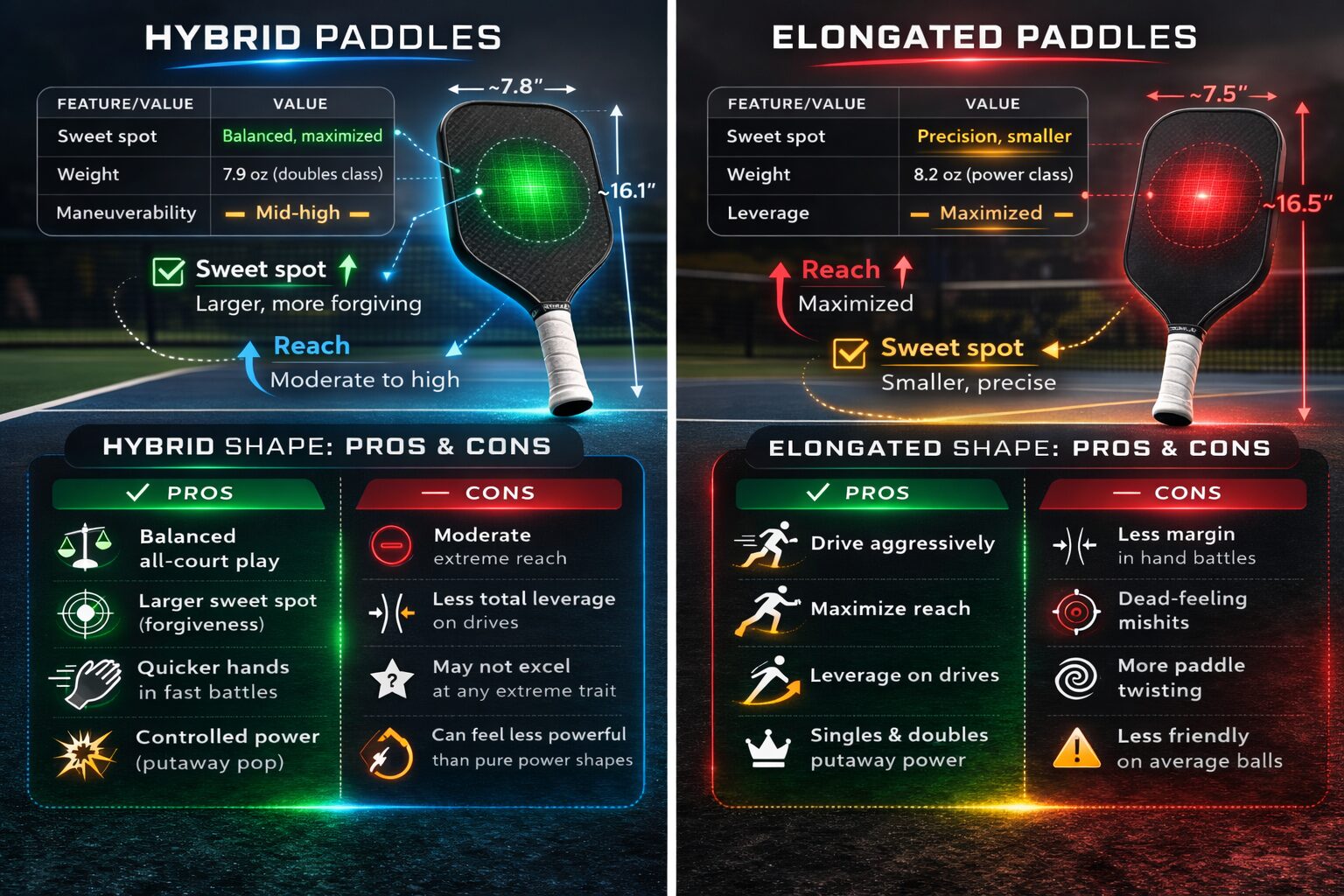
If you put an elongated paddle in someone’s hand and they immediately say, “This feels dangerous,” that usually makes sense. Elongated paddles tend to reward players who like to:
- drive aggressively
- counter with leverage
- take balls out in front
- use reach at the kitchen
- attack from extension rather than pure hand speed
That extra length can help you cover a little more space and attack balls slightly farther away from your body. It also tends to create a little more leverage through the swing, which is why elongated paddles are so often associated with power and reach-oriented offense.
That’s why elongated paddles show up so often in discussions around:
- singles
- former tennis players
- aggressive all-court players
- players who like to drive and counter hard
There’s also a reason many pros lean elongated or elongated-adjacent. Extra reach matters when your timing is already elite and you can live near the center of the face.
But this is where rec players need to be careful.
What elongated paddles often cost you
That extra length usually doesn’t come for free.
The face tends to be narrower, and that often means the paddle feels a little less forgiving when contact drifts outside the sweet spot.
For rec players, this shows up in a few very real ways:
- more dead-feeling mishits
- less margin in hand battles
- more twisting on off-center contact
- a paddle that feels great on your best balls, but less friendly on your average ones
That’s the classic elongated tradeoff.
And honestly, this is where a lot of 3.0–4.0 players make the wrong purchase. They try a friend’s elongated paddle, love the putaway power for ten minutes, and buy it without asking the more important question:
How does this paddle feel when I’m rushed, stretched, or slightly late?
That’s the real test.
What hybrid paddles do well
Hybrid paddles are attractive because they often solve the exact problem above.
They still give you enough length to feel modern and versatile, but they make life easier when the rally gets messy. That’s why so many reviewers use words like:
- balanced
- maneuverable
- all-court
- large sweet spot
- forgiving power
Many hybrid paddles stand out for combining a larger, more forgiving sweet spot with strong control and quick hand speed, while still offering enough pop to finish points when needed. The overall design tends to focus on a balanced reach-to-forgiveness ratio, making them especially effective for all-court doubles play. And that makes sense on court.
Hybrid paddles tend to appeal most to players who:
- play mostly doubles
- value resets and hand speed
- want a little more forgiveness without going fully widebody
- still want enough reach to attack comfortably
- don’t want a shape that punishes small misses
If elongated paddles often feel like they reward your ceiling, hybrid paddles often feel like they support your normal game.
That difference matters more than many people realize.
The hidden thing rec players miss: shape influences confidence
This isn’t talked about enough.
Paddle shape doesn’t just change technical performance. It changes how confident you feel in certain situations.
An elongated paddle might make you feel more confident:
- attacking shoulder-high balls
- extending on counters
- reaching wide at the kitchen
- ripping drives from deeper in the court
A hybrid paddle might make you feel more confident:
- resetting under pressure
- speeding up in fast hands exchanges
- taking balls out of the air without overreaching
- surviving off-center contact
That confidence piece matters because players tend to play better with shapes that match their instincts.
Practical dimensions: what “slightly different” really looks like
This is where things get more concrete. On paper, the difference between elongated and hybrid paddles often looks small—sometimes it’s just fractions of an inch in length or width. But on court, those small changes can feel surprisingly noticeable. And this is where a lot of rec players get misled.
Since “hybrid” isn’t a strict standard, two paddles labeled hybrid can feel very different. That’s why it’s important to look beyond the category and check actual specs like:
- paddle length
- paddle width
- handle length
- swing weight
- twist weight
Those last two—swing weight and twist weight—are especially important. They tell you how heavy the paddle feels in motion and how stable it is on off-center hits, which often matters more than shape alone.
If you want to compare this properly, one of the easiest ways is to use JustPaddles’ Paddle Lab, which provides standardized performance data across many popular paddles. It lets you see real numbers for swing weight, twist weight, balance point, and more—so you’re not relying on guesswork or marketing terms.
Because in reality, shape sets the foundation—but how the paddle is built on top of that shape is what determines how it actually plays.
Who should choose elongated?
I’d lean elongated if this sounds like you:
You’re an aggressive player who likes to drive, counter, and attack balls slightly outside your body line. You care about reach. You probably come from tennis or another racquet sport. You don’t mind a paddle that asks for more precise contact because you trust your mechanics. You may also play a fair amount of singles, where extra reach matters more.
Elongated can also work really well if you use a two-handed backhand and like a more stretched feel through your swing path—though handle length matters here too, and not all elongated paddles are equally generous in the handle.
What I would not do is recommend elongated by default to a player who is still struggling with:
- mishits
- rushed hand battles
- inconsistent resets
- late contact at the kitchen
In those cases, the shape often makes the game feel harder, not better.
Who should choose hybrid?
I’d lean hybrid if this sounds like you:
You mostly play doubles. You want a paddle that can do a little bit of everything well. You care about quick hands, resets, and consistency. You still want enough pop and reach to be dangerous, but you don’t want the face to feel narrow or punishing.
Hybrid is especially good for improving intermediate players who are starting to get more aggressive but don’t want to give up the safety net of a more forgiving face.
If you’ve ever said something like:
“I want more offense, but I don’t want to lose my control,”
that is almost the definition of a hybrid shopper.
That’s also why brands keep leaning into this category. It’s where a huge percentage of modern doubles players actually live.
What most rec players don’t realize about “all-court” shapes
Here’s one more thing worth saying clearly: hybrid does not automatically mean lower performance.
A lot of players unconsciously assume elongated = advanced, hybrid = compromise.
That’s too simplistic.
In practice, many modern hybrid paddles are extremely high-performance. They just distribute that performance differently. Instead of giving you the most extreme reach or the most extreme forgiveness, they try to give you enough of both to keep your game stable across all phases of doubles.
A simple way to choose between them
If you’re stuck between elongated and hybrid, ask yourself these questions:
1. Where do you actually win points?
If you win through drives, counters, and reach, elongated deserves a serious look.
If you win through resets, quick exchanges, and balanced doubles play, hybrid probably deserves the edge.
2. What happens when you’re late?
If you’re often a little late or stretched in fast rallies, hybrid usually helps more.
If you’re consistently on time and centered, elongated becomes more rewarding.
3. Are you buying for your current game or your dream game?
This is the most important question of all.
A lot of rec players buy elongated because they want to play like aggressive pros. But if your actual game is still built on consistency and doubles survival, hybrid may help you win more now.
And in my opinion, that’s the better way to buy paddles.
Final comparison table: who benefits most?
| Player Type | Better Starting Point |
|---|---|
| Former tennis player who likes to drive big | Elongated |
| Doubles-first rec player who values hand speed | Hybrid |
| Singles player needing extra reach | Elongated |
| Intermediate player wanting balanced all-court help | Hybrid |
| Player with very consistent sweet-spot contact | Elongated |
| Player who gets rushed in firefights | Hybrid |
| Player wanting a bit of everything without extremes | Hybrid |
If I had to simplify the whole elongated vs. hybrid debate into one sentence, it would be this: elongated paddles usually reward your best swings. Hybrid paddles usually support your average ones.
That doesn’t make hybrid “better.” It doesn’t make elongated “more advanced” in every case. It just tells you where each shape tends to help.
So don’t ask:
“Which shape is best?”
Ask:
“Which shape helps me play my game more cleanly, more often?”
That’s the smarter question. And for most rec doubles players, it leads to a much better paddle decision.