
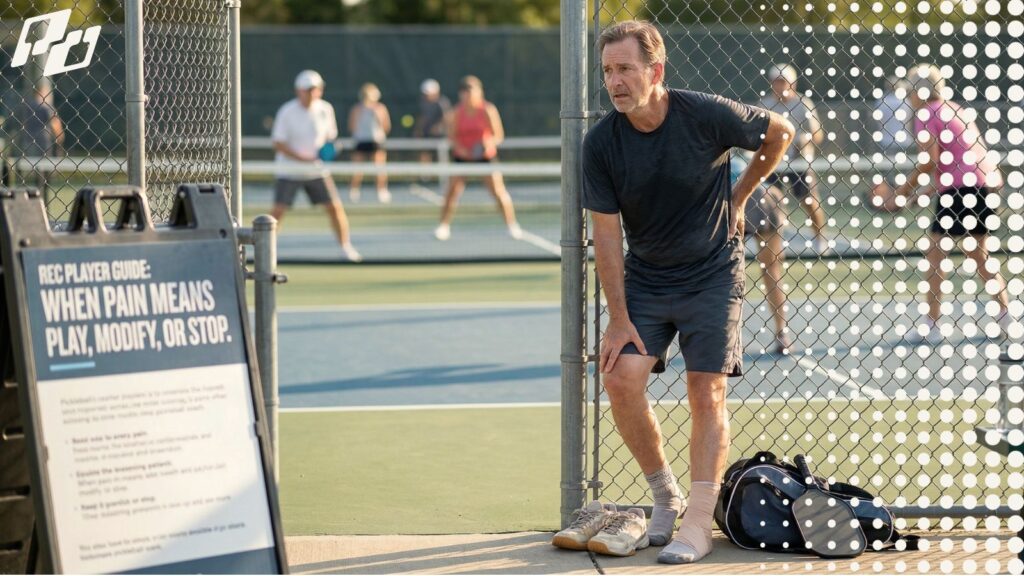
Rec players are weirdly good at this.
You wake up feeling off, your knee is barking, your throat is scratchy, your lower back feels “not great,” and somehow you still tell yourself: I’ll just loosen up once I get there.
Sometimes that’s true. Sometimes it is absolutely not.
And one of the biggest mistakes recreational pickleball players make is treating every bad-feeling day like a toughness test. But fitness does not improve from blindly stacking sessions. It improves from applying stress your body can actually absorb, recover from, and adapt to.
That means some days the smart move is to play. Some days the smart move is to cut the session short. And some days the smartest thing you can do for your game is not step on court at all.
This matters even more in pickleball because the sport hides fatigue well. You can still hit decent shots while your feet are slow, your reaction time is off, and your mechanics are compensating. By the time it looks bad, your body usually told you earlier.
So let’s talk about how to read those signals properly.
First: stop using “Can I technically play?” as the standard
A lot of rec players ask the wrong question.
⮕ Not: “Can I physically drag myself through two hours?”
⮕ Ask: “Will this session improve me, maintain me, or cost me?”
That one shift changes everything. If a session is likely to:
- worsen an illness,
- prolong an injury,
- reinforce bad mechanics,
- or increase your chance of a bigger problem,
then forcing it is not discipline. It is bad load management.
That idea is consistent with broader sports medicine thinking: return-to-play decisions should match the condition, the body region, the demands of the sport, and the person—not a one-size-fits-all calendar.
The illness rule: when a cold is still okay, and when it is not
This is where players get the most confused.
The old “above the neck vs below the neck” rule is still used as a quick screening tool. Mayo Clinic notes that light to moderate exercise is usually okay for a common cold with only “above the neck” symptoms like runny nose, nasal congestion, sneezing, or a minor sore throat.
But it says not to exercise with “below the neck” symptoms like chest congestion, a hacking cough, or upset stomach, and not to exercise if you have fever, fatigue, or widespread muscle aches.
That’s the big picture. Here’s the pickleball version.
Usually okay to skip hard play but consider very light activity
If you have:
- runny nose,
- mild nasal congestion,
- sneezing,
- a light scratchy throat,
- and no fever, chest symptoms, or major fatigue,
you may be okay for a short walk, mobility work, or maybe a light solo dink session.
But that does not automatically mean you should go to open play.
Why? Because even if your symptoms are mild, you may still be contagious, and crowded rec pickleball is basically a hand-contact, shared-ball, shared-bench environment. CDC guidance for respiratory illness says people should stay home until symptoms are improving overall and they have been fever-free for at least 24 hours without fever-reducing medication.
So here’s the practical rule:
Mild cold + feel okay + no fever = maybe light movement, but think twice before public play.
When a cold is too much to play
For pickleball, a cold crosses the line into “don’t play” when you have any of the following:
1. Fever
This is the clearest no-play sign. Fever plus exercise increases physiological stress, dehydration risk, and is a poor return-to-play setup. Mayo specifically says do not exercise with fever.
My advice: no pickleball with fever. None.
And don’t rush back the instant the fever breaks. Wait until you are fever-free for at least 24 hours without medication and feel clearly better overall.
2. Chest symptoms
Chest congestion, wheezing, chest tightness, shortness of breath, or a deep hacking cough are all major yellow-to-red flags. Those are exactly the symptoms Mayo flags as reasons not to exercise.
Pickleball may not look like sprinting, but repeated explosive rallies, bending, bracing, and recovery steps still stress your breathing.
If symptoms are in your chest, skip.
3. Heavy fatigue or widespread body aches
This one gets underestimated by rec players. Mayo includes fatigue and widespread muscle aches in the “don’t exercise” category.
If walking up the stairs feels like a project, you are not “warming into it.” You are under-recovered and sick.
4. Vomiting or diarrhea
This is an easy no. Viral gastroenteritis commonly causes diarrhea, vomiting, nausea, stomach pain, and sometimes fever, with dehydration being a major concern. Norovirus, for example, can make people vomit or have diarrhea many times a day and can lead to dehydration, especially in older adults.
A pickleball session with GI illness is a bad idea for performance, recovery, and everyone around you.
5. You feel faint, weak, or dizzy
CDC’s heat guidance is blunt: if you feel faint or weak, stop activity and get to a cool place.
That applies beyond heat. If you feel faint, weak, or unusually light-headed before play, do not “see how the first game goes.”
A useful sickness progression for rec players
Here’s the most practical ladder:
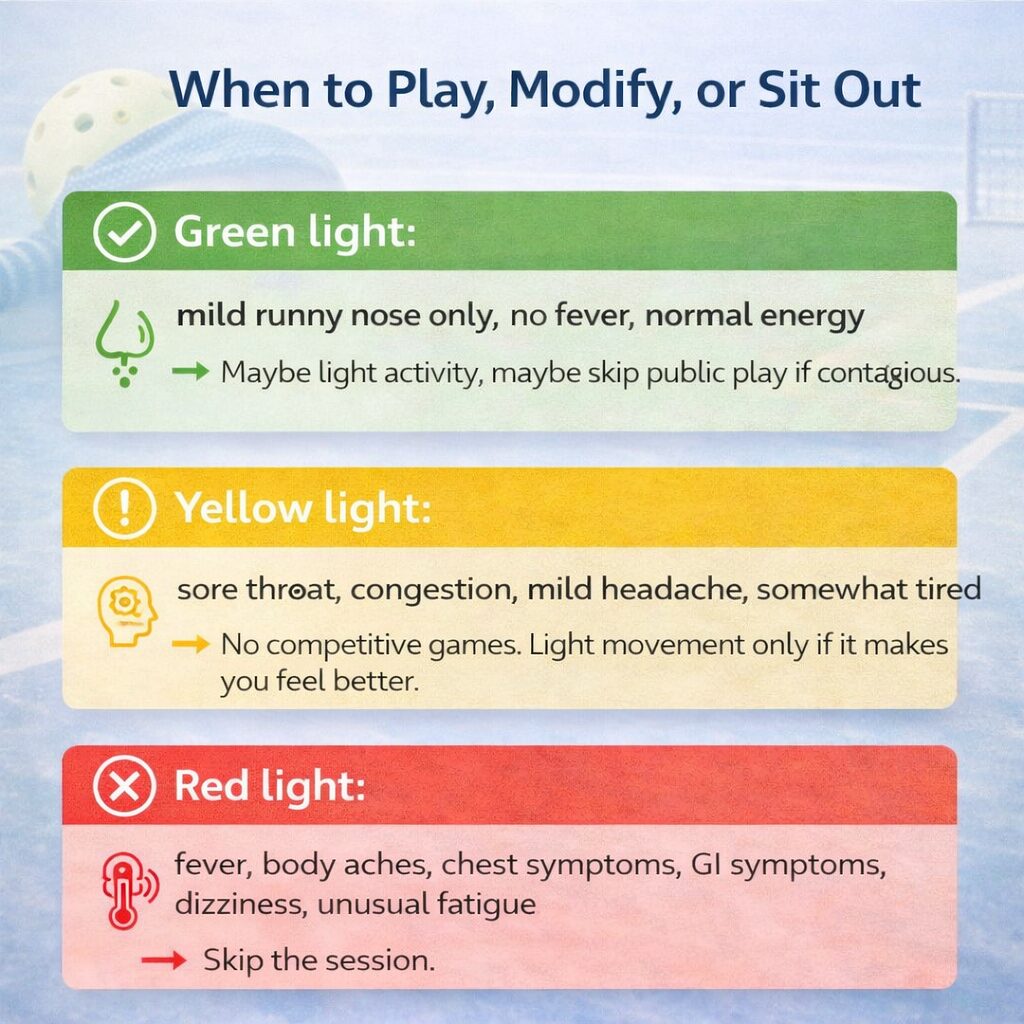
Green light: mild runny nose only, no fever, normal energy
→ Maybe light activity, maybe skip public play if contagious.
Yellow light: sore throat, congestion, mild headache, somewhat tired
→ No competitive games. Light movement only if it makes you feel better.
Red light: fever, body aches, chest symptoms, GI symptoms, dizziness, unusual fatigue
→ Skip the session.
And once you’re recovering, ramp back up gradually. Even return-to-play guidance after infection emphasizes a progressive build, and if symptoms return, you back down and rest before progressing again.
Now let’s talk pain: soreness vs. “something is wrong”
This is the second huge category.
Not all pain means “do not play.” But not all pain means “play through it” either.
Normal soreness usually looks like this
Delayed onset muscle soreness, or DOMS, usually starts one to three days after intense or unfamiliar exercise, affects the muscles you worked, and is usually not dangerous. Cleveland Clinic notes that it typically happens after you do something new or harder than usual.
That kind of soreness is annoying, but often manageable.
More concerning pain usually looks like this
Be more cautious when pain is:
- sharp instead of achy,
- localized to a joint or tendon rather than a broad muscle group,
- present during activity instead of only after,
- changing how you move,
- associated with swelling, heat, redness, locking, giving way, numbness, or weakness,
- or noticeably worse the next morning.
That’s the big divider: DOMS is sore. Injury pain changes behavior.
A practical pain rule that actually works
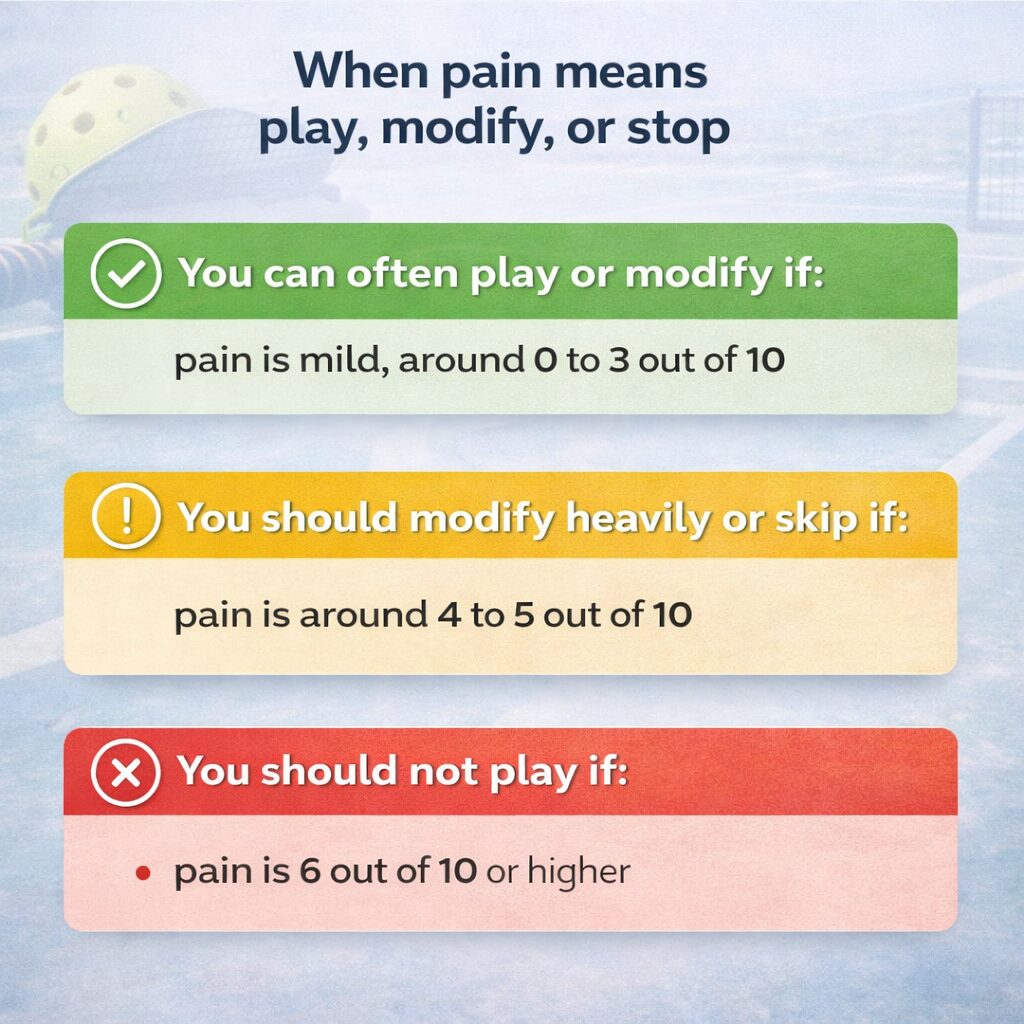
Here’s the easiest real-world framework:
You can often play or modify if:
- pain is mild, around 0 to 3 out of 10,
- it does not change your mechanics,
- it eases as you warm up,
- and it is not worse later that day or the next morning.
That “24-hour response” idea is commonly used in tendon rehab: some pain during loading can be acceptable, but symptoms should settle reasonably quickly and should not be progressively worse the next day.
JOSPT reviews describe pain provocation lasting more than 24 hours as a more irritable response.
You should modify heavily or skip if:
- pain is around 4 to 5 out of 10,
- you are limping, guarding, or changing your swing,
- the area is getting more painful as you play,
- or your last session clearly made it worse the next day.
You should not play if:
- pain is 6 out of 10 or higher,
- sharp, stabbing, unstable, or mechanical,
- or associated with swelling, weakness, locking, numbness, deformity, or inability to bear weight or grip normally.
That is not a formal universal law. It is a practical sports-medicine-style filter that keeps rec players from using “I can tolerate it” as proof they should keep going.
Exact body-part advice: back, knee, elbow, foot/ankle
Lower back: when to play, when not to
Back pain is common, and AAOS notes that simple activity-related low back soreness can happen when muscles and ligaments are overstretched, especially after doing more than you are used to; that kind of stiffness and soreness often settles within a few days.
So if your back is:
- stiff,
- generally sore,
- not radiating,
- loosens with warm-up,
- and does not change your movement much,
you may be okay for a modified session.
That means no lunging hero gets, no repeated overheads, no trying to play three hours because you “finally feel loose.”
Skip pickleball if your back pain:
- shoots into the leg,
- causes numbness, tingling, or weakness,
- makes you unable to rotate or bend normally,
- worsens with every rally,
- or changes your gait.
And seek urgent medical evaluation if back pain comes with new bowel or bladder problems, saddle numbness, fever, major trauma, or progressive neurologic deficits. Those are recognized red flags in back pain guidance.
Knee: the biggest rec-player trap
Knees are where players lie to themselves the most.
A mildly cranky knee after a heavy weekend is one thing. A swollen, unstable, or locking knee is another.
Mayo and NHS both flag these as reasons to get checked: inability to bear weight, marked swelling, instability or the knee “giving way,” inability to fully bend or straighten, locking, visible deformity, or fever with redness and swelling.
So the rule is simple:
Do not play on a knee that is swollen, unstable, locking, or altering your gait.
Even if you can technically move, pickleball’s deceleration, wide-base pushing, and quick recovery steps are brutal on a compromised knee.
A better return standard is:
- walking normally,
- stairs are manageable,
- no obvious swelling increase,
- and court movement does not feel like a gamble.
Elbow: when “it’s just tennis elbow” is not harmless
AAOS notes that tennis elbow is an overuse problem involving forearm tendons, often from repetitive or vigorous wrist and hand use, with pain on the outside of the elbow and weaker grip.
For rec pickleball players, elbow pain is a classic “I can still play” trap because the pain is often tolerable at first. The issue is that repeatedly hitting through it can keep the tendon irritated.
You may be okay to modify and play lightly if:
- pain is mild,
- your grip strength is basically normal,
- and the pain does not spike during or after play.
You should skip or stop if:
- your grip feels weak,
- you are changing your swing to protect it,
- backhands or volleys produce sharp pain,
- or the elbow is becoming more painful day to day.
See a clinician sooner if elbow pain is persistent, worsening, present even at rest, or comes with redness, swelling, or warmth. Mayo flags worsening redness, swelling, or pain as reasons to get checked.
Foot and ankle: do not outrun a sprain
AAOS warns that recurrent ankle sprains can happen if you return to sport before the ligaments heal and are rehabilitated; pain and swelling can help guide progression.
If your ankle is still swollen, painful with cuts, or feels unstable, you are not ready for normal pickleball movement. That is not “being cautious.” That is respecting how the sport loads the ankle.
If you cannot cut, push off, and stop confidently, skip.
Body-Part Guide: Play, Modify, or Skip
| Body Area | OK to Play (Modify) | Skip Playing If… | Extra Notes |
|---|---|---|---|
| Lower Back | Mild stiffness, general soreness, no radiating pain, loosens with warm-up, no movement changes | Pain shoots into leg, numbness/tingling, weakness, limited bending/rotation, worsening during play, altered gait | 🚨 Seek medical help if bowel/bladder issues, saddle numbness, fever, or major trauma |
| Knee | Mild soreness, no swelling, stable, walking and stairs feel normal | Swelling, instability (“giving way”), locking, can’t fully bend/straighten, altered walking | Pickleball stresses knees heavily—don’t “test it” if it feels unstable |
| Elbow | Mild pain, normal grip strength, no increase during/after play | Weak grip, sharp pain on shots, changing swing to compensate, worsening day to day | Persistent or worsening pain → get it checked early |
| Foot / Ankle | Light soreness, no swelling, stable movement, confident pushing off | Swelling, instability, pain during cuts or push-offs, lack of control | If you can’t cut and stop confidently, you’re not ready yet |
Fatigue: the most ignored injury risk of all
A lot of players respect pain more than fatigue, even though fatigue often causes the pain problem later.
There is not a single perfect “fatigue test,” but the pattern matters:
- your legs feel heavy in warm-up,
- your reaction time is clearly off,
- you’re missing routine balls early,
- your motivation feels flat,
- your sleep was poor,
- and your body just feels stale rather than energized.
That is not always laziness. Sometimes it is accumulated fatigue.
Cleveland Clinic lists overreaching-type signs like muscle soreness lasting more than two days, swollen/red/warm muscles, chronic tendon pain, and reduced performance despite continued effort.
For rec pickleball, I like this filter:
Skip or downgrade the session if:
- you slept badly for multiple nights,
- warm-up feels unusually hard,
- movement feels flat and heavy,
- you are still sore well beyond normal,
- or you already know your mechanics will be sloppy.
Because once fatigue changes your footwork, pickleball becomes a compensation sport.
A simple pre-court decision test
Before you leave for the courts, ask yourself these five questions:
- Do I have fever, chest symptoms, GI symptoms, dizziness, or unusual fatigue?
If yes, skip. - Is my pain changing how I walk, swing, bend, or react?
If yes, skip or modify heavily. - Is there swelling, instability, locking, numbness, or weakness?
If yes, skip. - Did my last session clearly make this worse for more than 24 hours?
If yes, skip or reduce load sharply. - Am I going to the court to improve—or just because I hate missing a day?
Be honest here. This is usually the real answer.