
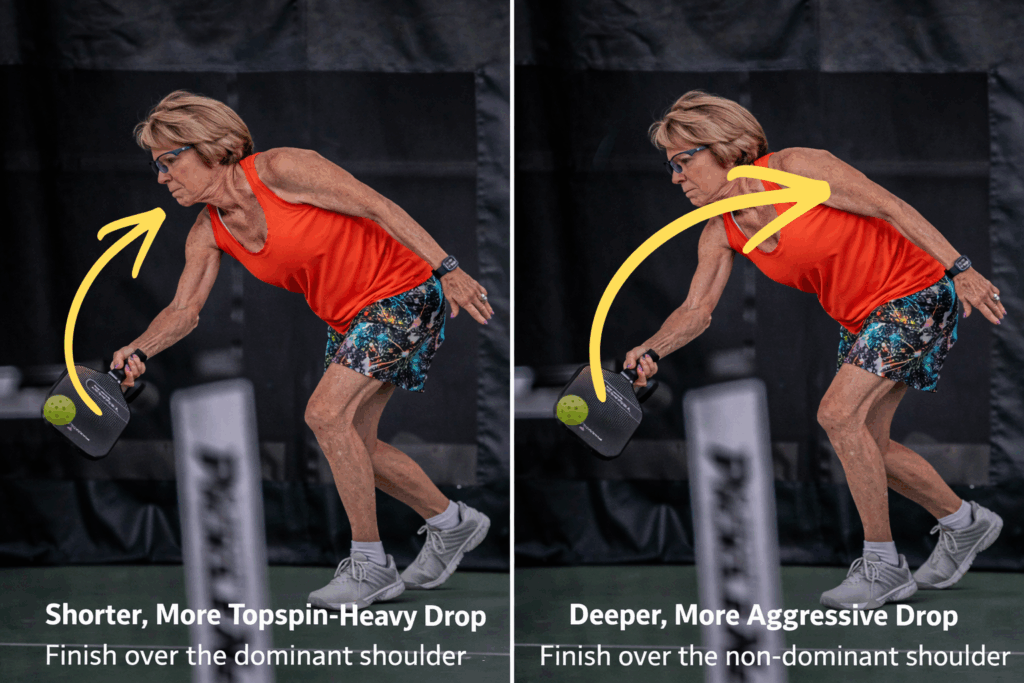
In pickleball, using two forehand drop variations helps you handle different opponents more effectively. A shorter, more topspin-heavy drop works better against players reaching in, while a deeper, more aggressive drop is useful against players who stay off the line and give you more space.
A lot of rec players learn one forehand drop and stop there.
That is usually enough to get by for a while. You find one shape that feels comfortable, you repeat it, and you hope consistency carries you. The problem is that better opponents start reading that one look. They get comfortable with your arc, your bounce, and your timing. And once they get comfortable, your “good” drop stops being nearly as good.
That is why this idea is so useful.
The basic point is simple: on the forehand side, you want two different drop finishes in your game. One finish produces a drop that gets down sooner and lands shorter with more topspin. The other creates a more linear, deeper, more aggressive ball that can push opponents back.
And for rec players, this is not just fancy technique for the sake of fancy technique. It is really about one thing:
making your forehand drop fit the player in front of you.
What this really means
Let’s put it into normal pickleball language.
You want two forehand drop patterns in your game:
1. The shorter, more topspin-heavy drop
The finish goes more toward your dominant shoulder. The purpose is to get the ball to dip earlier, land a little shorter, and stay less attackable.
That makes it especially useful against opponents who are long, reachy, or eager to step in and attack any ball that floats too far into their strike zone.
2. The deeper, more aggressive drop
The finish goes more over the non-dominant shoulder. The idea is to send the ball more forward and deeper, which can pressure players who are standing off the line, moving slower, or not great at handling a ball that pushes them backward or jams their spacing.
So the point is not “copy this finish because someone showed it online.”
The point is: learn two forehand-drop trajectories on purpose.
One that drops sooner.
One that carries deeper.
That is a very useful distinction.
Why rec players should care
Because rec players often throw the same drop at every opponent. And that is where a lot of trouble starts.
If you only have one forehand drop, you are usually making one of two mistakes:
- floating a safe ball that better players attack,
- or forcing an aggressive ball when you really needed shape and control.
So for rec players, this topic matters because it helps answer a really practical question:
What kind of drop should I hit against this pair, right now?
That is real strategy.
The first drop: when you need the ball to get down early
This is the version tied to finishing more toward the dominant shoulder.
Whether you use that exact finish cue or not, the important idea is that this drop has more topspin shape and tends to get down earlier.
When should rec players use it?
Use this version more often when:
- your opponents like to reach in and volley drops out of the air,
- they are tall or long-limbed and attack floaters easily,
- you are facing players with good hands who punish anything that hangs,
- or you need the ball to clear the net and then drop quickly before it becomes a sitting duck.
This is especially helpful against the player who is basically waiting to jump on your third-shot drop. If you know that team loves to step in and take early contact, the answer is not always “hit harder.” Sometimes the answer is “shape the ball so it gets down before they can do damage.”
What does it help with?
It helps you:
- reduce how attackable your drop is,
- create a lower first bounce,
- and make it harder for opponents to confidently take the ball early.
For a lot of 3.5–4.0 players, this is the drop that keeps them from getting punished by the aggressive kitchen hunter.
The second drop: when you want a deeper, more aggressive ball
This is the version tied to finishing more over the non-dominant shoulder.
Again, do not get hung up on the exact body cue as if that is the whole shot. The bigger point is that this drop is meant to be more linear, a little more driving, and a little more forceful.
When should rec players use it?
Use this version more often when:
- your opponents are standing off the line,
- they are slower getting forward or backward,
- they are uncomfortable when a drop carries deep into their feet or body space,
- or you want to stop them from camping comfortably at midcourt waiting to attack.
This is also a very useful option against players who are not really stepping in on your drop. If they are giving you more space, you do not always need the shorter, sharper dipping version. Sometimes the better answer is to carry the ball deeper, push them back a step, and take court.
What does it help with?
It helps you:
- apply pressure while still using a “drop” intention,
- force opponents into a more awkward contact point,
- and gain ground behind a deeper, more assertive ball.
For rec players, this is often the forehand drop that feels more natural at first because it is less delicate and more forward.
So do you really need both?
For beginners, no.
For developing rec players who want to get better, yes — eventually.
If you are still learning how to simply get a forehand drop over the net with reasonable control, adding two advanced-looking finishes right away may be too much.
But once you are in that 3.5-and-up rec world where:
- you can hit a drop with some consistency
- you are trying to get in against different styles
- and opponents are starting to read your patterns
then yes, learning both shapes becomes worth it.
That is when variety stops being decorative and starts being useful.
What level of player should learn this?
Here is the clean answer:
3.0 players
Probably focus first on one reliable forehand drop. You do not need two advanced-looking finishes if your first drop is still inconsistent.
3.5 players
This is the sweet spot for starting to learn both. You are good enough to benefit from different trajectories, and you are probably starting to face opponents who punish one-dimensional drops.
4.0+ players
You should absolutely understand both ideas, even if your personal mechanics look a little different. At this level, one-shape drop patterns become easier to read.
That progression makes sense because once players move beyond “just make it,” the next jump is often learning when to change shape, spin, and intent.
How should rec players think about the two drops?
Not as “the right one” and “the wrong one.”
Think of them as:
- the get-down-sooner drop
- and the carry-deeper drop
That mental model is much more useful than obsessing over which shoulder your paddle finishes near.
Because in real games, the question is not:
“Which shoulder do I finish on?”
The question is:
“Do I need this ball to dip sooner, or carry deeper?”
That is what actually helps you choose.
A good way to decide in a match
Here is a simple rec-player decision tree:
Use the shorter, more topspin-heavy drop when:
- the opponent is reaching in
- attacking floaters
- or taking drops out of the air too easily
Use the deeper, more aggressive drop when:
- the opponent is off the line
- slower to adjust
- or giving you space to push them backward or jam them
That is the practical application.
Not every point needs a full scouting report. But if you start noticing who is stepping in aggressively and who is giving ground, this choice becomes much easier.
What are the biggest mistakes players make with this idea?
A few stand out.
Mistake 1: turning this into two completely different swings
That usually hurts consistency. Most good drop systems are built on similar fundamentals with slightly different shape, path, or finish — not one swing for one shot and a totally unrelated swing for the other.
Mistake 2: trying the aggressive drop when they are under heavy pressure
If you are late, stretched, or defending, this is usually not the moment to hit the deeper, more assertive version. That is when shape and survival usually matter more.
Mistake 3: hitting the topspin version but still floating it
Topspin helps, but it does not excuse bad spacing, bad contact, or panic mechanics. A badly hit “topspin drop” can still sit up and get crushed.
Mistake 4: learning the shot in isolation but never matching it to opponents
This is huge. The whole point of having both drops is opponent-specific application. If you never change which one you use, you are missing the main benefit.
What cues actually help?
A few useful ones:
For the shorter, topspin-heavy drop:
- Shape it
- Brush and dip
- Get it down sooner
- Make them hit up
For the deeper, aggressive drop:
- Carry it through
- Push them back
- More forward, less float
- Take ground
Those cues are better than thinking about ten mechanical checkpoints while the ball is already on its way.
The bigger lesson
The bigger truth is this: good drop players are not just consistent — they are adaptable.
You need enough control to reach the kitchen, but also enough variety to avoid becoming predictable. Some opponents should see a ball that dips sooner. Others should see a ball that carries deeper and makes them uncomfortable.
That is how your forehand drop becomes a real weapon instead of just a survival shot.