
The third shot drop is one of the most important shots in pickleball, but it also gets overcomplicated fast.
Some players are told to “just drop it in.”
Others are told to roll everything with topspin.
Some try to slice every drop because it feels soft.
And plenty of rec players end up stuck in the middle, wondering why their third shot either floats high, dives into the net, or gets attacked before they can even move forward.
So let’s simplify it.
For most recreational players, especially in the 3.0–4.0 range, the question isn’t which drop is better—it’s which drop actually fits the ball they’re trying to hit.
Because the push drop and topspin drop are not competing shots. They are different tools.
The push drop is your reliable, high-percentage, get-to-the-kitchen shot. It moves slower, gives you time to advance, and is easier to control under pressure.
The topspin drop is your more aggressive, dipping, pressure-building shot. It can land heavier, dip faster, and make your opponent’s volley more awkward — but it requires better timing, balance, and paddle control.
The goal is not to be a “push drop player” or a “topspin drop player.”
The goal is to become a better shot selector.
First, What Is the Job of a Drop Shot?
Before we compare the two, we need to define the job.
A drop shot is not supposed to be pretty. It is not supposed to impress anyone. And most of the time, it is not supposed to win the point outright.
The main job of a third or fifth shot drop is to help your team move from the baseline or transition zone toward the kitchen without giving your opponents an easy attack.
That means a good drop should do at least one of these things:
- land in the kitchen
- stay low enough that your opponent has to hit up
- make the opponent reach or move
- buy you time to advance
- or create a weak volley you can handle on the next shot
This is important because rec players often judge drops the wrong way. They think a drop is bad if the opponent takes it out of the air.
Not necessarily.
If your opponent is reaching down near their knees and can only dink, block, or lift the ball, that may still be a good drop. The real danger is when your drop sits up near their waist, chest, or paddle-ready strike zone.
A perfect drop is nice.
A low, non-attackable drop that lets you move forward is often enough.
That is where the push drop becomes so valuable.
The Push Drop: Your High-Percentage Way to Get In
The push drop is the simplest effective drop for most rec players.
It uses a smooth, mostly forward paddle path with a stable paddle face. You are not trying to create heavy spin. You are not trying to whip the ball. You are not trying to carve underneath it.
You are basically guiding the ball forward and slightly upward with a quiet, repeatable motion.
Think: Low body. Stable paddle. Smooth push through the ball.
That simplicity is the whole point:
The push drop works because it removes a lot of timing problems. When you add more spin — topspin or slice — your contact has to be cleaner. If you are a little early, late, tense, or off balance, the miss gets bigger. With a push drop, a slightly imperfect contact often still produces a playable ball.
It may go a little deeper than you wanted, but if it stays low, you are still in the point. That is why the push drop is such a strong choice under pressure.
When the push drop is the right choice
Use the push drop when:
✓ the return is deep
✓ you are moving or stretched
✓ you are not fully balanced
✓ the ball is low or awkward
✓ your main goal is to get forward
✓ your partner needs time to move up
✓ or you simply need a high-percentage third shot
In plain English: When the point feels messy, push drop.
This is the shot that keeps you from turning a difficult third shot into a free point for the other team.
Push Drop Mechanics: Simple Does Not Mean Lazy
A good push drop is not a lazy shovel.
That is where a lot of rec players go wrong. They hear “push” and make a weak little lift with an open paddle face. The ball floats, sits up, and gets crushed.
A proper push drop still has structure.
1. Get low first
Your legs matter more than your wrist.
If you stand tall and try to lift the ball with your hand, the paddle face tends to open and the ball floats. Instead, bend your knees, lower your center of gravity, and let your body support the shot.
A good drop starts before the paddle moves.
2. Keep the paddle in front
Do not take the paddle way behind your body.
The more backswing you add, the harder it is to control depth. Keep the paddle inside your frame, slightly in front of your body, and use a short forward motion.
A good cue: Paddle in front, push through.
3. Use a neutral or slightly open face
The face should not be dramatically open like a slice. It also should not be closed like a roll.
Think of the paddle as mostly flat, with just enough openness to lift the ball over the net.
4. Push through the ball, not up at it
This is the biggest technical detail.
The push drop is not a scoop. You are not lifting the ball straight upward. You are moving through the ball with a gentle forward path.
If the ball is higher, the push may be more forward.
If the ball is lower, the path may rise slightly.
But it should still feel like you are sending the ball forward, not popping it up.
5. Let the ball travel slowly enough to move
One of the biggest advantages of the push drop is tempo. Because it does not come off the paddle as aggressively as a topspin drop, it can give you more time to close space.
That matters a lot at rec level.
The transition zone is where many points fall apart. If your push drop lets you skip a big chunk of that zone and get closer to the kitchen, it has done its job.
@johncincola 5 Options for your 3rd Shot Day 2 of 5 Grab your Adidas pickleball gear and save with code CINCOLA10 visit: allracquetsports.com #pickleball #pickleballislife #pickleballaddict #ppa ♬ original sound – John Cincola Pickleball
Where to Aim the Push Drop
A lot of players think the best drop is always sharp crosscourt. Not always.
Sharp angles can work, but they also bring danger:
- the net is higher near the sideline
- the ball can drift wide
- the opponent may have an Erne opportunity
- and if you miss too wide, you may create an easier angle for them
For a high-percentage push drop, a very useful target is around the opponent’s inside foot or the seam between players.
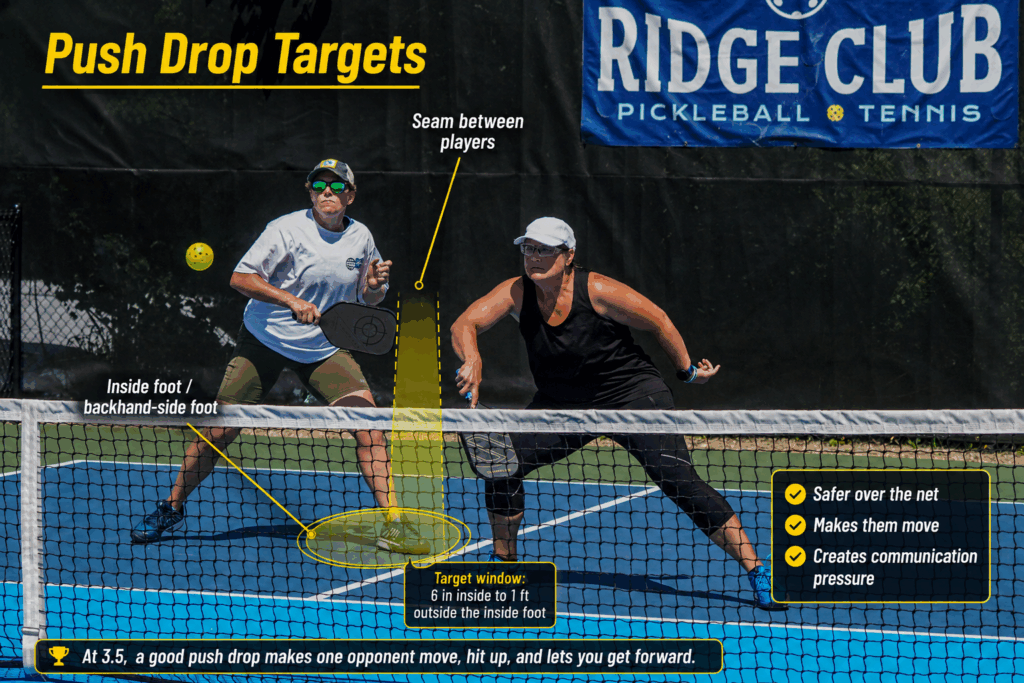
Against a right-handed opponent, that often means dropping toward their backhand-side foot. The goal is not just to land the ball in the kitchen. The goal is to make someone move and hit from a less comfortable position.
A good target window: Six inches inside to one foot outside the inside foot.
That type of drop does three useful things:
- It keeps you over a safer part of the net.
- It makes the opponent step instead of stand still.
- It can create communication pressure between partners.
At the 3.5 level, this is huge. You do not need the perfect highlight drop. You need a drop that makes one opponent move, hit up, and let you get forward.
The Topspin Drop: The Pressure Version
The topspin drop is a different animal.
Instead of simply pushing the ball forward, you are brushing up the back of the ball to create forward rotation. That spin helps the ball arc over the net and then dip down into the kitchen.
That dip is the magic.
A good topspin drop can look like it is clearing the net too high, then suddenly dive toward the opponent’s feet. It can also bounce forward or skid more aggressively, making the opponent’s volley timing less comfortable.
That is why the topspin drop is attractive.
It lets you apply pressure while still hitting a drop.
But there is a tradeoff: it is harder to control. The ball can come off faster, which means you may have less time to move forward. If the timing is wrong, the ball can pop up or sail long. If the brush is too thin, it can dive into the net.
Modern coaching descriptions of topspin drops generally frame them as a more advanced pressure shot because the upward paddle path creates forward spin that helps the ball dip quickly.
When the topspin drop is the right choice
Use the topspin drop when:
✓ you are balanced
✓ the ball is in your wheelhouse
✓ you can contact it out in front
✓ you have time to set your feet
✓ the opponent is pressing forward
✓ you want the ball to dip at their feet
✓ or you want to set your partner up with a more aggressive third or fifth
In plain English: When you are organized and want pressure, topspin drop.
This is not your emergency shot. It is your “I have time and I want to make this uncomfortable” shot.
Topspin Drop Mechanics: Brush, Don’t Blast
The most common rec-player mistake with the topspin drop is trying to hit it too hard. Topspin is not created by swinging wildly. It is created by paddle path and clean contact.
You need enough acceleration to brush the ball, but not so much that the shot turns into a drive.
1. Set your feet first
The topspin drop is much harder when you are reaching, falling back, or late.
Try to get your back foot behind the ball and your contact point out in front. If your feet are messy, choose the push drop instead.
2. Drop the paddle tip below the ball
To create topspin, the paddle has to travel from low to high.
That usually means the paddle tip starts lower than it would on a push drop. Some players think of the paddle starting near the knee or with the paddle tip pointing down toward the court.
3. Brush up the back of the ball
This is the key.
You are not hitting through the ball flat. You are brushing up the back of it so the ball rotates forward.
A simple cue: Lift the shape, brush the ball, finish controlled.
4. Keep the swing smooth
Do not jerk the paddle.
If the swing gets too fast too early, you lose control. If it slows down at contact, the ball dies. You want smooth acceleration through contact.
5. Finish with control
You do not need a giant follow-through over your shoulder. The finish should match the shot: controlled, balanced, and ready for the next ball.
Remember: the goal is not to hit a winner from the baseline. The goal is to make the opponent’s next contact worse.
The Biggest Difference: Time vs. Pressure
This is the cleanest way to understand push drop vs topspin drop.
The push drop usually gives you more time.
The topspin drop gives your opponent less comfort.
That is the tradeoff.
A push drop travels slower, so it can help you move forward and reduce how much transition you have to play.
A topspin drop may dip harder, but it often gets to the opponent sooner. That can be great if you are ready to move, your partner is ready, and the opponent is under pressure. But if you hit it and then get stuck in transition, you may have created your own problem.
So the question isn’t just whether you can make the drop—it’s whether you can make the drop and still handle the next ball.
That is the part many rec players miss.
A topspin drop that lands in the kitchen but leaves you frozen six feet behind the line may not be better than a slower push drop that gets you all the way up.
Push Drop vs. Topspin Drop: Quick Comparison
| Feature | Push Drop | Topspin Drop |
|---|---|---|
| Main purpose | Get forward safely | Apply pressure while dropping |
| Best when | Late, rushed, deep return, off balance | Balanced, set, contact in front |
| Paddle path | Smooth forward push | Low-to-high brush |
| Spin | Minimal or natural light backspin | Forward topspin |
| Ball speed | Slower | Medium / faster |
| Ball behavior | Floats softly and stays controllable | Arcs, dips, and can kick forward |
| Margin for error | Higher | Lower |
| Transition benefit | Gives more time to move in | Pressures opponent but gives less time |
| Common miss | Floating too high | Net, long, or pop-up |
| Best target | Inside foot / middle seam | Feet, body, or kitchen pressure zone |
The Decision Rule: Are You Trying to Get In or Apply Pressure?
This is the simplest on-court decision.
Before you hit the drop, ask:
Am I trying to get in safely, or am I trying to pressure them?
If the answer is get in safely, use the push drop.
If the answer is apply pressure, and you are balanced enough to execute, use the topspin drop.
That one question can clean up a lot of bad third-shot choices.
Use the push drop when the point feels unstable
Deep return.
Wind.
Late footwork.
Awkward bounce.
Partner still back.
Opponent waiting to punish a pop-up.
Push it. Keep it low. Move forward based on the quality of the shot.
Use the topspin drop when you have time
Shorter return.
Ball in front.
Balanced base.
Opponent crowding the kitchen.
You want to dip the ball into their feet.
Your partner is ready to follow the pressure.
Roll it with shape. Brush it. Make them volley up.
The “Felt Good, Go” Rule
One of the most underrated skills after a drop is knowing whether to move.
A lot of rec players hit the drop and automatically rush forward. That can be dangerous. If the drop is too high or too deep, you are running into a counter.
Other players hit a good drop and stay back because they do not trust it. That wastes the whole point of the shot.
Instead, learn to read your own drop immediately off the paddle.
Ask:
Did that feel clean?
Is it staying low?
Is it traveling slowly enough for me to move?
Is the opponent reaching down?
Is my partner moving with me?
If the answer is yes, go.
If the answer is no, stop, split, and prepare to hit another ball.
This is especially important with the push drop. Because it travels slower, you can often gain a lot of court — but only if you learn to trust the good ones.
With topspin drops, be a little more cautious. The ball may get there faster, so you need to move with control and be ready to split before the opponent contacts it.
Where Most Rec Players Go Wrong
Mistake 1: They use topspin when they are late
This is the big one.
Topspin needs time, spacing, and clean contact. If you are rushed, your body will usually compensate with wrist, arm, or panic acceleration.
Better fix: When rushed, simplify. Push drop.
Mistake 2: They push the ball upward instead of forward
A push drop should not be a balloon.
If you are popping it up, you may be opening the paddle too much, standing too tall, or lifting with your wrist instead of pushing through with your shoulder and arm.
Better fix: Get low and push through the ball, not under it.
Mistake 3: They judge drops only by whether they bounce
A drop that gets volleyed is not automatically bad.
If the opponent volleys it from low near their feet, you may have done your job.
Better fix: Judge the opponent’s contact point, not just whether the ball bounced.
Mistake 4: They follow bad drops too far
If your drop floats, do not sprint into danger.
Better fix: Move based on shot quality. Good drop, go. Bad drop, hold and defend.
Mistake 5: They think topspin means power
Topspin drop does not mean “drive softer.”
If you swing through too flat, you lose the dip. If you swing too hard, you lose control.
Better fix: Brush more, blast less.
The Flowchart: Which Drop Should You Hit?
Use this simple decision tree during games.
1. Are you late, stretched, or off balance?
Yes → Push drop.
You need margin and control.
No → Go to the next question.
2. Is the ball in front and comfortable?
No → Push drop.
Do not force topspin from a bad contact point.
Yes → Go to the next question.
3. Is your main goal to get to the kitchen safely?
Yes → Push drop.
Slow tempo gives you more time.
No → Go to the next question.
4. Do you want to pressure the opponent’s feet or jam their volley?
Yes → Topspin drop.
Use shape and dip.
No → Push drop.
Neutralize and move forward.
What About the Slice Drop?
The slice drop deserves a quick mention because some players use it well.
A slice drop has backspin and can stay low or skid. It can also disguise direction and make the ball feel dead when it lands.
But for most rec players, it is harder to control than a push drop and can sit up if the face opens too much. It also requires a different paddle path and contact feel.
So here is the practical advice:
If you already have a reliable slice drop, keep it as a variation.
If you are still trying to build a dependable third shot, master the push drop first.
Then add topspin.
Then experiment with slice.
Do not build your entire transition game around your trickiest drop.
Be a Shot Selector, Not a Shot Repeater
The push drop is your foundation.
It is simple, repeatable, and probably the best option for most rec players when they need to get to the kitchen without taking unnecessary risk.
The topspin drop is your pressure tool.
It is more aggressive, more demanding, and more useful when you are balanced enough to create shape and dip.
If you are late, rushed, or off balance, push.
If you are set, balanced, and want to pressure the feet, topspin.
That is the practical difference.
And once you stop asking, “Which drop is better?” and start asking, “Which drop does this ball call for?” your third shot gets smarter fast.