
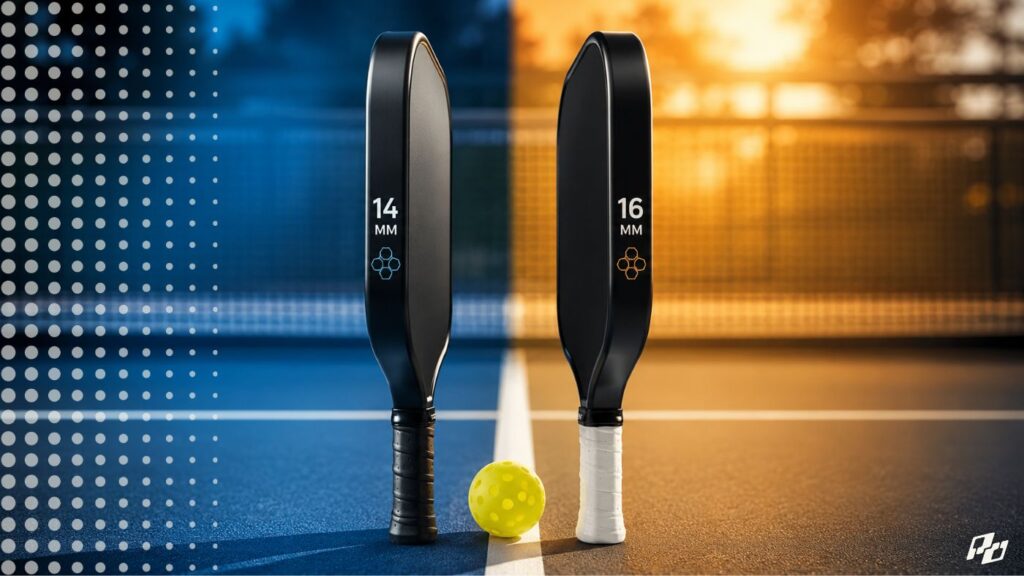
Most paddle guides make thickness sound simple:
14mm = power.
16mm = control.
New to pickleball? Start with our best beginner pickleball paddles, picked with lab data and 3,600 player survey responses.
That used to be a decent shortcut.
Now it can be flat-out misleading.
Modern paddle construction has changed too much. Foam-injected edges, full-foam cores, thermoforming, carbon layups, perimeter weighting, swing weight, twist weight, and new paddle-power testing have all made the old 14mm-vs-16mm advice less reliable.
USA Pickleball’s 2025 equipment standards added Paddle/Ball Coefficient of Restitution testing, known as PBCoR, to measure paddle power and control excessive “trampoline effect,” which shows how seriously paddle rebound has changed in recent designs.
So no, a 14mm paddle is not automatically more powerful.
And no, a 16mm paddle is not automatically softer, slower, or safer.
A modern 16mm foam or thermoformed paddle can hit harder than an older 14mm honeycomb paddle, while still feeling more stable on blocks and resets. Independent paddle-testing sites now track performance categories like power, pop, spin, swing weight, twist weight, balance point, and serve speed, which tells you a lot more than thickness alone.
If you would rather skip the theory, the paddle quiz turns your answers into three lab-scored picks in about 90 seconds.
Instead of choosing by the number on the paddle, start with the way the paddle behaves at contact.
Do you want the ball to jump off the face quickly?
Or do you want it to sit on the paddle a fraction longer so you can shape, reset, and absorb pace?
That is the real 14mm vs. 16mm question.
Ten questions, three paddles matched to how you play, scored on lab data.
First, What Does Paddle Thickness Actually Change?
Paddle thickness is the depth of the paddle’s core. Most modern paddles are around 14mm or 16mm, though you will also see thinner 11–13mm paddles and thicker 18–20mm options.
But thickness does not work by itself. It changes how the paddle behaves at contact:
| Thickness affects… | What you feel on court |
|---|---|
| Dwell time | How long the ball seems to stay on the face |
| Pop | How quickly the ball jumps off the paddle on blocks, counters, and short swings |
| Drive pace | How much speed you can produce when you swing fully |
| Reset ability | How easily the paddle absorbs pace |
| Sweet spot | How forgiving the paddle feels away from center |
| Stability | How much the paddle twists on off-center contact |
| Feedback | Whether the paddle feels crisp, muted, plush, or harsh |
| Hand speed | How quick the paddle feels in fast exchanges |
That is already more useful than “power vs control.”
A 14mm paddle often feels quicker and more immediate. A 16mm paddle often feels more stable and forgiving. But the final feel depends heavily on the paddle’s core type, face material, shape, weight, swing weight, and construction method.
Paddle-testing databases now compare these measured traits directly because thickness alone does not tell the whole story.
The Old Rule: 14mm for Power, 16mm for Control
The old advice came from traditional honeycomb paddles.
With many older polymer honeycomb designs, a thinner core tended to feel more direct and lively. The ball came off faster. The paddle felt crisp. Drives and counters felt easier to generate with a short swing.
A thicker core tended to feel softer. It absorbed more pace, gave players more margin on resets, and felt more forgiving on dinks and blocks.
That is still often true. But it is no longer the whole truth. Because today, thickness is only one part of the paddle’s power system.
A 16mm thermoformed paddle with a hot face and high swing weight can produce more drive pace than a light, soft 14mm paddle. A 14mm paddle with a muted face and low swing weight may feel quick but not especially powerful. A foam-core 16mm paddle may feel plush at the kitchen but still explode on drives.
That is why rec players get confused.
They demo a 16mm paddle expecting control and suddenly the ball is flying. Then they demo a 14mm paddle expecting power and it feels thin, harsh, or unstable.
The label did not lie.
It was just incomplete.
Thickness Changes How the Paddle Feels
The better way to think about thickness is this:
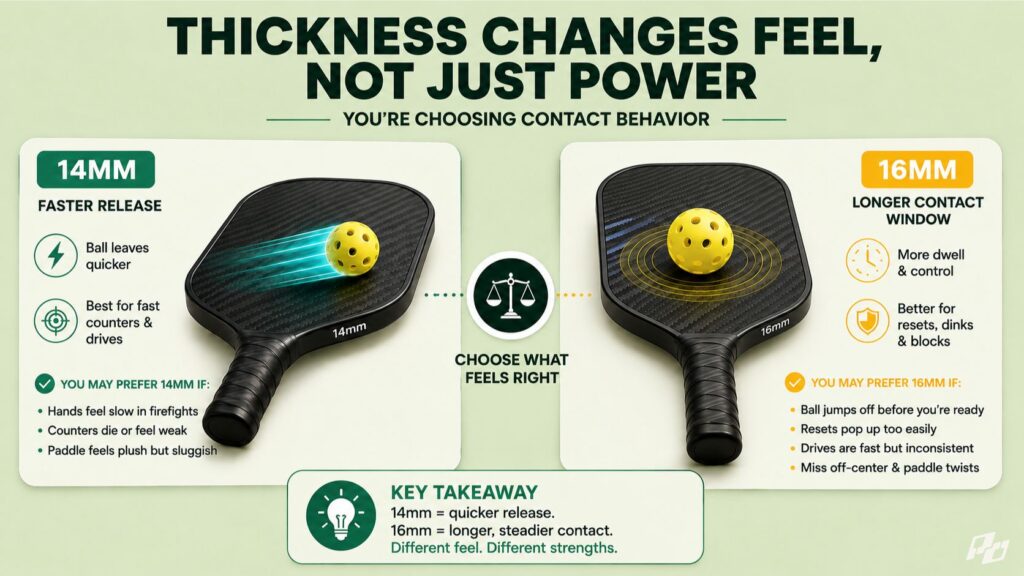
14mm usually gives you a faster release.
16mm usually gives you a longer, steadier contact window.
That difference shows up everywhere.
A 14mm paddle often feels like the ball leaves immediately. That can be great when you like quick counters, fast hand battles, and driving with a compact swing. But that same quick release can make resets, drops, and soft blocks feel jumpier.
A 16mm paddle often gives you a little more time on the face. That can help with resets, dinks, blocks, and off-center contact. But if the paddle has a high swing weight or a plush feel, it may feel slower in hand battles.
Several paddle guides describe thicker cores as increasing dwell time and stability, while thinner cores tend to feel quicker, livelier, and more direct.
Here is the practical version:
| If you feel this… | You may prefer… | Why |
|---|---|---|
| “The ball jumps off before I’m ready” | 16mm | More dwell and pace absorption |
| “My resets pop up too easily” | 16mm | More forgiving on soft-contact shots |
| “My hands feel slow in firefights” | 14mm | Usually quicker through the air |
| “My counters die or feel weak” | 14mm or a hotter 16mm | Faster release or more rebound |
| “My drives are fast but inconsistent” | 16mm | More stability and margin |
| “My paddle feels plush but sluggish” | 14mm or lower swing weight 16mm | Faster hand speed |
| “I miss off-center and the paddle twists” | 16mm or higher twist weight | More stability on mishits |
The important point: you are choosing contact behavior, not just a number.
14mm vs 16mm: What Rec Players Actually Feel
Here is the cleanest on-court comparison.
| Category | 14mm Paddle | 16mm Paddle |
|---|---|---|
| Feel at contact | Crisp, fast, immediate | Softer, steadier, more cushioned |
| Ball release | Quicker off the face | Stays on face a touch longer |
| Drives | Easy pace with shorter swing | Often heavier when swing weight/build supports it |
| Counters | Fast and punchy | Stable, but may feel slower depending on weight |
| Blocks | Can pop up if hands are firm | Easier to absorb pace |
| Resets | Requires softer hands | More forgiving under pressure |
| Dinks | More feedback, less cushion | More margin and control |
| Sweet spot | Usually smaller | Usually larger |
| Stability | Can twist more on mishits | Usually more stable |
| Hand speed | Usually faster | Depends on swing weight |
| Best for | Quick attackers, drivers, hand-speed players | Resetters, blockers, all-court players, players wanting forgiveness |
That table is useful, but there is one major warning:
A 16mm paddle with high swing weight can hit harder than a 14mm paddle with low swing weight.
Swing weight is how heavy the paddle feels when you swing it. Twist weight is how stable it is on off-center hits. Paddle-testing sites now measure these because they often explain performance better than static weight or thickness alone.
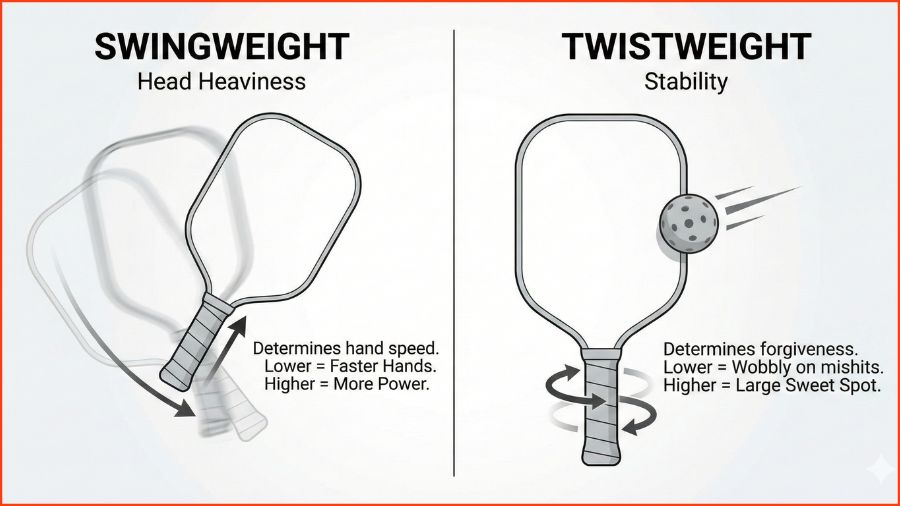
So when a player says, “This 16mm paddle has more power than my 14mm,” they may be right.
The 16mm paddle may simply have more mass behind the ball, a more powerful face, better energy return, or a more stable construction.
The Foam-Core Twist: Why the Old Advice Got Flipped
This is where modern paddle tech gets interesting.
Traditional paddles usually used a polymer honeycomb core. Many newer “Gen 4” or foam-core paddles use foam in different ways: around the perimeter, throughout the core, or combined with other structures. The term Gen 4 is not a single official standard, but it is commonly used by reviewers to describe newer foam-core or foam-enhanced paddle designs.
Foam-core paddles can offer a different mix of feel, power, durability, and stability compared with traditional honeycomb builds — but the important caveat is that not all foam paddles play the same.
Foam changes the feel because it can add bulk elasticity, stability, and rebound in ways that do not follow the old 14mm/16mm script.
That is why a 16mm foam paddle can sometimes feel like this:
Soft enough to reset.
Stable enough to block.
Big enough in the sweet spot to forgive mishits.
Powerful enough to outdrive a thinner honeycomb paddle.
That is the part many paddle guides do not explain clearly. The power is not coming only from thickness. It is coming from the whole build.
✅ Core material
✅ Face layup
✅ Thermoforming
✅ Foam placement
✅ Paddle shape
✅ Swing weight
✅ Balance point
✅ Face stiffness
✅ Energy return
That is why the phrase “14mm equals power” is now too simple.
A better modern comparison looks like this:
| Paddle Type | What It Often Feels Like |
|---|---|
| 14mm traditional honeycomb | Crisp, quick, direct, sometimes less forgiving |
| 16mm traditional honeycomb | Softer, more stable, more controlled |
| 14mm thermoformed/hot-face paddle | Fast, poppy, aggressive, sometimes jumpy |
| 16mm thermoformed/hot-face paddle | Stable but still powerful; can feel heavy or explosive |
| 16mm foam-core paddle | Plush/stable with surprising power depending on build |
| 14mm foam-core paddle | Fast and lively, but not always more powerful than 16mm foam |
The takeaway is simple: Thickness tells you the paddle’s contact style. Construction tells you how powerful that contact becomes.`
The Hidden Difference: Dwell Time vs Pop
This is the part rec players need to understand. People often use “power” as one giant word, but paddles create different kinds of power.
There is pop.
And there is drive power.
They are not the same.
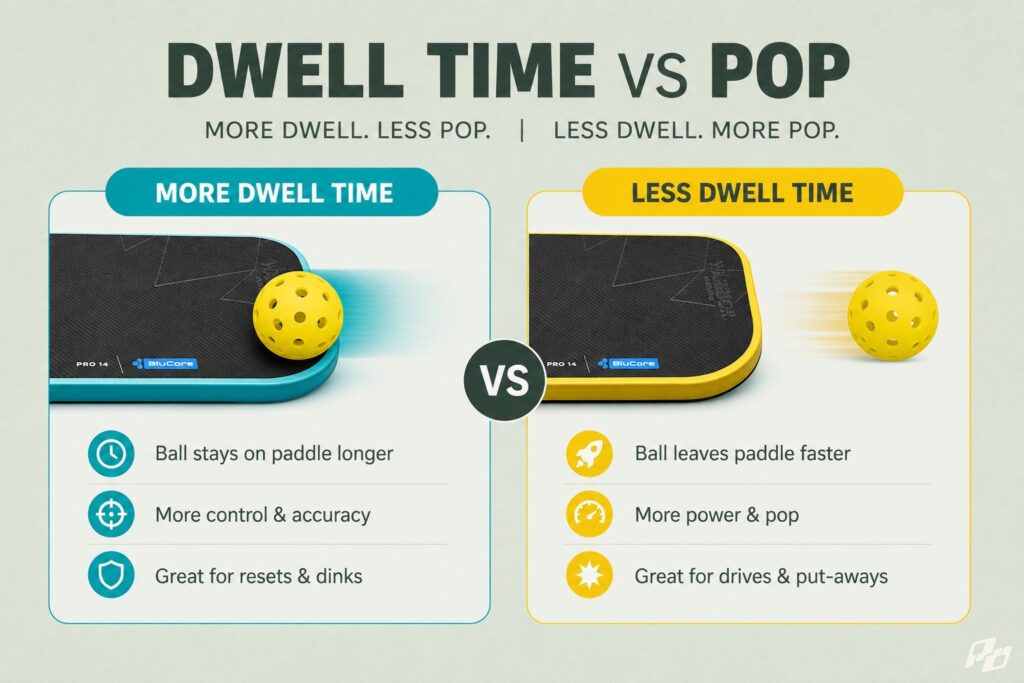
Pop is how quickly the ball jumps off the paddle on short swings: blocks, counters, speedups, punch volleys, hand battles.
Drive power is what happens when you take a fuller swing: serves, returns, drives, passing shots, speedups from deeper in the court.
A 14mm paddle may have more pop because the ball releases quickly.
A 16mm paddle may have more drive power if it has more mass, higher swing weight, a hotter face, or a foam/thermoformed build that returns more energy.
That is why two players can argue about the same paddle and both be right.
One says, “The 14mm has more power.”
They may mean it feels faster on counters.
The other says, “The 16mm hits harder.”
They may mean it produces heavier drives from full swings.
Use this table:
| Term | What It Means | Where You Feel It |
|---|---|---|
| Pop | Quick rebound on short contact | Counters, blocks, speedups, punch volleys |
| Drive power | Ball speed from a fuller swing | Serves, returns, baseline drives |
| Dwell time | Ball stays on face slightly longer | Resets, dinks, drops, roll volleys |
| Plow through | Paddle mass carries through the ball | Drives, counters, returns |
| Stability | Paddle resists twisting | Blocks, mishits, fast exchanges |
Ourreview of the CRBN1 TruFoam Genesis is a good reminder that thickness alone does not explain paddle performance. Even at 14mm, the paddle tested as powerful, stable, and consistent, with strong exit velocity and good twist-weight stability.
In other words, modern core construction can make a thinner paddle feel more solid and controlled than players might expect.
14mm vs 16mm for the Shots You Actually Hit
Thickness matters most when you connect it to real shots, not spec-sheet labels.
| Shot | 14mm Usually Feels Like | 16mm Usually Feels Like | Quick Test |
|---|---|---|---|
| Drives | Quicker release, crisp feedback, easy pace with a compact swing. | More stable and heavier when the paddle has enough swing weight. | Hit 10 drives at 80% effort. Pick the paddle that gives you the most deep, dipping balls — not the single hardest one. |
| Resets | Can work, but tense hands may make the ball jump. | Usually easier to absorb pace and drop the ball short. | Stand midcourt while someone attacks at your feet. Which paddle helps you reset without babying the ball? |
| Dinks | Sharper feedback and quicker response. | More margin, steadier contact, and better forgiveness off-center. | Dink crosscourt for five minutes. Notice which paddle stays predictable on slight mishits. |
| Counters and hands battles | Fast, punchy, and addictive when you’re on time. | More stable, but may feel slower if swing weight is high. | Trade controlled speedups. Judge the third and fourth counter, not just the first one. |
| Drops and roll volleys | More direct feel, but less cushion if your touch is tight. | More dwell, which can make shape and arc easier to feel. | Hit drops and roll volleys. Which paddle lets you create shape without launching the ball? |
The goal is not to find the paddle that wins one shot in a demo. It is to find the one that makes your repeatable shots better under real pressure.
The Better Buying Framework: Choose by Miss Pattern
Instead of asking whether you are a “power player” or “control player,” look at your actual misses.
Your misses are more honest than your self-image.
| Your Common Miss | What It Suggests | Paddle Direction |
|---|---|---|
| Resets pop up | Paddle may be too jumpy or hands too firm | Try 16mm, softer face, lower pop |
| Drives land long | Too much pop or launch | Try 16mm with control face, or lower power build |
| Drives lack depth | Need more plow/power | Try higher swing weight, hotter face, or powerful 16mm |
| Counters feel late | Paddle may be too sluggish | Try 14mm or lower swing weight |
| Blocks twist on mishits | Need more stability | Try 16mm or higher twist weight |
| Dinks feel dead | Paddle may be too muted | Try 14mm or livelier face |
| Hand battles sail | Too much pop | Try 16mm or softer build |
| Arm feels beat up | Harsh feel or too much vibration | Try thicker core, softer build, better balance |
This is why the framework is more useful than choosing by skill level.
Two players can both be 3.5, but need completely different paddles:
One wins with resets, blocks, and soft control.
The other wins with drives, counters, and pace.
Same rating. Different paddle needs.
The same is true at 4.0. A fast-hands kitchen player may want a different 16mm paddle than someone who drives heavy from the baseline.
So don’t ask, “What paddle should a 3.5 use?”
Ask: “What shots do I rely on most — and what misses am I trying to fix?”
Your shot profile, not your rating, should guide the choice.
The “Feel” Differences Nobody Explains Properly
Here is how to translate paddle language into actual court feel.
“Crisp”
The ball comes off quickly. You feel impact clearly. This can help with counters and quick exchanges, but it may punish tense hands.
Usually more common in thinner or stiffer builds.
“Plush”
The ball feels like it sinks into the face a little. This can help resets and dinks, but some players feel disconnected from the ball.
Often more common in thicker, softer, or foam-enhanced builds.
“Muted”
The paddle absorbs impact and feels quiet. This can be comfortable but may make touch feel less precise for players who rely on strong feedback.
“Poppy”
The ball jumps off on short swings. Great for counters. Risky for soft game if you grip too tightly.
“Heavy”
The ball feels like it carries through opponents. This often comes from swing weight, mass, and construction, not just thickness.
“Stable”
Off-center contact still goes where you expect. This matters more than many rec players realize because most rec players do not hit the exact sweet spot every time.
This is why you should not buy based only on “power” or “control.” Those words hide the actual feel.
14mm vs 16mm: Best Fit by Playing Style
| Your Game Looks Like This | Better Starting Point | Why |
|---|---|---|
| You counter aggressively and like fast hands | 14mm | Faster release and quicker feel |
| You reset often and play lots of transition balls | 16mm | Better pace absorption |
| You drive a lot but need more margin | 16mm power build | Stability plus drive pace |
| You dink and hand-battle at the kitchen | Depends on hand speed | 14mm for quickness, 16mm for stability |
| You play singles often | 14mm or powerful 16mm | Need pace and depth |
| You play mostly doubles | 16mm or balanced 14mm | Resets and blocks matter more |
| You have arm discomfort | 16mm softer build | Usually more dampened feel |
| You like very direct feedback | 14mm | Crisp contact |
| You mishit often under pressure | 16mm | Larger sweet spot and twist resistance |
Again, this is a starting point.
A modern 16mm foam paddle may satisfy a power player. A well-designed 14mm raw carbon paddle may still give enough control for a reset-heavy player.
But this table gets you closer than the old cliché.
A Simple Demo Test Before You Buy
Do not demo a paddle by hitting three drives and saying, “This feels powerful.” That is how players buy paddles that feel amazing for five minutes and annoying after two weeks.
Use a test sequence.
Test 1: Baseline Drives
⮕ Hit 10 forehand drives and 10 backhand drives at 80% effort.
You are looking for repeatable depth and shape, not the hardest single ball.
Test 2: Transition Resets
⮕ Stand midcourt while a partner attacks at your feet.
Which paddle lets you absorb pace without popping up?
Test 3: Kitchen Counters
⮕ Trade speedups and counters.
Which paddle lets you react, block, counter, and reload without feeling late?
Test 4: Dinks Under Tension
⮕ Dink crosscourt while intentionally keeping the grip relaxed.
Which paddle gives you the best blend of feel and forgiveness?
Test 5: Off-Center Hits
⮕ Do not try to hit the sweet spot every time.
Real pickleball includes mishits. See which paddle still behaves when contact is slightly high, low, or toward the edge.
Then ask yourself one question: Which paddle helps my worst shots the most without taking away my best shots?
That is usually the right paddle.
The Honest Verdict
Choose 14mm if you want the paddle to feel quick, crisp, and direct.
It usually makes the most sense if you like fast hands, quick counters, compact drives, and clear feedback off the face. It can be great for players who already trust their touch and do not need the paddle to absorb a lot of pace for them.
But be honest: if your resets float, your blocks sail, or your mishits twist the paddle, 14mm may make those problems louder.
⮕ 14mm rewards clean contact. It does not always forgive tense hands.
Choose 16mm if you want more stability, forgiveness, and control under pressure.
It often fits players who reset a lot, play mostly doubles, want a bigger sweet spot, or need more help absorbing pace on blocks, dinks, and transition balls.
But do not assume 16mm means weak. Modern foam-enhanced and thermoformed 16mm paddles can still bring plenty of power, depending on the face, build, and swing weight.
The tradeoff is hand speed. Some 16mm paddles feel slower in fast exchanges, especially if they are head-heavy.
⮕ 16mm gives you more margin. Just make sure it does not make your hands late.