The six-foot rope is a great beginner rule, but advanced doubles players know when to let it stretch. Move with your partner without copying every step, protect the opponent’s highest-percentage shot, and stay close enough to the middle to pressure the next ball instead of guarding out-of-bounds space.
If you’ve ever taken a pickleball lesson, you’ve probably heard this advice:
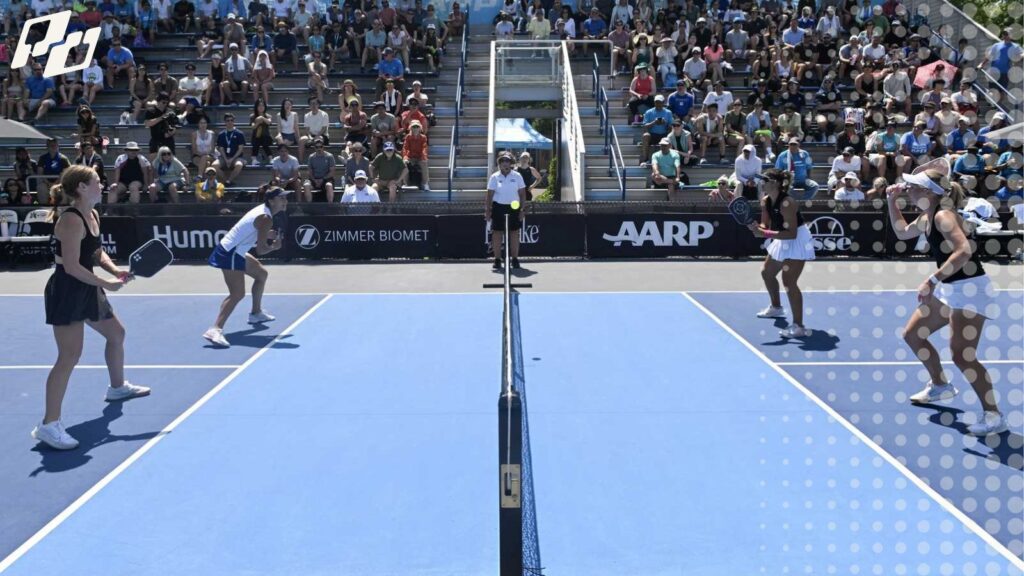
Imagine there’s a six-foot rope connecting you and your partner. When one player moves sideways, the other moves with them.
It’s one of the most useful beginner doubles concepts in pickleball. The imaginary rope keeps partners connected, closes dangerous gaps, and prevents two players from defending the court like separate singles competitors.
But popular pickleball coach Dayne Gingrich recently made an important clarification: the rope should not remain pulled tight through every kitchen exchange.
We agree.
The mistake isn’t moving with your partner. The mistake is copying their movement so literally that you slide toward the sideline, protect balls that would already land out, and remove yourself as a threat in the middle.
The six-foot rope is a teaching tool—not a fixed measurement.
At higher levels, partners stay connected by protecting the opponent’s most realistic shots, not by maintaining exactly the same distance throughout every rally.
Why the Six-Foot Rope Works
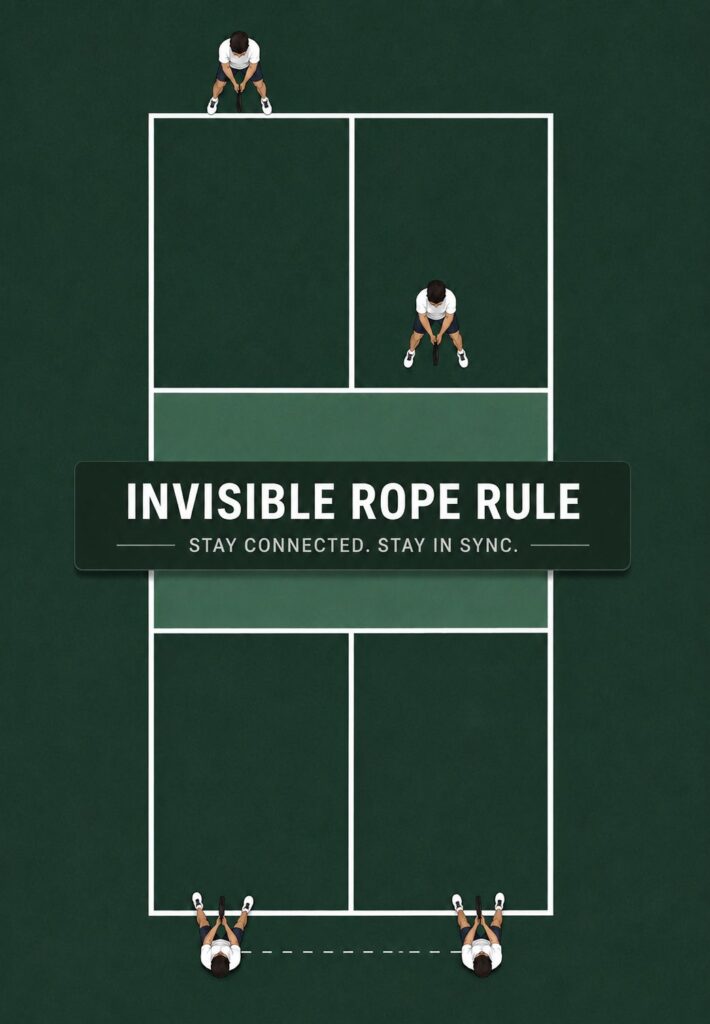
The rope concept solves a common recreational doubles problem: partners drifting too far apart.
When one player follows a wide ball and the other stays planted, a large seam opens between them. The opponents can attack that gap, create confusion over ownership, or repeatedly force one player to cover too much court.
The rope teaches both players to respond when the ball moves:
- Ball goes left, the team shifts left.
- Ball goes right, the team shifts right.
- One player gets pulled wide, the partner helps close the middle.
That foundation is correct. The problem begins when players assume both partners must move the same distance.
They don’t.
The Rope Should Stretch and Contract
Imagine your partner is on the left side and sends a sharp crosscourt dink. The opponent is pulled wide near the sideline.
Your partner naturally follows the ball and protects the immediate crosscourt exchange. You should also move—but probably not as far.
If you slide several feet toward your right sideline simply to preserve a perfect six-foot gap, you may end up guarding an extreme down-the-line shot that has very little court available. Much of the area beyond you is already out of bounds.
At the same time, you have moved away from the middle, reduced your ability to poach, and made the safest part of the court easier for your opponents to access.
The better movement is asymmetric:
The player closest to the ball moves more. The partner away from the ball moves less.
Think of the rope stretching slightly rather than staying rigid.
Stop Protecting Out-of-Bounds Space
This is the central idea behind Gingrich’s advice. You do not need to cover every possible ball.
From a severe crosscourt position, an opponent may technically be able to hit down the line past you. But the farther outside that target sits, the smaller their available court becomes.
If you move all the way over to remove that tiny lane, you may be sacrificing the middle to protect a low-percentage shot.
A smarter defender concedes part of the extreme sideline while protecting the more likely ball just inside it.
That doesn’t mean leaving the line completely open. It means understanding where the playable line ends and where out-of-bounds space begins.
A useful question is:
Am I protecting the court—or am I protecting the fence?
If your position primarily guards a ball that would land outside the sideline, you have shifted too far.
If you’d rather watch than read, the short Instagram video below features pickleball coach Dayne Gingrich explaining this concept. He shows why blindly moving side to side with your partner can actually hurt your doubles positioning—and what you should do instead.
Your Middle Presence Is an Offensive Weapon
Staying closer to the middle is not only about defense. It makes you a threat.
When the opponent across from your partner sees you near the seam, they know that a loose middle dink may be intercepted. That can influence their shot selection before they even make contact.
They may:
- aim wider and accept more risk
- avoid a comfortable middle target
- rush a crosscourt redirect
- contact the ball later
- choose a softer, more predictable dink
You can pressure an opponent without touching the ball.
This is why the partner away from the action should not disappear toward the sideline. That player often has the best opportunity to attack a weak reply into the middle.
Think “Tilt,” Not “Slide”
A better image than the six-foot rope is a defensive unit that tilts toward the ball. When the ball moves wide:
- the ball-side player protects the sharp angle and the line directly ahead;
- the off-ball partner shades toward the rally;
- the off-ball partner remains close enough to threaten the middle;
- both players stay balanced before the opponent contacts the ball.
The team still moves together, but it does not move symmetrically.
Simple cue
Ball-side player moves more. Middle player moves less.
This keeps the team connected without pulling both players unnecessarily toward one sideline.
Let the Opponent’s Contact Point Decide
Your final position should not be determined only by where your partner hit the ball. Watch how the opponent receives it.
| What you see | What it means | How the off-ball partner should position |
|---|---|---|
| Opponent is stretched wide | They have fewer controlled options and a smaller down-the-line window. | Stay more central, protect the middle, and look for a softer or defensive reply. |
| Opponent is balanced | They can comfortably redirect the ball to multiple targets. | Shade toward the line, but don’t abandon the middle. Cover the most likely line ball, not the extreme sideline. |
| Opponent contacts above net height | They can attack, speed up, or redirect aggressively. | Shift into a more defensive ready position, lower your stance, and close the seam with your partner. |
| Opponent contacts below net height | They’re hitting up on the ball, limiting their offensive options. | Stay assertive near the middle and be ready to poach or attack a weaker reply. |
1. When the opponent is stretched wide
A player reaching outside the sideline has fewer controlled options. Their down-the-line target is smaller, and producing a sharp redirect may require excellent balance and paddle control.
This is often the moment for the off-ball partner to stay more central.
Expect a softer crosscourt reply, a ball through the middle, or a defensive dink that your team may be able to attack.
2. When the opponent is balanced
A balanced opponent contacting the ball comfortably in front has more choices.
Shade enough to respect the line, but avoid abandoning the middle. Your job is to cover the highest-percentage line ball—not every inch near the sideline.
3. When the opponent contacts high
A high contact point changes the situation.
The opponent may be able to speed up, roll the ball, or redirect aggressively. Your priorities should shift from poaching to defending.
Lower your base, bring the paddle in front, and close the most dangerous seam with your partner.
4. When the opponent contacts below the net
A player hitting upward has fewer offensive options.
That allows the off-ball partner to remain more assertive near the middle and look for a floating reply.
The opponent’s contact height and balance tell you how aggressively you can position.
How Far Should You Move?
There is no universal number. Court position depends on:
- how far your partner was pulled
- whether the opponent is balanced
- the height of the opponent’s contact
- your reach and mobility
- your partner’s recovery speed
- whether your team has one or two forehands in the middle
For most intermediate players, the correct movement is smaller than expected. Try this sequence:
- Take one short adjustment step toward the ball.
- Watch the opponent’s approach and paddle height.
- Stop before you lose access to the middle.
- Split-step as the opponent begins the forward swing.
- React from balance instead of continuing to drift.
The objective is not to reach a predetermined spot. It is to arrive at a useful position before contact.
Cue
Shade, stop, read.
When You Should Shift Farther
Gingrich’s advice should not become another absolute rule. Sometimes a larger shift is necessary.
Move farther toward your partner when:
- your partner is pulled well outside the sideline
- your partner is still recovering after contact
- the opponent has a high, comfortable ball
- a sharp angle has genuinely opened
- the middle gap between you has become attackable
- your team’s agreed system requires you to cover more of the seam
If your partner is in trouble, you must help compress the available court. But even then, avoid blindly matching their movement. Protect the dangerous space first.
Paddle Position Matters Too
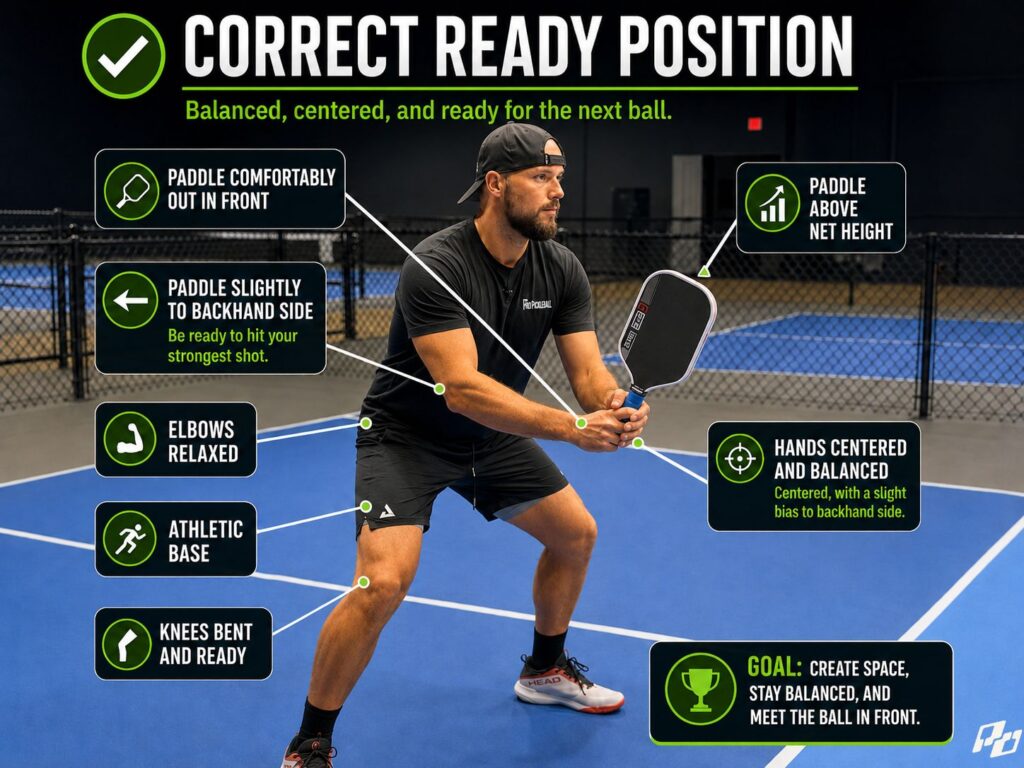
Good positioning is not just about the feet.
A player can stand in the correct place and still be ineffective if the paddle hangs low or points away from the likely reply.
When you are the partner away from the ball:
- keep the paddle in front of your torso
- shade it slightly toward the middle
- leave room to defend either side
- avoid turning your shoulders completely toward the sideline
- stay prepared for a body speed-up
Your paddle should communicate that the middle is occupied. A player standing centrally with a passive paddle does not create the same pressure as one who looks ready to intercept.
Handedness Changes the Movement
The six-foot rope becomes even less useful as a fixed rule when partners have different dominant hands.
A right-handed and left-handed team may have both forehands in the middle. That can justify keeping one or both players more central because the seam becomes an attacking strength.
Two right-handed players typically have a forehand in the middle from the left-side player and a backhand from the right-side player. That may influence which partner shades farther and who takes central balls.
Before playing, agree on:
✔️ Who owns neutral middle dinks
✔️ Who attacks floating middle balls
✔️ Which player covers a lob over the center
✔️ Whether the forehand always takes priority
✔️ How much the less-mobile player needs their partner to help
Connection should reflect the team you actually have—not an idealized six-foot measurement.
Don’t Confuse Staying Central With Ball-Watching
There is a danger on the other side of this advice.
Some players hear “don’t shift too far” and stop moving altogether. That is not the point.
You still need to move with the rally. You simply need to stop before the movement takes you away from higher-value court coverage.
The off-ball partner must remain active:
- make small adjustment steps
- track the opponent’s paddle
- update the ready position
- protect the middle
- prepare for the next ball
Staying central does not mean standing still. It means staying relevant.
A Practical Drill for Finding the Right Distance
Place two players at the kitchen line and one feeder across the net. The feeder alternates among:
- a wide crosscourt dink
- a middle dink
- a down-the-line dink
- a speed-up through the seam
After each feed, freeze the rally. The off-ball partner should ask:
- Can I reach a realistic line ball?
- Can I still influence the middle?
- Am I balanced?
- Is my paddle ready?
- Am I covering playable court or out-of-bounds space?
Then reset and repeat.
Once the players understand the spacing, play the rally live. The feeder should occasionally attack the areas the team appears to be leaving open.
The objective is not to prevent every successful shot. It is to determine whether the opponents are being forced toward lower-percentage targets.
Think Connection, Not Symmetry
The six-foot rope is still one of the best ways to teach doubles positioning. Just don’t mistake it for a rule that says both partners should always move the same distance.
As you improve, stop asking, “Am I staying six feet from my partner?” Start asking, “What shot am I actually protecting?”
Sometimes the answer means moving three feet with your partner.
Sometimes it means moving just one.
What matters isn’t that your positioning looks perfectly symmetrical. What matters is that your team stays connected, the middle remains protected, and you’re still in position to influence the next ball.
The best doubles teams don’t try to cover every inch of the court.
They identify the opponent’s highest-percentage shot, protect that first, and accept that some low-percentage targets simply aren’t worth chasing. That’s the real evolution from beginner to advanced doubles.
Stay connected—but don’t become mechanically tethered.