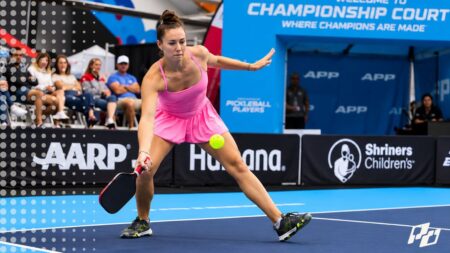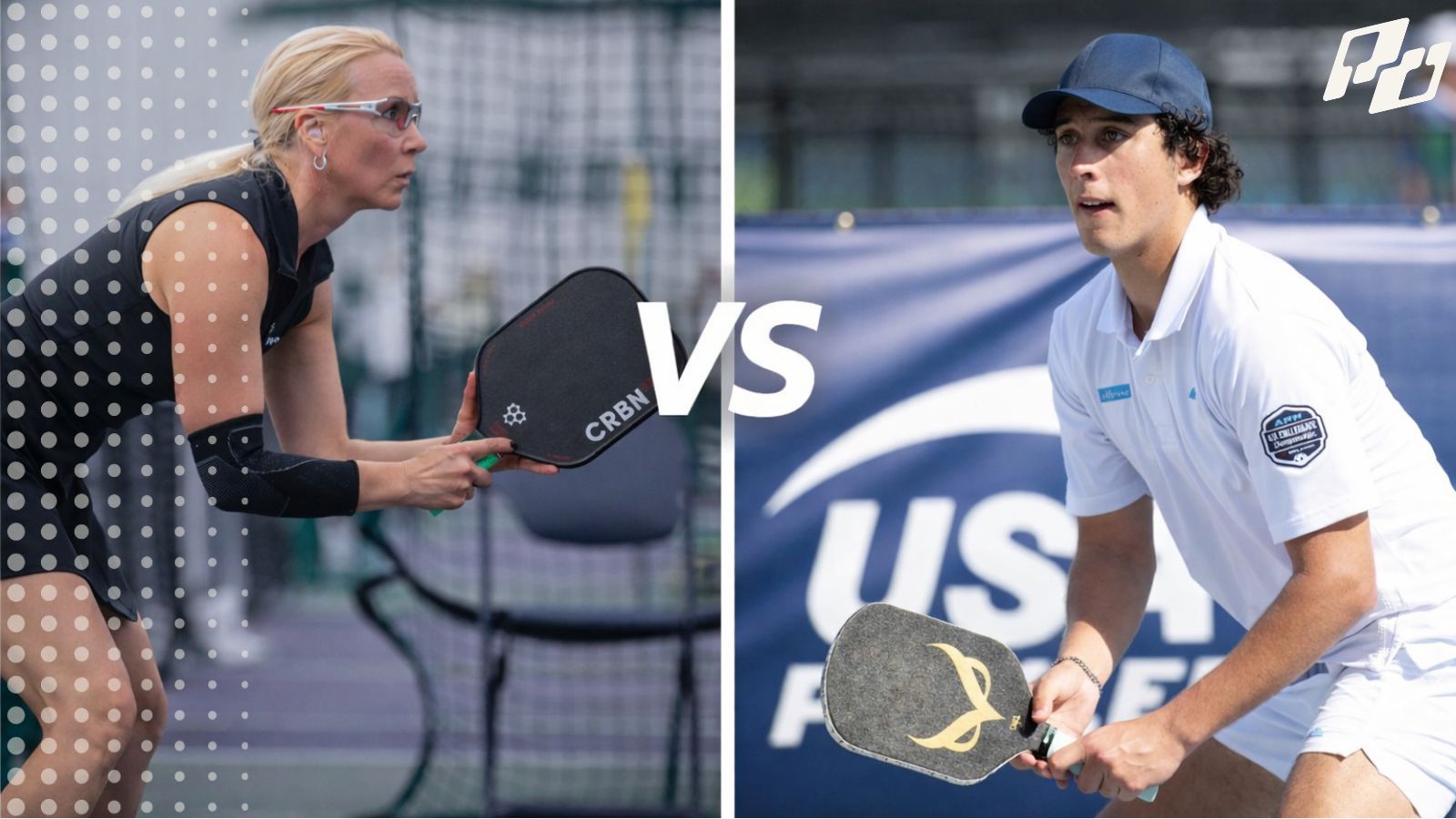
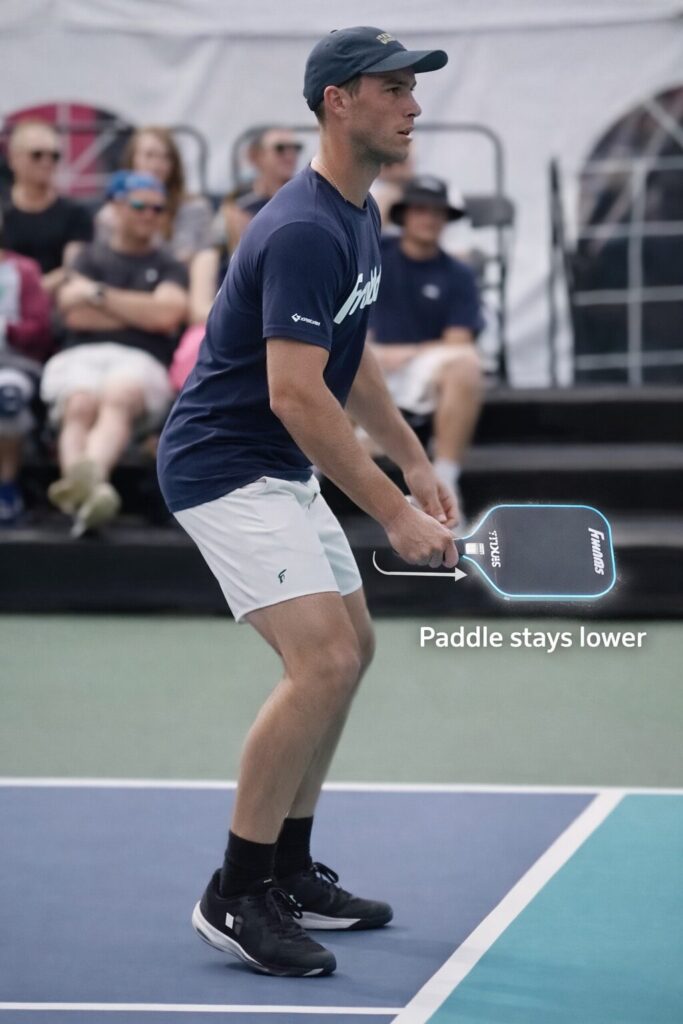
If you watch enough pro pickleball, you start noticing something that feels a little strange at first: a lot of top players keep their paddle surprisingly low at the kitchen line.
Not dangling by their knees, of course — but lower than most recreational players have been taught. Sometimes it sits around waist height. Sometimes it favors the backhand side. And if you are watching someone like J.W. Johnson, whose hands are among the fastest in the sport, it is easy to assume: that must be the ideal ready position.
So naturally, a lot of rec players try to copy it. And that is where the problem starts.
Because the question is not, “What do the pros do?”
The better question is, “Why do they do it, and does that reason apply to my game?”
For most 3.0 to 4.0 players, the answer is no — at least not in the same way.
A lower ready position can make sense in the pro game because pros are dealing with a completely different speed-up environment: harder balls, lower contact points, tighter trajectories, and much better disguise. But at the rec level, the threats are different. Balls are often higher, more attackable, less precise, and more chaotic. That changes what your ready position needs to protect.
So yes, many pros keep the paddle lower at the kitchen line. But that does not automatically mean you should.
In fact, for most intermediate rec players, a slightly higher ready position is one of the easiest ways to improve hand speed, reduce pop-ups, and win more kitchen exchanges.
Let’s break down why.
The Real Purpose of Ready Position
A lot of players think of ready position as just a “starting stance.” But it is more than that.
Your ready position is your first layer of defense. It is the place your paddle starts from before you react. And because pickleball hand battles happen so fast, that starting point matters a lot.
At the kitchen, you usually do not have time for a big correction. You are not taking a full swing. You are making a short reaction movement, often in a fraction of a second. So the best ready position is the one that lets you cover the most likely attack with the least amount of extra motion.
That is the key idea: a good ready position is not about style. It is about efficiency.
- If your paddle starts too low, you have to lift it before you can block, counter, or reset a fast ball.
- If it starts too high, you may feel cramped or less prepared for lower contacts.
- If it starts too far forehand or too far backhand, you may leave one side exposed.
So the right ready position depends on what kind of speed-ups you are most likely to face. And that is exactly why pros and rec players should not always use the same one.
Why Pros Can Hold the Paddle Lower
This is the part many rec players miss.
When you watch a pro like J.W. Johnson hold his paddle lower, that position is not random. It is a response to the kind of attacks he sees every day.
In pro pickleball, opponents can:
- speed up off balls that barely clear the net
- hit with much more pace
- attack with far better disguise
- target smaller windows
- keep the ball lower through contact
- counter with elite precision
That means pro players are often preparing for a very specific kind of firefight: fast, compact, low-line exchanges where the ball is not floating up into easy chest-height counters very often.
A lower paddle position can help in that environment because:
✔ it supports backhand counters from compact, low contact points
✔ it keeps the paddle in line with lower attack trajectories
✔ it can help players stay loose and compact rather than over-lifting the hands
✔ it reflects the fact that pro speed-ups often come from lower, more dangerous positions
In other words, the lower ready position is not “better” in the abstract. It is better for that environment.
And that is a huge distinction.
Too many rec players copy the visible shape without understanding the problem that shape is solving.
Why Rec Players Usually Need a Higher Ready Position

Now let’s compare that to the average 3.0 to 4.0 rec game. At your level, a lot of speed-ups are:
- hit from slightly higher contact points
- less disguised
- less precise
- more pop-up dependent
- more likely to come shoulder-high or chest-high than one inch over the net
- more likely to be mishit, floated, or redirected awkwardly
That changes everything.
If your opponents are not consistently ripping low, perfectly placed counters at pro speed, then your ready position should not be optimized for that world. It should be optimized for your world.
And in the rec game, a slightly higher ready position works better for several important reasons.
1. It protects the most common attack zone
Most rec speed-ups are not laser beams at the shoelaces.
They are more likely to arrive somewhere between upper waist and chest height. Sometimes even higher. Many come off popped-up dinks, rushed speed-ups, or balls struck from unstable positions. Those attacks are still dangerous — but they usually do not stay as low as pro speed-ups.
So if your paddle starts too low, you are forced to lift into the contact point.
That extra upward movement costs time. And in hand battles, even a small amount of extra paddle travel matters.
A higher ready position helps you start closer to where the ball is actually going.
2. It is easier to drop the paddle than raise it
This is one of the simplest and most useful truths in kitchen play.
If the ball comes lower than expected, you can usually drop the paddle down quickly and still stay structurally sound.
But if the ball comes faster and higher than expected, and your paddle starts too low, you have to raise the paddle while reacting. That usually creates one of three problems:
- you are late
- your contact is unstable
- your counter pops up
That is why so many intermediate players feel like they “have slow hands,” when in reality their hands are not always the main problem. Their starting position is.
They are giving themselves too much distance to travel before contact.
3. A lower start often creates weaker counters
When players lift the paddle up at the last second, they often do not counter cleanly.
Instead, they:
- flick upward
- open the paddle face too much
- get jammed near the body
- block late and high
- send the ball popping up instead of driving it back
This is a big deal.
A lot of pop-ups in kitchen hand battles do not happen because players swung too hard. They happen because the paddle was late getting to the contact point, so the player had to improvise upward.
That upward rescue motion is one of the main causes of weak counters. A slightly higher ready position reduces the need for that rescue.
4. It helps intermediate players stay organized
At the rec level, hand battles are often less about elite reaction time and more about organization.
Who was ready?
Who stayed balanced?
Who had the paddle set?
Who stayed compact?
Who panicked less?
That is why a higher ready position is so helpful. It helps you look and feel more prepared, which makes your reactions more compact and repeatable.
You do not need to be lightning fast if your paddle is already in a smart place.
The Biggest Mistake: Copying the Shape Instead of the Principle
This is really the heart of the whole topic.
Rec players often see a pro do something and think, “That must be the technique.” But what they should be asking is, “What game condition is that technique responding to?”
That is the difference between copying a pro and learning from a pro.
The principle behind ready position is not: “Hold the paddle low because J.W. does.”
The principle is: “Place your paddle where it best protects the attacks you are most likely to face.”
That is a much smarter framework. Because it adapts. And for most 3.0 to 4.0 rec players, that means the paddle should usually start a little higher than where many pros keep it.
What “Higher” Actually Means
This is important, because “higher” does not mean glued to your chin.
A lot of players hear “higher ready position” and immediately picture an awkward, tense stance with the paddle way up in front of the face.
That is not the goal. A good rec-level ready position is usually:
- out in front
- slightly favoring the backhand side
- around upper waist to mid-chest height
- with the elbows comfortably away from the body
- with the hands relaxed, not rigid
Think of it as high enough to protect the most common speed-up, but not so high that you become stiff or overcommitted.
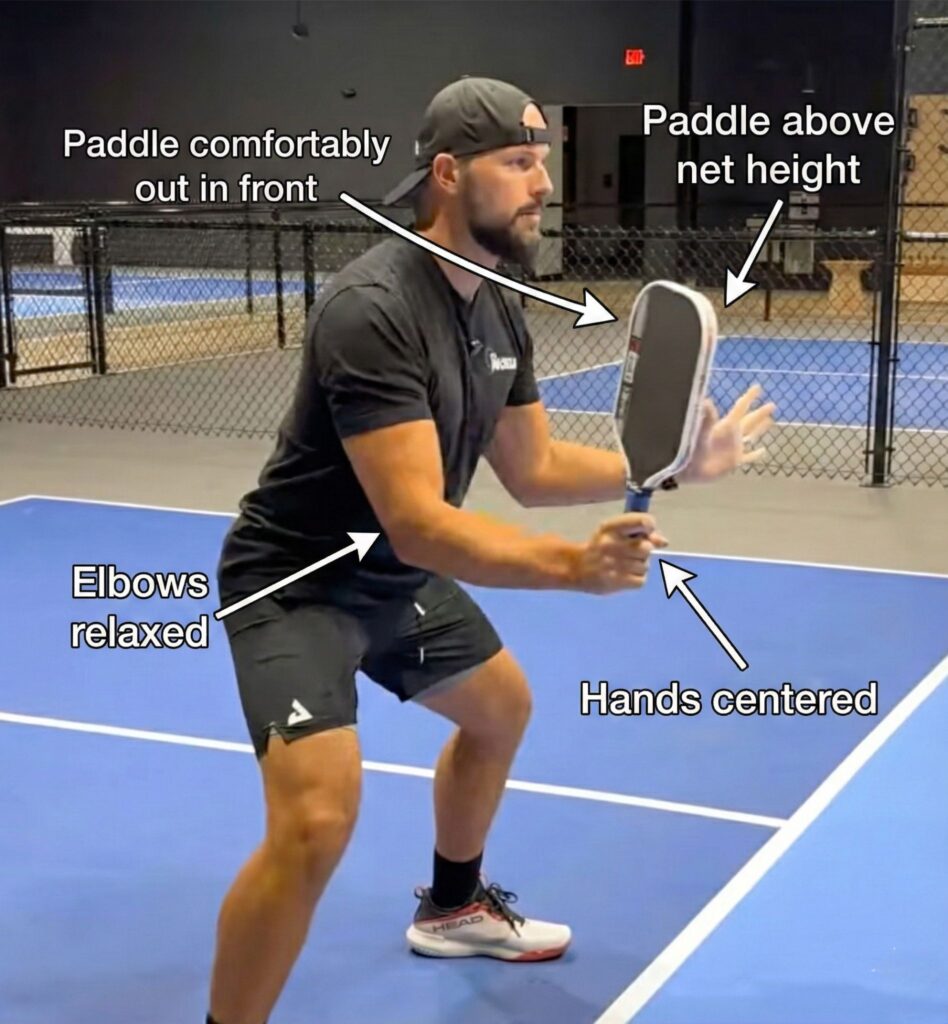
The paddle should feel available, not forced.
When Rec Players Shouldn’t Keep the Paddle Higher
Now let’s be fair. This does not mean your paddle should always stay higher no matter what. There are situations where a lower ready position can make sense, even for rec players. For example:
On lower, dead dinks
If you are expecting a soft, low contact and your opponent is not in an attackable position, your paddle may naturally settle a bit lower because the next likely ball is also low.
When you are specifically protecting a low backhand counter
Some players feel very strong taking compact backhand counters from a slightly lower, backhand-biased setup. That can work, especially if they are balanced and the exchange is expected to stay low.
Against opponents who attack unusually low and hard
If you happen to be playing stronger players who really can speed up aggressively off low balls, a lower ready position might become more useful.
When your higher setup is making you too tense
This is important. Some players hear “higher” and overdo it. If raising the paddle makes you feel stiff, your setup is not helping. You need enough height to be prepared, but still enough looseness to react naturally.
So the answer is not “always high.”
The answer is: high enough for your game, low enough to stay relaxed, and adjustable based on the situation.
That is a much better way to think about it.
A Simple Test You Can Use in Your Own Games
If you are not sure whether your ready position is too low, here is a simple check. Think about the last few hand battles you lost at the kitchen.
Did you feel like:
- you were late getting the paddle up?
- your counter popped up?
- you got jammed near the chest?
- you blocked defensively when you should have countered?
- you reacted upward instead of forward?
If yes, there is a good chance your ready position is too low, too passive, or too far from the real contact zone.
Now think about your opponents.
Are they really attacking one inch over the net at pro pace? Usually, the answer is no. That should tell you something.