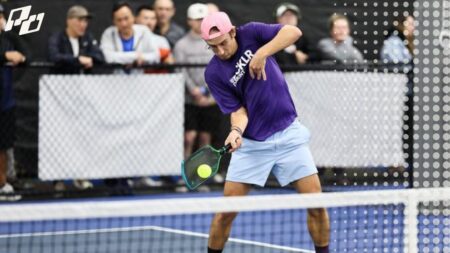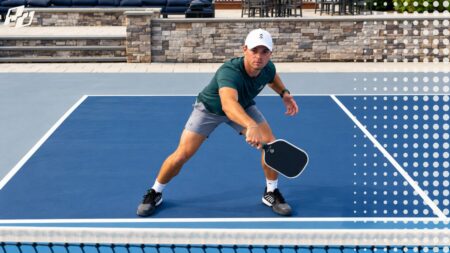


If you’ve ever been stuck mid-court wondering, “Do I rip an overhead here or go swinging volley?”—you’re not alone. This is one of the most misunderstood decisions in pickleball, and it costs recreational players free points all the time.
Both shots are weapons. Both shots apply pressure. But they serve very different strategic purposes, and choosing the wrong one leads to:
- Overheads that sail long (classic mid-court mistake)
- Swinging volleys that die in the net
- Or worse… giving away attackable balls when you should have ended the point.
This article breaks down when to hit an overhead vs when to use a swinging volley, based on ball height, position, timing, court geometry, and your opponent’s positioning. This isn’t theory. This is real match clarity. Let’s go.
The Real Difference: Purpose Over Power
Before we get tactical, we need to clear up one thing:
| Shot | Purpose | Best Used For |
|---|---|---|
| Overhead | End the point | Punish high floaters, finish rallies |
| Swinging Volley | Take time away + attack early | Step in early, create offense before bounce |
Overhead = finisher.
Swinging volley = aggressor.
The mistake most players make? They use them interchangeably. They try overheads from the baseline or take swinging volleys at bad heights—and both are losing plays.
The Position Rule: Where You Are Decides What You Hit
This one rule alone will clean up 50% of your shot selection mistakes:
| Your Court Position | Best Shot |
|---|---|
| Inside non-volley line or at it | Standard volley |
| Between NVZ and mid-court | Overhead |
| Mid-court to service line | Swinging volley |
| Behind service line | Let it bounce, use drive/drop |
✅ Rule of thumb: If you’re inside the court, overheads are high percentage.
If you’re back in transition, swinging volley is safer and more aggressive.
The Height Rule: Ball Height Always Wins the Argument
Think of height as your coach—it tells you what shot is possible.
| Ball Height | Shot |
|---|---|
| Above your head | Overhead—always |
| Shoulder to head high | Overhead if close to NVZ; swinging volley if deeper |
| Chest-height | Swinging volley sweet spot |
| Below chest | Drive/reset, NOT a swing or overhead |
The Timing Rule: Early vs. Late Attack
Swinging volley = hit early, before the bounce, while the ball is rising or level.
Overhead = let it peak, then strike down.
✅ If the bounce makes your life harder → swinging volley
✅ If waiting lets the ball rise higher → overhead
So When Do You Use Each Shot?
✅ Hit an OVERHEAD when:
- You’re inside the court or at the NVZ line
- The ball is high above your head
- You can step through your shot
- You want to finish the point
- Opponents are scrambling or out of position
✅ Hit a SWINGING VOLLEY when:
- You’re mid-court or deeper
- Ball is chest to shoulder height
- You can’t get under it for an overhead
- Letting it bounce would push you backward
- You want to take time away and attack earlier in the rally
One player in our group summed it up perfectly:
“The swinging volley is for balls too low for an overhead but too good to let bounce.”
Exactly right.
Mechanics: Clean Execution for Each Shot
Overhead – The Simple System
Forget tennis-style hero swings. Here’s the pickleball overhead checklist:
✅ Compact shoulder turn
✅ Paddle up early
✅ Left hand points for tracking
✅ Hit down and forward
✅ Contact in front
✅ Finish through target—not sideways
Pro tip: Don’t jump. Jumping lowers your consistency and kills shoulder stability:
@letspicklenow How to Perfect Your Overhead Smash in Pickleball This shot gives a lot of players trouble—but it doesn’t have to. Think of it like throwing a ball. Here’s how to break it down: 1. Turn sideways – Your hitting arm should be up, elbow cocked (not down!). 2. Point with your non-hitting arm – This helps rotate your shoulders and track the ball. 3. Full extension on contact – Reach up and snap down with your wrist. 4. Head up + follow through – Don’t pull your head early. Finish strong. Thanks to @Bryant Salcedo for these awesome tips! Hit that FOLLOW for daily pro tips, drills, and strategies to level up your game! Looking to up your pickleball game? 🚀 Check out this great drill app! Click the link in our bio to sign up and start improving today. #pickleballtips #pickleballpro #overheadsmash #pickleballtraining #pickleballlife #pickleballcoach #smashshot #pickleballskills #pickleball #pickleballislife #pickleballers #pickleballrocks #pickleballaddict #pickleballtournament #pickleballaddiction #pickleballhighlights #pickleballtips #pickleballplayers #pickleballcentral #pickleballcourt #pickleballcourts #pickleballpro #pickleballdrills #pickleballusa ♬ original sound – letspicklenow
Swinging Volley – Controlled Violence
Get under the ball and roll with topspin, not a flat hack. Think drive mechanics, not “smash” mechanics.
Checklist:
✅ Short backswing
✅ Paddle below the ball
✅ Drive up through contact (topspin)
✅ Hit forward with controlled acceleration
✅ Land balanced and ready for the next ball
Swinging volleys look aggressive—but they’re actually smooth timing shots. Treat them like a groundstroke in the air:
@thezaneford HOW TO: forehand swinging volley #pickleball #pickleballhighlights #pickleballplayers #pickleballtiktok #pickleballcoach ♬ original sound – thezaneford
Common Mistakes (And Fixes)
| Mistake | Why it happens | Fix |
|---|---|---|
| Forcing overheads from mid-court | Ball too low | Replace with swinging volley |
| Swinging volley jammed at body | No spacing | Move feet before contact |
| Overhead goes long | Hitting too flat | Add topspin and aim middle |
| Swinging volley into net | Too much wrist | Use shoulder + body rotation |
| Panic overheads | Poor preparation | Paddle up EARLY |
Shot Selection Flow Chart
If you only take one thing from this article, take this:
Ball is high + you’re inside = OVERHEAD
Ball is medium height + you’re in transition = SWINGING VOLLEY
Ball is low = RESET OR DRIVE
That’s it. That’s the clarity most players are missing.
Target Selection
You don’t win attacking—you win attacking smart.
Overhead Targets
✅ At opponent’s chest (right hip for righty)
✅ Deep middle
✅ Between partners (the seam)
❌ Avoid: short crosscourt (out risk)
Swinging Volley Targets
✅ Deep at feet while they’re moving
✅ Body attacks mid-court
✅ Topspin angle into open space
❌ Avoid: overhitting long
Which Should You Train More?
Rec players are overhead-obsessed. They think it’s the main offensive weapon. It’s not.
The swinging volley creates more pressure earlier. It lets you attack third shots, punish floaters, and speed up safely from transition. Rec players blow TONS of points by letting attackable balls bounce.
Start training swinging volleys twice as much as overheads. You’ll instantly start dictating pace.
Simple Drills to Build Both Weapons
Drill 1 – Mid-Court Swinging Volleys
- Partner feeds waist-to-shoulder balls
- Hit 15 swinging volleys deep middle
- Focus: short swing, top spin, balanced landing
Drill 2 – Transition Decision Drill
- Mix slow floaters and deep lobs
- Call out decision before hitting: “Swing!”, “Overhead!”, “Bounce!”
- Trains clarity under speed
Drill 3 – Overhead Targets
- Aim for hip/shoulder zone—not just open court
- Hit 20 overheads down and forward, not flat
Decision Wins
Both shots are useful. Both are weapons. But if you don’t know when to use each, they become liabilities.
If you remember nothing else:
✅ Height tells you what’s possible
✅ Court position decides the shot
✅ Timing + purpose decide the winner
Don’t force overheads. Don’t panic swing. Play smart. Attack early when it makes sense. Finish clean when it’s time.
The players who figure this out don’t just win more points—they run games.