Pickleball has a secret injury epidemic, and it’s not coming from beginners or aging athletes who “just aren’t in shape.” It’s coming from serious recreational players—the weekday warriors stacking four, five, even six days a week of play. Not training. Not recovering. Just playing.
And then it happens.
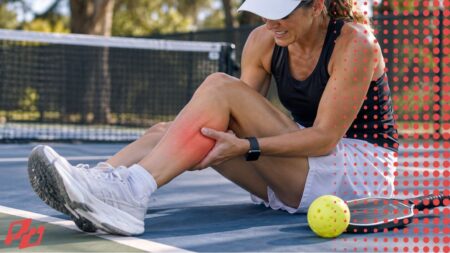
The calf that “just feels tight” tears. The elbow that was “just sore” becomes tendonitis that lasts six months. The shoulder that was “no big deal” becomes a chronic power leak. Sound familiar?
Here’s the hard truth:
You can overtrain even if you never go to the gym.
Play alone can break you if you don’t recover like an athlete.
Why Rec Players Break Before Pros Do
Most rec players assume pros get hurt more because they train harder. Wrong. Pros get hurt less because they train smarter. They have training cycles, recovery days, mobility programs, and coaches watching their workload.
Rec players? They show up, warm up for 30 seconds, and play until something hurts.
Why overtraining hits rec players hardest:
- No off-season → no tissue recovery cycle
- Too much volume, not enough rest
- Playing tired = sloppy movement = injury
- Aging bodies + youthful egos = collision course
- No strength/stability to support high repetition loads
- Playing through “small pain” that becomes big pain
The Overtraining Curve: The Most Dangerous Phase
You don’t get hurt when you’re new. You get hurt when you get good.
When players go from casual to competitive, three things happen:
| Phase | Play Style | Risk |
|---|---|---|
| Beginner | light games, low speed | Low |
| Leveling Up | more power, more days per week, more intensity | High 🔥 |
| Experienced | smarter movement, built strength | Medium |
Peak danger: when your skill improves faster than your body adapts.
You start hitting bigger drives. Moving faster. Attacking harder. But you’re still stabilizing like a beginner—and your tendons can’t cash the checks your confidence is writing.
Pain Is a Report Card
Most players ignore pain—but pain isn’t weakness. Pain is information.
Muscles get tired → they warn you early.
Tendons get overworked → they warn you late.
Joints don’t warn you at all—they just fail.
The Sneaky Warning Signs You’re Overtraining
You’re overtraining long before you get injured. Here’s how to tell:
✅ You feel fine while playing—but hurt hours later
✅ First step feels sluggish each day
✅ Pain disappears after warm-up, returns after
✅ Morning stiffness that wasn’t there before
✅ Shoulder or elbow fatigue from resets and dinks
✅ Calves always tight no matter how much you stretch
✅ Losing control of your balance at the kitchen
If two or more are happening—you’re not “fine.” You’re leaking power and building injury debt.
Red Flag Pain Checklist
If you feel these, stop playing and reset.
| Body Part | Red Flag Signal |
|---|---|
| Elbow | Pain when squeezing paddle |
| Achilles | Pain first thing in morning |
| Shoulder | Pain raising arm overhead |
| Knee | Pain during deceleration |
| Wrist | Sharp pain blocking speedups |
| Back | Pain standing after sitting |
If pain sharpens as you play, that’s not soreness—it’s your body negotiating. It won’t negotiate for long.
The 5 Hidden Causes of Injury in Rec Players
1. Volume Creep
Playing 3 days/week becomes 4. Then 5. Then double sessions. Load explodes, but recovery doesn’t.
2. No Stability Base
Players improve shots without building joint stability. The body needs anchors—without them, you’re playing high-speed Jenga with your skeleton.
3. Repeat Motions
Reset battles = thousands of tiny wrist and shoulder loads.
Drives = forearm fatigue.
Overheads = chronic rotator cuff strain.
4. Bad Recovery Strategy
Rec players think days off = recovery. Nope.
Real recovery = glutes fired up, hips aligned, rotation restored.
5. Ego Chasing
Playing one more game while cooked? Classic ego injury setup. Fatigue doesn’t hit your game—it hijacks your movement.
The Performance Rule No One Follows
You don’t get injured because you’re weak—you get injured because you’re weak under fatigue.
The Fix: Play Harder by Recovering Smarter
You don’t need to play less—you need to plan better.
✅ The 48-Hour Rule
Never stack more than two high-intensity sessions in a row if you’re over 35.
Your tendons take 48 hours to recover—even if you “feel good.”
✅ The 2:1 Rule
For every 2 days of play, do 1 reload day (mobility + light strength only).
✅ The Anti-Breakdown Blueprint
| Before Play | During Play | After Play |
|---|---|---|
| 4-min joint warmup | 90% intensity, not 110% | 5-min ankle/knee/hip reset |
| Activate glutes | Smart footwork first | 10-minute cooldown walk |
| Elbow + wrist prep | Use drop resets when tired | Hydrate + protein |
Quick Recovery Stack (10 Minutes)
Use this after heavy sessions so fatigue doesn’t stack into pain.
- 90/90 hip resets – protect your lower back
- Calf + Achilles unload – wall lean, 45 sec each
- Forearm decompression – flexor/extensor stretch, 30 sec
- Band pull-aparts – shoulder balance, 20 reps
- Deep breathing – downshift nervous system
Avoid These 5 “Fake Fixes”
| Myth | Reality |
|---|---|
| “I’ll stretch more” | Stretching doesn’t fix overload |
| “I’ll push through it” | Ego injuries take longest to heal |
| “I’ll rest a week” | Recovery ≠ rest |
| “It’s just tendonitis” | Tendons don’t heal without loading |
| “I’ll ice it” | Ice hides symptoms—not causes |
When to Take a Recovery Week (And Still Improve)
If:
- Pain now shows up during warm-up
- Grip strength feels weak
- Your body “feels heavy”
- First step speed is gone
→ Take a reload week: play once, drill once, 3 days mobility + strength. You’ll come back better.
Your “Stay Bulletproof” Checklist
- 2 mobility days per week
- 2 stability lifts per week
- 1 day completely off
- Hydrate and eat like someone who wants to move well
- Sleep like it’s part of training (because it is)
You Can’t Outplay Biology
You’re not injured because you’re old or unlucky. You’re injured because you’ve been asking your body to perform without preparing it.
You don’t need to train like a pro—but you do need rules:
- Protect your joints
- Recover on purpose
- Stop stacking fatigue like it’s a badge of honor
- Play smarter and longer—not harder and shorter
Pickleball isn’t going to break you. Overtraining is.